Small Town vs City Dental Practice: Which to Buy

Co-Founder, Minty Dental

In Summary
- Rural dental practices typically sell for 0.6-0.8x collections while urban practices command 0.8-1.0x or higher, creating a significant difference in acquisition cost and debt burden
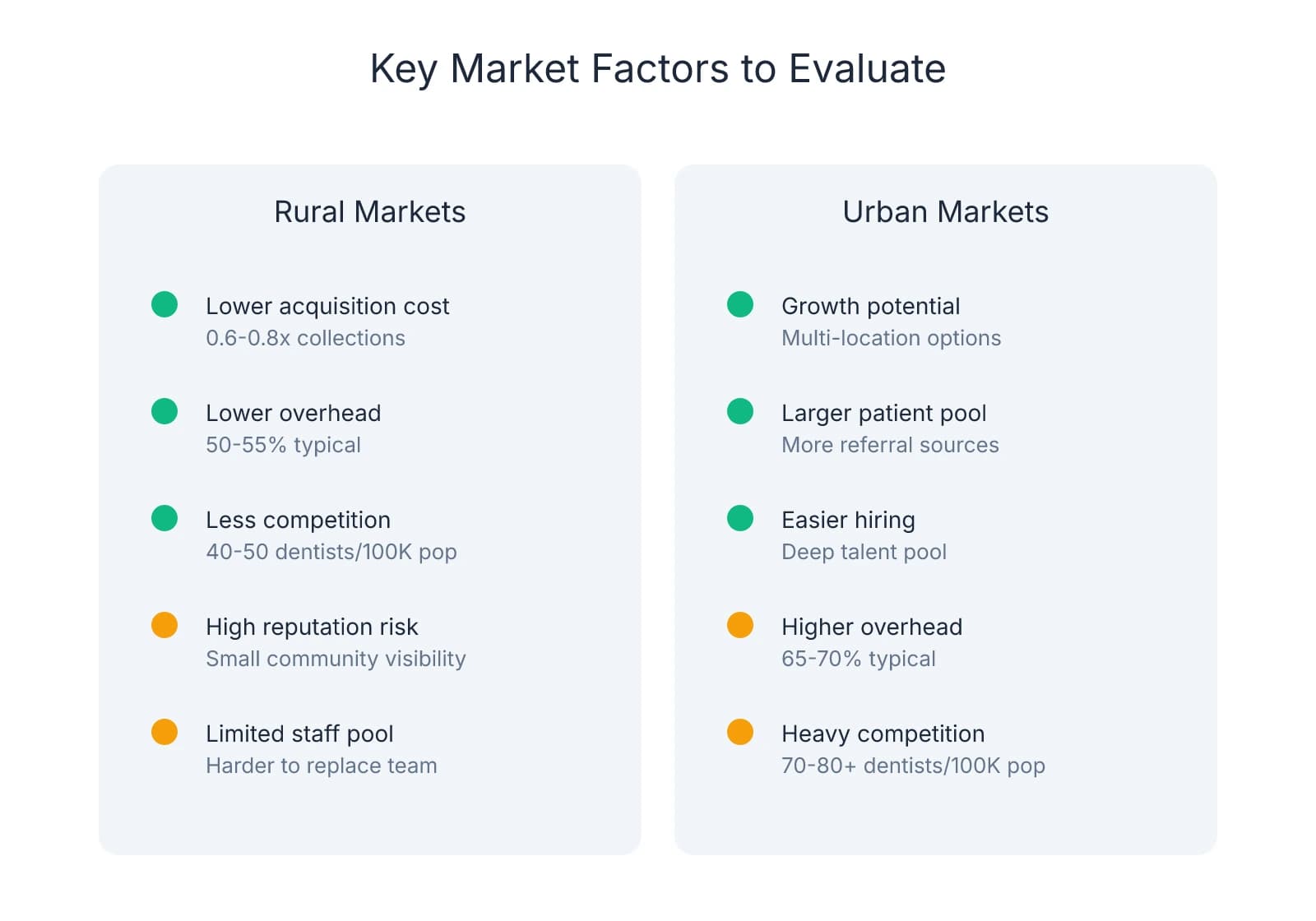
- Overhead in small town practices often runs 50-55% compared to 65-70% in urban settings, driven by lower rent, staff wages, and marketing expenses
- A rural practice collecting $800K with 50% overhead can deliver higher owner income than an urban practice collecting $1.2M with 70% overhead
- The location decision determines your debt service capacity, cash flow stability, and timeline to profitability—not just your lifestyle preferences
The Financial Models Are Fundamentally Different
The choice between a small town and city practice isn't about where you want to live—it's about which business model you're buying into. The revenue patterns, cost structures, and profit margins operate differently enough that comparing gross collections alone misses the point.
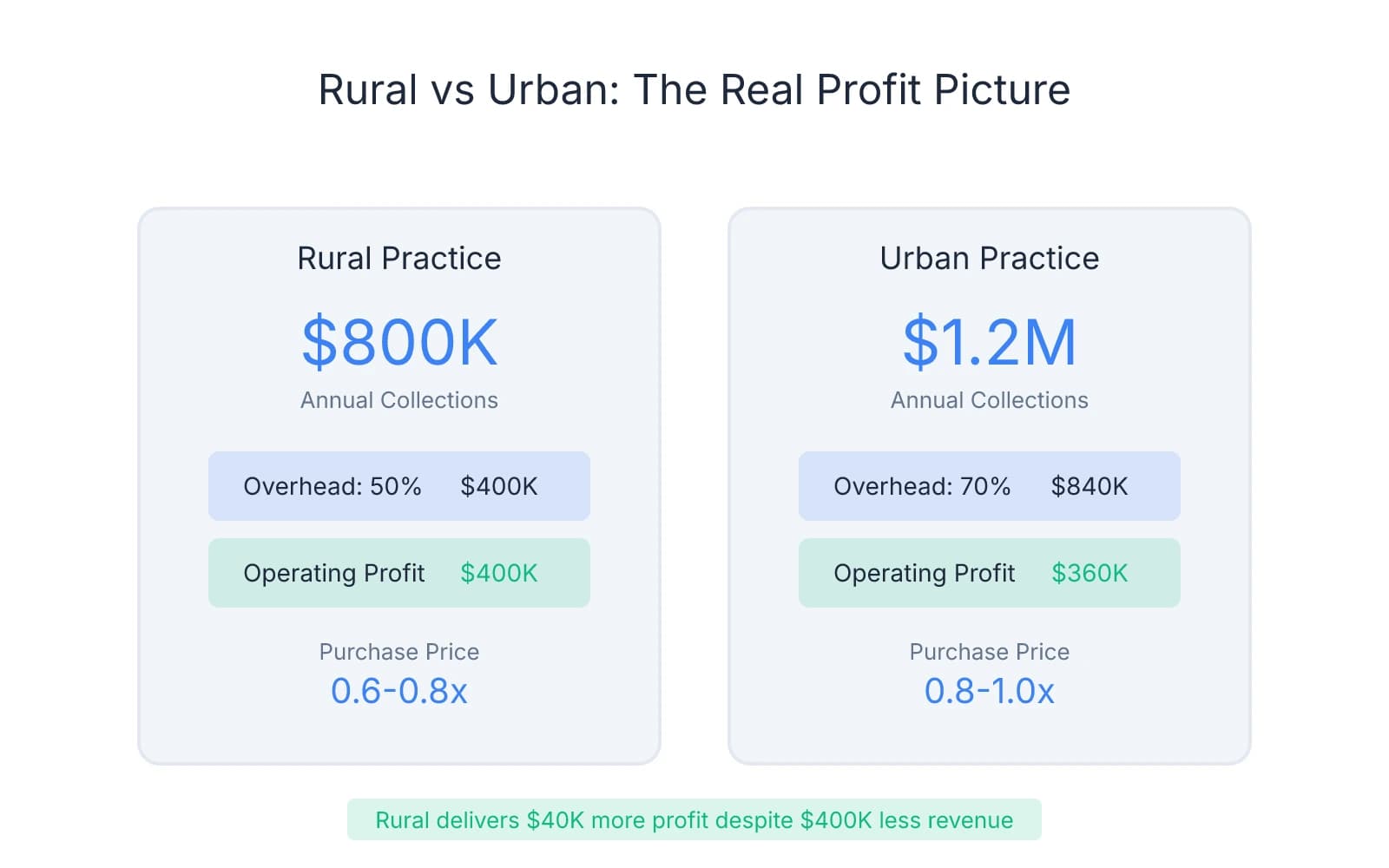
Start with acquisition cost. Rural practices typically sell for 0.6-0.8x annual collections, while urban practices command 0.8-1.0x or higher in competitive markets. On a $900,000 practice, that 0.2x difference translates to $180,000 in purchase price—which means $180,000 less debt, lower monthly payments, and faster breakeven. For a buyer carrying $400,000 in student loans, that gap in debt service can be the difference between comfortable cash flow and financial strain in year one.
The overhead difference is where the models diverge most sharply. Small town practices often run 50-55% overhead, while urban practices sit closer to 65-70%. The gap comes from three sources: rent (a 1,500 sq ft space in a rural market might cost $3,000/month versus $8,000+ in a metro area), staff wages (hygienists in small towns often earn $35-40/hour versus $50-55/hour in cities), and marketing spend (rural practices rely more on referrals and less on paid acquisition).
Here's what that overhead gap means in practice. A rural practice collecting $800,000 with 50% overhead delivers $400,000 in operating profit. An urban practice collecting $1.2M with 70% overhead delivers $360,000. The smaller practice produces more take-home income despite collecting $400,000 less annually. When you factor in the lower acquisition cost and debt service, the rural practice often reaches positive cash flow 12-18 months faster.
The model you choose also determines your debt service capacity. Lower overhead means more cash available to cover loan payments, which matters when you're servicing both acquisition debt and student loans. Many buyers focus on the revenue number and assume higher collections mean better financial performance—but profitability depends on the relationship between revenue and expenses, not the top-line figure alone.
One pattern worth noting: urban practices often require higher working capital reserves. When overhead runs at 70%, a single slow month can strain cash flow. Rural practices with 50% overhead have more margin for variability, which translates to less financial stress during the transition period when collections typically dip 10-15%.
What Competition Actually Costs You in Each Market
That financial foundation leads directly to how you'll acquire and retain patients—and competition shapes those costs dramatically. In urban markets, high dentist-to-population ratios force practices into a patient acquisition arms race. When there are 8-10 practices within a 3-mile radius, new patient marketing becomes a fixed expense rather than an occasional investment. Many urban practices allocate 5-8% of collections to marketing—Google Ads, SEO, direct mail, social media campaigns—just to maintain patient flow. In rural markets with limited competition, that number often sits at 2-3%, with most new patients coming from word-of-mouth referrals.
The insurance decision follows the same pattern. Urban practices competing for patients often join multiple PPO networks to stay visible in insurance directories and employer benefit plans. The tradeoff is predictable: higher patient volume at lower reimbursement rates. Practices with mostly PPO patients can still be profitable, but the margin compression is real—PPO reimbursements typically run 20-30% below fee-for-service rates. In small towns with one or two competing practices, you have more leverage to remain fee-for-service or be selective about which networks you join.
But limited competition in rural areas comes with its own cost: reputation risk. In a small town where you're one of two dental practices, a string of negative reviews or visible staff turnover can impact your entire patient base quickly. There's no anonymity—patients talk, and word spreads faster when the community is tightly connected. Managing online reputation becomes critical in a way that's less acute in urban markets where patients have more options and less social overlap.
During due diligence, evaluate competitive density by mapping practices within a 5-mile radius for urban locations or a 20-mile radius for rural ones. Calculate the dentist-to-population ratio using census data—the national average sits around 61 dentists per 100,000 residents, per the American Dental Association. Urban markets often exceed 70-80 per 100,000, while rural areas may sit at 40-50 or lower.
One framework many buyers find useful: if the ratio is above 70 per 100,000, expect to compete on marketing and insurance participation. Below 50 per 100,000, expect easier patient acquisition but higher reputation sensitivity. Between 50-70, you're in a middle zone where both factors matter, and your competitive advantage will depend more on clinical skill, patient experience, and operational efficiency than on location alone.
Lifestyle and Staffing Realities You Can't Ignore
While the business model determines your margins, the lifestyle factors determine whether you'll still want to own the practice five years in. Start with on-call expectations. In small towns where you're one of two practices, emergency coverage often falls to you by default. Patients call your cell phone on weekends. You're the dentist who handles the Saturday abscess or the knocked-out tooth at a high school football game. Many rural owners report being on call 24/7 in their first few years, with limited backup options. Urban practices offer more anonymity—patients have multiple emergency options, and you're rarely the only dentist available after hours.
Staffing dynamics shift just as sharply between markets. Urban practices benefit from larger hiring pools—if a hygienist leaves, you can post the role and interview 10 qualified candidates within two weeks. In rural markets, the pool is smaller, and losing a key staff member can take months to resolve. One pattern many rural buyers encounter: you inherit a tight-knit team that's been together for years, and retention becomes critical because replacement options are limited. The upside is loyalty—staff in small towns often stay longer and integrate deeply into the practice culture.
Community integration cuts both ways. In small towns, your professional and personal lives overlap more than they do in cities. You see patients at the grocery store, your kids go to school with their kids, and your reputation as a dentist is inseparable from your reputation as a neighbor. This builds trust and strengthens patient loyalty—many rural practices see 80-90% patient retention year over year because the relationship extends beyond the clinical setting. But it also means less separation. If you value privacy or prefer to keep work and personal life distinct, the fishbowl effect of small-town ownership can feel constraining.
Beyond the practice itself, consider the broader lifestyle fit. Commute time in urban markets often adds 45-60 minutes each way, which compounds over years. Cost of living differences are real—housing, childcare, and daily expenses in cities can consume 30-40% more of your income than in rural areas. School quality and spousal employment opportunities vary widely by location. When your spouse isn't on board with the location decision, it creates tension that affects both your family and your ability to commit fully to the practice.
One framework that helps: map your non-negotiables before evaluating practices. If you need access to specialists for referrals, urban proximity matters. If you want your kids in a specific school district or your spouse needs a robust job market, that narrows your options. If you prioritize lower cost of living and tighter community ties, rural ownership aligns better.
Matching Practice Type to Your Ownership Goals
With the financial, competitive, and lifestyle factors mapped, the location decision comes down to what you're optimizing for: immediate cash flow and debt paydown, or long-term enterprise value and growth optionality.
Choose a rural practice if your priority is debt paydown, lifestyle stability, and maximizing take-home income in the near term. Lower acquisition cost means less debt service. Lower overhead means more cash flow hits your account each month. If you're carrying $300K+ in student loans and need to generate strong owner compensation quickly, a small town practice collecting $750K with 50% overhead will often outperform an urban practice collecting $1.2M with 70% overhead—despite the revenue gap. The math is straightforward: $375K in operating profit versus $360K, with $150K less acquisition debt to service.
Choose an urban practice if you're building toward multi-location ownership, want access to specialists and referral networks, or plan an eventual DSO exit. Urban markets offer the infrastructure for growth—larger patient pools, proximity to specialists for complex cases, and the visibility that attracts acquisition interest when you're ready to sell. If your goal is to own a second location within five years, urban density makes that expansion more feasible.
Before committing to either path, evaluate the specific market using four data points: demographic trends, dentist supply, median household income, and population growth projections. Pull census data for the county or metro area. Calculate the dentist-to-population ratio—anything below 50 per 100,000 signals undersupply and pricing power; above 70 per 100,000 means you're competing on marketing and insurance participation. Check whether the population is growing or declining over the past five years. Median household income tells you whether the market can support fee-for-service rates or whether PPO participation is necessary to stay competitive.
When structuring your offer, reflect location-specific risks in the terms. Rural practices often depend heavily on the seller's reputation and long-tenured staff—include transition support clauses requiring 60-90 days of seller presence with defined responsibilities, and add staff retention bonuses tied to staying through the first six months. Urban practices face different risks: competitive pressure and lease stability. Negotiate non-compete protections that prevent the seller from opening a practice within a 10-mile radius, and secure lease assignment guarantees that lock in your occupancy terms for at least five years.
One final checkpoint: ask the seller directly why they chose this location and what they'd do differently if starting over. Their answer often reveals whether the market dynamics have shifted—population decline, increased competition, or insurance reimbursement pressure—in ways that aren't visible in the financials alone. The best location decision is the one that aligns with your financial position, clinical preferences, and the life you're building outside the practice.
Sources & References
The data and claims in this article are drawn from the following sources. We prioritize government data, peer-reviewed research, and established industry publications to ensure accuracy.
- American Dental Association— ada.org
Frequently Asked Questions
Find Your Ideal Dental Practice Location
Whether you're drawn to the community focus of small-town dentistry or the patient volume of urban markets, Minty Marketplace connects you with practices across all settings. Browse listings nationwide and discover the location that matches your practice vision.