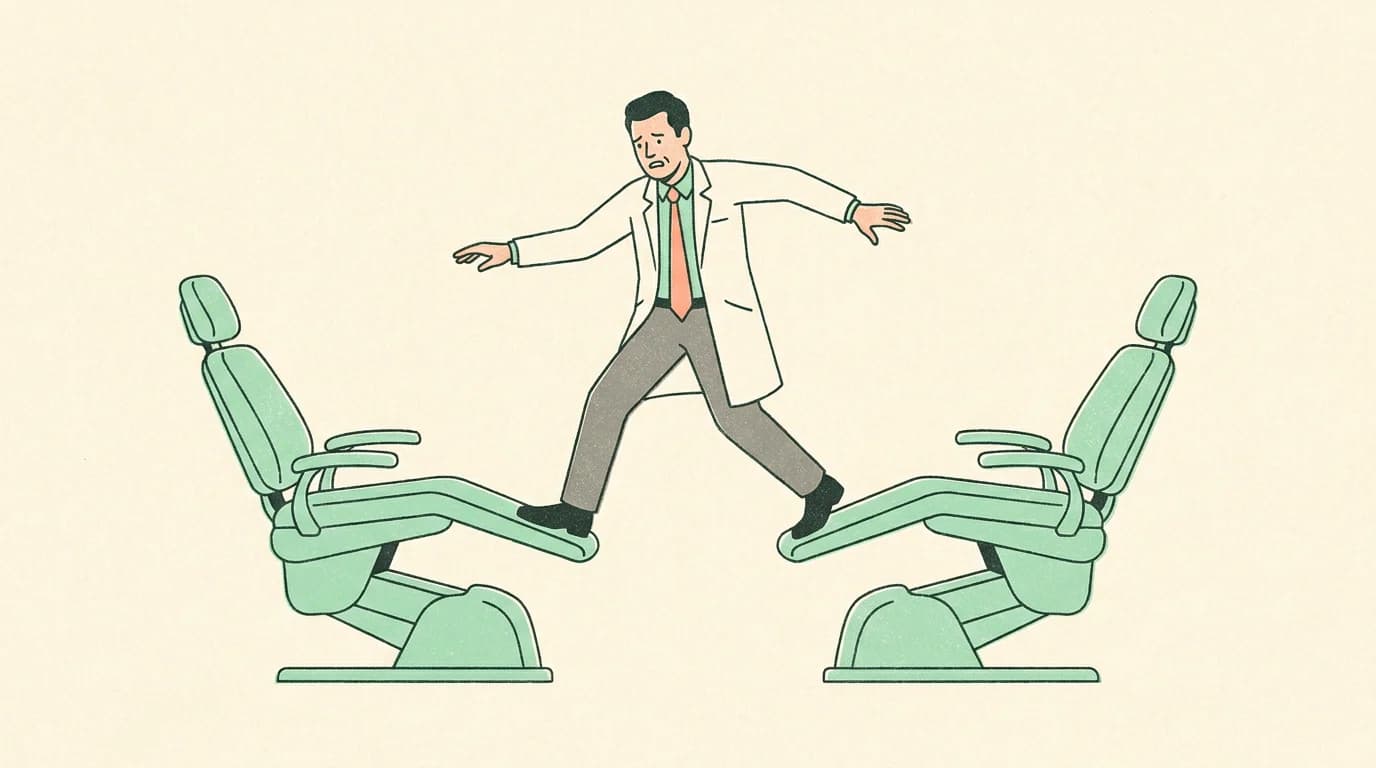
Why a Second Dental Practice Is Harder Than the First

Co-Founder, Minty Dental

In Summary
- Most first practices succeed because the owner is physically present daily—driving energy, making decisions, and building patient relationships that associates can't replicate.
- Splitting time between two locations typically causes the original practice to decline in collections and staff morale while the second location struggles to ramp up without full owner attention.
- A practical readiness test: if your first practice can't maintain 90% or better performance when you're absent 2-3 days per week, you're not ready to acquire a second location.
- Opening a second location nearly doubles fixed overhead while your production capacity stays the same—you can still only treat patients in one place at a time.
- The core mistake is assuming success comes from buying another good practice, when it actually requires building systems that function without constant owner involvement.
Your First Practice Runs on Your Presence—Your Second Can't
The success of your first practice likely depends far more on you being there than you realize. Your energy when you walk through the door, the treatment decisions you make on the fly, the way patients ask for you by name—these aren't incidental. For most owner-dentists, daily presence is what drives performance. Staff look to you for direction. Patients schedule around your availability. The practice hums because you're the engine.
That model breaks the moment you split your time across two locations. Neither location gets your full attention. The original practice starts showing cracks—collections dip, staff morale shifts when you're not around as much, and patients who used to see you every visit now get scheduled with an associate more often. Meanwhile, the second location struggles to build momentum. New patient volume is slower than projected. The team hasn't gelled. Operational issues that you'd normally catch in real time go unnoticed for days.
The financial strain compounds quickly. Opening a second practice nearly doubles your fixed overhead—rent, payroll, insurance, equipment leases—while your production capacity stays exactly the same. You can still only treat patients in one place at a time. If the second location isn't generating enough revenue to cover its costs, the first practice subsidizes the losses. This is one of the most common failure patterns: the profitable original location masks how poorly the second is actually performing.
Before you evaluate any second practice, run a readiness test on your first. Block out 2-3 full days per week where you're completely absent—not just out of the operatory, but unavailable for questions and decisions. Track collections, patient volume, and staff engagement over 60-90 days. If performance holds at 90% or better without you, your systems are strong enough to consider expansion. If collections drop, staff start texting you with questions, or patient complaints increase, you're not ready. The infrastructure that needs to exist before you acquire a second location is one where your first practice can grow without you physically present.
What most buyers miss: replicating success doesn't mean finding another well-run practice to buy. It means building operational systems—clinical protocols, staff training frameworks, financial dashboards, patient communication workflows—that function without your constant involvement. Until those systems exist and prove themselves at location one, adding location two just spreads the same dependencies across more square footage.
Fixed Costs Double, But Your Production Capacity Doesn't
The financial math of a second location catches most buyers off guard. Dental practices carry 60-65% overhead on average, and the majority of those costs are fixed—rent, full-time staff salaries, malpractice insurance, equipment leases, utilities. These expenses don't scale down when you're not physically in the building.
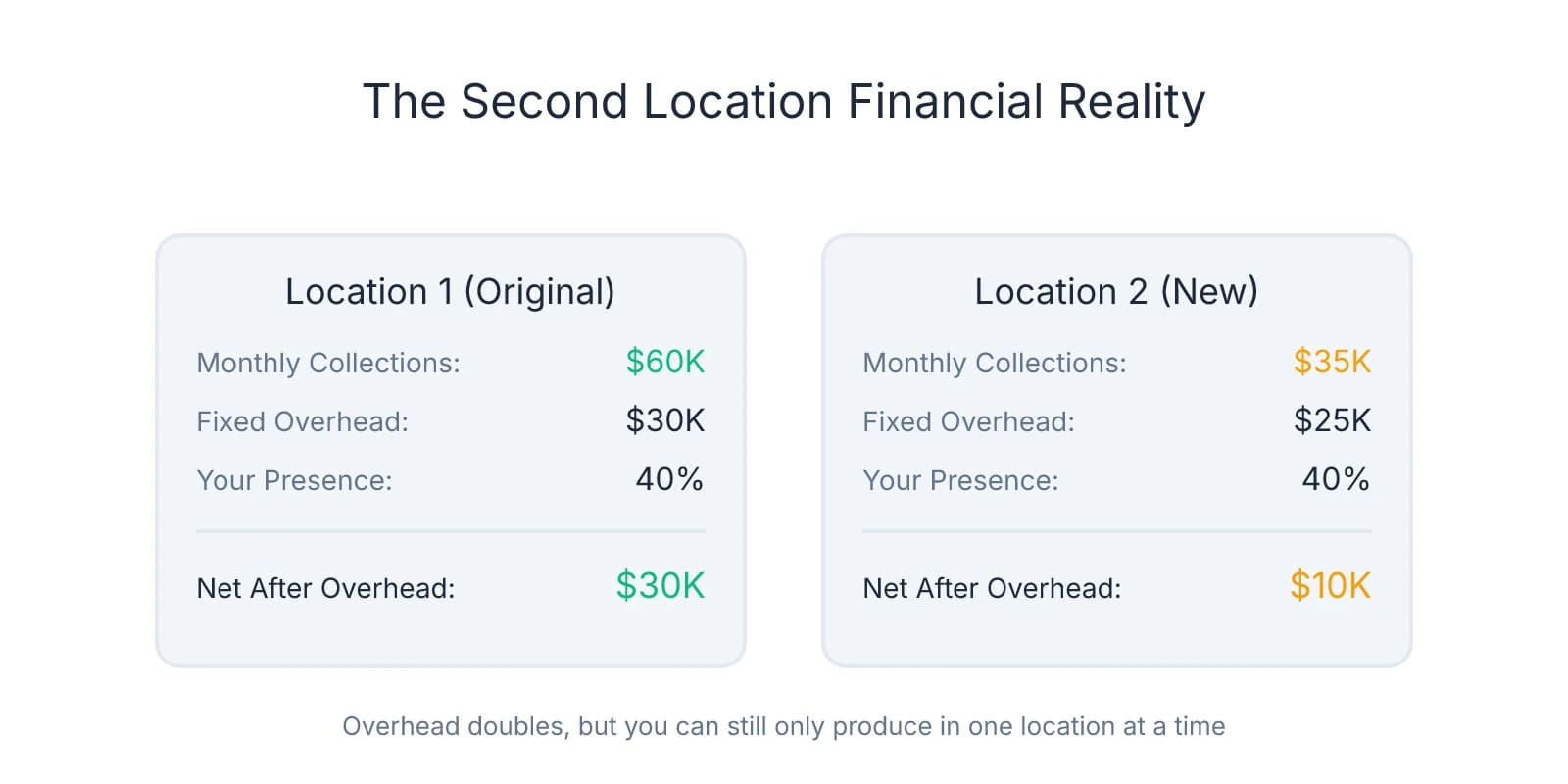
Acquiring a second practice doubles those fixed costs immediately. You now have two leases, two full staff payrolls, two sets of insurance premiums, two equipment maintenance contracts. But your production capacity stays exactly the same. You can still only be chairside in one location at a time. Unless you're hiring an associate who produces at your level from day one—which rarely happens—the second location operates at a fraction of its revenue potential while carrying full overhead.
The most common outcome: your profitable first location subsidizes the second location's losses for 12-24 months while it ramps up. Patient attrition during ownership transitions averages 15-20%, and it takes time to rebuild that volume. Meanwhile, rent is due. Payroll doesn't pause. If the second location is collecting $35,000 per month but carrying $28,000 in fixed overhead, you're netting $7,000 before debt service—and that's optimistic.
Before making an offer, model whether the second practice can cover its own overhead from day one. Pull the seller's last 12 months of P&L statements and isolate fixed costs: rent, payroll (excluding doctor compensation), insurance, equipment leases, utilities. Add those up and divide by 12 to get the monthly fixed overhead baseline. Then compare that number to the practice's average monthly collections. If collections are running at 1.5x fixed overhead or better, the practice has breathing room. If the ratio is tighter—say, collections are only 1.2x overhead—you're looking at a location that needs immediate production growth just to stay solvent.
Where buyers get burned is underestimating how long ramp-up takes. If you're planning to be at the second location two days per week, you're producing at 40% of full capacity. Budget cash reserves to cover shortfalls during the transition. A useful benchmark: set aside 6-9 months of the second location's fixed overhead as a contingency fund. If monthly fixed costs are $25,000, that's $150,000-$225,000 in liquid reserves before you close.
Lenders scrutinize second-location financing differently than first-practice loans. They want proof your first location can carry additional debt even if the second struggles. Expect them to stress-test your cash flow: if the second practice generates zero profit for 12 months, can location one still service both loans? If your first practice is netting $15,000 per month and the second loan adds $8,000 in monthly debt service, you're left with $7,000 in margin—tight enough that one bad quarter puts you underwater. Buyers who get denied by multiple lenders often discover the issue isn't creditworthiness—it's that the first practice doesn't generate enough surplus to absorb the risk of a second location underperforming.
One decision point worth evaluating early: does the second practice need to be profitable independently, or are you building a portfolio where combined EBITDA is what matters? If you're planning to scale to three or more locations, treating each practice as a standalone P&L might not make sense long-term. But if this is your only planned expansion, the second location needs to carry its own weight.
Associates Rarely Drive Growth the Way Owners Do
Most buyers planning a second location assume they can hire an associate to run the new practice while they stay focused on location one. What actually happens is the second location underperforms for months—or years—because associates rarely have the ownership mindset required to drive a practice forward.
The performance gap shows up immediately in patient acquisition and retention. Owner-dentists hustle differently. They follow up personally with new patients who didn't schedule. They call patients who missed hygiene recalls. They stay late to accommodate a patient with a toothache. Associates, even excellent ones, clock in and clock out. They treat the patients on the schedule, do good work, and go home. That's not a character flaw—it's a function of incentives.
Treatment acceptance rates reflect this gap clearly. When the owner presents a treatment plan, patients sense the investment in the outcome. When an associate presents the same plan, it often reads as transactional. One pattern many buyers notice after hiring an associate: case acceptance on comprehensive treatment drops 15-20% compared to when the owner was doing the consults. The clinical skill is identical, but the patient relationship isn't.
Day-to-day problem-solving is where the gap becomes expensive. When a hygienist calls in sick, the owner scrambles to cover the schedule because every open appointment is lost revenue. An associate shrugs and takes the lighter day. When a patient complains about billing, the owner intervenes to save the relationship. The associate refers them to the front desk. These aren't failures of competence—they're differences in accountability.
Before you make an offer on a second location, decide how you're structuring the staffing model. One model that works more reliably is hiring a partner-track associate with a defined buy-in timeline. When the associate knows they're working toward ownership, the incentive structure shifts. But this requires legal structure upfront—buy-in terms, equity percentages, performance benchmarks—not a vague promise of "maybe someday."
Another approach that reduces risk: hire an associate at location one, where systems are already proven and the patient base is stable, then shift your focus to ramping location two. This keeps your highest-value production at the new practice during the critical first 12-18 months while the associate maintains momentum at the original location. The associate inherits a well-oiled operation with established patient relationships, which makes their job easier and their performance more predictable.
If you're planning to split your time between both locations without hiring an associate, model the production math carefully. Two days per week at each location means you're producing at 40% capacity at both. Unless you're extraordinarily efficient or the practices are already overstaffed with hygiene production, that's not enough doctor presence to maintain historical revenue levels. Forty percent presence yields forty percent production, and overhead doesn't adjust downward to match.
The decision on how to staff the second location isn't something to figure out after closing. It's a structural choice that determines whether the acquisition makes financial sense at all. If the model depends on an associate performing at 80-90% of your production level from day one, and most associates don't, the deal is mispriced before you sign the LOI.
What to Evaluate Before You Make an Offer
Before you submit an offer on a second practice, run a structured readiness assessment on your current situation. The decision to expand isn't just about finding a good deal—it's about confirming you've built the infrastructure to succeed when your attention is divided.
Can your first location maintain performance without you there full-time? A practical benchmark: your first practice should hold at 90% or better of its normal collections when you're present less than 50% of the time. If you block out three full days per week—not just out of the operatory, but completely unavailable—and collections drop, staff start texting you with questions, or patient complaints increase, you're not ready. Track this over 60-90 days, not just a single week.
Profit margins at location one should exceed 40% over multiple quarters. This isn't just a sign of operational health—it's the surplus cash you'll need to buffer the second location during ramp-up. If your first location is netting $15,000 per month and the second loan adds $8,000 in debt service, you're left with $7,000 in margin. One bad quarter puts you underwater.
Cash reserves need to cover 3-5 months of combined overhead for both locations. Pull the target practice's P&L and isolate fixed costs: rent, payroll (excluding doctor compensation), insurance, equipment leases, utilities. Add those to your current practice's fixed overhead and multiply by four. If the second location's monthly fixed costs are $25,000 and your first location runs $30,000, you need $220,000-$275,000 liquid before you make an offer.
During due diligence, ask questions specific to a second acquisition. Can this practice operate independently without daily owner oversight? Pull the last 24 months of production data and look at associate performance. If 70%+ of production came from the selling dentist, you're buying a practice that depends on one person's clinical output. What's the patient retention rate when the seller steps back? Request patient visit frequency data for the last 12 months. If 40%+ of active patients haven't been seen in over a year, the practice has retention issues that will compound during transition.
Does the practice require owner production to hit debt service? Model the math assuming you're there two days per week. If the practice collected $60,000 per month with the seller working full-time, and you're planning 40% presence, expect collections to drop to $35,000-$40,000 initially. Add your projected debt service and compare that to the practice's fixed overhead. If the numbers don't work at 40% production, the deal is mispriced or you need a different staffing model.
Honestly assess your leadership capacity. Can you manage two teams, two P&Ls, and two sets of operational challenges simultaneously? One pattern that surfaces repeatedly: buyers who are excellent clinicians but haven't built the delegation and systems-thinking skills required to lead from a distance. If you're still the person staff call when the autoclave breaks or a patient wants a refund, you're not ready to manage two locations.
Before you pursue a second acquisition, evaluate whether you'd generate better ROI by growing within your existing practice. Many buyers assume expansion means acquiring another location, but adding operatories, extending hours, or hiring an associate at your current practice often delivers higher returns with lower risk. If your first location has physical capacity to add another operatory and patient demand supports it, the incremental revenue from that buildout typically exceeds what you'd net from a second location after accounting for dual overhead and divided attention.
The second location makes sense when it serves a different geographic market, your first location is truly stable and systematized, and you've proven you can delegate effectively. If the target practice is 15+ miles from your current location and draws from a distinct patient base, you're building a portfolio rather than cannibalizing your own demand. If your first practice runs smoothly when you're gone three days per week, and you've documented the systems that make that possible, you have a foundation to replicate.
Before you make an offer, confirm the deal structure aligns with your operational model. If you're planning to be at the second location two days per week, the purchase price should reflect that reduced production capacity. Walk through how to evaluate the location's demographics and competitive landscape before you commit. A second location isn't just another practice—it's a test of whether you've built a business that can scale beyond your personal clinical output.
Sources & References
The data and claims in this article are drawn from the following sources. We prioritize government data, peer-reviewed research, and established industry publications to ensure accuracy.
- The Second Location Trap: What Dentists Should Know Before ...— practicecfo.comIndustry
- The Owner's Dilemma: Why Your Second Dental Practice Is The ...— precisiondentalanalytics.comIndustry
- Average Dental Practice Overhead: Benchmarks and Insights - Overjet— overjet.comIndustry
- What Practice Owners Want in Dental Associates— ada.orgIndustry
Frequently Asked Questions
Ready to expand your dental empire?
Growing from one practice to multiple locations requires strategic planning and expert guidance. Minty Plus connects you with acquisition specialists who understand the unique challenges of scaling dental practices.