How to Tell If a Dental Practice Broker Is Hiding Problems

Co-Founder, Minty Dental

In Summary
- Dental practice brokers earn 6-12% commission only when deals close, creating financial incentive to prioritize speed and deal size over buyer protection—on an $800,000 practice, that's roughly $80,000, but only if the transaction completes
- Dual agency arrangements—where one broker represents both buyer and seller—create irreconcilable conflicts where the broker cannot simultaneously protect your negotiating position and maximize the seller's outcome
- Five warning patterns signal information management: vague financial responses, pressure to offer before seeing documents, dismissiveness about advisors, broker summaries instead of source documents, and restricted practice access
- Understanding these structural incentives helps you identify which broker statements reflect genuine market insight versus economic self-interest, so you know what requires independent verification
Broker Incentives Shape What You See—and What You Don't
The broker showing you practices isn't paid to find you the best deal. They're paid to close deals—and only when deals close.
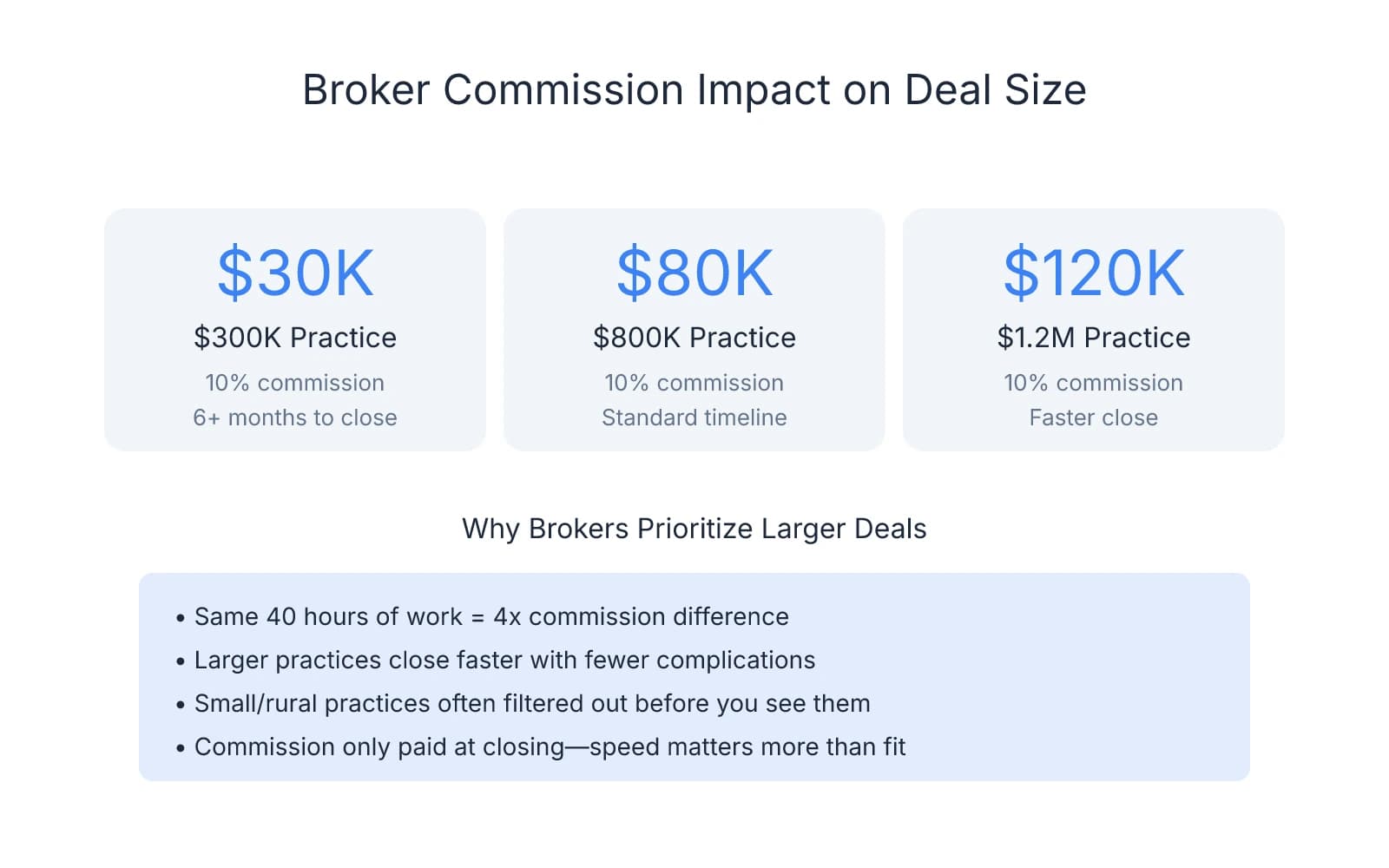
Most dental practice brokers earn 6-12% of the final sale price, with the industry average around 10%. On an $800,000 practice, that's $80,000 in commission. On a $300,000 practice in a rural market that takes six months longer to close, it's $30,000—for substantially more work. The math creates predictable behavior: brokers gravitate toward large, urban, easily marketable practices and deprioritize smaller or operationally complex ones.
When a broker tells you a practice is "priced to move" or that "multiple buyers are circling," ask yourself: does this reflect genuine market pressure, or the broker's timeline for closing this month's pipeline?
Speed over vetting: A broker's commission materializes only at closing. Every day a deal sits in due diligence is a day the commission remains hypothetical. When you raise questions about patient retention trends or deferred maintenance, pay attention to whether the broker helps you investigate or steers you toward reassurance. The former serves your outcome. The latter serves theirs.
Deal size over complexity: A broker spending 40 hours marketing a $1.2 million practice earns roughly $120,000. The same 40 hours on a $400,000 practice with aging equipment generates $40,000. If you're looking in smaller markets or considering practices with operational challenges, recognize that some brokers have already filtered those opportunities out—not because they lack value, but because they lack sufficient commission.
The dual agency problem: When one broker represents both you and the seller, the conflict becomes structural. A dual agent cannot simultaneously maximize your negotiating position and protect the seller's—yet they're paid only if both parties agree to terms. Full disclosure requirements in dual-agency arrangements mean the broker must share material information with both sides, which eliminates any negotiating advantage either party might have held.
One protection many buyers overlook: hiring independent legal counsel before signing anything. A broker may provide template agreements or "standard" terms, but those documents reflect the broker's interest in closing quickly—not your interest in protecting downside risk.
The question isn't whether your broker is ethical. The question is whether their economic incentives align with your outcome—and in most cases, they don't. Recognizing that gap early helps you identify which information requires independent verification.
Five Patterns That Signal a Broker Is Managing Information
Information control rarely looks like outright refusal. It shows up as deflection, delay, and selective disclosure. These five patterns reveal when a broker is managing what you see rather than facilitating transparency.
1. Vague or delayed responses to specific financial questions
Ask about accounts receivable aging, and a responsive broker pulls the A/R report within 48 hours. A broker managing information gives you a verbal summary: "Collections are solid, nothing unusual there." When you follow up requesting the actual aging report, the response shifts to "I'll check with the seller" or "That's typically reviewed during due diligence."
The accounts receivable ratio—total A/R divided by average monthly production—should sit around 1.0 for a healthy practice. A ratio above 1.5 signals collection problems or billing issues the seller may not want surfaced early. Your move: request the documents directly in writing, with a timeline. If the broker continues stalling, that's your answer.
2. Pressure to submit offers before seeing complete documentation
One pattern worth watching: brokers who frame urgency around other buyers rather than your readiness. "Two other parties are preparing offers this week" or "The seller wants to move quickly" are common tactics to compress your review timeline. Sometimes the urgency is real. Often, it's manufactured to prevent you from digging into financials that might lower your offer price.
Before submitting any offer, you should have reviewed at minimum: three years of profit and loss statements, the most recent tax return, a current A/R aging report, and a patient count breakdown by visit frequency. If the broker discourages this—framing it as "overkill for the LOI stage" or suggesting you'll see everything "once we're in due diligence"—they're managing information flow to keep the deal moving.
3. Dismissiveness when you mention bringing independent advisors into the process
A broker facilitating transparency welcomes your CPA and attorney. A broker managing information treats outside advisors as obstacles. The dismissiveness often sounds reasonable: "Most buyers don't involve their CPA until after the LOI" or "Attorneys tend to overcomplicate things at this stage." What they're actually saying: I don't want someone reviewing these financials who knows what to look for.
Dental accountants trained in practice acquisitions spot warning signs general practitioners miss—inflated production numbers, unsustainable referral sources, or expense categories that don't align with revenue. Bring your CPA in before making an offer, not after.
4. Providing only broker-prepared summaries rather than source documents
Many brokers create practice summary packets—clean, formatted overviews of financials, patient demographics, and operational highlights. These summaries are useful starting points. They are not substitutes for source documents.
The gap between broker summaries and source documents is where problems hide. A summary might report "$600K in collections" without showing that $150K came from a single referring specialist who has since retired. It might list "stable patient base" without revealing that 40% of active patients are over 65. Request tax returns and bank statements early. If the broker frames this as premature or suggests waiting until due diligence, recognize the pattern.
5. Reluctance to let you visit the practice multiple times or speak directly with the seller
Access restrictions often get framed as protecting the seller's confidentiality or minimizing disruption to operations. Sometimes that's legitimate—especially before an LOI. But when a broker limits you to a single walkthrough, discourages follow-up visits, or insists all communication flow through them rather than directly with the seller, they're controlling the narrative.
Staff interactions, patient flow, and operational rhythms vary significantly across different days and times. A second or third visit—ideally unannounced or at different times—reveals whether what you saw initially reflects normal operations or a staged performance.
These patterns don't prove deception. They signal that the broker's priority is managing your perception rather than facilitating your evaluation. When you spot them, the response is straightforward: verify independently, request source documents in writing, and bring your own advisors into the process early.
What to Verify Independently (And How)
Once you've identified patterns suggesting a broker is managing information, the next step is building your own independent picture of what the practice actually looks like—not what the broker's summary claims.
Financial verification: hire a dental-specific CPA before you make an offer
Before submitting an offer, engage a CPA who specializes in dental practice acquisitions to review source documents directly—tax returns for the past three years, bank statements, and practice management software reports. Not broker-prepared summaries. The actual documents.
What healthy financials look like: A practice with solid collections maintains an accounts receivable ratio around 1.0—meaning total A/R roughly equals one month of production. Your CPA should also compare production to collections over time. A widening gap—where production climbs but collections lag—often indicates billing issues, insurance write-offs, or patient payment problems the seller hasn't addressed.
One calculation many buyers skip: overhead percentage. Divide total operating expenses by total collections. Most general practices run between 60-70% overhead. If the seller's overhead sits below 50%, either they're running an unusually efficient operation or they're underreporting expenses. If it's above 75%, the practice may not generate enough margin to service acquisition debt and pay you.
Patient base quality: request direct access to practice management software
Patient counts on a broker summary mean nothing without context. A practice listing "1,200 active patients" sounds strong until you discover that "active" means anyone seen in the past three years—and only 400 have visited in the past 12 months.
Request read-only access to the practice management system to verify patient counts, recall effectiveness, and production by procedure. Specifically, pull reports showing:
- Patients seen in the past 6, 12, and 18 months: A healthy practice sees 60-70% of its active patients annually
- New patient flow by month: Look for consistent acquisition—ideally 20-30 new patients monthly for a solo practice
- Recall effectiveness: Practices with strong recall systems maintain 70-80% effectiveness. Below 50% suggests operational problems
- Production by procedure code: If 40% of revenue comes from a single high-value procedure the seller performs but you don't, that's a revenue cliff you're buying into
If the broker or seller resists granting software access, citing confidentiality or operational disruption, that's a signal. Most practice management systems allow read-only guest access that protects patient privacy while giving you the data you need.
Seller motivation: speak directly with the seller, not just through the broker
Brokers frame seller motivation in ways that keep deals moving: "retiring after 30 years," "relocating for family reasons," "ready for a lifestyle change." These explanations may be true. They may also be covering deeper problems—burnout from declining revenue, staff turnover the seller can't solve, or personal health issues affecting clinical quality.
One step many buyers find valuable: requesting a direct conversation with the seller, without the broker present. Frame it as wanting to understand their practice philosophy and transition expectations. What you're actually assessing: does their story stay consistent? Do they seem genuinely ready to step away, or are they selling because the practice has become unsustainable?
Pay attention to how the seller describes their transition involvement. A seller who's truly retiring should be willing to commit to 60-90 days of structured support—defined hours, specific responsibilities, and clear expectations for patient introductions. Vague commitments like "I'll be available if you need me" often signal a seller who wants to exit quickly and won't be there when problems surface.
Lease and equipment verification: have your attorney review the actual agreements
Brokers describe lease terms in shorthand: "five years remaining with renewal options" or "favorable rent at $4,000 monthly." Your attorney needs to review the actual lease agreement to verify what those terms actually mean. Specifically:
- Renewal options: Are they automatic, or does the landlord have discretion to decline? What's the rent escalation formula?
- Assignment provisions: Does the lease allow you to take over as tenant, or does it require landlord approval with conditions you can't meet?
- Maintenance and improvement responsibilities: Who pays for HVAC replacement, roof repairs, or ADA compliance upgrades?
For equipment, request a detailed asset list with purchase dates, maintenance records, and condition assessments. Then have your own technician inspect high-value items—compressors, sterilizers, digital radiography systems, and operatory chairs. Equipment the broker describes as "well-maintained" may be 15 years old and due for replacement within 24 months.
Many buyers assume digital assets transfer automatically and discover post-closing that the seller retained ownership. Your attorney should review these agreements before you sign the purchase contract, not after.
The verification framework: what to request, when to request it
Before making an offer, you should have independently verified:
- Financials: Three years of tax returns and bank statements reviewed by your dental CPA
- Patient base: Direct access to practice management reports showing visit frequency, recall rates, and production trends
- Seller motivation: At least one direct conversation with the seller, ideally without the broker present
- Lease terms: Full lease agreement reviewed by your attorney, with renewal and assignment provisions clearly understood
- Equipment condition: Independent inspection by a dental equipment technician, with a written condition report
If the broker or seller refuses any of these requests before you submit an offer, that refusal is information. It tells you they're prioritizing deal momentum over transparency—and that the risk of what you'll discover during due diligence outweighs the risk of losing you as a buyer.
Questions That Expose Evasiveness
The right questions don't just gather information—they reveal how willing a broker is to facilitate transparency. These six questions force clarity. The answers matter less than how the broker responds to being asked.
"Can I review the last three years of tax returns and bank statements before making an offer?"
This should be a yes-or-no question. A transparent broker says yes and provides the documents within 48-72 hours. An evasive broker reframes the request: "Most buyers wait until after the LOI for that level of detail" or "We can get you those during due diligence."
Tax returns and bank statements reveal what the practice actually generates—not what the broker's summary claims it generates.
"What is the accounts receivable aging breakdown, and what percentage is over 90 days?"
A healthy practice maintains most receivables under 60 days, with less than 10% sitting past 90 days. When you ask for the A/R aging report, a responsive broker pulls it immediately. An evasive broker gives you a verbal summary: "Collections are strong, nothing concerning there."
Practices with elevated A/R ratios carry collection problems you'll inherit. Request it in writing, with a specific timeline.
"Do you represent other buyers looking at this practice, or just the seller?"
Dual agency isn't illegal, but it creates structural conflicts where the broker cannot simultaneously protect your negotiating position and maximize the seller's outcome. A transparent broker discloses representation clearly: "I represent the seller exclusively" or "I'm working with both parties, which means I'm required to share material information with both sides." An evasive broker minimizes the conflict: "I facilitate transactions for both buyers and sellers."
"Can you provide the practice management system reports showing active patient counts and new patient flow by month?"
Patient counts on a broker summary are marketing language. The practice management system holds the actual data. A broker facilitating transparency arranges read-only access to the system or provides exported reports within days.
An evasive broker gives you summary numbers without source documentation, or frames the request as intrusive: "The seller prefers to keep that information confidential until we're further along."
"What problems have other buyers identified during due diligence on this practice, and how did the seller address them?"
This question reveals whether the broker views your due diligence as obstacle or partnership. A transparent broker acknowledges concerns previous buyers raised—equipment condition, lease terms, staff turnover—and explains how those issues were resolved or why deals didn't close. An evasive broker claims no previous buyers raised concerns.
If the practice has been listed for six months and no one has raised concerns, either the listing just went live or the broker isn't being honest.
"Why is the seller really selling, and can I speak with them directly?"
Brokers frame seller motivation in ways that keep deals moving: retirement, relocation, lifestyle change. Sometimes that's accurate. Often it's covering deeper problems. One step that clarifies motivation: requesting a direct conversation with the seller, without the broker mediating every exchange.
A broker facilitating transparency arranges the conversation and steps back. An evasive broker insists on being present for every interaction, or discourages direct contact entirely: "The seller prefers to keep communication through me to avoid confusion."
The pattern across all six questions: good brokers welcome verification because it facilitates informed decisions. Evasive brokers treat verification as distrust, delay documentation requests, and frame your questions as excessive. If a broker responds to these questions with deflection or delay, bring in your own advisors immediately and proceed with heightened scrutiny.
Sources & References
The data and claims in this article are drawn from the following sources. We prioritize government data, peer-reviewed research, and established industry publications to ensure accuracy.
- Practice Broker Conflict of Interest | Precision Dental Analytics— precisiondentalanalytics.comIndustry
- The Dual Agency Dilemma - Dental Attorneys— www.dentalattorneys.com
- Financial Due Diligence for Dental Practices: What to Look For in 2026— duckettladd.comIndustry
- 10 Problems To Avoid When Hiring a Business Broker— www.midstreet.com
Frequently Asked Questions
Find Your Next Practice With Confidence
Don't let hidden problems derail your practice acquisition. Minty's transparent marketplace connects you directly with verified dental practice listings, while our expert team helps you navigate the entire buying process with full visibility into practice financials and operations.