How Much Cash You Actually Need to Buy a Dental Practice

Co-Founder, Minty Dental

In Summary
- Most dental lenders require 10% of the purchase price in liquid assets, but many finance 100% of the practice itself—that 10% stays in your account as a safety buffer, not a down payment
- Liquidity includes savings, stocks, bonds, and mutual funds you can access without penalty, but excludes retirement accounts and home equity
- Actual out-of-pocket costs at closing typically run $15,000-$20,000 for earnest money, legal fees, and due diligence—far less than the total liquidity requirement
- A $500,000 practice needs roughly $50,000 in accessible cash, though lenders often reduce this for high-producing associates or practices with exceptionally strong financials
Most Lenders Want 10% Liquidity—But Not as a Down Payment
The biggest misconception about buying a dental practice is that you need a massive down payment. Most buyers hear "10%" and assume they're handing over $50,000 on a $500,000 practice at closing. That's not how it works.
What lenders actually require is 10% of the purchase price in liquid assets—money you have accessible in savings, stocks, bonds, or mutual funds. That 10% stays in your account. Most dental-specific lenders offer 100% financing on the practice itself, meaning you're not putting any of that liquidity down as a deposit. The cash requirement exists as a buffer, not a payment.
Lenders care about liquidity because the first six months of ownership tend to be financially unpredictable. You're learning the practice's rhythm, building patient trust, and managing cash flow that may not stabilize immediately. Having six months of operating expenses accessible protects both you and the lender if collections dip or unexpected expenses surface.
What counts toward that 10%? Savings accounts, taxable investment accounts, money market funds—anything you can withdraw without penalty. What doesn't count? Retirement accounts like 401(k)s or IRAs, even if you're willing to take the early withdrawal hit. Home equity doesn't count either, since it's not liquid in the sense lenders define it.
The 10% threshold isn't universal. Some lenders reduce or waive liquidity requirements for buyers with strong production history—typically $400,000 or more annually as an associate. Others relax the rule when the practice has exceptionally stable financials: consistent collections, low overhead, and a patient base that isn't dependent on the seller's reputation.
For most buyers, the 10% rule means $40,000 to $60,000 in accessible cash for practices in the $400,000 to $600,000 range. If you've been working as an associate for two to three years and saving deliberately, you're likely closer to ownership readiness than you think.
Where Your Cash Actually Goes: Transaction Costs Beyond the Purchase Price
With the liquidity requirement clarified, the next question is what you'll actually spend at closing. Even when a lender finances 100% of the purchase price, you'll still write checks before and during the transaction. Understanding which expenses come out of pocket versus which get rolled into the loan helps you budget for what's actually required upfront.
The first check you'll write is earnest money—typically 1-5% of the purchase price, often landing between $5,000 and $25,000. This deposit goes into escrow when your offer is accepted and applies toward your closing expenses. It requires accessible cash early in the process, often weeks before closing. If the deal falls through due to contingencies you've negotiated, you get it back. Walk away without cause, and the seller keeps it.
Legal fees are the next major expense. Contract review and closing documents typically run $4,000 to $10,000, depending on whether you're buying the practice alone or also purchasing real estate. A good attorney catches restrictive covenants that limit where you can practice if you sell again, ambiguous language around equipment condition, or transition support clauses that sound binding but have no enforcement mechanism.
Due diligence expenses add another layer. Practice valuations range from $1,500 to $4,000, though some brokers waive this fee if they're representing both sides. A CPA review of the seller's financials—verifying collections, spotting expense anomalies, projecting cash flow under your ownership—typically costs $2,000 to $5,000. These costs are almost always out of pocket, though some buyers negotiate for the seller to cover the valuation as part of the offer.
Then there's working capital—the cash needed to cover payroll, supplies, and overhead during your first 60-90 days while you're building momentum. Many lenders include this in the loan amount or offer a separate line of credit, but not all do. If your lender maxes out at 100% of the purchase price and doesn't extend additional working capital, you'll need $20,000 to $40,000 accessible to cover the gap between closing and when collections stabilize.
Some lenders finance 100% of the purchase price plus working capital, meaning your only out-of-pocket expenses are earnest money and professional fees. In that scenario, you might close a $500,000 practice with $15,000 to $20,000 in actual cash outlay—far less than the $50,000 liquidity requirement sitting in your account. The rest stays liquid, available for unexpected equipment repairs, staffing adjustments, or the inevitable surprise that surfaces in month two.
Build a transaction budget early, confirm with your lender what's financed versus out of pocket, and keep enough accessible cash to cover the upfront costs without draining your safety net for the first quarter of ownership.
How to Build Liquidity When You're Carrying Student Debt
The pattern many lenders see: an associate with $300,000 in student loans, strong production numbers, and $8,000 in savings. They've been aggressively paying down debt for three years, convinced that lowering their loan balance is the path to ownership. Then they apply for financing and learn the opposite is true—lenders care far more about accessible cash than your debt-to-income ratio.
A buyer carrying $250,000 in student debt with $60,000 in liquid assets will qualify for better loan terms than someone who paid their balance down to $150,000 but has only $15,000 saved. The reason: lenders view liquidity as your ability to weather the first six months of ownership when cash flow is unpredictable. Your student loan payment is fixed and predictable. Your practice revenue during the transition period is not.
This creates a counterintuitive strategy for the 1-2 years before you start looking at practices: stop making extra payments on your student loans. Redirect that money into a high-yield savings account or taxable brokerage account that counts toward liquidity. If you've been throwing an extra $1,500 per month at your loans, that's $18,000 in accessible cash over a year—enough to move from "not ready" to "competitive buyer" in many lenders' eyes.
The math shifts even more if you're contributing heavily to retirement accounts. A 401(k) or IRA doesn't count toward liquidity, even if you're willing to take the early withdrawal penalty. If you're maxing out a 401(k) at $23,000 annually while struggling to build savings, consider temporarily reducing contributions to the employer match threshold and banking the difference in a taxable account. You're not abandoning retirement planning—you're prioritizing the liquidity that unlocks ownership, which typically generates far more wealth than an extra year of compounding in a 401(k).
One area where buyers often stumble is family gifts. If a parent or relative offers $20,000 to help with closing costs or liquidity, that money must be documented as a gift, not a loan. Lenders will require a gift letter stating the funds don't need to be repaid—without this, they'll treat it as additional debt that worsens your debt-to-income ratio. The documentation is simple, but it has to happen before the money moves.
Most buyers need 2-3 years post-graduation to accumulate $40,000 to $60,000 in accessible cash. High earners in strong associate positions—$180,000 or more annually with low living expenses—can accelerate this to 18-24 months if they're disciplined about saving. The key is treating liquidity as the primary financial goal during this window, even if it means carrying student debt longer than you'd prefer.
A buyer with strong liquidity has leverage to negotiate seller financing, request extended transition support, or pursue practices that require working capital upfront. You're not just qualifying for a loan—you're positioning yourself as a low-risk buyer who can close quickly and handle the financial realities of the first year.
When You're Ready: Matching Your Cash Position to the Right Deal
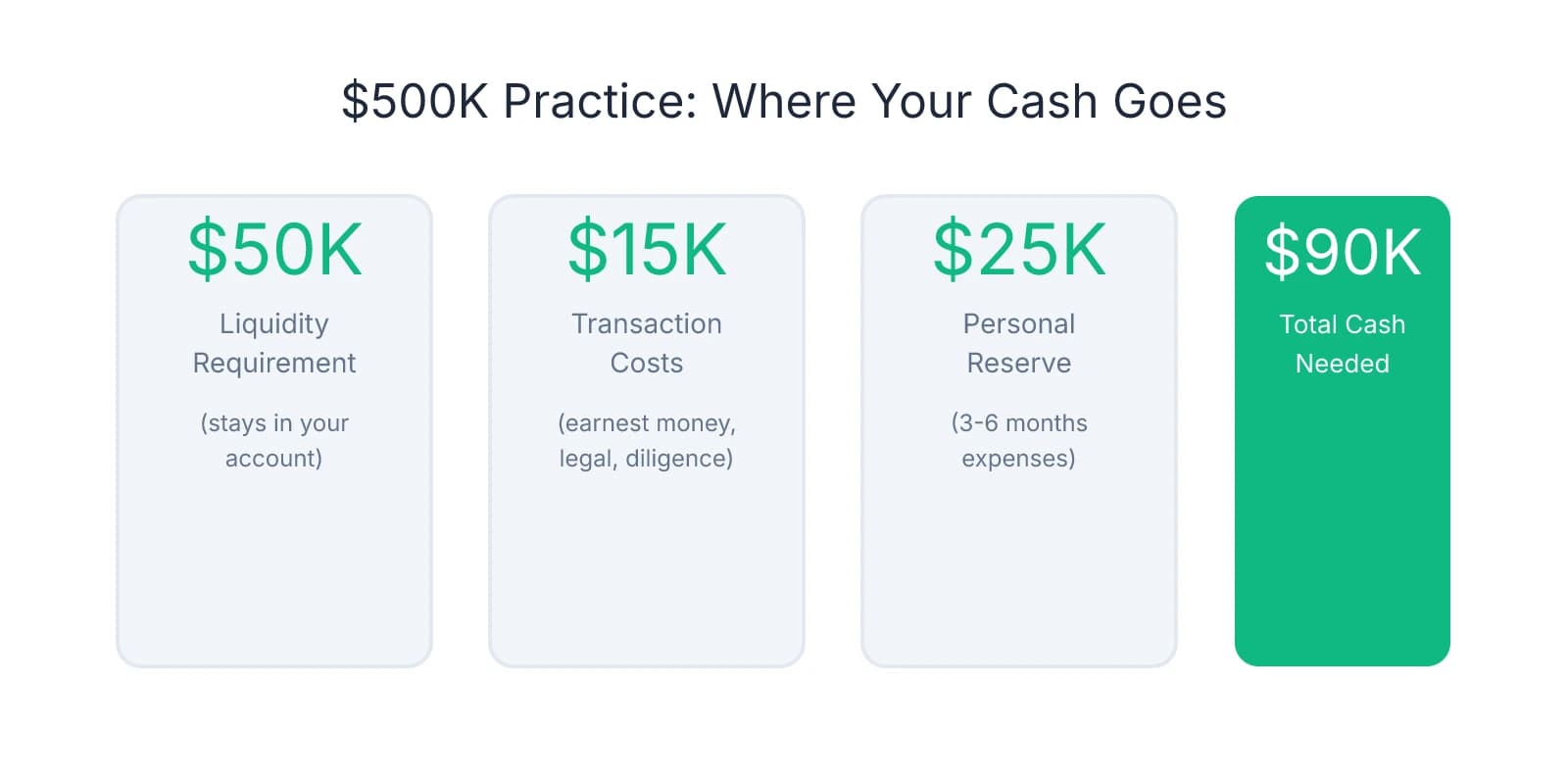
The question most buyers ask too late is whether they have enough cash to start looking. A simple readiness formula gives you a clear threshold: take 10% of your target purchase price, add $10,000 to $15,000 for transaction costs, then confirm you can cover three to six months of personal expenses without touching that money.
For a $500,000 practice, that means $50,000 in accessible cash for the liquidity requirement, plus $10,000 to $15,000 for earnest money, legal fees, and due diligence, plus another $15,000 to $30,000 in personal reserves—roughly $75,000 to $95,000 total. If you're sitting at $80,000 in liquid assets and your monthly personal expenses run $4,000, you're in range.
What happens when you're close but short by $10,000 to $20,000? One option is targeting smaller practices in the $300,000 to $400,000 range. These deals lower the liquidity threshold to $30,000 to $40,000, and many smaller practices generate stronger cash flow margins because overhead tends to scale more efficiently at lower revenue levels. Practices in rural markets often hit this profile, offering lower acquisition costs with faster paths to profitability.
Seller financing is another lever. When a seller agrees to finance 10-20% of the purchase price, your liquidity requirement drops because the institutional lender is covering a smaller percentage of the deal. Not every seller is willing to carry a note, but those who do are often motivated by tax advantages or confidence in the practice's stability.
If you're six to twelve months away from your target number, the smartest move is getting pre-qualified now anyway. Most lenders will review your financials, confirm what they'll require at closing, and give you a clear savings target. That conversation often reveals flexibility you didn't expect—maybe your production history offsets a slightly lower liquidity position, or the lender offers a working capital line that reduces the cash you need upfront.
Ownership readiness isn't binary—it's a spectrum. A buyer with $60,000 in liquidity and strong production numbers is more competitive than someone with $80,000 and inconsistent associate income. A buyer targeting a $400,000 practice in a stable market has more options than someone chasing a $700,000 practice in a saturated area.
Buyers who get pre-qualified early tend to close deals faster when the right practice surfaces. They've already cleared the financial hurdles, built relationships with lenders, and understand exactly what their offer can look like. When a well-priced practice hits the market, they're not scrambling to gather documents or figure out liquidity—they're ready to move.
Calculate your numbers. If you're at or above the readiness threshold, reach out to a dental-specific lender and start the pre-qualification process. If you're close but not quite there, decide whether targeting smaller practices or waiting another six months makes more sense for your situation. Either way, you're working from a clear financial position and a timeline that matches your actual liquidity.
Sources & References
The data and claims in this article are drawn from the following sources. We prioritize government data, peer-reviewed research, and established industry publications to ensure accuracy.
- Credit and Liquidity Tips for Dental Practice Buyers— www.menlotransitions.com
- What Is Liquidity & Why Is It Important For Practice Ownership?— members.perio.orgIndustry
- The Truth about Dental Practice Loans - ADA.org— ada.orgIndustry
- Working Capital Strategies When Buying a Practice - Dental CPAS— dentalcpas.comIndustry
- The Truth about Dental Practice Loans - ADA.org— ada.orgIndustry
- 5 Financial Must-Dos Before Buying a Dental Practice— www.ada.orgIndustry
Frequently Asked Questions
Ready to make your practice purchase happen?
Understanding cash requirements is just the first step. Minty Plus provides personalized guidance on financing strategies and acquisition planning to help you navigate the entire purchase process with confidence.