Buying a Dental Practice in an Oversaturated Market: What to Look For

Co-Founder, Minty Dental

In Summary
- The traditional 2,000:1 resident-to-dentist ratio is a starting benchmark, but success depends on whether the specific practice has competitive advantages like patient loyalty, location convenience, or service differentiation.
- Established practices with 5-10% annual attrition maintain revenue even when new competitors open nearby, because switching costs and relationship inertia protect the patient base.
- Urban markets function well at lower ratios (1,400-1,600:1) because patients rarely travel far for routine care, while rural markets need higher ratios (3,000+:1) since patients routinely drive 15-30 minutes.
- High dentist density in affluent areas often signals strong demand and willingness to pay for premium service—not oversupply—especially when population growth outpaces new practice openings.
Market Saturation Matters Less Than the Practice's Competitive Position
When demographic reports show dentist-to-population ratios below 2,000:1, the instinct is to walk away. More dentists competing for the same patients means less revenue per practice. But that framing misses what actually determines success—does this specific practice have structural advantages that insulate it from competition?
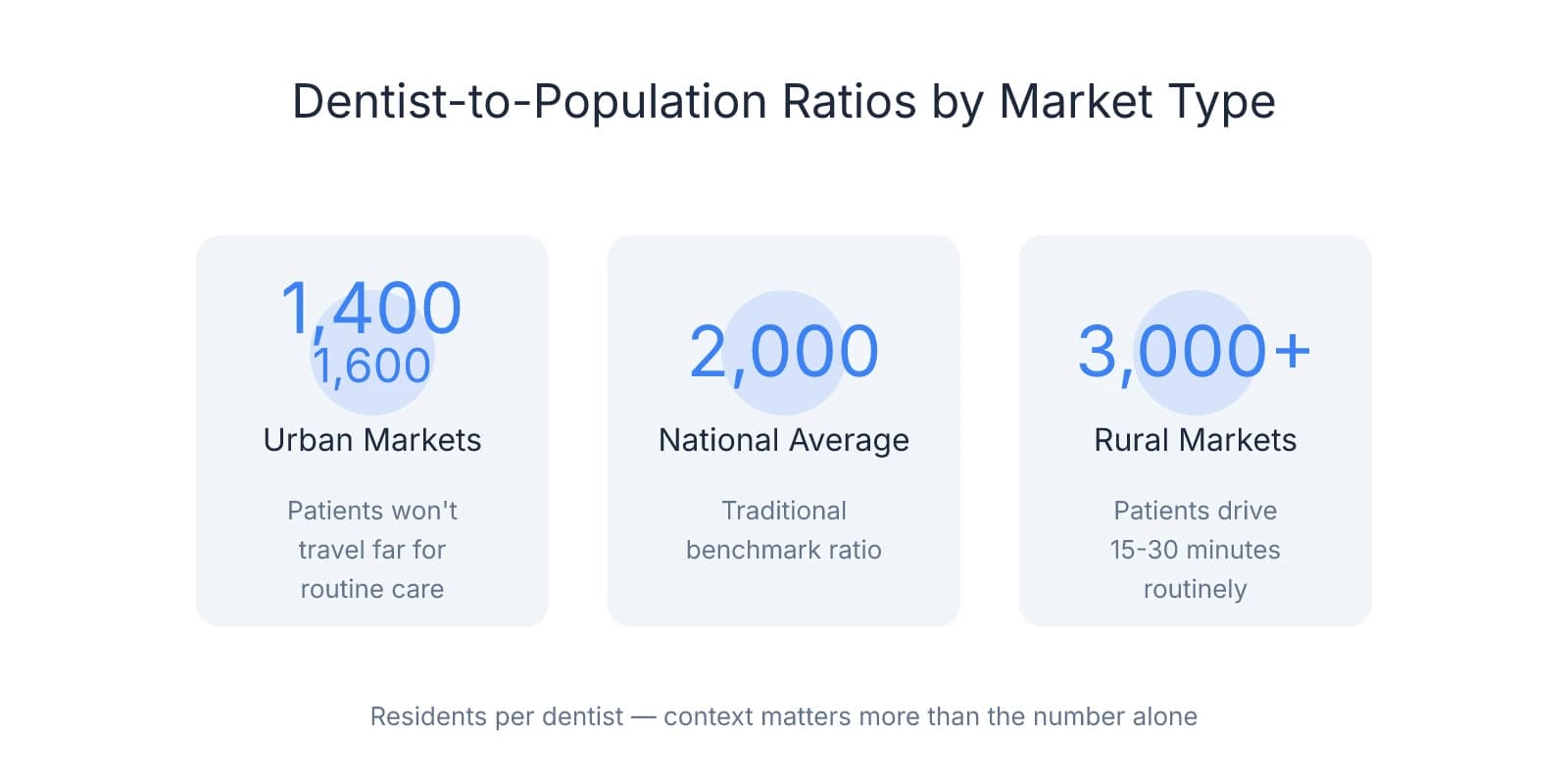
The national average sits around 1,643 residents per dentist, which by traditional standards signals saturation. Yet thousands of practices in those markets generate strong collections year after year. The difference isn't the ratio—it's whether the practice has built competitive moats that protect revenue.
Patient retention is the clearest signal of competitive strength. A practice with 5-10% annual attrition has established relationships, trust built over years, and switching costs that keep patients from leaving. When a new office opens nearby, most patients don't immediately transfer. If the practice you're evaluating shows consistent patient counts despite competitors entering over the past 3-5 years, the patient base is sticky.
Location convenience operates the same way. A practice near residential neighborhoods, with ample parking and easy highway access, holds an advantage raw dentist counts don't capture. Patients drive past other offices to reach the one that fits their commute. Physical barriers matter—analyzing multiple scales reveals whether a river, highway, or commercial district segments the market, reducing practices truly competing for the same patients.
The 2,000:1 ratio needs context. Urban markets tolerate much lower ratios—often 1,400-1,600:1—because patients won't travel far for routine care. Rural markets require higher ratios (3,000+:1) because patients routinely drive 20-30 minutes, expanding each practice's service area.
One pattern worth noting: practices that maintained or grew revenue while competitors opened nearby. Pull five years of production data and map when new offices entered. If collections stayed flat or increased despite new competition, the practice has something—service quality, insurance mix, hours, specialty offerings—competitors haven't matched.
Before dismissing a market as oversaturated, ask whether the practice has advantages that protect it from competition. If yes, the dentist-to-population ratio becomes context, not a verdict.
Four Questions That Reveal Whether a Practice Can Compete
Most buyers evaluate competitive markets by counting nearby offices on Google Maps. That tells you how many dentists exist—not whether the practice you're considering can hold market share. What separates viable practices from vulnerable ones isn't luck or location alone. It's whether the practice has built structural advantages competitors can't easily replicate.
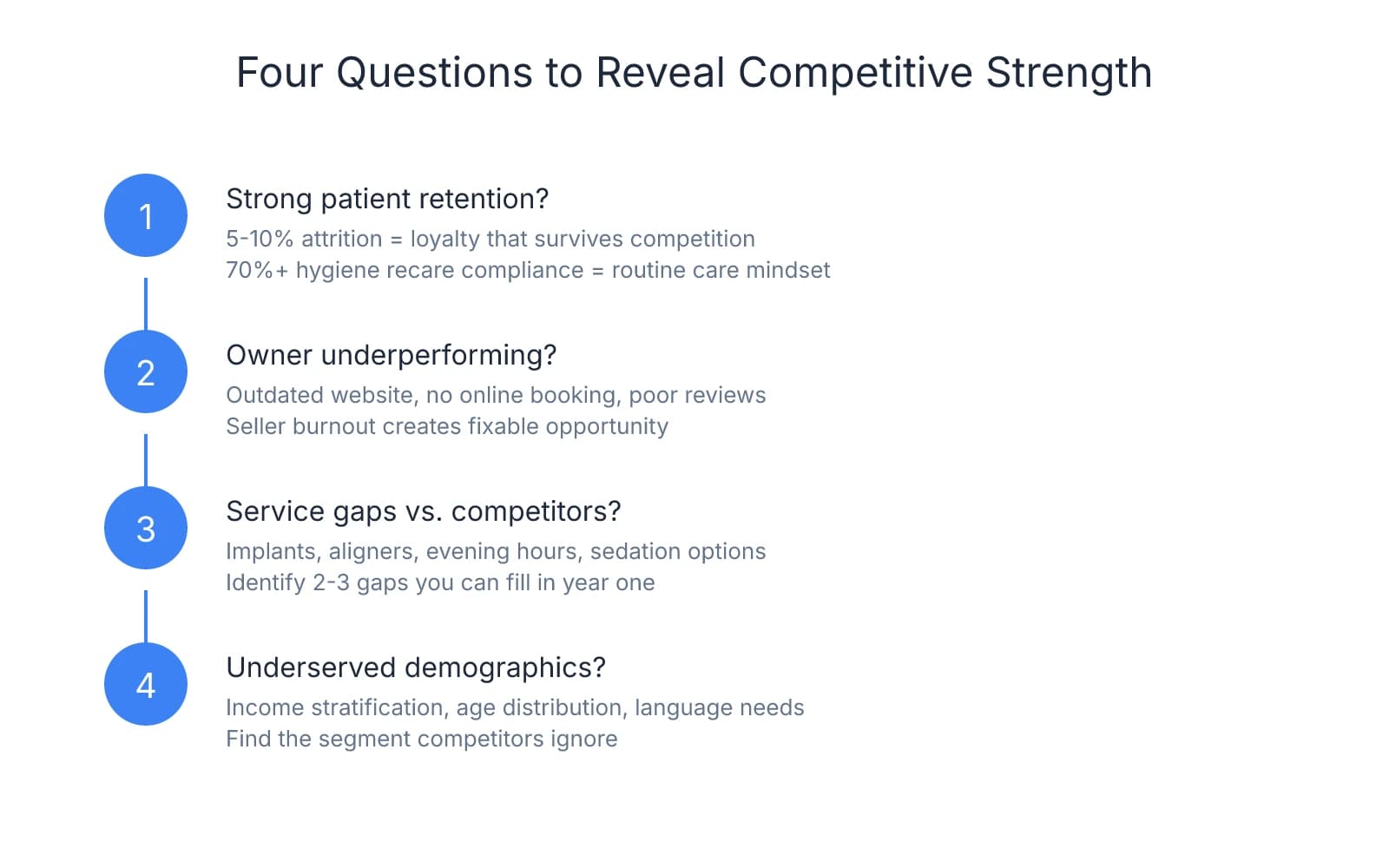
These four questions diagnose competitive strength during due diligence. Each addresses a different dimension of defensibility—patient loyalty, operational efficiency, service differentiation, and demographic alignment.
1. Does the practice have strong patient retention metrics?
Patient retention rate: Calculate annual attrition by dividing patients lost by total active patients. Practices with 5-10% attrition have built loyalty that survives competition. Above 15%, patients leave faster than the practice can replace them, signaling deeper problems—poor service quality, insurance changes, or weak patient relationships.
Hygiene recare compliance: Pull the percentage of patients returning for scheduled hygiene appointments within 90 days of their due date. Practices with 70%+ compliance have patients who view dental care as routine, not optional. Low compliance (below 50%) means the patient base is transactional—they come when something hurts.
Multi-generational families: Count how many patient charts include multiple family members or span generations. When parents bring their kids and refer their own parents, you're looking at relationship depth competitors can't easily break.
If the practice shows weak retention but strong new patient flow, that's a warning. You're buying a leaky bucket, and in a saturated market, filling it gets harder as competitors multiply.
2. Is the current owner underperforming in ways you can fix?
Seller burnout creates opportunity. A dentist working three days a week, skipping CE courses, and ignoring online reviews isn't maximizing potential—they're surrendering market share. Declining revenue doesn't always signal a dying practice—sometimes it signals fixable neglect.
Marketing gaps: Check when the website was last updated, whether the practice runs Google Ads, and social media activity. Many sellers stopped marketing years ago because they had enough patients. In competitive markets, that comfort becomes vulnerability.
Outdated systems: Look for practices using paper charts, manual appointment reminders, or no online booking. When potential patients can book with a competitor in 30 seconds online but must call your office during business hours, you lose that patient.
Poor online presence: Pull the practice's Google reviews, response rate, and star rating. If the practice has 15 reviews averaging 3.8 stars while competitors have 200+ reviews at 4.7 stars, you're looking at a reputation problem costing new patient flow.
The key question: are revenue declines driven by market saturation or operational neglect? If the owner has been coasting, you're buying upside. If they've been fighting hard and still losing ground, the market may genuinely be oversaturated.
3. What services are competitors offering that this practice isn't?
Service differentiation lets you compete without adding chairs or expanding square footage. Compare the practice's service mix to what nearby competitors advertise. The gaps are opportunities to capture patient segments the current owner never pursued.
High-margin procedures: Does the practice refer out implants, clear aligners, or cosmetic cases? Those referrals represent revenue walking out the door. If you can bring even one service in-house, you capture cases that currently go to specialists and differentiate from competitors who still refer out.
Underserved patient segments: Check whether competitors offer pediatric dentistry, sedation options, or extended hours. If the practice closes at 5 PM and competitors stay open until 7 PM, you're losing every working professional who can't take time off. Adding evening hours requires scheduling adjustments and evaluating whether your staff can support extended availability.
Insurance and payment flexibility: Compare the practice's insurance participation to competitors. If you're fee-for-service in a market where most accept PPOs, you're limiting your patient pool. Conversely, if you're heavily PPO-dependent and competitors are successfully fee-for-service, that signals an opportunity to transition toward higher-margin payer mixes.
The goal isn't to offer everything—it's to identify 2-3 service gaps that align with your skills and let you differentiate without major capital investment.
4. Are there underserved demographic pockets within the saturated market?
Saturation data measures averages across zip codes—but patients don't distribute evenly. Within any market, demographic segments exist that competitors aren't capturing.
Income stratification: Pull census data on median household income by census tract. If the practice sits in a middle-income area but nearby tracts show higher income levels, you may capture affluent patients by adjusting service offerings and marketing. Conversely, if competitors focus on high-income patients and ignore Medicaid-eligible populations, that's a volume play many overlook.
Age distribution: Check whether the area skews young families, retirees, or working professionals. A practice surrounded by young families but offering no pediatric services is missing an obvious demographic.
Language and cultural alignment: If census data shows significant Spanish-speaking, Vietnamese, or other non-English populations, and no nearby practices advertise bilingual services, that's a patient segment competitors aren't serving.
Insurance preferences: Cross-reference the practice's insurance participation with dominant employers in the area. If a major employer offers a specific PPO plan the practice doesn't accept, you're excluding a large patient pool by default.
The most defensible practices in competitive markets aren't trying to serve everyone—they identified a specific demographic segment and built operations around serving that group better than anyone else. Your individual preferences affect how quickly you find the right opportunity, but finding the segment competitors ignore gives you your competitive position.
When Saturation Signals Opportunity Instead of Risk
High dentist density doesn't always mean weak demand—sometimes it confirms the opposite. Markets with 1,400-1,600 residents per dentist can support multiple thriving practices when underlying economics justify it. The distinction is whether saturation reflects demand exhaustion or market maturity with room for well-positioned entrants.
Affluent demographics shift competitive dynamics entirely. In markets where median household income exceeds $100,000, patients choose dentists based on experience quality, not availability. They wait weeks for appointments with providers they trust, pay out-of-pocket for cosmetic procedures, and refer friends based on outcomes. High dentist density in these areas often signals strong demand and willingness to pay for differentiated service—not oversupply.
One metric that reveals opportunity: population growth trends. A market adding 2-3% annually can absorb new practices even when current ratios look unfavorable. Pull five-year population projections from census data and compare them to new practice openings. If population grows faster than dentist supply, today's saturation becomes tomorrow's equilibrium. Markets in suburban growth corridors often show high current dentist density but strong forward demand competitors haven't captured.
Retiring dentists create acquisition windows that bypass startup risk. When you see multiple practices with owners age 60 or older, you're looking at transition opportunities, not permanent competition. Buying from a retiring dentist lets you inherit patient relationships without the 3-5 year ramp-up new practices face. In competitive markets, acquiring an established patient base eliminates the hardest part of market entry: convincing patients to switch providers.
Many buyers find highest upside in distressed or underperforming practices within saturated markets. These sell at significant discounts—4.2-5.1× EBITDA for add-on acquisitions compared to 5-8× for healthy practices—because sellers assume competitive pressure permanently damaged the business. But revenue decline often traces to fixable operational problems: outdated technology, poor online reputation, limited services, or an owner who stopped marketing.
The calculation shifts when you can execute improvements competitors haven't. If nearby practices thrive while the one you're evaluating struggles, that gap represents operational upside, not market failure. A practice generating $600K with a burned-out owner working three days a week might produce $900K under an engaged buyer who adds evening hours, brings implants in-house, and invests in digital marketing.
One pattern worth tracking: markets where multiple practices recently sold to DSOs or private equity groups. That activity signals buyer confidence in long-term fundamentals. Institutional buyers don't enter saturated markets unless their models show defensible returns. For individual buyers, the same logic applies—you're just executing improvements one practice at a time.
The key distinction is whether saturation reflects a mature market with stable demand or a declining market losing patients to economic shifts, population outmigration, or reimbursement pressure. Pull five-year revenue trends for practices that sold recently. If they maintained or grew collections despite competition, the market is healthy.
Before dismissing a market as too competitive, ask whether competition itself confirms demand strength. If multiple practices coexist profitably, if population growth outpaces new openings, and if retiring sellers create acquisition opportunities, saturation may signal opportunity—not risk.
Building Your Competitive Strategy Before You Close
Once you've determined a saturated-market practice is viable, the work shifts from evaluation to execution planning. Success in competitive markets requires building your differentiation strategy during due diligence, not after closing.
Audit competitors' online presence while you're still in escrow. Pull Google reviews, website quality, local search rankings, and social media activity for every practice within three miles. If competitors average 4.2 stars with 40 reviews while you're inheriting 3.8 stars with 15 reviews, reputation management is your first priority. If their websites load slowly, lack online booking, or haven't been updated since 2018, you've found a conversion advantage you can exploit within 60 days.
One step that consistently separates successful buyers from struggling ones: identifying 2-3 service expansions you can implement in year one that competitors don't offer. Walk through what nearby practices advertise and find the gaps. If no one within two miles offers same-day crowns, clear aligners, or sedation dentistry, those become your positioning levers. If competitors close at 5 PM and you can staff evening hours twice a week, you capture every working professional who can't take time off.
Your patient transition communication strategy determines retention in competitive markets more than any other factor. In underserved areas, patients tolerate communication gaps because they have limited alternatives. In saturated markets, poor communication during ownership transition gives patients permission to try the new office or the competitor sending them mailers. Before closing, script exactly how you'll introduce yourself, what continuity you'll emphasize, and how you'll address concerns patients voice when ownership changes. What you say in those first 90 days shapes whether patients see you as a continuation of trusted care or as a reason to explore other options.
This planning pays off most clearly at the first hygiene appointment after transition. Patients who've been with the practice for years form their opinion based on whether their hygienist is still there, whether their appointment time stayed the same, and whether you acknowledged their history. If you reference their last visit, ask about their family by name, and explain what you're continuing from the previous owner's approach, you've reinforced the relationship.
Set retention and new patient acquisition benchmarks based on market conditions before taking ownership. In saturated markets, protecting existing patients matters more than aggressive new patient growth. Target less than 10% attrition in year one—anything above that signals you're losing patients faster than competitive pressure alone explains. Track monthly new patient counts, but weight them against retention. Adding 20 new patients monthly while losing 25 existing patients means you're running backward. Understanding how many patients typically leave after ownership transition lets you separate normal attrition from execution problems.
One benchmark many overlook: reactivation rate for patients who went inactive under the previous owner. Pull the list of patients who haven't scheduled in 12-24 months and plan your reactivation campaign before closing. In competitive markets, these patients didn't leave because they hated the practice—they left because life got busy, insurance changed, or the previous owner stopped following up. A well-timed reactivation campaign in months 2-3 can bring back 15-20% of inactive patients, giving you immediate production lift.
Practices that succeed in saturated markets aren't hoping differentiation emerges organically—they built competitive positioning into their transition plan before the purchase agreement. Buying an established practice delivers immediate cash flow and an existing patient base, but that advantage only holds in competitive markets when you've audited competitors, identified service gaps, scripted patient communication, and set retention benchmarks during due diligence. By the time you take ownership, you should know exactly how you're competing and what success looks like in month six.
Sources & References
The data and claims in this article are drawn from the following sources. We prioritize government data, peer-reviewed research, and established industry publications to ensure accuracy.
- Dentists - Health, United States - CDC— www.cdc.govGovernment
- How important is an area's ratio of residents per dental office?— www.dentagraphics.com
- How to purchase with confidence | American Dental Association— www.ada.orgIndustry
- Dental Market Trends: Is There an Oversupply of Dentists in CO & WY?— cowy.ddsmatch.comIndustry
- Dental Practice Valuation for 2026— focusbankers.comIndustry
- Buying vs. Starting a Dental Practice: Which is Right for You?— ctc-associates.com
Frequently Asked Questions
Find Your Ideal Practice in Competitive Markets
Navigating an oversaturated dental market requires expert guidance to identify undervalued opportunities and avoid costly mistakes. Minty Plus connects you with acquisition specialists who understand competitive markets and provide hands-on support throughout your purchase journey.