Should I Give Staff Raises After Buying a Dental Practice?

Co-Founder, Minty Dental

In Summary
- Staff prioritize job security and familiar workflows over immediate raises—most turnover decisions are made before you arrive, not because you didn't offer more money
- Matching existing compensation for 90-180 days protects patient retention without straining cash flow or creating entitlement expectations
- Your first-year budget is already stretched between debt service, working capital, and inevitable repairs—premature raises compress margins before you understand revenue patterns
- Strategic raises at 6-12 months, tied to measurable performance, reward contributions without setting a precedent that compensation increases on demand
- When staff demand raises early, acknowledge their value but hold your timeline—immediate concessions signal vulnerability and invite repeated negotiations
Staff Retention Depends More on Stability Than Immediate Raises
When you're weeks from closing, the fear that staff will leave without immediate raises feels urgent. But most staff want what patients want—stability. They want to know their job is secure, benefits won't disappear, and systems they've relied on won't vanish overnight.
Practices where new owners match existing compensation—salaries, PTO, health benefits—see far less turnover in the first six months than those who cut pay or hand out raises immediately. The staff member who's been there twelve years isn't calculating whether she could make $2 more elsewhere. She's asking whether you respect her role, understand the patient relationships she's built, and will let her do her job without unnecessary disruption.
Premature raises often backfire. When you offer a raise before working alongside someone for 90 days, you signal either uncertainty about your authority or that compensation increases whenever staff feel uneasy. Staff begin treating raises as negotiation tools rather than performance rewards—and you've created that dynamic before seeing a full hygiene schedule or understanding who carries the clinical load.
Your first-year cash flow is already stretched between loan payments, working capital reserves, and inevitable equipment repairs. Patient retention through ownership transitions depends on continuity: the hygienist who's cleaned Mrs. Patterson's teeth for eight years is still there, the receptionist who knows which patients need reminder calls still answers the phone. That continuity keeps the schedule full—not a 5% raise in week two.
The staff planning to leave have already decided—they're retiring with the seller, moving out of state, or staying only out of loyalty to the previous owner. A raise won't change that. The staff who stay are evaluating whether you'll respect their expertise, maintain reasonable expectations, and avoid abrupt changes that make their jobs harder. Spending the first 60-90 days observing workflows and understanding which team members patients specifically request protects you from rewarding the wrong people and gives you data to make strategic raises later—when they're tied to performance, not fear.
Your First-Year Cash Flow Determines What You Can Actually Afford
Before committing to raises, calculate what's left after your loan payment clears each month. Most buyers underestimate how quickly first-year cash gets allocated. You're covering acquisition debt—often $15,000 to $25,000 monthly for a $750,000 practice—plus working capital reserves, marketing spend, and equipment repairs that surface once you own the building. Adding $500 per month per employee might sound manageable in isolation, but stacked against those commitments, it can push your take-home below what you earned as an associate.
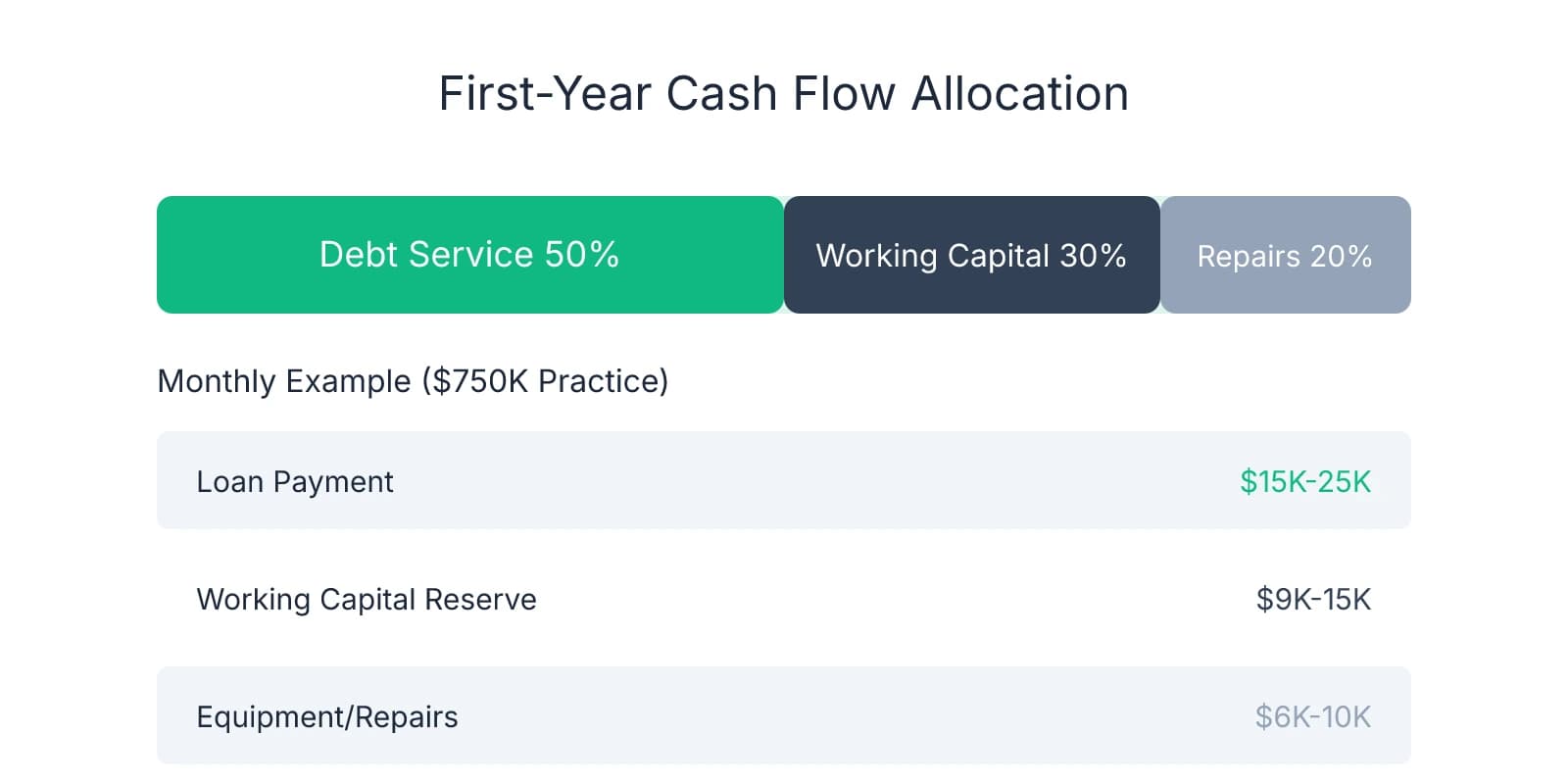
Staff compensation should sit between 25-30% of collections. When that percentage climbs higher, you compress profit margins and limit flexibility to handle slow months or unexpected expenses. Many buyers discover inherited payroll was already at 28-29%—near the upper threshold. Adding raises without corresponding revenue growth pushes overhead into territory that makes the practice harder to operate profitably.
Dental practice overhead averages 60-65% of collections—covering staff, facility costs, supplies, lab fees, and administrative expenses. A practice at 63% overhead that adds $3,000 monthly in raises without revenue growth moves to 66-67%. That difference shows up directly in your take-home and limits your ability to reinvest or weather a slow quarter.
Waiting until you've operated a full quarter before making compensation changes protects you from creating commitments before understanding whether collections will support them consistently. Dental practices have seasonal patterns—summer cleanings, December insurance rushes, January slowdowns when deductibles reset. Practices that maintain liquidity through the first year can handle those fluctuations without scrambling to cut costs later.
Inherited staff compensation may already be above market rate. The previous owner may have kept a longtime hygienist at $52 per hour when the regional benchmark sits closer to $46. In those cases, raises compound an existing cost structure problem. Before closing, compare the practice's payroll against regional compensation data for similar roles. If you're already paying at or above market, the retention strategy should focus on non-monetary factors.
If cash flow is tight, consider alternatives that cost less than permanent raises. Flexible scheduling—four 10-hour days instead of five 8-hour shifts—costs nothing but improves quality of life. Professional development opportunities signal investment without recurring expense. Performance-based bonuses tied to measurable outcomes—patient retention rates, treatment acceptance, schedule utilization—align compensation with results and give you control over when and how much you spend.
When Raises Make Sense—and How to Structure Them
The ideal timing is 6-12 months post-acquisition, after evaluating performance, understanding revenue patterns, and building trust. That window gives you operational data to identify who drives production, which staff patients specifically request, and whether collections can support increased payroll. By month nine or ten, you know which hygienist maintains 95% on-time completion versus who consistently runs behind, which assistant anticipates clinical needs versus who requires constant direction, and which front desk staff converts phone inquiries into scheduled appointments at the highest rate.
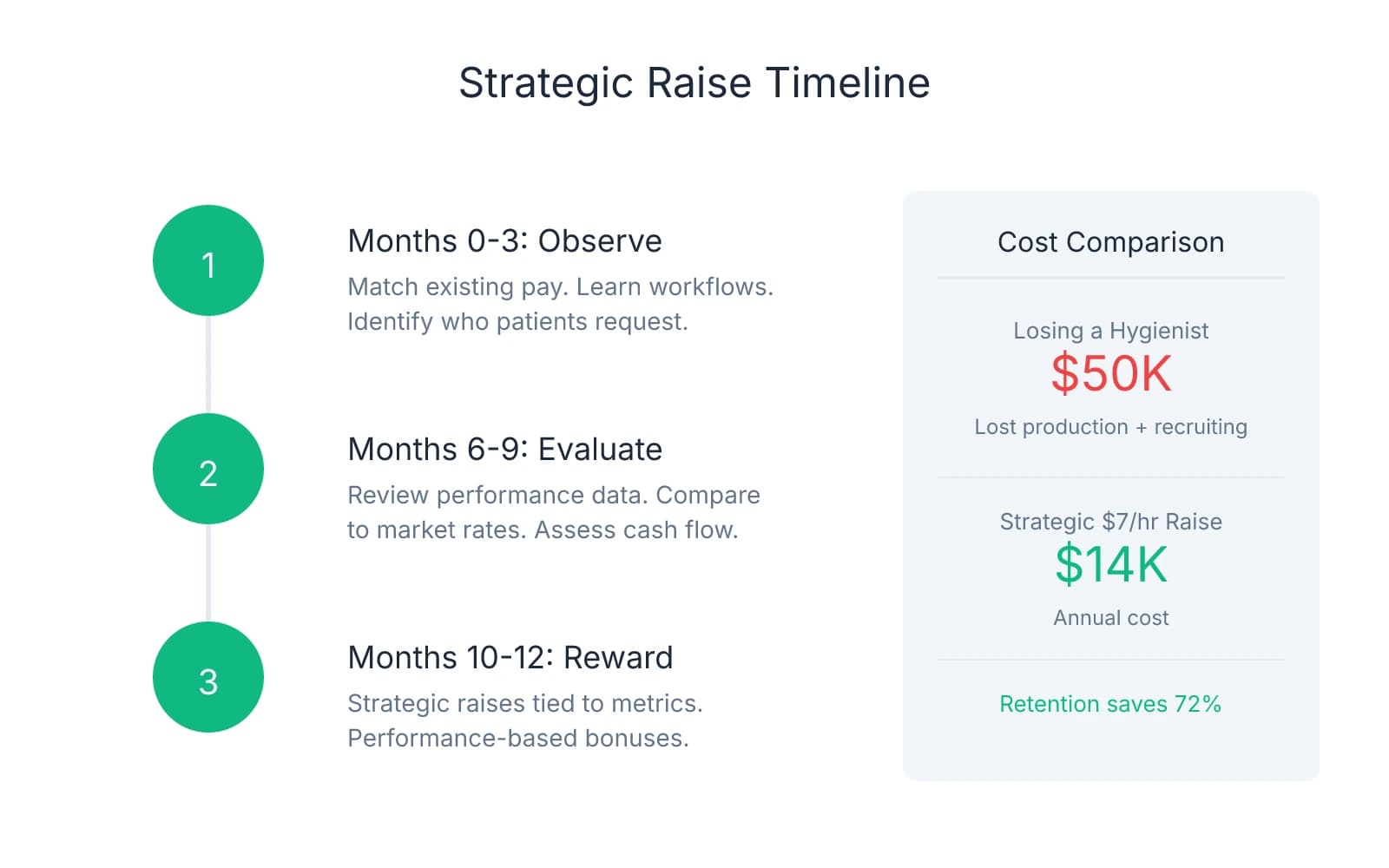
Raises make strategic sense when market research shows your compensation sits meaningfully below regional benchmarks. If your hygienist earns $38 per hour and the local average sits around $45, you're operating with turnover risk. Losing a hygienist costs 8-12 weeks of lost production while you recruit and train—often $40,000 to $60,000 in foregone revenue. A $7 per hour raise costs roughly $14,000 annually. When retention costs a fraction of replacement, the raise becomes a financial hedge.
Tie raises to measurable outcomes rather than creating entitlement without accountability. Structure compensation around production increases, patient retention rates, case acceptance improvements, or expanded responsibilities. A hygienist who increases same-day treatment acceptance from 22% to 38% has directly contributed to revenue growth. A front desk coordinator who reduces no-show rates from 11% to 6% has improved schedule utilization and cash flow. When raises connect to specific contributions, staff understand compensation growth depends on results.
Performance-based models—percentage of collections, production bonuses—align staff incentives with practice growth and avoid fixed cost increases. Recent ADA data shows around 80% of owner-dentists provided pay increases within the last 12 months, with most raises in the 4-6% range. But many were structured as bonuses tied to quarterly performance rather than permanent salary adjustments. A hygienist earning a base rate plus 8% of production above a threshold has direct financial reason to maximize productivity. That model costs nothing when production is flat and rewards the employee only when the practice benefits.
Retention bonuses—paid at 6-month or 12-month milestones—can be more cost-effective than permanent raises, especially for staff you're unsure about long-term. A $2,000 bonus at the one-year mark costs less than a $1.50 per hour raise over the same period and gives you an exit point if performance doesn't meet expectations. This works particularly well for roles where replacement is disruptive but long-term value is uncertain—like an office manager who knows the billing systems but hasn't demonstrated whether they can adapt to your operational preferences.
When a key employee has significant leverage—like a hygienist with 15 years of patient relationships—a strategic raise may protect patient retention. If 40% of your active patients specifically request that hygienist, the cost of a raise becomes secondary to the cost of patient attrition. Pair the raise with a structured transition plan: the hygienist receives the increase in exchange for helping you build relationships with her patient base over 12 months, introducing you during appointments, and gradually shifting loyalty from her to the practice. The raise buys you time to reduce dependency.
Treat raises as ongoing performance conversations rather than one-time decisions. If you give a raise in month ten, establish clear expectations for continued compensation growth—annual reviews tied to specific metrics, production thresholds that trigger bonuses, or expanded responsibilities that justify further increases. Without that structure, staff expect raises on an annual cycle regardless of performance. Frame raises as part of a broader compensation philosophy: you reward measurable contributions, adjust for market conditions when necessary, and invest in staff who invest in the practice's success.
What to Do When Staff Demand Raises Before You're Ready
Early demands for raises—especially collective ones in your first weeks—often signal staff feel uncertain about the transition or believe you're vulnerable to pressure. When a team approaches you before you've established authority, reviewed performance, or processed your first month of collections, they're testing boundaries as much as negotiating compensation. Practices where new owners make immediate concessions to collective demands often face repeated negotiations over the next 12 months.
Acknowledge their contributions while clearly communicating your timeline: "I want to make sure any compensation changes are sustainable and fair—I'll be reviewing everyone's performance and market rates at the 6-month mark." This tells staff raises are possible but will be based on data and observation rather than pressure. It buys you time to understand who carries the clinical load, which team members patients request, and whether cash flow can support increased payroll. Staff who initially push for immediate raises often become more reasonable once they see you're willing to have structured conversations—just not on their timeline.
Avoid immediate concessions out of fear. When you agree to raises in week two because you're worried the team will leave, you signal compensation is negotiable on demand. That creates a dynamic where staff learn collective pressure works. If the demand feels opportunistic—staff coordinating to approach you together before you've learned everyone's names—one or two people are likely driving the conversation. Holding firm protects you from rewarding the wrong behavior and gives you space to identify who's genuinely essential versus who's testing your resolve.
If staff collectively refuse to sign new employment agreements or threaten to leave, evaluate whether they're truly essential or whether turnover might create an opportunity to rebuild with a stronger team. Practices that experience turnover during ownership transitions often discover departures opened space for better hires who align with the new owner's vision. A front desk coordinator who refuses to sign an agreement because she wants a $5 per hour raise before you've observed her work is telling you something about how she views authority. Sometimes the right decision is letting her leave rather than setting a precedent that undermines your ability to manage effectively.
Strategic concessions might include non-monetary benefits that cost less than permanent salary increases. Additional PTO—an extra three days per year—costs you coverage logistics but doesn't create recurring payroll expense. Flexible scheduling improves quality of life without increasing labor costs. Continuing education stipends—$500 to $1,000 annually—signal investment in professional development while keeping monthly payroll stable. Staff who genuinely care about growth and work-life balance respond well to these options, while those focused solely on salary increases reveal their priorities may not align with long-term retention.
When one key employee has legitimate leverage—like a hygienist with 15 years of patient relationships—consider a private conversation and targeted adjustment rather than blanket raises. If 40% of your active patients specifically request that hygienist, a strategic raise may protect patient retention. But that conversation should happen individually, not as part of collective negotiation. Frame it as recognition of specific value: "I've noticed how many patients request you by name, and I want to make sure your compensation reflects that contribution. Let's talk about what makes sense at the 6-month mark." This protects you from creating entitlement across the team while addressing the one relationship that carries financial risk.
The staff making the loudest demands often aren't the ones you'll regret losing. The truly essential team members—the ones patients trust, who keep the schedule running smoothly, who anticipate problems—usually stay quiet during these negotiations. They're waiting to see how you handle pressure, whether you make decisions based on data or emotion, and whether you'll protect the practice's financial health or cave to whoever complains first. Holding firm signals you're running the practice based on performance and sustainability, not fear. That's the foundation you need to build a team that respects your authority and earns their compensation through results.
Sources & References
The data and claims in this article are drawn from the following sources. We prioritize government data, peer-reviewed research, and established industry publications to ensure accuracy.
- Managing Performance: Staff Compensation— ada.orgIndustry
- Dental Practice Overhead Breakdown: A Comprehensive Guide— www.teero.comIndustry
- 5 Cash Flow Moves for Dental Practices in 2026 - US Medical Funding— usmedicalfunding.comIndustry
- Dental hygienist compensation increases 21% since 2019— www.beckersdental.comIndustry
- Vast majority of US dentists increase pay for dental teams— www.dental-tribune.comIndustry
Frequently Asked Questions
Ready to navigate post-acquisition staffing decisions?
Deciding on staff compensation after acquiring a dental practice requires strategic planning. Minty Plus provides hands-on guidance through every phase of practice ownership, including staffing and retention strategies.