Staff Expect Me to Match Previous Owner Benefits After Buying Practice

Co-Founder, Minty Dental

In Summary
- Your lender underwrote the acquisition based on the seller's disclosed payroll—adding unexpected benefits can threaten debt service coverage and working capital reserves
- Matching the previous owner's package is both financially defensible and legally sound—it's what the business has historically supported and what you budgeted for
- Before committing to any benefit, calculate its annual cost against your collections and EBITDA margin after debt service—benefits that sound modest can consume 5-10% of net income
- Individual conversations defuse collective pressure and reveal who has legitimate needs versus who's testing boundaries
- Replacement isn't the first option, but when demands exceed market norms or threaten your authority, the cost of turnover may be lower than years of capitulation
Matching the Seller's Package Protects Your Cash Flow
Your acquisition loan was approved based on specific financial assumptions—most critically, the payroll and benefit costs the seller disclosed during due diligence. When staff push for benefits the previous owner never offered, they're asking you to absorb expenses you didn't underwrite. That gap between what you budgeted and what you're now being asked to provide can destabilize debt service coverage, drain working capital reserves, and push profitability targets out of reach before you've collected your first month of revenue.
Ownership transitions often trigger requests for improvement. Staff see a new owner as an opportunity to negotiate what the previous dentist wouldn't provide—health insurance, retirement contributions, continuing education stipends. The problem isn't that these requests are unreasonable in isolation; it's that your financial model didn't account for them. Dental practice lenders typically require a debt service coverage ratio of 1.25 or higher, meaning your practice needs to generate $1.25 in net operating income for every dollar of debt service. Adding $30,000 in annual benefits you didn't budget for can drop you below that threshold, triggering covenant violations or forcing you to subsidize payroll from personal savings.
The practice's cash flow hasn't changed just because you bought it. Revenue, patient volume, and operational expenses remain what they were under the previous owner—at least in the short term. If the seller's disclosed payroll was $180,000 annually and you're now being asked to increase it to $210,000, that $30,000 difference comes directly out of your take-home income or debt service capacity. You paid for a practice with a known cost structure, and deviating from that structure creates risk you didn't price into the purchase.
Matching the seller's package is defensible. It's what the practice has historically supported, what you underwrote during acquisition, and what staff agreed to under the previous owner. Frame it as a commitment to stability: "I'm committed to honoring what you've been receiving while I learn the business. Once I understand the practice's financial health and where we can grow, we can revisit compensation." This language acknowledges their request without committing to changes you can't afford, and buys you time to evaluate whether the practice can support additional benefits once you've seen three to six months of actual cash flow.
The risk of setting precedent is real. Agreeing to benefits in week two—before you've processed payroll, reconciled accounts receivable, or identified where the practice is leaking revenue—creates expectations that are difficult to walk back later. If you approve health insurance contributions in month one and then realize in month four that collections are softer than projected, you're now in the position of either absorbing a loss you didn't plan for or reversing a benefit you already granted. The latter damages trust more than never offering the benefit in the first place.
Before committing to any changes, pull the practice's actual payroll records from the past 12 months and compare them to what the seller disclosed. If the numbers match and staff are asking for benefits that were never part of the package, your position is straightforward: you're maintaining the compensation structure that came with the practice. If you discover discrepancies—benefits the seller claimed not to offer but actually provided informally—that's a different conversation, and one worth addressing with your attorney. But in most cases, the seller's disclosed package is what you're obligated to match, and what your cash flow can support.
What Benefits Actually Cost—And Whether Your Budget Can Absorb Them
Before you respond to any benefit request, calculate what it actually costs. Staff often frame asks in terms that sound modest—"just health insurance" or "a small 401(k) match"—but the cumulative annual expense can represent 5-10% of your net income.
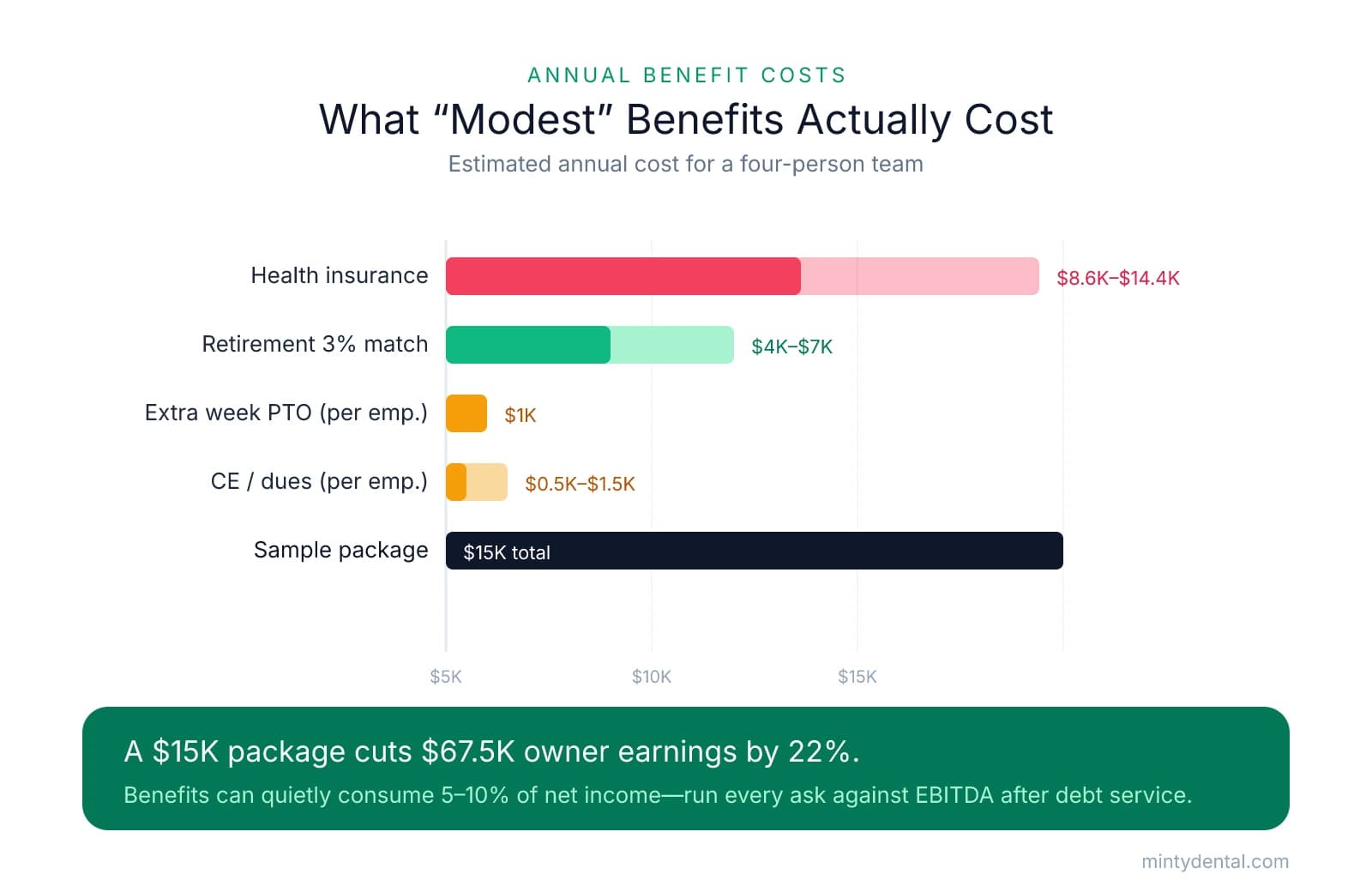
Health insurance is typically the largest ask. If your practice covers 50% of employee premiums, expect to pay $180-300 per month per employee, or $2,160-3,600 annually. For a four-person team, that's $8,640-14,400 per year. If your practice collects $800,000 annually, that benefit alone consumes 1.1-1.8% of gross revenue. The question isn't whether health insurance is valuable—it is—but whether your EBITDA margin after debt service can absorb it without forcing you to cut elsewhere or subsidize payroll from personal funds.
Retirement matching at 3% of salary costs roughly $1,200-1,800 annually for a hygienist earning $40,000-60,000. Extend that to a full team and you're looking at $4,000-7,000 per year. This is one of the more affordable benefits to add if your cash flow supports it, and it carries tax advantages that reduce the net cost. But if you're already running tight on working capital, even a modest 3% match can strain liquidity in months where collections dip or unexpected equipment repairs hit.
Additional PTO is easy to underestimate. Each week of paid time off represents roughly 2% of an employee's annual pay. If a $50,000-per-year employee requests three weeks of PTO instead of two, that extra week costs $1,000. Multiply that across your team and the annual expense adds up quickly.
Continuing education stipends, uniform allowances, and professional dues are smaller line items individually—$500-1,500 per employee annually—but they compound. These benefits improve morale and skill development, but they're discretionary. If your first-year budget is tight, they're easier to defer than health insurance or retirement contributions.
To evaluate whether a specific benefit fits your budget, use this framework: calculate the total annual cost, divide by your projected collections, and assess whether that percentage fits within your target EBITDA margin after debt service. If your practice collects $750,000 annually and generates a 25% EBITDA margin ($187,500), and your annual debt service is $120,000, you have $67,500 in owner earnings before taxes. A $15,000 benefit package reduces that to $52,500—a 22% reduction in take-home income.
Benefits that improve retention—health insurance, retirement matching—may justify their cost if your cash flow supports them, but not in month one if you're still building working capital. Many buyers find it more prudent to stabilize operations for 90-180 days, confirm that collections match projections, and then introduce benefits once they've proven the practice can absorb the expense.
If a benefit request would push your total payroll and benefits above 30-32% of collections, you're likely overextending. Dental practices typically allocate 22-28% of revenue to staff compensation, with benefits adding another 3-5%. Exceeding that range compresses your margin for debt service, taxes, and owner compensation.
For buyers navigating tax planning in their first year, benefits like retirement contributions and health insurance offer deductions that reduce taxable income—but only if the practice generates enough profit to make those deductions meaningful. Run the numbers with your CPA before committing, and make sure the benefit improves your financial position rather than just reducing a tax bill you weren't going to owe anyway.
How to Negotiate Without Losing the Team or Setting Unsustainable Precedent
When staff present benefit requests as a collective front, the dynamic shifts from individual employment discussions to something closer to a negotiation standoff. The pattern many buyers miss is that collective requests obscure individual motivations. One hygienist may genuinely need health insurance for a family situation. Another may be testing whether you'll cave under pressure. A third may be fine with the current package but doesn't want to break ranks.
Schedule one-on-one meetings with each team member within the first two weeks. Frame these as check-ins: "I want to understand what's important to you as we move forward together." In these conversations, you'll often discover that the unified front wasn't as unified as it appeared. Individual discussions also give you leverage: staff members are less likely to make unreasonable demands when they're not performing for their peers.
When benefit requests come up, acknowledge them without committing. A script that works: "I understand you're hoping for additional benefits. Right now, I'm matching what the practice has historically provided while I learn the financials. Let's revisit this at six months once I have a clear picture of what we can sustainably support." This validates their request, explains your constraint without oversharing financial details, and sets a timeline that defers the decision until you've seen actual cash flow.
Where staff refuse to sign employment agreements, you're facing a negotiation tactic, not a legal impasse. Your position is straightforward: continued employment requires acceptance of the offered terms, and those terms reflect what the practice has historically supported. If an employee refuses to sign after a reasonable deadline—say, 10 business days—you clarify the consequence: "I need everyone on the team to operate under the same employment structure. If you're not comfortable with these terms, I understand, but I'll need to move forward with someone who is."
The question of where to compromise depends on cost and precedent. Low-cost benefits that signal goodwill without materially impacting cash flow are worth considering if they improve morale and retention. A $500 annual continuing education stipend costs $2,000 for a four-person team—meaningful to staff, manageable for you. Occasional team lunches or small recognition gestures cost even less and build culture without creating recurring obligations. These compromises work because they're discretionary: you can offer them in profitable months and scale back if cash flow tightens.
Hold firm on requests that exceed local market norms, threaten debt service coverage, or set precedent you can't maintain. Frame these decisions around sustainability: "I want to build a practice where we can offer strong benefits long-term, and that means making sure we're financially stable first. Right now, this request would put us in a position I can't sustain."
One scenario that catches buyers off guard: staff who threaten to leave if you don't meet their demands. This is where understanding your local labor market matters. But even in tight labor markets, caving to ultimatums sets a precedent that undermines your authority for years. A better approach: acknowledge the risk, express your hope that they'll stay, and reaffirm your position. "I'd hate to lose you, and I hope you'll give this transition time to stabilize. But I can't commit to benefits the practice hasn't historically supported until I know we can afford them." Most staff who threaten to leave don't actually leave—they're testing whether you'll fold.
For buyers managing inherited staff dynamics where one employee dominates the team, these negotiations often reveal power structures you didn't see during due diligence. Individual conversations break the ability of dominant staff to speak for the group, and clear boundaries prevent them from positioning themselves as the intermediary between you and the rest of the team.
The six-month review you promised isn't a formality—it's a decision point. If collections exceed projections and working capital is stable, you may be able to add benefits. If collections are softer than expected, you revisit the conversation with data: "I've now seen six months of financials, and here's where we stand. Right now, adding health insurance would reduce our margin below what's sustainable. Let's target the 12-month mark and reassess." Before entering any negotiation, rank your priorities and consider tradeoffs that satisfy both parties—whether that means accepting a lower salary in exchange for continuing education support, or offering discretionary benefits that don't create permanent obligations.
When Replacing Staff Makes More Sense Than Meeting Demands
Not every benefit negotiation ends with compromise. In some transitions, staff demands signal deeper misalignment—expectations that exceed what the practice can support, or behavior that suggests they're testing whether you'll capitulate under pressure. The calculus shifts when the cost of meeting demands exceeds the cost of turnover and retraining, or when agreeing to their terms undermines your authority in ways that compound over years.
One pattern that surfaces early: collective refusal to sign employment agreements after reasonable negotiation. If you've offered terms that match the seller's package, provided a clear deadline, and staff still won't sign, they're signaling that they believe you need them more than they need the job. When a team coordinates to withhold signatures, they're betting you'll fold rather than face the operational disruption of replacing them.
Another warning sign: demands that far exceed local market norms. If a hygienist with three years of experience requests $50/hour in a market where the average sits at $38-42, or an assistant asks for four weeks of PTO when regional practices offer two, they're either misinformed about their market value or testing whether you'll overpay to avoid conflict. Pull compensation data from your state dental association or local job postings to confirm what's reasonable.
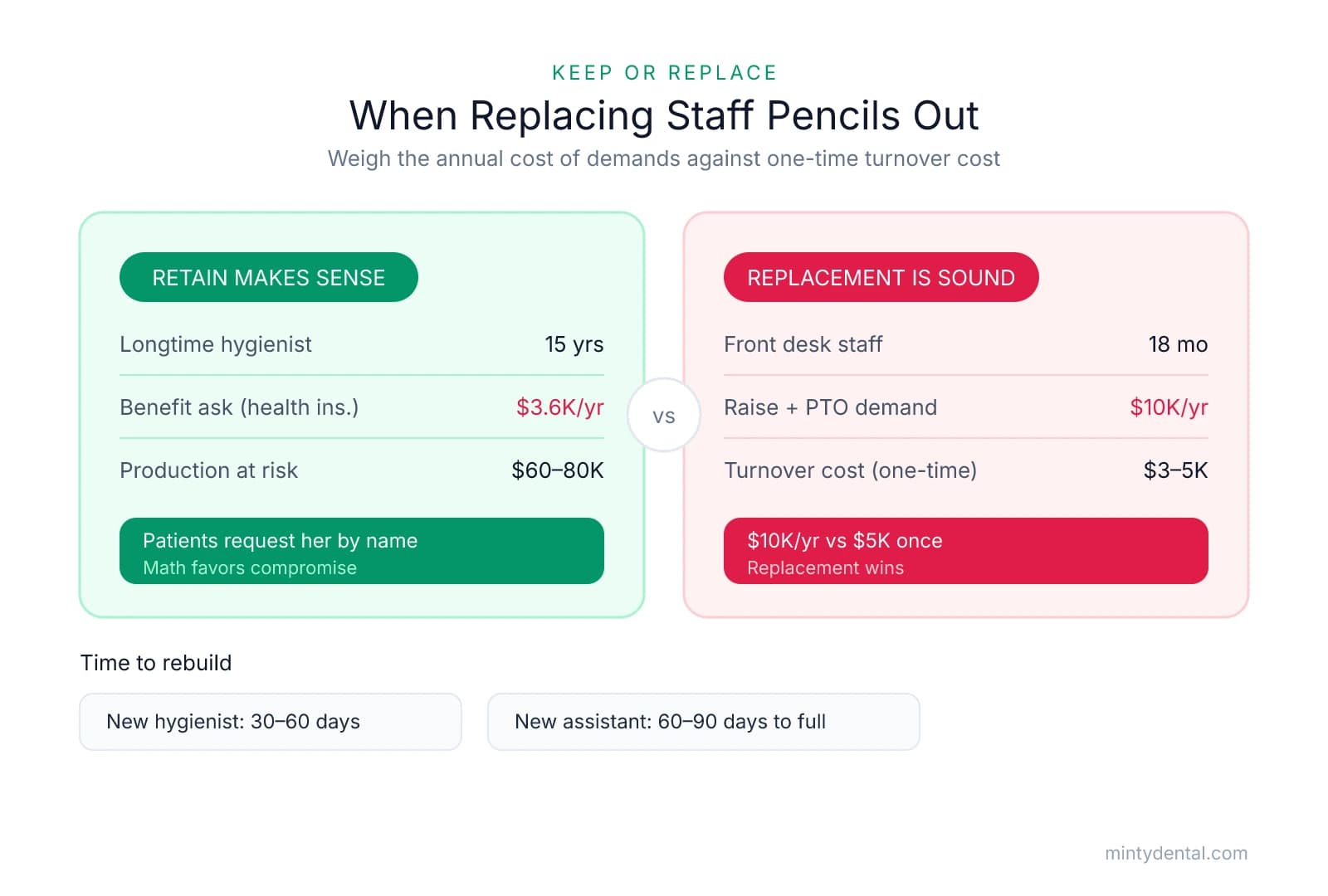
The retention argument is real, but it's not absolute. Experienced staff who know the patients and systems carry value—a longtime hygienist with a loyal following can drive patient retention in ways that justify higher compensation. If she's been with the practice 15 years, patients request her by name, and her ask is for health insurance that costs $3,600 annually, the math may favor compromise. Losing her could mean losing the 200 patients who see her twice a year, which translates to $60,000-80,000 in annual production.
But not all staff are equally difficult to replace. Front desk employees or newer team members whose demands threaten cash flow may not justify retention if they won't accept market-rate compensation. A receptionist with 18 months of tenure asking for a $10,000 raise and three weeks of PTO—when you're already matching the seller's $40,000 salary and two weeks off—is replaceable. The operational disruption of hiring and training a new front desk employee is real, but it's a one-time cost of $3,000-5,000. Compare that to the $10,000 annual increase she's requesting, and replacement becomes the financially sound decision.
The decision framework comes down to three variables: replaceability, cost of demands, and long-term precedent. For each staff member making requests, evaluate:
- How difficult are they to replace? Hygienists in rural markets or specialists with niche skills are harder to replace than general assistants or front desk staff in metro areas.
- What's the cost of meeting their demands versus the cost of turnover? If their request adds $5,000 annually and replacing them costs $4,000 in recruiting and training, retention makes sense. If their request adds $15,000 and replacement costs $5,000, the math favors moving on.
- What precedent does agreeing set? If you grant one employee's demand, will the rest of the team expect the same?
One scenario that forces the decision: staff who frame their requests as ultimatums. "If you don't offer health insurance, I'm leaving" is different from "I'm hoping we can work toward health insurance over time." The former is a negotiation tactic designed to pressure you into a decision before you've evaluated whether it's sustainable. A boundary that works: "I'd hate to lose you, but I can't commit to benefits the practice hasn't historically supported until I've confirmed we can afford them. If that timeline doesn't work for you, I understand."
Setting boundaries early protects your long-term authority. Capitulating to unreasonable demands in week two establishes a pattern that's nearly impossible to reverse. Staff remember that you agreed under pressure, and they'll return to that tactic every time they want something. The cost isn't just financial—it's the erosion of your ability to make decisions without staff approval.
For buyers navigating whether staff dynamics warrant a fresh start, the transition period reveals more than due diligence ever could. If the first two weeks involve collective demands, refusal to sign agreements, or behavior that suggests they're testing your resolve, you're seeing a preview of the next five years. Addressing it now—even if it means replacing one or two team members—prevents years of resentment and financial strain. The stakes extend beyond benefits negotiations: trusted employees can sometimes become sources of significant financial harm, making early boundary-setting essential for protecting both authority and practice finances.
Replacement is difficult, but it's not catastrophic. Hiring a new hygienist takes 30-60 days in most markets. Training a new assistant takes 60-90 days to reach full productivity. The operational disruption is real, but it's temporary. The alternative—agreeing to benefits you can't afford or working with staff who don't respect your authority—compounds over time. If you're six months in and already regretting the purchase because staff dynamics are draining your energy and cash flow, the problem likely started with a boundary you didn't set in week two.
The decision isn't easy, but it's one some buyers will face. Experienced staff who know the patients and systems are valuable, and turnover in year one creates operational risk. But staff who use the transition to extract concessions that threaten your financial stability or undermine your authority may cost more to keep than to replace. The calculus is individual to each team member, but the principle is consistent: you're building a practice you can sustain for decades, and that means making decisions that protect both cash flow and control—even when those decisions are uncomfortable in the short term.
Sources & References
The data and claims in this article are drawn from the following sources. We prioritize government data, peer-reviewed research, and established industry publications to ensure accuracy.
- Managing Performance: Benefits - American Dental Association— ada.orgIndustry
- How Benefits Increase Hygienists and Dental Assistants Hourly Rate— directdental.comIndustry
- Managing Performance: Benefits - American Dental Association— ada.orgIndustry
- Prepare & Prioritize: How to Negotiate with Confidence— www.ada.orgIndustry
- Is Your Team Stealing From You? What Every Dental Practice ...— www.youtube.com
Frequently Asked Questions
Navigate Staff Expectations When Buying Your Practice
Inheriting a team with established benefit expectations requires strategic planning. Minty's operations experts help new practice owners optimize compensation structures, manage staff transitions, and build sustainable benefit packages that align with your business goals.