How Much Is a Dental Practice Patient Base Worth Per Patient?

Co-Founder, Minty Dental
In Summary
- Per-patient value is calculated by dividing annual collections by active patient count—a practice collecting $900K with 1,500 patients ($600/patient) represents different opportunity than one collecting $900K with 2,500 patients ($360/patient)
- Industry benchmarks suggest roughly 900 active patients per $500K in collections, but this ratio varies widely based on practice type, production mix, and treatment philosophy
- Higher per-patient revenue can signal strong treatment acceptance but may also indicate a patient base that's already been heavily restored with limited growth potential
- Lower per-patient revenue often points to under-diagnosis, poor case acceptance, or significant untapped treatment—the key is determining which scenario you're walking into
- Patient count alone is misleading without the collections context—a practice listing 3,000 patients with $500K in collections likely hasn't archived inactive records in years
Per-Patient Value Is a Ratio, Not a Fixed Number
Start by calculating one number: annual collections divided by active patient count. That ratio tells you more about a practice's opportunity than the patient count alone ever will.
The conventional benchmark sits around 900 active patients per $500K in collections—roughly $555 per patient annually. A practice collecting $1 million would ideally carry close to 1,800 active patients under this framework. But these are derived metrics, not fixed valuations. The ratio shifts based on practice type, production mix, and how aggressively the seller has diagnosed and treated over the years.
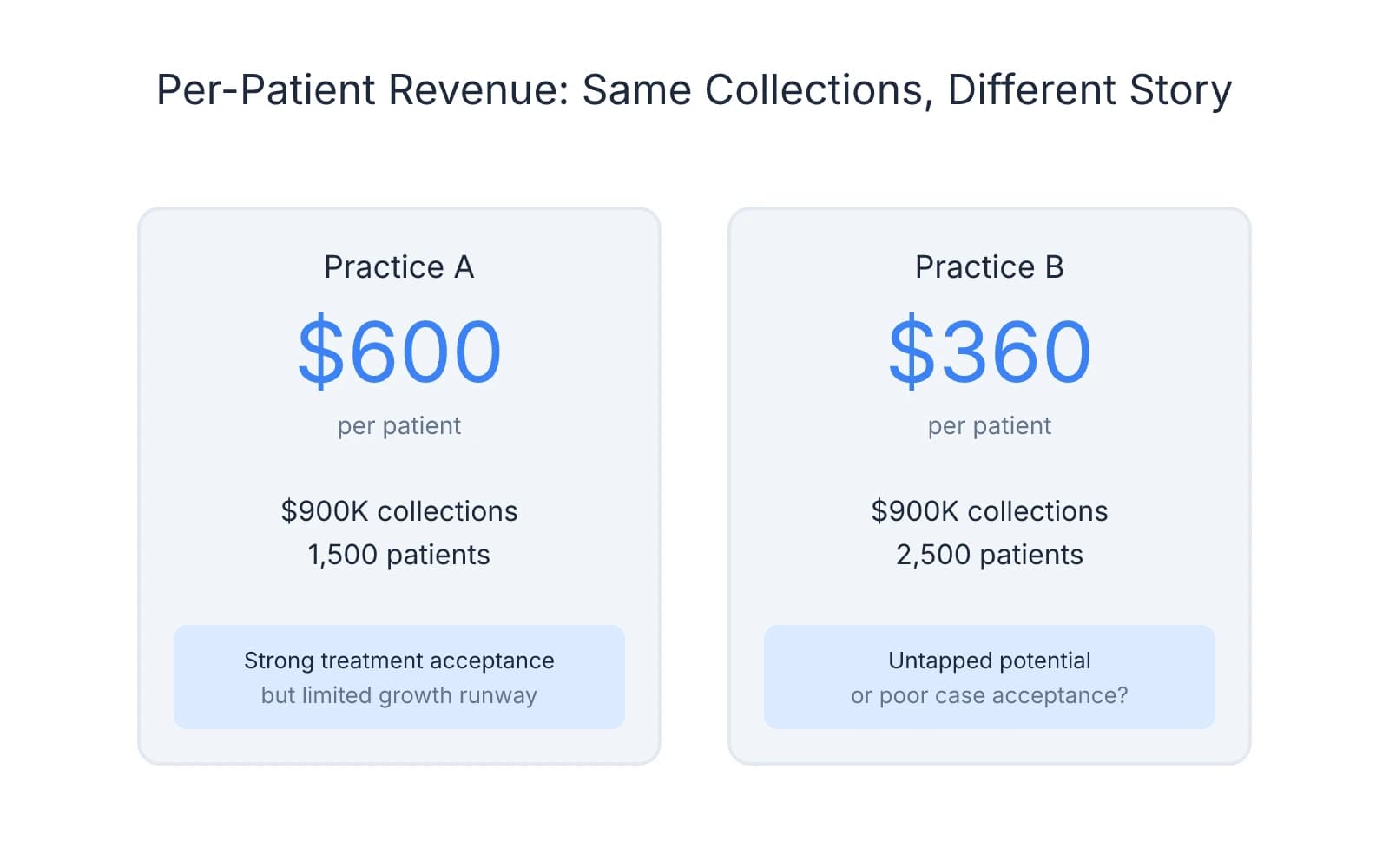
Take the practice's trailing twelve-month collections and divide by the active patient count (typically defined as patients seen within the past 14-18 months). A practice collecting $900K with 1,500 patients generates $600 per patient annually. The same $900K spread across 2,500 patients drops to $360 per patient. Both practices have identical top-line revenue, but the underlying patient dynamics are completely different.
The higher per-patient number could signal strong case acceptance or comprehensive treatment planning. It might also mean the seller has already placed most of the crowns, completed the endo, and extracted the questionable teeth—leaving you with a well-maintained base but limited growth runway. When evaluating collections versus production, this distinction matters: high per-patient revenue isn't inherently good or bad until you understand what's driving it.
Lower per-patient revenue often points to one of three scenarios: under-diagnosis, poor case acceptance, or untapped potential—a patient base with significant unmet needs that a new owner could address through better systems, technology, or case presentation skills.
What trips up buyers is treating patient count as the primary metric. A practice listing 3,000 patients with $500K in collections isn't a hidden gem—it's a red flag that the seller likely hasn't maintained accurate records of who's actually walking through the door. The inflated count obscures the real question: how many of those patients are generating revenue, and how much runway is left?
The ratio matters more than the absolute numbers because it reveals whether you're buying productive relationships or just names in a database. Before you calculate practice value using EBITDA or collections multiples, understand the per-patient revenue driving those figures—it's the foundation everything else rests on.
How to Calculate What You're Actually Buying
The per-patient revenue number you calculated is your starting point, not your conclusion. What matters now is understanding whether that number reflects sustainable production or a patient base that's been mined out.
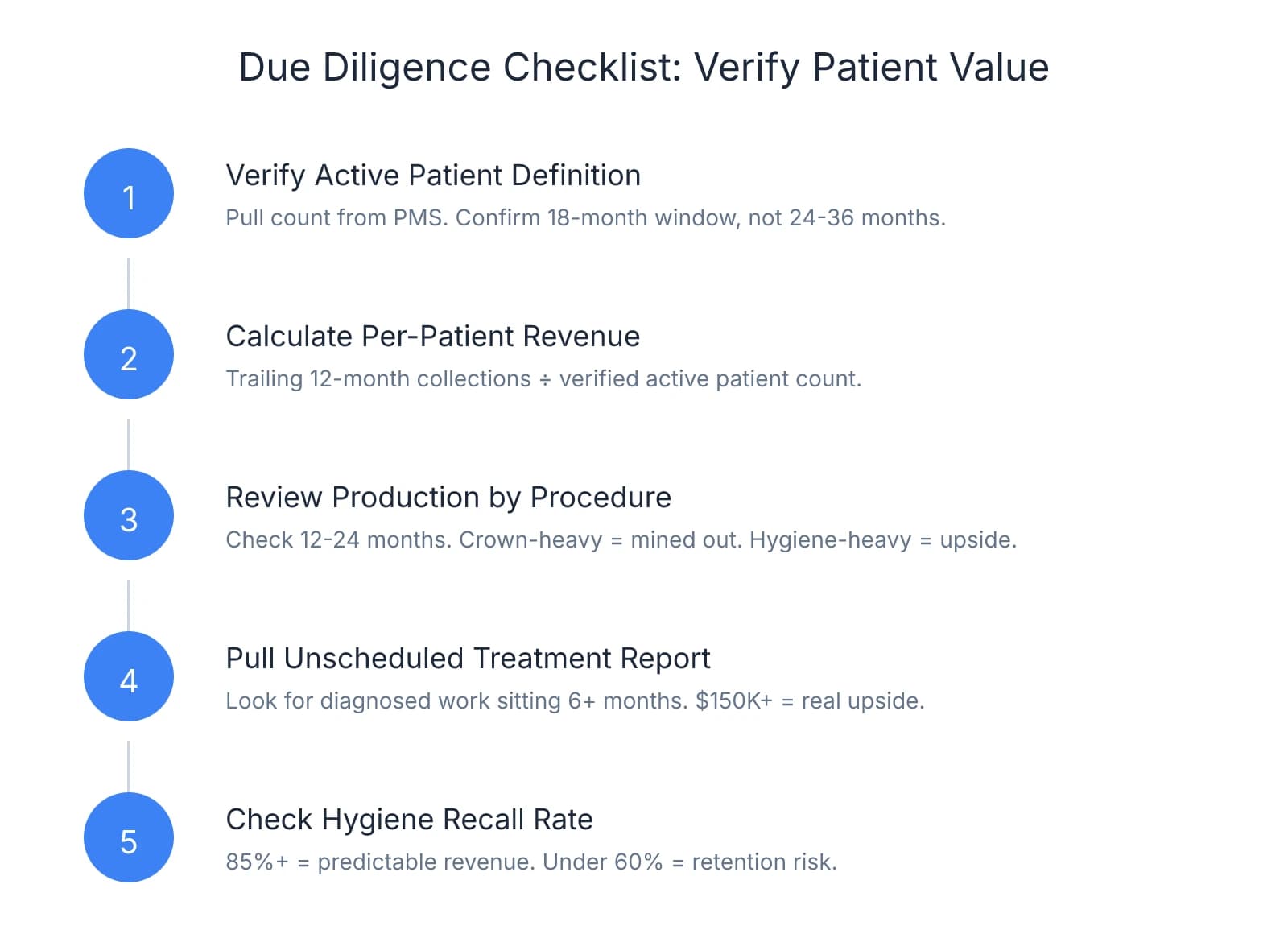
Verify the active patient definition. Pull the active patient count directly from the practice management software and confirm how "active" is defined. Most systems default to patients seen within 18 months, but some sellers stretch this to 24 or even 36 months to inflate the count. A practice claiming 2,200 active patients under a 36-month window might only have 1,400 patients seen in the past 18 months—which changes your per-patient calculation immediately.
Calculate per-patient annual revenue. Take the trailing twelve-month collections figure and divide by the verified active patient count. If the practice collected $850K and has 1,600 active patients (18-month definition), that's $531 per patient annually. This becomes your baseline for evaluating whether the patient base is productive, exhausted, or under-utilized.
Review the production by procedure report. Per-patient revenue alone doesn't tell you whether the practice has growth potential or has already extracted most of the value. Pull the last 12-24 months of production data and break it down by procedure category: preventive/hygiene, restorative (fillings, crowns), endo, surgery, and cosmetic. A practice generating $750 per patient with 60% of production coming from crowns and bridges in the past year likely just completed a wave of major restorative work—those patients won't need another crown for 10-15 years. Compare that to a practice at $550 per patient where 70% of production is hygiene and basic restorative—there's likely unscheduled treatment sitting in the charts.
One pattern worth paying attention to: practices with 2,500+ patients collecting under $600K often haven't archived inactive records in years. According to Dental Buyer Advocates, this scenario typically signals that "the office hasn't archived inactive patients in years and the seller doesn't even have a rough idea of how many people are walking through his door." The inflated count isn't necessarily deceptive—it's often just poor database hygiene—but it means you're not buying the patient volume the listing suggests.
Another red flag surfaces when per-patient revenue exceeds $800 and the production mix is heavily weighted toward crowns, endo, and extractions completed in the past 12-18 months. This often indicates the seller ramped up treatment before listing the practice—either to boost collections for valuation purposes or because they knew they were exiting. The result is a patient base with limited near-term restorative needs. You'll maintain hygiene revenue, but the high-margin procedures that drove the valuation may not recur for years.
The opportunity signal you're looking for: moderate per-patient revenue in the $450-$600 range, combined with documented unscheduled treatment or low hygiene pre-booking rates. Pull the unscheduled treatment report from the practice management system and look for patients with diagnosed but unaccepted treatment plans. If the practice has $200K+ in unscheduled treatment and hygiene recare is only 40-50% pre-booked, that's upside you can capture through better systems and case presentation.
Before you move forward with an offer, cross-reference these calculations with the practice's stated growth potential. If the seller or broker claims "you can easily increase collections by reaching out to inactive patients," but the per-patient revenue is already $700+ and production is crown-heavy, the math doesn't support that narrative. Conversely, if per-patient revenue is $480 and the unscheduled treatment report shows significant diagnosed work, the growth story may be legitimate—but only if you're prepared to implement the systems the current owner hasn't.
Why Patient Count Alone Doesn't Tell the Story
Two practices with identical patient counts can have valuations that differ by $200K or more—and the difference comes down to what those patients actually produce. A practice with 1,500 patients generating $900K in collections ($600 per patient) looks fundamentally different from one with 2,000 patients generating the same $900K ($450 per patient). The first suggests strong per-patient productivity but requires you to determine whether that level is sustainable. The second signals lower per-patient productivity but potentially more room for growth if you can improve case acceptance or identify unscheduled treatment.
What trips up most buyers: assuming more patients automatically means more value. A practice listing 2,200 patients with $650K in collections isn't necessarily a better buy than one with 1,400 patients at the same revenue. The larger patient count might include 600-800 inactive records that haven't been archived, inflating the base without adding actual production capacity. When you filter to patients seen in the past 18 months, the count often drops by 30-40%, and suddenly the per-patient math looks very different.
Patient retention rate matters more than raw count. A practice with 1,800 patients and an 85% hygiene recall rate is generating predictable, recurring revenue. Compare that to a practice with 2,200 patients and a 60% recall rate. The larger base looks appealing until you realize that 880 of those patients aren't returning for preventive care, which means they're unlikely to schedule restorative work either. Retention directly impacts how many patients leave after you take over, and a low recall rate before the transition amplifies that risk.
One pattern that surfaces repeatedly: practices with high per-patient revenue but limited future opportunity. If a practice is generating $750 per patient and you pull the production report to find that 55% of last year's revenue came from crowns, bridges, and implants, that's a signal the seller has been aggressive with restorative treatment. Those patients won't need another crown for 10-15 years. The patient count looks strong, but the revenue potential has already been extracted.
The inverse scenario—lower per-patient revenue with significant upside—requires more diligence but often represents better long-term value. A practice collecting $480 per patient with 70% of production coming from hygiene and basic restorative work likely has unscheduled treatment sitting in the charts. If the practice has $150K+ in unscheduled work and hygiene recare is only pre-booked at 45%, that's upside you can capture through better case presentation, financing options, and recall systems.
Where sellers inflate counts—intentionally or not—is by never archiving inactive patients. When a practice reports 3,000+ patients but collections are only $500K, the actual active patient base is far smaller than advertised. Verify the active patient definition during due diligence: pull a report filtered to patients seen in the past 18 months and compare it to the broker packet. If the count drops by 40%, your per-patient revenue calculation just changed, and so did the practice's growth potential.
The framework that cuts through the noise: calculate per-patient revenue, then assess whether that number reflects sustainable production or a base that's been mined out. Patient count is a lagging indicator. What matters is what those patients will produce under your ownership—and whether the seller has already captured that value or left it for you to realize.
Using Per-Patient Metrics to Negotiate and Structure Your Offer
Per-patient revenue becomes leverage once you understand what's driving it. A practice generating $750 per patient with recent heavy crown and implant work should trigger a conversation about valuation adjustments or earnout structures—you're buying maintenance revenue, not growth potential. A practice at $420 per patient with claims of "huge upside" requires chart audits and unscheduled treatment reports before you pay for hypothetical opportunity.
When per-patient revenue exceeds $700 and production is crown-heavy, consider negotiating a lower multiple or earnout structure. Pull the last 24 months of production by procedure and calculate what percentage came from crowns, bridges, implants, and endo. If 50%+ of collections in the past 18 months came from major restorative work, those patients won't need another crown for a decade. One protection many buyers use: structure part of the purchase price as an earnout tied to first-year collections. If the practice maintains $900K in year one, the earnout pays. If collections drop to $650K because the restorative wave is over, you're not overpaying for revenue that evaporated the day you took over.
Where bank appraisals often come in lower than asking price is when the appraiser sees this pattern and adjusts the valuation downward. If you're seeing the same red flags the appraiser will catch, negotiate the adjustment before the appraisal forces it—you'll have more control over the structure and avoid renegotiating under time pressure.
If per-patient revenue sits below $400 and the seller claims untapped potential, verify with chart audits and unscheduled treatment reports. A practice collecting $480K with 1,400 patients ($343 per patient) might genuinely have $150K in unscheduled treatment sitting in the charts—or it might just have poor case acceptance. Request access to the practice management system during due diligence and pull the unscheduled treatment report. Look for diagnosed treatment that's been sitting for 6+ months without follow-up. If the report shows significant diagnosed work but no documented patient communication or financing discussions, that's upside you can capture.
One question worth asking: why didn't the seller capture this revenue themselves? If the answer is "I didn't have time" or "I wasn't focused on case presentation," that's plausible—but only if the practice's systems support your ability to do better. If the answer is "patients here just don't accept treatment," that's a market signal, not a systems problem.
Use per-patient revenue to stress-test your first-year projections. Take the verified active patient count, multiply by your realistic per-patient revenue under your clinical style, and see if the result supports the debt service and take-home pay you're planning for. If the practice has 1,600 active patients and you're producing $550 per patient as an associate, your first-year collections ceiling is around $880K—not the $950K the seller was hitting at $594 per patient. That $70K difference changes your cash flow projections.
Many buyers assume they'll match the seller's per-patient productivity immediately, but that rarely happens. A more realistic assumption: plan for 85-90% of the seller's per-patient revenue in year one, then build from there. If the gap between your current production per patient and the seller's is wider than 15-20%, understand why before assuming you'll close it.
Patient lifetime value (PLV) benchmarks for general dentistry range from $5,000-$15,000, according to Dental Strategic, but acquisition value focuses on near-term cash flow, not lifetime potential. A patient worth $12,000 over 15 years is only worth what they'll produce in the first 3-5 years under your ownership—and that's the window your lender and valuation are based on. The seller's asking price should reflect near-term revenue, not the theoretical lifetime value of the patient base.
The framework that keeps offers grounded: calculate per-patient revenue, assess whether it's sustainable or inflated, then model your first-year collections based on your own production style and realistic patient retention. If the math doesn't support the asking price, negotiate a lower multiple or structure part of the purchase as an earnout tied to performance. If the practice genuinely has upside—documented unscheduled treatment, low recall rates you can improve, or a fee-for-service opportunity in a PPO-heavy base—that's value you can capture, but only if you're prepared to implement the systems the seller didn't. Per-patient metrics don't just inform your offer—they tell you whether the deal makes sense at all.
Sources & References
The data and claims in this article are drawn from the following sources. We prioritize government data, peer-reviewed research, and established industry publications to ensure accuracy.
- Evaluating Active Patients in Dental Practice Valuations— www.dentalbuyeradvocates.comIndustry
- How to Determine the Value of a Dental Patient - Dental Strategic— dentalstrategic.comIndustry
Frequently Asked Questions
Ready to value your dental practice accurately?
Understanding patient base valuation is crucial when buying or selling a dental practice. Minty Plus provides expert guidance on practice acquisition and valuation to help you make informed decisions.