How Long After Buying a Dental Practice Can You Sell It?

Co-Founder, Minty Dental
In Summary
- No law prevents you from selling a dental practice immediately after buying it, but the timing determines how much of the sale proceeds you actually keep
- The IRS taxes profits from assets held less than 12 months as ordinary income at rates up to 37%, compared to the 15-20% long-term capital gains rate for assets held longer than a year
- Most SBA and conventional practice loans include due-on-sale clauses or prepayment penalties that can trigger significant costs if you sell within the first 3-5 years
- Practices rarely appreciate during the first 1-2 years of ownership—most new owners are still stabilizing operations, not building measurable equity that would justify a profitable resale
No Legal Minimum, But Real Financial Consequences
You can sell a dental practice the day after you close on it. There's no statutory holding period, no regulatory waiting window, and no industry rule that forces you to operate for a minimum number of years before listing.
That freedom doesn't mean the decision is financially neutral. Three constraint categories determine whether a quick resale makes sense or costs you money: tax treatment, lender agreements, and the timeline required to build sellable equity. Each operates independently, but together they create a financial structure that penalizes early exits—not through prohibition, but through measurably worse outcomes.
Tax treatment shifts dramatically at the 12-month mark. The IRS taxes profits from assets held less than a year as ordinary income, which means capital gains on a quick flip face rates up to 37% instead of the 15-20% long-term rate that applies after 12 months. If you bought a practice for $800,000 and sold it 10 months later for $850,000, that $50,000 gain gets taxed at your marginal income rate. The difference between a 37% hit and a 20% hit is $8,500 on a $50,000 gain—the cost of selling 60 days too early.
Lender agreements often include exit penalties that aren't obvious at closing. Many SBA 7(a) loans and conventional practice loans carry due-on-sale clauses or prepayment penalties that trigger if you sell within the first 3-5 years. A due-on-sale clause means the full loan balance becomes immediately due when ownership transfers—forcing you to either pay off the loan in full or negotiate a release with the lender. Prepayment penalties, common in the first few years of a loan term, can range from 1-3% of the outstanding balance. On a $600,000 loan with a 2% penalty, that's $12,000 you're handing back just to exit early.
Equity-building timelines work against early resales. Practices don't appreciate during the stabilization phase—most buyers spend the first 12-24 months maintaining patient retention, integrating into the community, and learning the operational rhythms that drive profitability. Revenue might hold steady or dip slightly as patients adjust to the new owner. Unless you're actively growing the patient base, renegotiating payer contracts, or expanding services, the practice you're selling in year one looks nearly identical to the one you bought. Buyers won't pay a premium for a practice that hasn't changed, which means your sale price will likely mirror what you paid—minus transaction costs, which can run 8-12% of the sale price when you factor in broker fees, legal costs, and valuation work.
The 12-Month Tax Threshold and Why It Matters
Holding period: The IRS measures from your closing date to your sale date. Sell one day before the 12-month anniversary and the entire gain gets taxed as ordinary income.
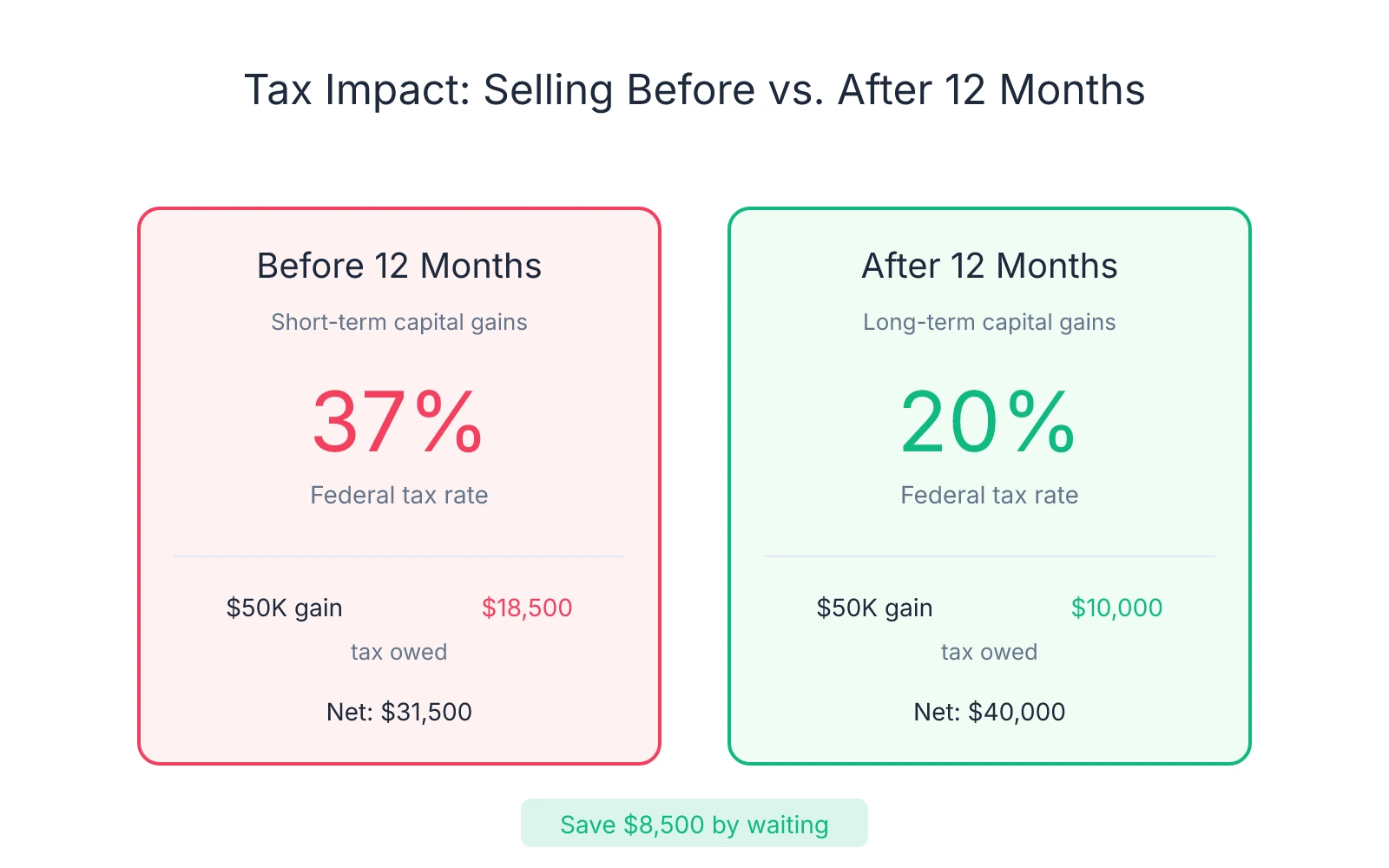
The distinction matters because ordinary income rates climb as high as 37% at the federal level, while long-term capital gains top out at 20% for most high-income professionals. That 17-percentage-point spread translates directly into how much of your sale proceeds you keep versus how much you send to the IRS.
Here's the calculation on a straightforward transaction: You buy a practice for $750,000 and sell it 10 months later for $800,000. The $50,000 gain is short-term, taxed at your marginal rate. If you're in the 35% federal bracket, you owe $17,500 in federal tax. Wait four more months—crossing the 12-month threshold—and that same $50,000 gain gets taxed at the 20% long-term rate. Your federal bill drops to $10,000. The difference is $7,500, or 15% of your entire gain, lost purely to timing.
State taxes compound the problem in high-tax jurisdictions. California adds 13.3% on capital gains. New Jersey adds 10.75%. New York adds 10.9%. These rates apply to both short-term and long-term gains, but when you're already paying 37% federally on a short-term sale, the combined rate in California hits 50.3%. Cross the 12-month mark and your combined rate drops to 33.3%—a 17-point improvement that keeps an additional $8,500 on a $50,000 gain.
One complication that applies regardless of holding period: depreciation recapture. If you've been depreciating equipment, leasehold improvements, or other tangible assets during your ownership, the IRS recaptures that depreciation as ordinary income when you sell—even if you've held the practice for years. Depreciation recapture is taxed at up to 25%, separate from the capital gains calculation. On a practice with $100,000 in accumulated depreciation, that's a $25,000 tax bill that hits whether you sell in month 10 or month 24.
The 12-month threshold isn't arbitrary—it's the IRS's way of distinguishing between investors flipping assets for quick profit and owners building long-term value. The tax code rewards the latter.
Where buyers often miscalculate is assuming the threshold applies to when they made an offer or signed an LOI. It doesn't. The clock starts on the closing date—the day ownership legally transfers and you take possession. If you closed on March 15, 2025, you need to hold until March 16, 2026 to qualify for long-term treatment. Selling on March 14, 2026 costs you the preferential rate, even if you've been operating the practice for 364 days.
One scenario where the 12-month rule creates real tension: a buyer who realizes within the first year that the practice isn't a fit—patient base is declining faster than expected, staff turnover is unsustainable, or the location isn't viable long-term. Waiting another few months to cross the tax threshold might feel irrational if the practice is losing value. In those cases, the tax cost of selling early becomes the price of cutting losses before they compound.
Lender Restrictions, Prepayment Penalties, and Due-on-Sale Clauses
Most buyers assume their loan agreement governs monthly payments and interest rates. What they miss: many practice loans also govern when and how you can exit. The terms that matter most for early resales—due-on-sale clauses, prepayment penalties, and change-of-ownership provisions—sit buried in loan documents that most borrowers skim at closing.
Due-on-sale clauses: The most common restriction in dental practice loans. A due-on-sale clause requires full repayment of the outstanding loan balance if ownership transfers within a specified period—typically 3-5 years from origination. The clause doesn't prevent you from selling. It just means the loan can't transfer with the practice. You either pay off the balance in full at closing, or the buyer secures their own financing and uses part of the purchase price to satisfy your loan. On a $700,000 loan with $650,000 still outstanding, that's $650,000 that has to come out of the sale proceeds before you see a dollar.
Where this creates friction: if your sale price is close to what you paid and you haven't built meaningful equity, the loan payoff can consume most or all of the proceeds. Sell a $750,000 practice for $775,000 after two years, and after paying off $650,000 in debt, you're left with $125,000 before transaction costs. Subtract 10% for broker fees, legal work, and valuation, and you're walking away with $47,500—less than the down payment you likely made at purchase.
Not all lenders enforce due-on-sale clauses aggressively. Some allow loan assumption, where a qualified buyer takes over your existing loan rather than securing new financing. Assumption keeps your interest rate and loan terms intact, which can be attractive if rates have risen since you borrowed. The catch: assumption requires lender approval, a creditworthiness review of the buyer, and often extends the closing timeline by 60-90 days while the lender underwrites the new borrower.
Prepayment penalties: A separate cost that applies even if you're paying off the loan voluntarily. Many practice loans include prepayment penalties during the first 3-5 years, structured as a percentage of the remaining balance—commonly 1-3%, though some lenders use a sliding scale that decreases over time. On a $600,000 loan with a 2% penalty, that's $12,000 you're paying just to exit early.
The penalty structure varies by lender and loan product. SBA 7(a) loans, which many buyers use for practice acquisitions, typically don't include prepayment penalties—one reason they're popular for buyers who value flexibility. Conventional bank loans, however, often do. If you financed through a regional bank or a lender that specializes in healthcare practice loans, check your loan agreement for a prepayment schedule. The penalty usually phases out over time—3% in year one, 2% in year two, 1% in year three, then zero after that.
SBA loan provisions: If you financed with an SBA 7(a) loan, change-of-ownership provisions add another layer. SBA loans require lender approval for any ownership transfer, even if the loan is assumable. The SBA wants to ensure the new owner meets creditworthiness standards and that the practice remains viable under new management. This approval process can take 30-60 days and requires the buyer to submit financials, tax returns, and a business plan.
Before you list a practice for sale, pull your loan documents and identify three things: whether a due-on-sale clause applies, what prepayment penalties are in effect, and whether your loan allows assumption. If you financed through an SBA 7(a) loan, contact your lender to confirm the change-of-ownership process and timeline. These aren't deal-breakers, but they are costs and delays that affect your net proceeds and your buyer's willingness to close. Knowing them before you list gives you time to structure the sale in a way that minimizes both. For practices financed through conventional banks specializing in dental practice loans, lenders may provide up to 100% financing, which affects both the initial acquisition structure and the complexity of early exit scenarios.
How Long It Actually Takes to Build Resale Value
Even if tax treatment and lender terms don't block an early exit, the economics of practice ownership work against quick resales. Most practices don't appreciate during the first 1-3 years under new ownership—not because buyers are doing anything wrong, but because the work required to stabilize operations, retain patients, and demonstrate consistent performance takes time.
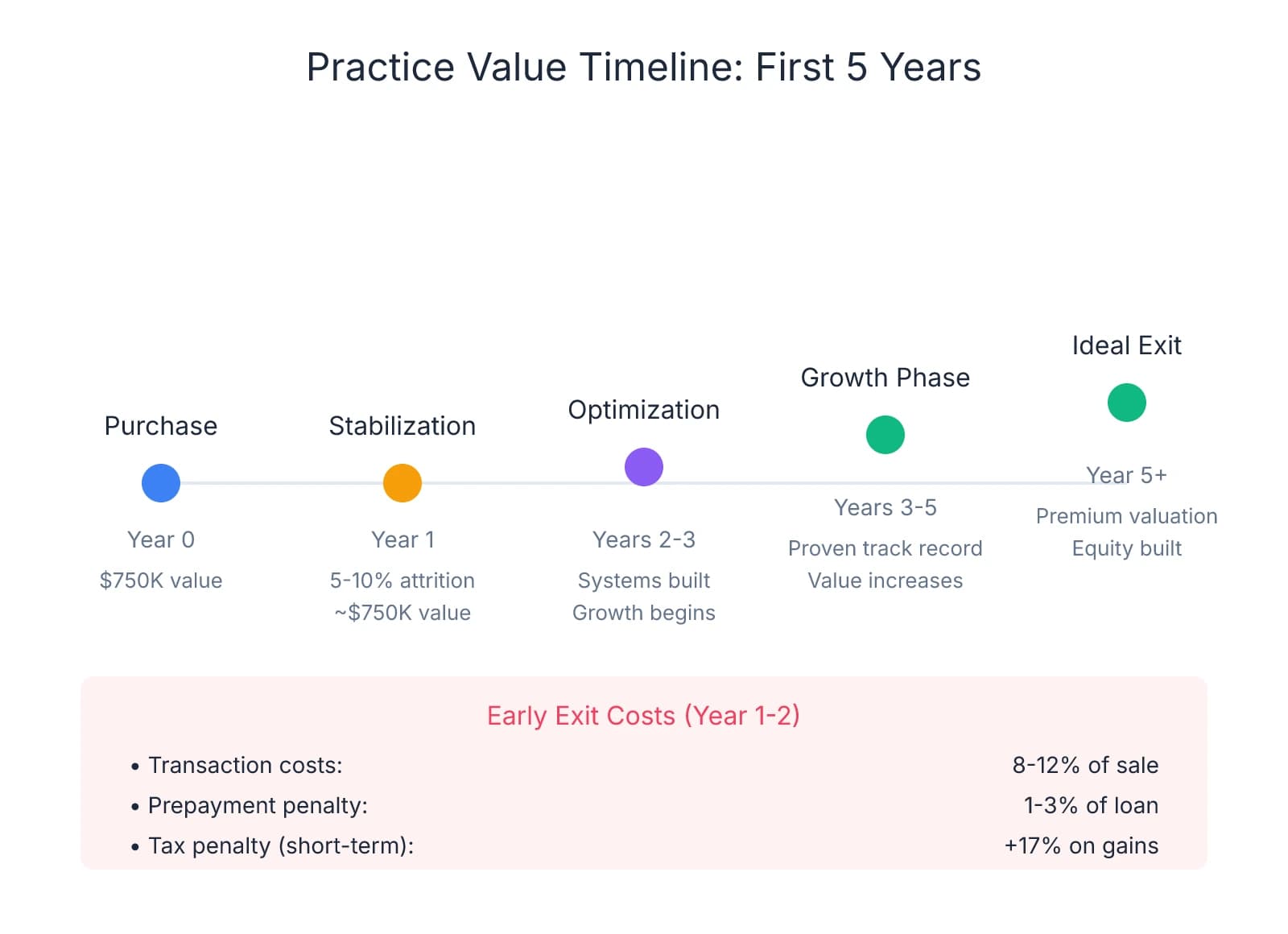
Year one is survival and stabilization, not growth. The first 12-18 months after closing, most new owners are focused on preventing attrition, learning the practice's operational rhythms, and maintaining the patient relationships the seller built. Patient attrition typically runs 5-10% in the first year after a sale, even when the transition is well-managed. Collections often dip slightly during this period—not catastrophically, but enough that year-one financials rarely show improvement over the seller's final year.
Where this affects resale value: buyers evaluate practices based on consistent financial performance, typically reviewing 2-3 years of tax returns and P&L statements. If you're selling after 18 months, you have one full year of records under your ownership—maybe less if you're listing before you've filed a complete tax return. That single year of data doesn't demonstrate stability. It shows a practice in transition. Buyers discount for uncertainty, which means your asking price will reflect the risk that your brief ownership period introduced volatility the next buyer will need to manage.
The factors that drive resale value take 3-5 years to build and prove. Practices appreciate when they demonstrate attributes buyers are willing to pay a premium for: year-over-year revenue growth, strong hygiene production ratios, low owner dependency, and documented systems that reduce operational risk. None of these materialize quickly.
Revenue growth requires either expanding the patient base, increasing case acceptance, or adding services—all of which take 18-24 months to implement and another 12 months to show up as a trend in your financials. If you're selling in year two, you might have one year of modest growth, but that's not enough to justify a valuation premium. Buyers want to see a pattern, not a single data point.
Owner dependency—the degree to which the practice's revenue relies on the owner's clinical production—decreases when you've built a referral base, established the practice's reputation independent of the previous owner, and created systems that allow the practice to function without your constant presence. Reducing owner dependency is one of the most valuable improvements you can make, but it requires years of consistent patient experience and community presence.
Practices are valued on trailing performance, not future potential. When a buyer evaluates your practice, they're looking at what the practice has done, not what you believe it could do. If you bought at $750,000 and spent two years maintaining revenue at $650,000 annually, your practice is still worth approximately $750,000—maybe less if patient attrition or staff turnover introduced risk. You haven't built equity. You've preserved what the seller built, which is valuable for your own income but doesn't translate into resale appreciation.
Where buyers often miscalculate: assuming that cosmetic improvements—new equipment, updated operatories, a refreshed website—will drive resale value. These upgrades improve patient experience and can support future growth, but they don't change the practice's financial performance in the short term. A buyer evaluating your practice will see the improvements, appreciate them, and then base their offer on trailing collections and profitability. If those numbers haven't moved, neither will your valuation.
Selling before you've built equity means you're exiting at wholesale. Transaction costs on a practice sale typically run 8-12% of the purchase price when you include broker commissions (usually 8-10%), legal fees, valuation work, and closing costs. On a $750,000 sale, that's $60,000-$90,000 in expenses. If you're selling at the same price you paid, those costs come directly out of your proceeds. After paying off your loan balance and covering transaction expenses, you might walk away with less than your original down payment—even if the practice performed exactly as expected.
The timeline that makes sense for most buyers: hold for at least 3-5 years, focus the first 18 months on stabilization, spend years 2-3 optimizing operations and growing revenue, and consider resale only after you've demonstrated consistent performance that justifies a valuation above what you paid.
Sources & References
The data and claims in this article are drawn from the following sources. We prioritize government data, peer-reviewed research, and established industry publications to ensure accuracy.
- DSOs Present Challenges for Dental Practices Seeking COVID-19 ...— ddslawyers.comIndustry
- Tax Consequences of Selling a Dental Practice: Guide | LPS— largepracticesales.comIndustry
- Negotiating the Sale of a Dental Practice - DDS Lawyers— www.ddslawyers.com
- Financing for Dental Practices Today - ADS Transitions— www.adstransitions.com
- What to Do When Selling a Practice | American Dental Association— ada.orgIndustry
- Dental Practice Goodwill: How to Identify, Measure, and Value It | CBIZ— www.cbiz.comIndustry
Frequently Asked Questions
Ready to acquire your next dental practice?
Understanding resale timelines is crucial when planning your practice acquisition strategy. Minty's buying guidance helps you navigate the entire acquisition process—from identifying the right opportunity to closing—so you can build a practice positioned for long-term success or strategic exit.