Should You Wait to Buy a Dental Practice Until Interest Rates Drop?

Co-Founder, Minty Dental

In Summary
- Dental practice loan rates in 2026 sit between 7-10%—higher than 2020-2021 but down from recent peaks
- A 2-3 point rate increase on an $800K loan adds roughly $1,000-1,500 monthly, but strong practice fundamentals matter more than the rate itself
- Waiting for lower rates means forfeiting $300,000-450,000 in equity accumulation over three years while optimizing for $20,000-30,000 in potential interest savings
- Qualified buyers still access 100% financing when practice cash flow supports it, and refinancing later captures rate drops without delaying ownership
- The practices worth owning still attract multiple offers—higher rates filter out marginal buyers but don't eliminate competition for quality opportunities
Higher Rates Change the Payment, Not the Decision
Current dental practice loan rates range from 7-10% in 2026—higher than the sub-5% environment of 2020-2021, but down from recent peaks above 7%. The payment impact is narrower than most buyers assume.
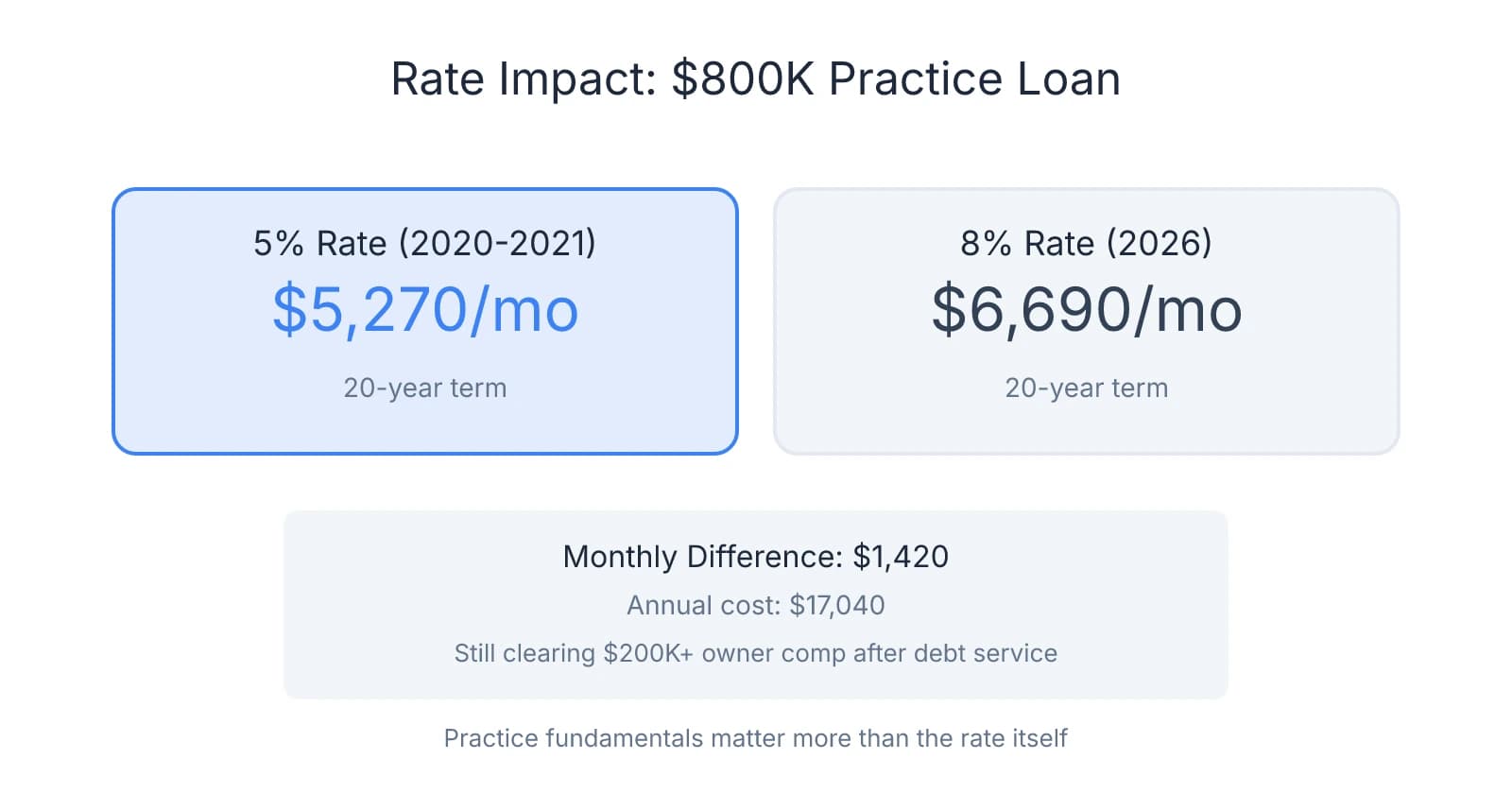
On a typical $800,000 practice acquisition, 5% costs roughly $5,270 monthly over 20 years. At 8%, that same loan runs about $6,690 per month—a difference of $1,420, or $17,040 annually. Not trivial, but also not the determining factor in whether ownership makes financial sense.
What matters more is whether the practice generates enough cash flow to cover debt service and pay you competitively. A well-run practice collecting $800,000 annually with 65% overhead leaves roughly $280,000 in owner compensation and profit before debt service. After the $6,690 monthly payment at 8%, you're still clearing over $200,000 annually—significantly more than most associate positions pay, even accounting for benefits.
Buyers get stuck treating the rate as the decision point rather than one variable in a larger equation. A practice with strong patient retention, efficient systems, and stable staffing can support higher debt service. A practice with declining collections, high turnover, or deferred equipment needs becomes risky at any rate. The fundamentals determine whether the deal works—the rate just adjusts the margin.
Lenders still offer 100% financing for qualified buyers when practice cash flow supports it. Your credit score, debt-to-income ratio, and the practice's historical performance matter more than the rate environment. A buyer with a 750+ credit score and minimal existing debt can access full financing at 7.5-8.5% in 2026. A buyer with $400,000 in student loans and a 680 credit score will face higher rates or down payment requirements regardless of where the Fed sets policy.
The down payment question hasn't changed across rate cycles. If the practice is priced appropriately and the numbers work, lenders finance the full purchase price. If the deal is marginal—thin cash flow, high seller compensation, questionable adjustments—you'll need skin in the game whether rates are at 5% or 9%.
What changes in higher-rate environments is the margin for error. A practice that barely covers debt service at 5% becomes unworkable at 8%. But a practice with strong cash flow and room for growth remains sound even when rates climb. Buyers who wait for perfect rate conditions often miss this distinction—they're optimizing for the wrong variable while the right practices move to others who understand the broader picture.
The Equity You're Not Building While You Wait
The cost of waiting isn't just the interest rate you might save—it's the equity you forfeit every year you remain an associate. That gap compounds faster than most buyers realize.
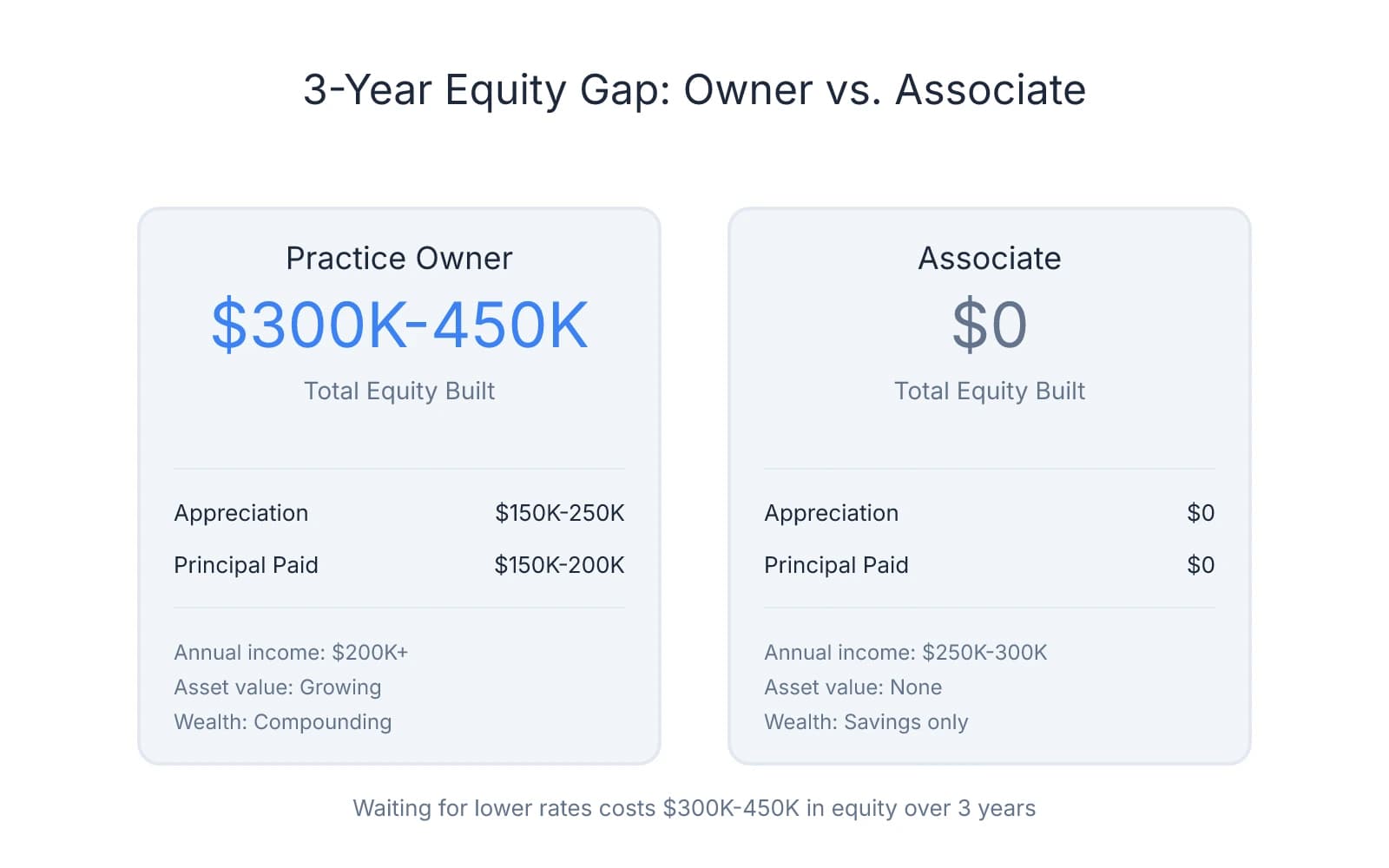
Consider a $900,000 practice today. Over three years of ownership, two wealth-building mechanisms run simultaneously: the practice appreciates in value, and you pay down the acquisition loan. Dental practices typically appreciate 3-5% annually when maintained well, which means that $900,000 practice could be worth $1,050,000 to $1,150,000 in three years. At the same time, you're paying down roughly $50,000-65,000 in loan principal each year through normal debt service. By year three, you've built $150,000-200,000 in equity through principal reduction alone.
Add those together. Three years of ownership on a $900,000 practice generates $300,000-450,000 in total equity gain—$150,000-250,000 from appreciation, plus $150,000-200,000 from principal paydown. That's wealth you own, not income that disappears when you stop working.
Compare that to three years as an associate. You earn a salary, maybe $250,000-300,000 annually if you're productive. But when those three years end, your net worth from clinical work is exactly what you saved and invested from that income. No asset appreciated. No loan balance decreased. No equity position compounds independent of your daily production.
The wealth gap between owners and high-earning associates widens most dramatically in years 3-7 of ownership, when practice appreciation and debt reduction start compounding together. An associate earning $280,000 might out-earn a new owner in year one when you account for debt service and startup costs. By year five, the owner has built $400,000-600,000 in equity while the associate has built zero—even if the associate saved aggressively and invested well.
That's the trap of waiting for perfect conditions. You're optimizing for a 2% rate difference—maybe $20,000-30,000 in interest savings over three years—while forfeiting $300,000-450,000 in equity accumulation during that same period. The math doesn't justify the delay unless you genuinely believe practice values will drop by 20-30% in the next few years, which would require a fundamental collapse in demand for dental services.
One pattern worth noting: buyers who wait for lower rates often face higher purchase prices when they finally move. If rates drop from 8% to 6%, more buyers enter the market, competition for quality practices increases, and sellers price accordingly. You might save $1,200 per month in debt service, but if the same practice now costs $950,000 instead of $900,000, you've erased most of that savings and delayed three years of equity growth in the process.
The question isn't whether rates will drop—they probably will at some point. The question is whether the opportunity cost of waiting exceeds the interest savings you might capture later. For most buyers evaluating practices with strong fundamentals, the equity you're not building while you wait is the larger financial risk.
What You're Competing Against While Rates Are High
The assumption that higher rates thin out buyer competition doesn't match what's happening in the market. Qualified buyers are still actively pursuing practices, and the practices worth owning still attract multiple offers.
Lenders continue to provide 100% financing for qualified buyers when practice fundamentals are strong. A buyer with solid credit, manageable debt-to-income ratios, and a practice generating consistent cash flow can still access full purchase price financing at current rates. Banks understand that a well-run practice collecting $850,000 annually with 65% overhead can support an 8% loan just as reliably as it could support a 5% loan—the monthly payment changes, but the fundamental ability to service debt remains intact.
That means your competition isn't just the rare buyer with cash reserves or family backing. It's every qualified associate who's done the math and recognized that refinancing options exist later. Buyers who understand this view current rates as temporary. They're willing to accept an 8% rate today because they know they can refinance to 6% in two or three years if conditions shift—and in the meantime, they're building equity and controlling their income rather than waiting on the sideline.
The demographic pressure on the seller side hasn't eased. More than 40% of practicing dentists in the United States are now age 55 or older, which means sustained practice inventory as Baby Boomer dentists move toward retirement. That sounds like a buyer's market—more supply should mean less competition and better pricing. But quality practices with strong patient bases, modern systems, and stable staffing still generate competing offers. The increased inventory mostly affects marginal practices—the ones with declining collections, deferred maintenance, or operational issues that make financing difficult.
If you're evaluating a well-run practice in a desirable location, you're not competing against fewer buyers just because rates are higher. You're competing against buyers who recognize that the fundamentals matter more than the rate, and who are willing to move quickly when they find the right opportunity. Buyers lose out when they assume they have more time to decide because "no one else will pay these rates."
The risk of waiting becomes clearer when you consider what happens if rates drop significantly. Lower rates don't just reduce your monthly payment—they bring more buyers into the market, intensify competition, and push purchase prices higher. A practice listed at $850,000 today might command $920,000 or more in a 6% rate environment, as buyers who were previously priced out suddenly qualify for larger loans. The interest savings you gain from the lower rate get partially or fully offset by the higher purchase price, and you've lost 1-2 years of equity accumulation while you waited.
The practices available today may not be available when rates drop. Sellers don't wait indefinitely for perfect market conditions—they retire, relocate, or shift to other plans. A practice that fits your clinical interests, geographic preferences, and financial criteria is a specific opportunity, not a commodity you can find again later.
One pattern many buyers overlook: the competition you face today is more informed than it was five years ago. Associates have access to better data, clearer financing options, and more transparent market information. The buyers you're up against have likely run the same calculators and consulted the same advisors. They know that losing a bidding war doesn't mean the market is overheated—it means they found a practice other qualified buyers also recognized as solid.
The takeaway isn't that you should panic or overbid. It's that rate-driven timing strategies often misread the competitive landscape. You're not waiting for an empty market—you're waiting for a more crowded one, with higher prices and fewer quality options. Buyers who succeed in this environment evaluate practices on cash flow, growth potential, and operational strength, then move decisively when those fundamentals align. The rate is a variable you manage through refinancing later, not a reason to delay ownership when the right practice appears.
Refinancing Gives You a Second Chance at Lower Rates
The strategic option most buyers overlook when fixating on current rates: you can refinance a dental practice loan when rates drop, just like a mortgage. This isn't theoretical—it's a standard mechanism that removes most of the financial risk from buying at higher rates.
Dental practice loans typically carry minimal or no prepayment penalties when structured correctly. Most lenders understand that practice owners may want to refinance as market conditions change. Before signing any acquisition financing, verify the prepayment language—specifically whether early payoff triggers penalties and under what conditions. A loan with a prepayment penalty of 2-3% in the first three years is still refinanceable, you just need to factor that cost into the savings calculation.
The threshold where refinancing makes financial sense sits around a 1.5-2 percentage point rate reduction. Below that, closing costs and administrative effort often exceed the monthly savings. Above that threshold, the math starts working clearly in your favor. Consider a $750,000 loan at 8.5% with 18 years remaining. Refinancing to 6.5% saves roughly $850-950 per month in debt service, or $10,200-11,400 annually. Closing costs on a practice loan refinance typically run $8,000-12,000, which means you recover those costs in the first year and capture pure savings afterward.
Even a modest rate reduction on a larger loan generates meaningful cash flow improvement. A $900,000 loan refinanced from 8% to 6.5% saves approximately $1,100-1,300 monthly—funds that can go toward equipment upgrades, associate hiring, or simply improving your personal cash flow. That's the compounding benefit of buying now and refinancing later: you capture both the equity-building years and the eventual rate benefit, rather than sitting on the sideline capturing neither.
The refinancing process itself carries relatively low friction compared to the original acquisition loan. You're not proving practice viability from scratch—you have 2-3 years of operational history under your ownership, demonstrable cash flow, and an established relationship with the practice. Lenders view refinances as lower risk than acquisitions, which often translates to faster approval timelines and less invasive underwriting. The process typically closes in 45-60 days rather than the 90-120 days common for acquisition financing.
Where buyers sometimes miscalculate is assuming rates will drop quickly or dramatically. The Federal Reserve adjusts rates based on inflation, employment, and broader economic conditions—not dental practice affordability. Rates could decline gradually over 3-5 years, remain elevated longer than expected, or even rise again if inflation pressures return. The point isn't to predict rate movements accurately; it's to recognize that refinancing gives you optionality regardless of when or how much rates shift.
One pattern worth noting: practices that barely support debt service at 8% often don't improve enough through refinancing to justify the original purchase. If your practice is generating $800,000 in collections with 70% overhead, refinancing from 8% to 6% saves you roughly $900 monthly—helpful, but not transformative if the underlying practice economics are weak. Refinancing works best when you bought a fundamentally sound practice that can support current debt service, and the rate reduction simply improves an already viable financial position.
The decision framework comes down to a single question: does this practice generate enough cash flow to cover debt service and pay you competitively as an owner at current rates? If yes—if the practice clears $200,000+ in owner compensation after an 8% loan payment, maintains strong patient retention, and operates with efficient systems—then the timing is right regardless of rate forecasts. You buy now, build equity immediately, and refinance later if rates drop meaningfully. If no—if the practice barely breaks even at current rates, requires significant operational fixes, or depends on aggressive growth projections to work financially—then waiting for lower rates won't fix the fundamental problem.
Refinancing isn't a guarantee, but it's a realistic option that removes the primary argument for waiting. Buyers who succeed in any rate environment evaluate practices on collections, profits, and operational fundamentals, then use refinancing as a tool to optimize their position over time. The rate you start with matters less than the equity you build while you own the practice—and that equity accumulation starts the day you close, not the day rates hit some theoretical ideal. While rate cuts may open a window for refinancing, the opportunity depends more on broader bond market conditions than Fed announcements alone.
Sources & References
The data and claims in this article are drawn from the following sources. We prioritize government data, peer-reviewed research, and established industry publications to ensure accuracy.
- Dental Practice Loans And Financing Options [2026 Guide]— dentalpracticeinsider.orgIndustry
- Equity Owners vs. High Earners: Why Ownership Builds Greater ...— engageadvisors.comIndustry
- What the Data Says About Today's U.S. Dental Practice Market— www.aftco.net
- Delay Dental Practice Purchase Because of High Interest Rates?— engageadvisors.com
- How Fed Rate Cuts Impact Dentists and Their Investments— practicecfo.com
Frequently Asked Questions
Find Your Ideal Practice Today
Whether rates rise or fall, the right dental practice opportunity won't wait. Explore available practices in your market and connect with an acquisition expert who can guide you through financing options tailored to current conditions.