Do I Need Malpractice Tail Coverage When Buying a Dental Practice?

Co-Founder, Minty Dental

In Summary
- Tail coverage protects the seller's past work, not your future liability—it extends their claims-made policy to cover claims filed after they stop practicing
- Your job is securing malpractice coverage that protects you from day one of ownership, with zero gaps between closing and when you start treating patients
- Most coverage gaps happen because buyers don't align their policy's effective date and retroactive date with the closing timeline—not because they skip insurance entirely
- Understanding claims-made versus occurrence policies determines your coverage structure: one requires careful attention to retroactive dates and prior acts coverage, the other doesn't
- The seller's tail coverage appears in your purchase agreement because you want assurance they won't be uninsured for past work that could generate claims after you take over
Tail Coverage Protects the Seller, Not You—Here's What Buyers Actually Need
The question surfaces in nearly every practice acquisition: "Do I need to buy tail coverage?" The short answer is no—tail coverage isn't something you buy for yourself. It's an extended reporting endorsement that allows the seller to report claims after their claims-made malpractice policy expires, covering the seller's past work, not your future liability.
If the seller carried a claims-made policy, that policy only covers claims both made and reported while the policy is active. Once they stop practicing and cancel the policy, they lose the ability to report new claims—even for treatment they provided years earlier. Tail coverage closes that gap, giving them an unlimited reporting period for incidents that occurred during the policy's active years.
As a buyer, you don't purchase this coverage for the seller. That's their responsibility—and typically their cost, though it sometimes becomes a negotiation point in the purchase agreement. Where this surfaces is in the contract language. Many buyers want explicit confirmation that the seller will maintain tail coverage, because an uninsured seller creates risk. If a patient files a claim two years post-closing for work the seller performed, and the seller has no coverage, that claim could complicate your ownership—even if you're not legally liable.
One pattern worth noting: tail coverage costs can be significant, often running 150-200% of the seller's annual premium. Some sellers assume the buyer will cover this cost unless explicitly stated otherwise. If you're negotiating the letter of intent, clarify who pays for tail coverage before you move into due diligence—it's easier to resolve upfront than after both sides have invested in the deal.
Your actual concern is different: making sure your own malpractice policy covers you from the moment you start treating patients. The coverage gap most buyers face isn't whether the seller has tail coverage, but whether their own policy is structured correctly for the transition. If you're moving from an associate role with claims-made coverage to practice ownership, you need to understand how your retroactive date, policy type, and effective date align with your closing timeline.
Claims-Made vs. Occurrence: Which Policy Type Protects You as a New Owner
The two policy structures work differently, and the one you choose determines whether you'll need tail coverage when you eventually sell or retire. A claims-made policy covers you only when both the incident and the claim occur while your policy is active. If you treat a patient in year one, cancel your policy in year three, and the patient files a claim in year four, you're not covered—unless you purchased tail coverage or switched to a new carrier with prior acts coverage.
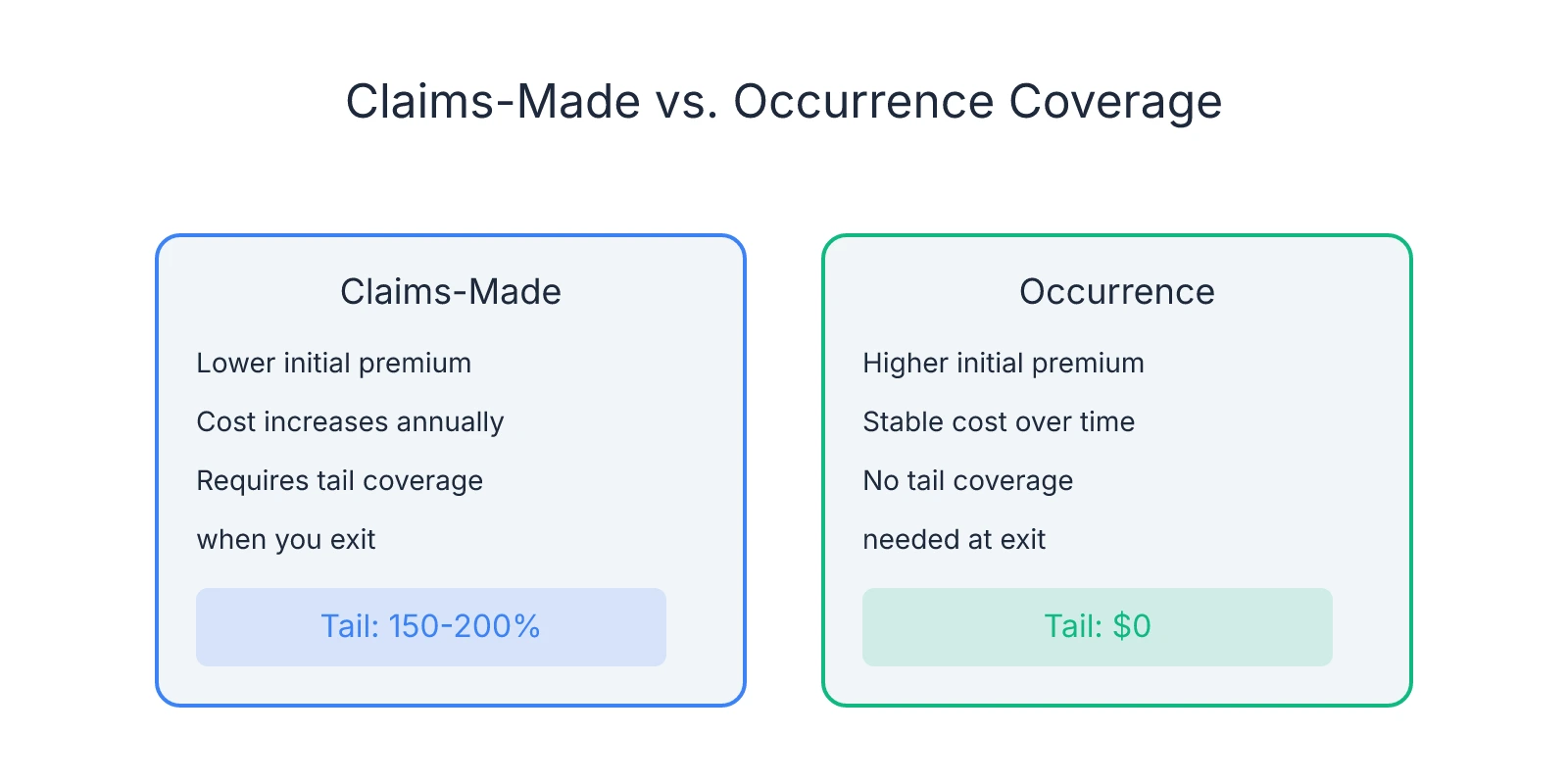
An occurrence policy eliminates that problem. It covers any incident that happened while the policy was in force, regardless of when the claim is filed. If you treat a patient today and they file a claim ten years from now—long after you've sold the practice or switched carriers—you're still covered.
For practice buyers, occurrence coverage offers simplicity and portability. You can switch carriers, sell the practice, or retire without purchasing expensive tail coverage. Many buyers starting their first practice choose occurrence policies for exactly this reason. The tradeoff is cost. Occurrence policies typically carry higher premiums upfront, but the rate stays relatively stable over time.
Claims-made policies start with lower premiums in year one, but the cost increases annually as your retroactive date extends further into the past. According to Gallagher Healthcare, tail coverage for a mature claims-made policy often runs 150-200% of your annual premium. If you're paying $8,000 annually for claims-made coverage, expect tail coverage to cost $12,000-$16,000.
Where this becomes relevant is the transition period. If you're moving from an associate role where your employer provided claims-made coverage, and you're now purchasing your own policy as a practice owner, you need to decide whether to continue with claims-made or switch to occurrence. Switching mid-career creates a gap: your old claims-made policy won't cover claims filed after you cancel it, even for work you did while insured. You'll need either tail coverage on the old policy or prior acts coverage on the new one.
One scenario that catches buyers: you buy a practice, secure a claims-made policy with a retroactive date matching your closing date, and start treating patients. Two years later, a patient files a claim for a procedure you performed in month three of ownership. You're covered—the incident and the claim both occurred while your policy was active. But if you switch carriers in year four without purchasing prior acts coverage, that same claim filed in year five would fall outside your coverage window.
Most buyers with stable carrier relationships and no plans to switch practices in the next 5-10 years find claims-made policies cost-effective. The lower initial premiums free up cash flow during the early ownership years, when loan payments and working capital demands are highest. Buyers who anticipate moving, merging, or selling within a few years often prefer occurrence coverage to avoid the tail coverage expense later.
The decision framework comes down to three variables: your expected tenure at the practice, your tolerance for future tail costs, and your current cash flow. If you're buying your first practice at 40 or 45 with plans to practice for 15-20 years before retiring, occurrence coverage removes one future liability from your exit planning. If you're 32, buying a starter practice you expect to outgrow in seven years, claims-made coverage with lower upfront costs may make more sense—as long as you budget for tail coverage when you sell.
Prior Acts Coverage and Retroactive Dates: Closing the Gap Between Policies
Retroactive date: The earliest date from which your claims-made policy will cover incidents. Any work you performed before that date isn't covered unless you have prior acts coverage extending your protection backward.
The most common coverage gap for practice buyers isn't forgetting to buy insurance—it's starting a new claims-made policy with a retroactive date that leaves prior work unprotected. If you close on January 1 and your new policy's retroactive date is also January 1, you're covered for any work you do from that point forward. But if you worked as an associate for three years before buying the practice, and a patient files a claim in June for a procedure you performed during your associate years, you're not covered—unless you secured prior acts coverage.
Prior acts coverage (sometimes called "nose" coverage) extends your retroactive date backward, covering work you did under a previous policy or employer. When structured correctly, it eliminates the need to purchase tail coverage from your old carrier.
Here's where buyers get caught: many carriers will provide prior acts coverage when you switch to them, but this must be negotiated before your old policy expires. If you cancel your associate-era policy, wait two weeks, then apply for new coverage as a practice owner, most carriers will set your retroactive date to match your application date—leaving a gap for all your prior work. According to MedPro Dental, this creates a scenario where neither your old carrier nor your new carrier covers claims from your associate years.
One scenario that surfaces repeatedly: a buyer works as an associate for four years, then purchases the same practice where they've been working. They assume their employer's malpractice policy covered them as an associate, so they simply need new coverage as an owner. They secure a claims-made policy with a retroactive date matching the closing date. Six months later, a patient files a claim for a crown prep the buyer performed two years earlier, while still an associate. The buyer's new policy won't cover it—the incident predates the retroactive date.
The fix is straightforward but time-sensitive. Before your old policy expires, confirm whether your new carrier will provide prior acts coverage back to your first day of practice. If they will, you avoid purchasing tail coverage from your previous employer's carrier. If they won't—or if they'll only extend the retroactive date partway—you need to either purchase tail coverage on the old policy or accept the gap.
Most buyers miss this because the timing doesn't align with their other closing tasks. Prior acts coverage requires underwriting approval, which can take 10-14 days. If you apply for new coverage two weeks before closing and discover the carrier won't provide full prior acts coverage, you're left scrambling to purchase tail coverage from your old carrier—often at a higher cost than if you'd planned ahead.
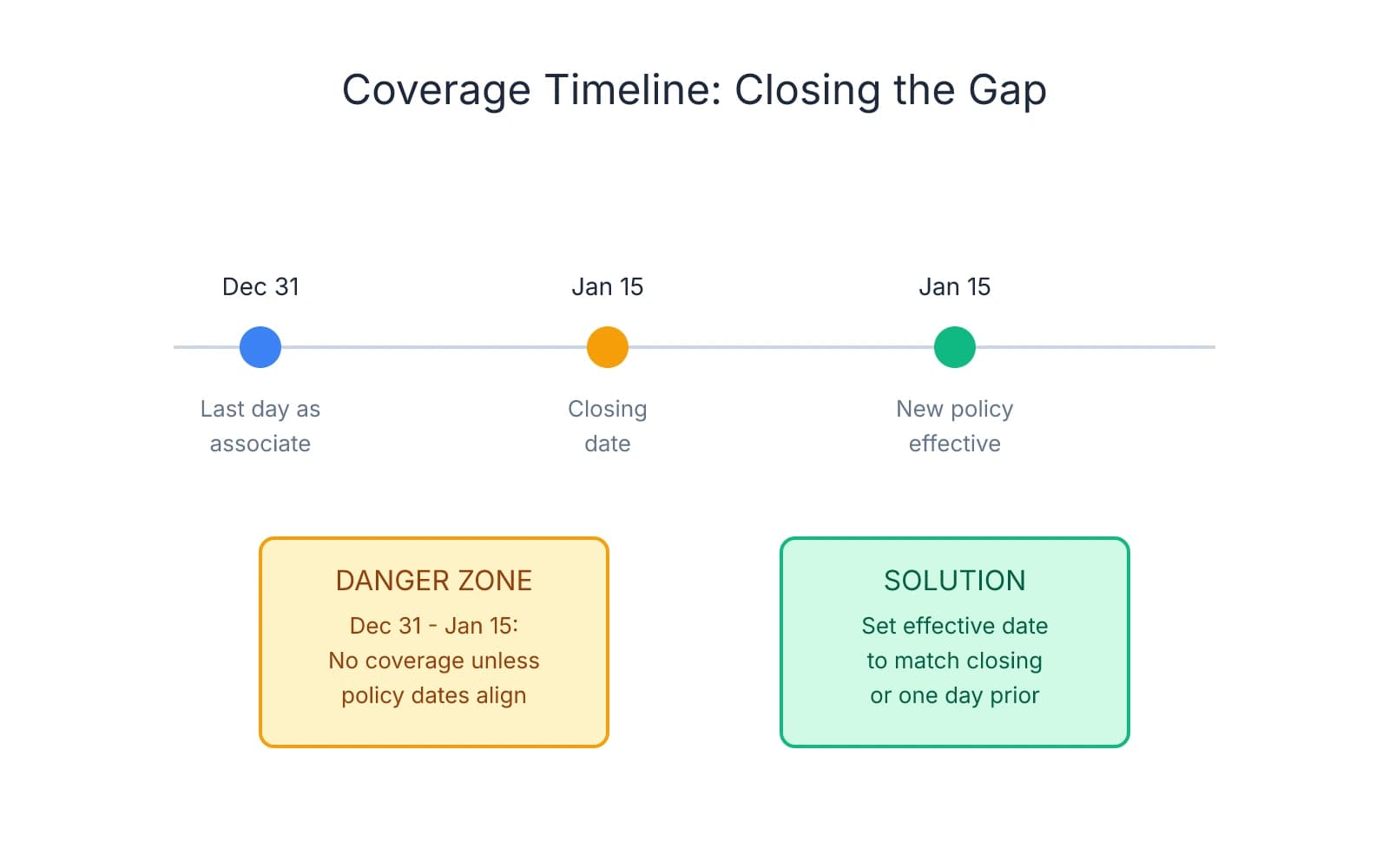
The most dangerous gap sits between your last day as an associate and your first day as an owner. If you leave your associate position on December 31 and close on the practice January 15, you need coverage for those two weeks—and confirmation that your new policy's retroactive date covers all work performed before closing.
When evaluating prior acts coverage, ask your carrier: "Will this policy cover claims filed after the effective date for incidents that occurred while I was insured under my previous carrier, back to [original retroactive date]?" If the answer is yes, and there's no gap between when your old policy expires and your new policy begins, you're protected.
The cost structure varies by carrier, but prior acts coverage typically adds 10-25% to your annual premium in the first year, then levels out. This is significantly less expensive than purchasing tail coverage, which often runs 150-200% of your annual premium as a one-time payment.
How to Structure Coverage in Your Purchase Agreement and Transition Plan
Three insurance-related items belong in your purchase agreement before you reach closing: who pays for the seller's tail coverage, when your new policy becomes effective, and what happens if the seller stays on during transition.
Tail coverage responsibility: In most transactions, the seller purchases and pays for their own tail coverage. But if the purchase agreement doesn't specify who bears this cost, it becomes a negotiation point after both sides have invested in due diligence. One approach many buyers find valuable is requesting written confirmation that the seller will maintain tail coverage for a minimum period (often 5-10 years). This doesn't mean you're paying for it—it means you're documenting that the seller won't be uninsured for work performed under their ownership.
Where this gets negotiated differently: if the seller is retiring and tail coverage represents a significant expense (often $12,000-$18,000), some buyers agree to cover part or all of the tail premium in exchange for a lower purchase price or more favorable transition terms.
Effective date coordination: The most common coverage gap happens in the 24-48 hours around closing. You sign documents on Thursday, your new policy starts Monday, and you're uninsured from Friday through Sunday. The fix is straightforward: set your new policy's effective date to match your closing date exactly, or one day prior if there's any uncertainty about closing timing.
One scenario that catches buyers during transitions: you close on the 15th, your policy is effective the 15th, but the seller's policy was canceled on the 14th—and a patient who was in the chair on the 14th files a claim on the 16th. Whose policy responds? This is why many buyers request that the seller maintain their policy through closing day rather than canceling it the day before.
Seller transition and associate coverage: If the seller stays on as an associate for 60-90 days to support patient handoffs, their insurance status changes. Where buyers get exposed: the seller assumes they're covered under your policy because they're working in your practice, you assume they're covered under their own policy because they're a licensed dentist, and neither policy actually responds when a claim is filed.
The cleanest structure is to add the seller as a named insured on your policy for the transition period, with clear start and end dates. This typically increases your premium by 15-25% for those months, but it eliminates the question of whose coverage applies.
Insurance credentialing timelines: One issue that doesn't appear in most purchase agreements but directly affects your cash flow is provider credentialing with PPO networks. Credentialing can take 60-90 days, and until you're credentialed as the new provider, you may be forced to treat patients as out-of-network—which means lower reimbursement rates and potential patient attrition.
The timeline matters because you can't start the credentialing process until you have a signed purchase agreement and a confirmed closing date. This creates a gap: you close on March 1, submit credentialing applications March 2, and you're not fully credentialed until May. During those 8-10 weeks, patients who expect in-network benefits may receive out-of-network explanations of benefits, which often triggers calls to the practice asking why their coverage changed.
One protection: start credentialing applications 90+ days before your target closing date if your purchase agreement allows it, or negotiate a transition period where you can bill under the seller's provider number while your credentialing completes. The latter requires the seller to remain actively involved, but it maintains continuity for patients and preserves your revenue during the credentialing window. Not all carriers permit this, but it's worth exploring during the first 90 days of transition planning.
Policy structure and coverage limits: Before you finalize your malpractice policy, review three specific terms. First, the consent-to-settle clause—does your policy require your consent before the carrier settles a claim, or can they settle without your approval? Second, your coverage limits—$1 million per occurrence / $3 million aggregate is standard, but some buyers in higher-risk specialties carry $2 million per occurrence. Third, whether your policy automatically extends to associates, hygienists, and other clinical staff you may hire post-acquisition.
The last item surfaces when buyers plan to hire an associate within the first 12-18 months of ownership. If your policy doesn't include automatic coverage for associates, you'll need to notify your carrier and pay an additional premium when you hire. Where buyers get caught is hiring an associate, assuming they're covered under the practice policy, and discovering six months later (often when a claim is filed) that the associate was never added as a named insured.
FAQ
Do I need tail coverage if I'm buying a practice?
No—tail coverage is the seller's responsibility, not yours. It extends their claims-made policy to cover claims filed after they stop practicing. Your job is securing your own malpractice coverage that protects you from day one of ownership. You may want the seller to confirm they'll maintain tail coverage in the purchase agreement, but you don't purchase it yourself.
What's the difference between claims-made and occurrence malpractice policies?
Claims-made policies only cover claims made and reported while the policy is active. If you cancel the policy, you lose coverage for past work unless you buy tail coverage. Occurrence policies cover any incident that happened while the policy was in force, regardless of when the claim is filed—no tail coverage needed when you leave.
What is prior acts coverage and when do I need it?
Prior acts coverage extends your claims-made policy's retroactive date backward to cover work you did under a previous policy or employer. You need it when switching carriers mid-career to avoid a coverage gap for your past work. Without it, your new policy won't cover claims for incidents that occurred before your new policy's retroactive date.
When should my new malpractice policy start?
Your policy's effective date should match your closing date exactly, or one day prior if there's uncertainty about closing timing. The most common coverage gap happens in the 24-48 hours around closing when buyers don't coordinate their policy start date with the transaction timeline.
What happens if the seller stays on as an associate after closing?
The seller's insurance status changes when they transition from owner to associate. The cleanest structure is adding them as a named insured on your policy for the transition period. Without this, neither your policy nor their old policy may cover them in their new role, creating a coverage gap if a claim is filed.
Sources & References
The data and claims in this article are drawn from the following sources. We prioritize government data, peer-reviewed research, and established industry publications to ensure accuracy.
- Tell Me More About Tail Coverage. Do I Need It and How ...— edic.comIndustry
- Tail Coverage Insurance and Buying or Selling a Business— www.kmco.comIndustry
- What Is Tail Coverage Medical Malpractice Insurance?— gallaghermalpractice.comIndustry
- What is prior acts coverage in Dental Malpractice Insurance?— www.graceybacker.comIndustry
- Are You Covered for Malpractice After Leaving a Dental ...— medprodental.comIndustry
- The Hidden Challenge in Dental Practice Transitions— ameriprac.comIndustry
Frequently Asked Questions
Navigate Malpractice Coverage for Your Practice Acquisition
Purchasing a dental practice involves complex insurance considerations that require expert guidance. Minty Plus provides hands-on support through every stage of your acquisition, including navigating malpractice tail coverage and other critical post-close details.