Where to Get Down Payment for Dental Practice Loan

Co-Founder, Minty Dental

In Summary
- Most dental practice lenders finance 100% of the purchase price but require 10% of the loan amount sitting in your account as liquidity—money you keep, not hand over at closing
- Liquidity includes savings accounts, taxable investment accounts, and money market funds—anything you can access without penalty or waiting periods
- Retirement accounts like 401(k)s and IRAs don't count toward the 10% threshold because lenders view them as restricted funds
- High-producing associates earning $400,000+ annually or buyers acquiring practices with exceptionally stable financials often see reduced or waived liquidity requirements
- Actual out-of-pocket costs at closing typically run $15,000-$20,000 for earnest money, legal fees, and due diligence expenses—not the full 10% liquidity amount
Most Lenders Want 10% Liquidity—Not a Down Payment
The single biggest misconception about dental practice financing is what the "10% requirement" actually means. When a lender tells you they need 10% of the purchase price, they're not asking you to hand over that money at closing. They want to see it sitting in your account—accessible, liquid, and available if the practice hits turbulence in the first six months.
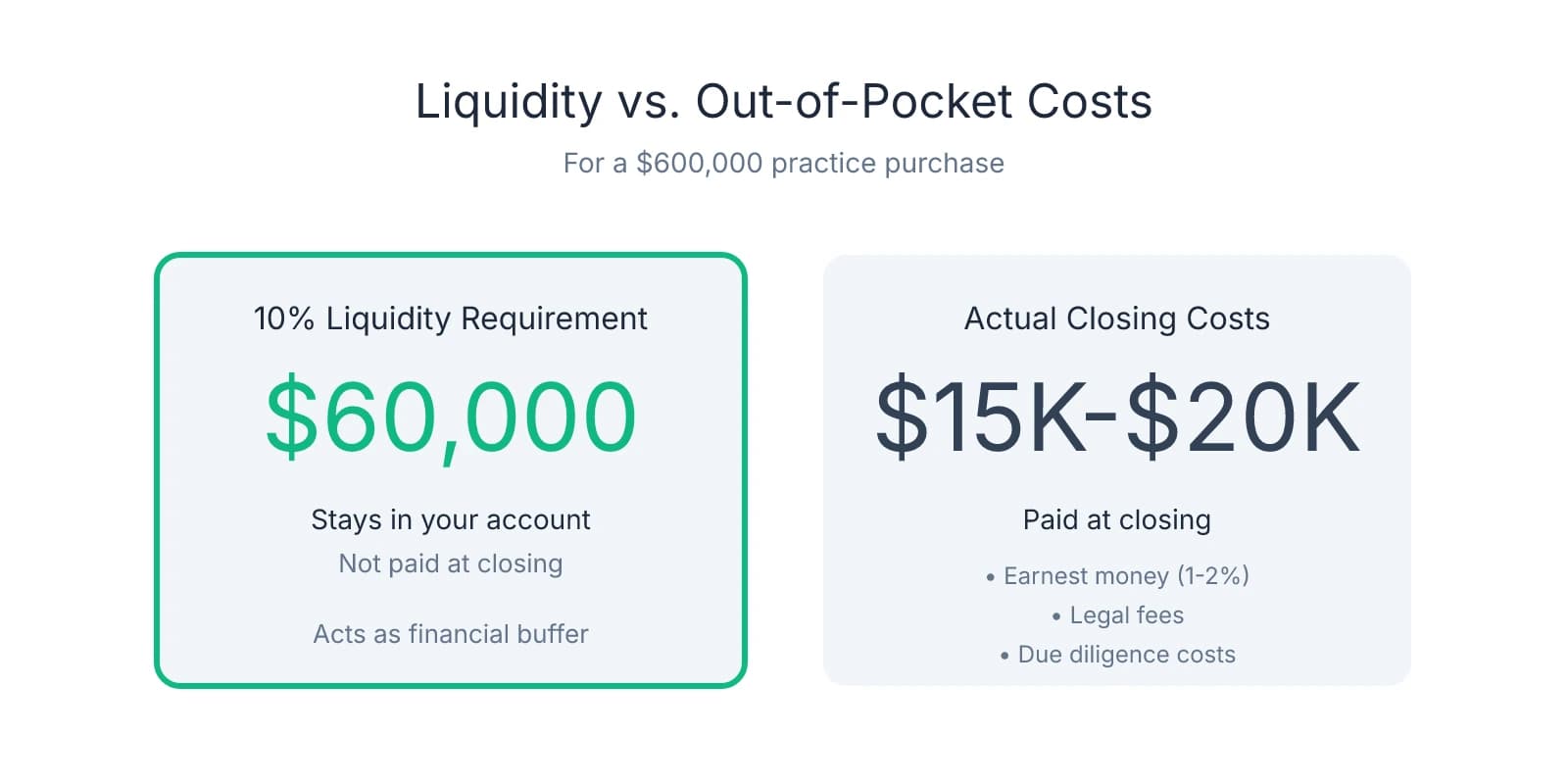
Liquidity vs. down payment: The 10% stays yours. If you're buying a $600,000 practice, the lender wants proof you have $60,000 in liquid assets before they approve the loan. That $60,000 remains in your account after closing. It's a buffer, not a payment. Most dental lenders finance 100% of the practice purchase price, which means you're not contributing equity upfront—you're demonstrating you can weather unexpected expenses without defaulting.
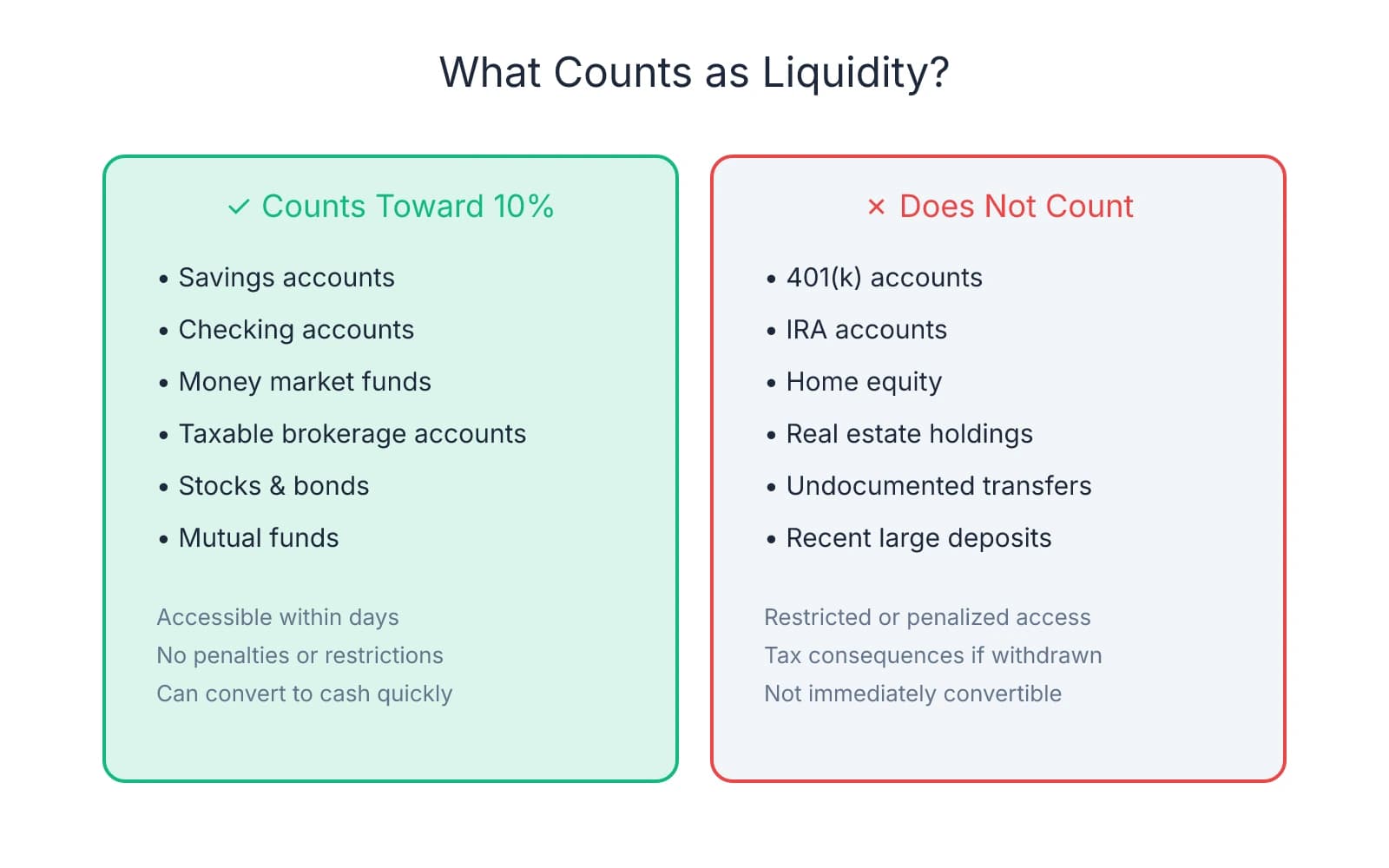
What counts as liquidity? Savings accounts, checking accounts, taxable brokerage accounts, money market funds, stocks, bonds, mutual funds—anything you can convert to cash within a few days without penalty. What doesn't count? Retirement accounts. Your 401(k) and IRA balances don't satisfy the liquidity requirement because lenders view them as restricted funds. Accessing them early triggers penalties and tax consequences, which makes them unreliable in a cash crunch. Home equity doesn't count either—it's an asset, but not a liquid one.
One pattern worth noting: lenders reduce or waive the 10% threshold when the risk profile shifts in your favor. If you're producing $400,000+ annually as an associate, many banks drop the liquidity requirement to 5% or eliminate it entirely. The same flexibility appears when you're acquiring a practice with rock-solid financials—consistent collections, low overhead, minimal patient attrition.
Where buyers often get tripped up is conflating liquidity with out-of-pocket costs. You will spend money at closing, but it's nowhere near 10%. Typical out-of-pocket expenses run $15,000-$20,000: earnest money (usually 1-2% of the purchase price), legal fees for contract review, due diligence costs like appraisals and inspections, and lender fees. These are real costs you pay, but they're separate from the liquidity requirement sitting in your account. The timeline for securing dental practice financing typically spans 60-90 days from initial application to final approval—which means you'll want that 10% liquidity documented and stable well before you make an offer.
Personal Savings and Investments: The Primary Source
For a $500,000 practice, you're looking at $50,000 in accessible cash. That's achievable by setting aside $1,500-$2,000 monthly over 2-3 years—a realistic target for most associates earning $180,000-$250,000 annually. The math is straightforward: if you're planning to buy in three years, $1,400 monthly gets you to $50,000. If you're on a two-year timeline, you'll need closer to $2,100 per month.
High-yield savings accounts and money market funds are the most reliable vehicles for building this liquidity. They preserve capital, earn modest interest (currently 4-5% APY at most institutions), and keep funds immediately accessible when lenders request bank statements. There's no market risk, no withdrawal penalties, and no complexity when it's time to verify your liquidity. Many buyers split their savings between a high-yield account for the bulk of the funds and a checking account for day-to-day expenses, which keeps the liquidity pool clearly documented and separate from operating cash flow.
Taxable brokerage accounts count as liquidity, but they introduce variables that can complicate approval. If you're holding diversified index funds or stable bond positions, most lenders accept the account value at face value. Where it gets messy is when you're sitting on volatile individual stocks or positions that have dropped below your cost basis. Lenders don't want to see you liquidating at a loss to meet their liquidity threshold—it signals poor timing and raises questions about whether you'll have enough cash after taxes and transaction costs.
One tension many buyers wrestle with is whether to pay down student loans aggressively or prioritize liquidity building. The instinct to eliminate debt is understandable—especially when you're carrying $300,000-$400,000 in loans at 6-7% interest. But lenders care more about liquidity than your debt-to-income ratio when evaluating practice acquisition loans. A buyer with $200,000 in student debt and $60,000 in savings gets approved faster than a buyer with $100,000 in debt and $15,000 in the bank. The practice loan itself will improve your debt position over time as collections cover payments and you build equity. Delaying ownership by two years to pay down loans costs you two years of equity accumulation and income growth—often a bigger financial hit than the interest savings.
Lenders review 2-3 months of bank statements to verify your liquidity is stable, not borrowed or recently transferred. A $50,000 deposit that appears 30 days before your loan application raises red flags. They want to see consistent balances, regular deposits from employment, and a pattern that suggests the money has been yours for a while. If you're receiving a financial gift from family or liquidating an asset to boost liquidity, plan to do it at least 90 days before applying—and be prepared to document the source with a gift letter or transaction records. Deciding when to buy a dental practice often comes down to whether you've built enough liquidity to meet lender thresholds without stretching your budget too thin.
Family Gifts, Seller Financing, and Alternative Sources
Family gifts can cover part or all of the 10% liquidity requirement, but lenders treat them differently than money you've saved yourself. The critical piece is documentation: the donor must sign a gift letter explicitly stating the funds are a gift, not a loan, and that no repayment is expected. Without that letter, the lender assumes it's borrowed money—which counts against your debt-to-income ratio instead of helping you meet the liquidity threshold. Most banks also verify the donor's ability to give by requesting bank statements showing the funds left their account.
One pattern that trips up buyers is timing. If a $50,000 deposit hits your account 45 days before you apply for financing, the lender will ask where it came from—even with a gift letter. Many banks prefer to see gifted funds sitting in your account for 60-90 days before application. The alternative is providing extensive documentation upfront: the gift letter, the donor's bank statements, and proof the transfer cleared.
Seller financing shifts the equation entirely. When a seller agrees to carry 10-20% of the purchase price—meaning they loan you that portion and you pay them back over 3-5 years—many lenders reduce or eliminate the liquidity requirement. The logic is straightforward: if the seller has $100,000 of their own money at risk, they're incentivized to help you succeed during the transition. Where this gets complicated is in deal structure. Seller financing usually comes with a higher interest rate than your primary loan (8-10% vs. 6-7%), and the seller's note is subordinated to the bank's lien. Not every seller is willing to take that position, but in slower markets or when the practice has been listed for months, seller financing becomes a negotiating tool that benefits both sides.
Whole life insurance policies with accumulated cash value can be borrowed against, though the mechanics are tricky. If you've been paying into a policy for 10+ years and have $40,000 in cash value, you can take a policy loan without triggering taxes or penalties. The catch: lenders may treat the loan as additional debt when calculating your debt-to-income ratio, which can tighten your approval margins if you're already carrying student loans and a car payment.
Recent large deposits—anything over $5,000 that appears in your account within 60 days of application—trigger documentation requirements. Lenders want to know the source, verify it's not borrowed money, and confirm it won't disappear before closing. If you're planning to sell a rental property, liquidate stock positions, or receive a bonus from your current employer, structure those transactions at least 90 days before you start the loan process.
Partnership buy-ins often involve deferred payment structures that reduce upfront cash needs. If you're buying into a 50/50 partnership, the existing owner may finance your equity stake over 5-7 years rather than requiring a lump sum at closing. The risk is that you're taking on two debt obligations simultaneously—one to the bank, one to your partner—which tightens cash flow in the first few years. Many buyers negotiate a grace period where the partner buyout payments don't start until 12-18 months after closing, giving the practice time to stabilize under new ownership.
What lenders view favorably: savings accounts with consistent balances, gifts from financially secure family members, seller financing that aligns incentives. What raises red flags: undocumented transfers, loans disguised as gifts, and sudden deposits that can't be explained. The cleaner your liquidity picture, the faster you move through underwriting.
Building Your Liquidity Position Before You Start Shopping
The buyers who close deals fastest are the ones who talked to lenders two years before they started looking at practices. That timeline matters because it gives you room to address credit issues, adjust your savings strategy, and understand exactly what your target lender expects. Banks that specialize in dental transitions are willing to have these conversations long before you're ready to buy. They'll review your current financial position, tell you where you fall short, and give you a roadmap for strengthening your application.
Talk to at least three lenders, even if one seems like the obvious choice. Each institution weighs liquidity, credit, and production history differently. One bank might require the full 10% for a $500,000 practice while another drops it to 5% because you're producing $450,000 annually as an associate. When you're comparing offers, focus on the total cost structure—not just the interest rate. A lender offering 6.5% with a $50,000 liquidity requirement and flexible underwriting may be a better deal than one offering 6.2% with rigid credit thresholds and a $75,000 liquidity floor.
Production history is the second piece lenders scrutinize after liquidity. Most banks want to see $400,000+ in annual collections as an associate before they'll approve a practice loan. That threshold exists because it signals you can generate enough revenue to cover loan payments, overhead, and your own compensation. Document everything: pay stubs showing your percentage of collections, employment contracts outlining your compensation structure, and any bonuses tied to production.
Credit scores above 700 open more financing options and often reduce liquidity requirements. A buyer with a 750 score and $40,000 in savings gets approved faster than a buyer with a 680 score and $60,000 in the bank. If your score is below 700, address it now—not six months before you plan to buy. Pay down credit card balances to below 30% utilization, dispute any inaccuracies on your report, and avoid opening new accounts or taking on additional debt. The timeline for credit repair is 6-12 months, which is why starting early gives you leverage.
If you're short on liquidity when you're ready to buy, you have options—but they require flexibility on practice selection. Prioritize listings with seller financing, where the seller carries 10-20% of the purchase price and reduces the bank's risk exposure. Look at partnership opportunities where you're buying into an existing practice over time rather than acquiring 100% upfront. Target practices with exceptionally strong financials—consistent $800,000+ collections, sub-60% overhead, minimal patient attrition—because those deals reduce lender risk and often come with relaxed liquidity thresholds. The alternative is delaying your search for 12-18 months to build more reserves.
One thing worth understanding: liquidity requirements are negotiable. The 10% threshold is a guideline, not a universal rule. High producers, buyers with established banking relationships, and acquisitions involving practices with rock-solid financials all see reduced requirements. If you're producing $500,000 annually and buying a practice that's been stable for a decade, you're in a position to negotiate. If you're a first-time buyer with $350,000 in production and targeting a practice with declining revenue, you'll need to meet the full threshold—or exceed it.
Sources & References
The data and claims in this article are drawn from the following sources. We prioritize government data, peer-reviewed research, and established industry publications to ensure accuracy.
- How Much Down Payment Do You Need for a Dental Office Loan?— dentalcpausa.comIndustry
Frequently Asked Questions
Ready to acquire your dental practice?
Finding the right financing and down payment sources is just the first step. Minty Plus provides comprehensive guidance through the entire acquisition process, helping you navigate funding requirements and manage your practice post-close.