Buying a Dental Practice from a Retiring Dentist vs Younger Seller

Co-Founder, Minty Dental

In Summary
- The average dentist retirement age now sits at 68, up from 64 in 2001, while younger sellers trend toward age 44 driven by DSO consolidation and equity opportunities
- Retiring dentists typically offer longer transition support (6-12 months) and decades-long patient relationships, but may have deferred equipment upgrades and an aging patient base
- Younger sellers often bring modern digital systems and younger patient demographics, but the motivation for sale—burnout, equity arbitrage, relocation—requires closer investigation
- Each scenario presents distinct risks: retiring sellers may leave you with capital improvement needs, while younger sellers may be exiting operational problems or market challenges
Seller Age Changes What You're Actually Buying
When you evaluate a dental practice, the seller's age isn't demographic trivia—it's a proxy for what you're inheriting. A retiring dentist at 68 (the current average retirement age, up from 64 in 2001) typically hands you a practice shaped by decades of patient relationships, established referral networks, and deep community ties. A younger seller at 44 (the average age now trending in DSO-driven sales) often delivers modern systems, digital workflows, and a patient base that skews younger—but the reason they're selling demands scrutiny.
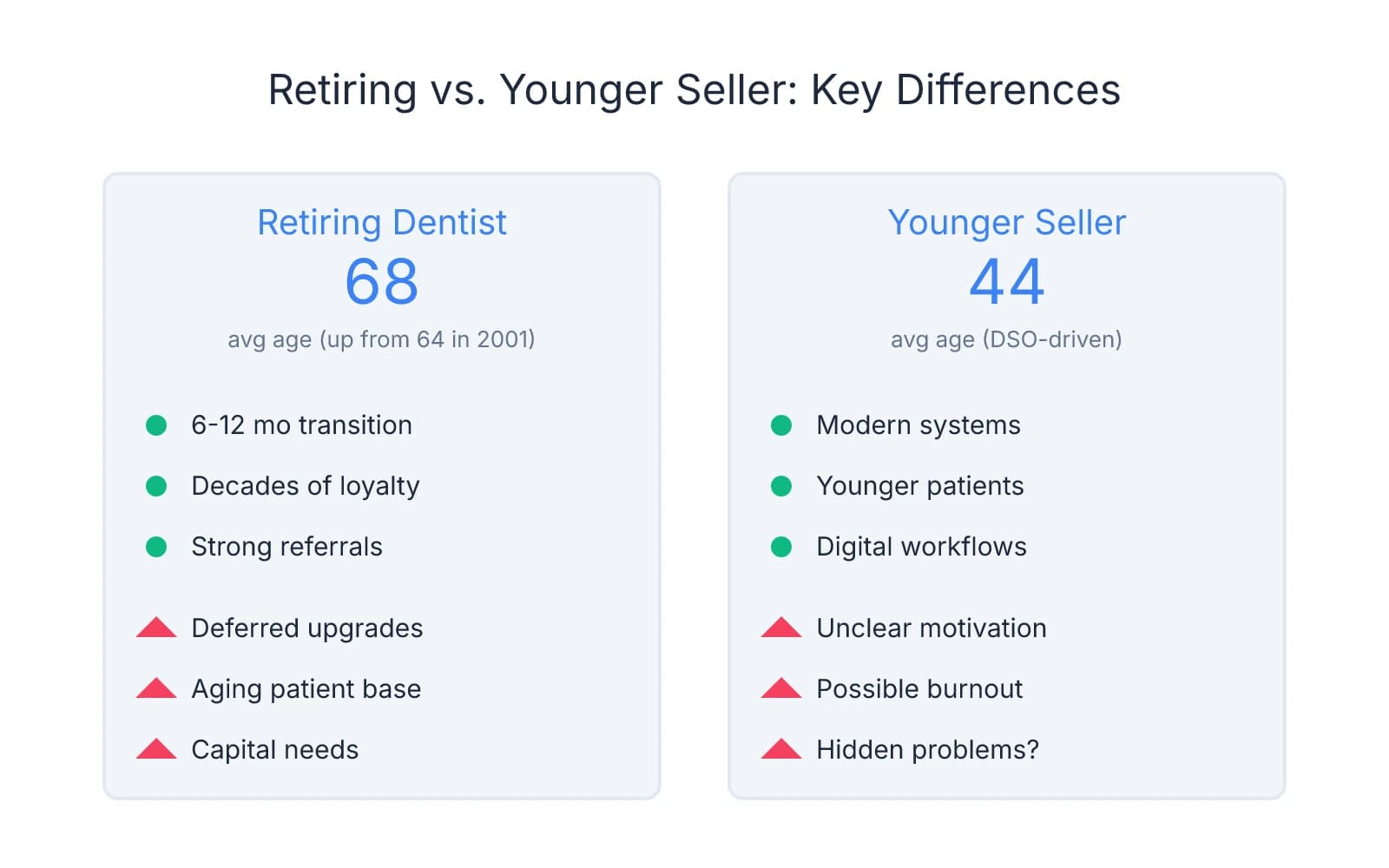
Neither scenario is inherently better. What matters is recognizing the tradeoffs each presents and adjusting your diligence accordingly.
What Retiring Sellers Typically Offer
A dentist selling after 30+ years in the same location usually brings patient loyalty you can't manufacture overnight. Many patients have been with the practice since their own children were young—they trust the dentist, the hygienists, and the front desk staff. That continuity often translates to higher retention during ownership transitions, especially if the seller stays on for 6-12 months to introduce you personally.
Where retiring sellers tend to fall short is capital investment. If the seller has been planning retirement for several years, they may have deferred equipment upgrades, delayed office renovations, or avoided adopting digital systems that require training. One pattern worth watching is practices where the most recent major equipment purchase happened 8-10 years ago—right around the time the seller started thinking about an exit.
The patient demographics also skew older. If the seller built the practice in the 1990s, many core patients are now in their 60s and 70s. That's not a dealbreaker—older patients often have higher treatment acceptance rates and more complex restorative needs—but it does mean you'll need a strategy for attracting younger families to sustain long-term growth.
What Younger Sellers Typically Offer
A dentist selling at 44 is often exiting for reasons unrelated to retirement. DSO consolidation and equity arbitrage have created wealth-building opportunities that didn't exist a generation ago—many younger sellers are rolling equity into larger platforms or cashing out to relocate. Others are leaving due to burnout, partnership disputes, or market saturation they didn't anticipate.
What you gain in these scenarios is infrastructure. Younger sellers are more likely to have invested in digital radiography, intraoral scanners, and practice management software that integrates with patient communication platforms. The patient base tends to be younger, with higher percentages of families with children and working-age adults who expect online scheduling and text reminders.
What you lose is certainty about motivation. When a dentist in their mid-40s sells a practice they've owned for less than a decade, the reason matters. If they're relocating for a spouse's career or joining a DSO for equity upside, that's straightforward. If they're vague about why they're leaving, or if the practice has been on the market for 12+ months, you need to dig into patient retention trends, staff turnover, and competitive dynamics. Why the seller is really selling becomes the central question in your diligence process.
Equipment, Technology, and Capital Investment Patterns
One of the most visible differences between buying from a retiring dentist versus a younger seller shows up the moment you walk through the operatories. Practices run by dentists in their mid-60s or older often operate with equipment that's 10-15 years past its expected replacement cycle—analog X-ray systems, chairs with patched upholstery, compressors that sound like they're negotiating with gravity. This isn't neglect. It's rational economics. If you're planning to exit in 3-5 years, spending $80,000 on digital radiography doesn't make financial sense when you won't recoup the investment before closing.
Capital investment typically stops 3-5 years before a planned retirement. Pull the equipment purchase history during diligence. If the last major upgrade happened in 2016 and the seller is now 67, you're looking at a practice where deferred maintenance has become deferred replacement. That's not a dealbreaker—it's a negotiation variable.
Calculate Replacement Costs Before You Make an Offer
Start by inventorying the major systems: operatory chairs, X-ray units (digital vs. film), compressor, sterilization equipment, suction systems, and practice management software. For each, note the age, condition, and whether it's owned outright or under lease. Then price out replacement costs using current market rates:
- Operatory chairs: $8,000–$15,000 per unit
- Digital X-ray sensors: $6,000–$10,000 per sensor (plus imaging software)
- Panoramic X-ray: $30,000–$60,000
- Compressor: $5,000–$15,000 depending on capacity
- Autoclave/sterilization: $3,000–$8,000 per unit
If you're walking into a four-operatory practice where three chairs are 12+ years old, the X-rays are still film-based, and the compressor sounds like it's filing a grievance, you're looking at $100,000–$150,000 in near-term capital needs. That figure should either reduce the purchase price or appear as a seller concession in the asset purchase agreement. One protection many buyers build in is a post-closing equipment reserve funded by the seller—essentially an escrow account that covers replacement costs for systems likely to fail within 12-24 months.
Younger Sellers: Modern Systems, But Who Owns Them?
Practices sold by dentists in their 40s typically present the opposite profile. You're more likely to see digital radiography, intraoral scanners, modern practice management software with integrated patient communication, and operatories that don't require immediate updates. The risk here isn't age—it's ownership structure.
Many younger sellers financed their equipment upgrades through leases or equipment loans that haven't been fully paid off. During diligence, request a schedule of all outstanding equipment leases and financing agreements. If the seller still owes $60,000 on a CBCT unit or $25,000 on operatory chairs, you need to know whether those obligations transfer to you, get paid off at closing, or reduce the net proceeds the seller receives.
Where buyers get burned is assuming that "modern equipment" means "owned equipment." If the practice has state-of-the-art technology but the seller has been making monthly lease payments for the past three years, you're either inheriting those payments or the purchase price needs to account for the seller paying off the leases before transfer. Renegotiating after due diligence becomes necessary when you discover financing obligations that weren't disclosed upfront.
The Opportunity Hidden in Outdated Practices
An outdated practice with strong fundamentals—consistent patient flow, high hygiene reappointment rates, solid collections—can offer a lower acquisition cost and immediate growth potential if you're prepared to invest in upgrades. The math works like this: if a practice is priced at 65% of collections instead of 75% because it needs $120,000 in equipment updates, and those updates unlock 15-20% revenue growth through improved case acceptance and expanded services, you're buying below market and creating equity through operational improvement.
The framework for evaluating this tradeoff is straightforward. Take the replacement cost estimate, add 20% for contingency and installation, then compare that total to the discount you're receiving on the purchase price. If the practice is listed at $500,000 but comparable practices with modern equipment sell for $650,000, and your capital investment will be $130,000, you're still $20,000 ahead—plus you control the timing and selection of equipment rather than inheriting someone else's choices.
What makes this strategy work is having the capital reserves and risk tolerance to execute it. If you're already stretching to cover the down payment and working capital, taking on an additional $100,000+ in equipment financing within your first year creates cash flow pressure that can destabilize the transition. But if you've structured your acquisition financing to include a capital improvement budget, an outdated practice becomes a value play. Upgrading equipment remains a top priority for practice owners looking to enhance patient care and increase revenue potential.
Patient Demographics and Long-Term Retention Risk
The patient age distribution in a practice tells you whether you're buying stable cash flow or inheriting an attrition problem. Practices owned by retiring dentists often carry patient bases with an average age in the low-to-mid 50s—loyal, insured, and committed to preventive care, but also nearing the stage where they retire, relocate, or reduce dental spending. Practices with patient bases averaging 53-55 years old signal short-term stability but long-term replacement risk. Younger sellers typically present broader age distribution with higher percentages of families and working-age adults, which supports growth if retention systems are strong.
The question during diligence isn't whether older patients are valuable—they are. It's whether the practice has the new patient flow and recall infrastructure to replace natural attrition over the next 5-7 years.
Pull Patient Age Distribution and Map Attrition Risk
Request a patient age breakdown from the practice management system. Most platforms can generate a report showing patient count by age bracket: under 18, 18-34, 35-54, 55-64, 65+. What you're looking for is balance. A healthy distribution might show 20-25% under 18, 25-30% in the 35-54 range, and 20-25% over 65. If 40%+ of active patients are over 55, you're looking at a base that will naturally shrink 3-5% annually through retirement and relocation, even with perfect retention.
Patient demographics influence both buyer interest and long-term practice value because they determine whether the practice can sustain revenue without aggressive marketing investment. A practice dominated by patients in their 60s and 70s may generate strong hygiene recare and restorative revenue today, but if new patient acquisition has averaged 3-4 per month for the past three years, you're buying a declining asset unless you're prepared to double that intake rate immediately.
One pattern worth watching is practices where the seller built the base in the 1990s and early 2000s. Those patients are now 50-70 years old. If the practice hasn't systematically attracted younger families over the past decade, the age skew becomes structural. You're not just replacing individual patients—you're rebuilding an entire demographic segment.
Evaluate Recall Rates and New Patient Trends
Recall rate—the percentage of patients who return for hygiene appointments within 6-9 months—tells you whether the base is engaged or drifting. Pull the last 24 months of recall data and calculate the percentage of patients who completed their recommended recare visit. A strong recall rate sits above 70%; anything below 60% suggests either weak systems or a patient base that's disengaging.
For practices with older patient demographics, recall rates often stay high because those patients value preventive care and have established habits. The risk appears in new patient flow. If the practice is adding 5-6 new patients per month but losing 4-5 through attrition, net growth is minimal. Over time, that equilibrium shifts as attrition accelerates.
Compare new patient counts by year for the past three years. If new patient acquisition has been flat or declining while the patient base ages, you're looking at a practice that will require immediate marketing investment to stabilize. Younger sellers with family-oriented demographics typically show stronger new patient trends—often 8-12 per month—but you need to verify whether that flow is organic (referrals, location, reputation) or paid (advertising, Groupon, heavy discounting). Organic growth transfers. Paid growth stops the day the seller stops writing checks.
The Transition Letter and Seller Presence Matter More with Older Patients
Patient retention during ownership transitions correlates directly with how the seller introduces you. For practices with older, loyal patient bases, the transition letter and the seller's willingness to stay on for 60-90 days significantly impact retention. These patients didn't choose the practice—they chose the dentist. If the seller sends a form letter two weeks before closing and disappears, retention drops 15-20% in the first year.
What works better is a structured transition: the seller introduces you in person during the final 30-60 days, sends a personalized letter explaining the transition and endorsing you by name, and remains available for patient questions during the first 90 days. The first 90 days after closing set the tone for long-term retention, and older patients respond to continuity and personal reassurance more than younger demographics.
Younger sellers often have less emotional attachment to the patient base, which can make transition support less consistent. If the seller is exiting to join a DSO or relocate, they may be less invested in ensuring patients stay. Negotiate transition terms explicitly in the asset purchase agreement: number of days the seller will be present, expectations for patient communication, and whether the seller will participate in staff meetings to reinforce the transition message.
Staff Retention Protects Patient Retention
The staff—especially long-tenured hygienists and front desk coordinators—are the continuity anchor for patients during ownership transitions. If the hygienist has been with the practice for 15 years and the front desk coordinator for 10, those relationships often matter more to patients than the dentist's identity, particularly in practices with older demographics.
Keeping staff after buying a practice requires early communication, clear retention incentives, and reassurance about job security. If key staff leave within 60 days of closing, patient retention drops sharply because the familiar faces patients trusted are gone. For practices with aging patient bases, staff continuity can be the difference between 85% retention and 65% retention in year one.
During diligence, assess staff tenure, compensation structure, and any verbal agreements the seller made that aren't documented. If the seller promised the hygienist a raise that never materialized, or if the front desk coordinator has been underpaid for years, those issues surface immediately after closing—often in the form of resignation letters. Budget for retention bonuses and compensation adjustments as part of your working capital plan, particularly if the staff has been with the practice for 10+ years and represents institutional knowledge you can't replace quickly.
Structuring Transition Support and Deal Terms by Seller Motivation
The seller's timeline and motivation determine how much transition support you can realistically expect—and how much leverage you have to negotiate it. A dentist retiring at 68 after 35 years in the same location typically has no competing obligations and often welcomes a structured handoff period. They're not rushing to another job. Many actively want to ensure patient continuity, protect their professional legacy, and avoid the guilt of abandoning relationships they've built over decades. That creates space for 6-12 month transitions where the seller works 2-3 days per week, introduces you to key patients and referral sources, and remains available for clinical questions.
A younger seller exiting for burnout, DSO equity, or relocation operates under different constraints. If they're joining a corporate group with a start date 60 days out, or relocating for a spouse's career, they may offer 30-60 days of part-time support—enough to introduce you to staff and patients, but not enough to stabilize operations if retention issues emerge. Where this becomes a problem is when the seller's stated motivation doesn't align with their proposed transition terms.
Define Transition Length and Responsibilities in the LOI
Transition support isn't a courtesy—it's a deal term that belongs in the letter of intent alongside price and closing date. Vague language like "seller will assist with transition as needed" creates no enforceable obligation. When structured well, a transition clause protects both sides and keeps expectations aligned from day one.
Start by defining the transition period in calendar days and clinical days per week. A retiring dentist might agree to work three days per week for 90 days, then two days per week for an additional 90 days, with the option to extend on a month-to-month basis if both parties agree. A younger seller might commit to 60 days at two days per week, with no extension option. The difference matters because it tells you how much operational risk you're absorbing and how quickly you need to build your own patient relationships.
Next, separate clinical responsibilities from administrative ones. In most cases, the seller should focus exclusively on patient care during the transition—seeing their established patients, introducing you during appointments, and reinforcing the message that you're the continuity provider. Administrative tasks like staff management, vendor negotiations, and financial decisions should transfer to you immediately. Sellers who won't leave often blur this line, continuing to make operational decisions or undermining your authority with staff because the transition agreement didn't clearly define boundaries.
Compensation structure also needs explicit terms. Many transitions use a per diem rate or a percentage of collections generated during the transition period. A retiring dentist working three days per week might receive $800-$1,200 per day, or 30-35% of their daily production. Younger sellers often negotiate higher per diem rates because they're sacrificing income from their next opportunity. Whatever structure you choose, document it in the purchase agreement so there's no ambiguity about what the seller earns and when they get paid.
Red Flags in Transition Proposals
A retiring dentist who refuses to stay on for any transition period—especially one who's been in the practice for 20+ years—signals a problem you haven't uncovered yet. The most common reasons are staff issues (key employees planning to leave), patient dissatisfaction (negative reviews or complaints the seller hasn't disclosed), or operational problems (billing disputes, insurance credentialing issues) that will surface immediately after closing. If a seller in their late 60s insists on a 30-day transition or none at all, ask directly: "What's preventing you from staying on longer?" The answer—or the evasion—tells you whether to dig deeper into staff interviews and patient retention data.
The inverse red flag appears with younger sellers. If a dentist claims they're selling due to burnout or career change but insists on a 6-9 month transition, the motivation doesn't match the timeline. Burned-out dentists want out—they don't volunteer to keep working in the same environment that exhausted them. What this pattern often reveals is hidden operational problems: the seller knows patient retention will be weak without their presence, or they're aware of issues (staff turnover, competitive pressure, payer mix deterioration) that will become obvious once they leave. A younger seller proposing an unusually long transition deserves the same scrutiny you'd apply to a retiring dentist who won't stay at all.
Earnouts and Seller Financing as Transition Incentives
When the seller's motivation involves maximizing sale price but their commitment to transition support is uncertain, earnouts and seller financing create alignment. Earnouts in dental practice sales tie a portion of the purchase price to post-closing performance—typically 10-20% of the total, paid out over 12-24 months based on revenue retention or patient continuity metrics. If the seller receives $50,000 contingent on maintaining 80% patient retention through month 12, they have a financial incentive to stay engaged during the transition and ensure patients accept the ownership change.
Seller financing works similarly. If the seller holds a $100,000 note with payments over five years, they benefit from your success because default risk affects their returns. A seller who finances part of the deal is more likely to provide meaningful transition support, answer questions after closing, and help you navigate relationships with key referral sources or difficult patients. The structure creates interdependence that vague "goodwill" clauses don't.
Where this becomes particularly valuable is with younger sellers exiting for reasons other than retirement. If a 45-year-old dentist is selling to join a DSO but agrees to hold 15% of the purchase price as a seller note, their willingness to stay involved during the transition—and their candor about operational challenges—improves significantly. They're not just handing you the keys and walking away; they're invested in your ability to sustain the revenue that funds their note payments.
Negotiate Based on What the Seller Actually Wants
The most effective transition terms come from understanding what the seller values beyond price. A retiring dentist may care more about patient continuity and professional legacy than squeezing an extra $50,000 out of the sale. Offering a longer transition period with clear clinical responsibilities—and framing it as protecting the relationships they built—often yields better terms than focusing solely on price concessions.
A younger seller motivated by equity arbitrage or relocation may prioritize speed and certainty over transition length. If they need to close within 90 days to meet a DSO start date, offering a streamlined diligence process and fewer contingencies in exchange for a 60-day transition commitment can create a deal structure that works for both sides.
The framework is simple: identify what the seller wants most (legacy, speed, price certainty, minimal post-closing involvement), then structure transition terms that align with those priorities while protecting your operational needs. A retiring dentist who wants to ensure patients are cared for will often agree to extended transitions at below-market compensation. A younger seller who wants a clean exit will accept shorter transitions if you remove financing contingencies or agree to a faster close. What to negotiate in your LOI starts with understanding the seller's real motivation—then building deal terms around it.
Sources & References
The data and claims in this article are drawn from the following sources. We prioritize government data, peer-reviewed research, and established industry publications to ensure accuracy.
- 5 Years Out? How to Sell Now and Retire Later— ada.orgIndustry
- Why Dentists Are Selling Their Practices at an Earlier Age— professionaltransition.comIndustry
- Purchasing, Starting or Expanding a Dental Practice: Investments in ...— dentalentrepreneur.com
- How a 53.5 Patient Age Impacts Practice Value | PPS— ppssellsdds.comIndustry
- How Patient Demographics Influence Buyer Interest - CTC Associates— ctc-associates.comIndustry
- Understanding Deal Structures in Dental Practice Transactions— ctc-associates.com
Frequently Asked Questions
Ready to acquire your ideal dental practice?
Whether you're targeting a retiring dentist's established patient base or a younger seller's modern systems, finding the right practice match is crucial. Minty connects you with available practices nationwide and provides expert guidance through every stage of your acquisition.