What Happens If You Can't Make Your Dental Practice Loan Payments

Co-Founder, Minty Dental

In Summary
- Most lenders define default after 60-120 days of missed payments, but late fees and credit damage start within 10-15 days of your first missed payment
- Acceleration clauses allow lenders to demand your entire loan balance immediately once you default, not just the overdue payments
- Lenders typically prefer working with borrowers over foreclosure because dental practices lose operational value quickly without an active dentist
- Your loan agreement contains the specific default triggers and timeline that govern your situation—reading it carefully is the first step in understanding your options
- Ignoring lender communications eliminates your negotiating leverage and speeds up the path to foreclosure
The Timeline from Missed Payment to Default Moves Faster Than You Think
The progression from a single missed payment to full loan default follows a predictable sequence, but the window to act is narrower than most buyers expect. Understanding where you are in this timeline determines which options remain available.
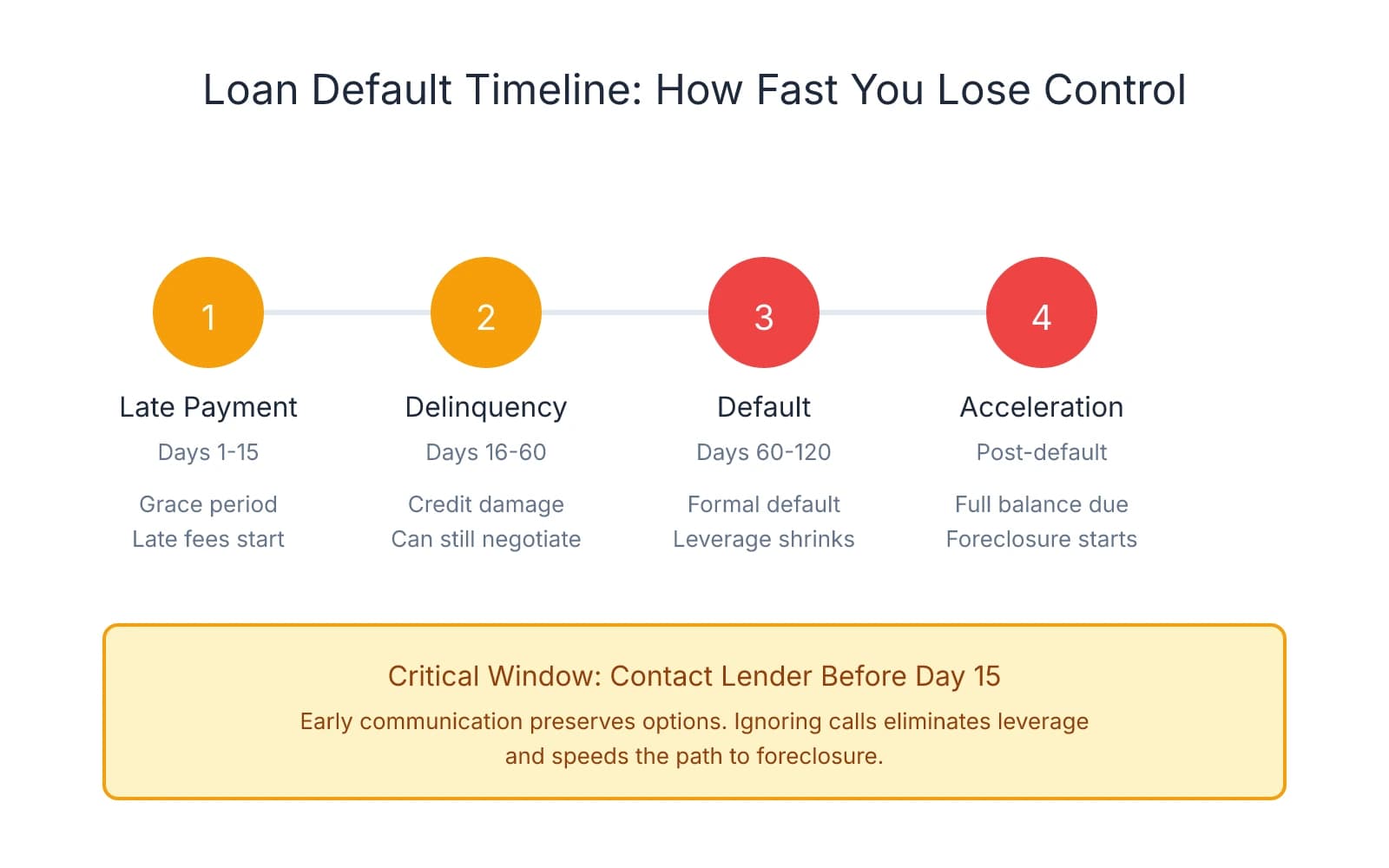
Late payment marks the first 10-15 days after your payment due date. Most loan agreements include a grace period during this window, meaning you won't face immediate penalties if you catch up quickly. Late fees typically begin accruing around day 10, and your lender may send an initial notice, but you haven't yet crossed into delinquency. A single phone call to your lender can prevent further escalation.
Delinquency begins once you pass the grace period without making payment. Late fees compound, and your credit score starts taking damage. Many buyers assume delinquency is the same as default—it's not. Delinquency means you're behind, but the lender hasn't yet triggered the formal default process. This stage can last 30-60 days depending on your loan terms, and it's still possible to negotiate a payment plan or forbearance agreement if you act quickly.
Default occurs when you've missed payments beyond the period specified in your loan agreement—typically 60-120 days, though some agreements define default more aggressively. Once you're in default, the lender has the legal right to accelerate the loan, meaning they can demand the entire remaining balance immediately. This is where personal guarantees become enforceable, and the lender can pursue both business and personal assets.
Acceleration is the lender's nuclear option. Instead of waiting for you to catch up on missed payments, they invoke the acceleration clause and demand full repayment of the outstanding principal, accrued interest, and fees. For a $500,000 practice loan, that means the lender can require immediate payment of the full balance—not just the $10,000 you owe from two missed months. Foreclosure proceedings typically begin at this stage.
One pattern worth paying attention to: lenders almost always prefer working with borrowers over foreclosing. A dental practice loses operational value the moment an active dentist stops seeing patients—equipment depreciates, patient lists erode, and staff turnover accelerates. Foreclosure is expensive and time-consuming, and lenders rarely recover the full loan value through asset liquidation. This creates leverage for you, but only if you communicate early and demonstrate a realistic path back to solvency.
Pull your loan documents and identify the exact language around grace periods, default definitions, and acceleration clauses. Generic advice about "60-90 days until default" doesn't matter if your agreement defines default at 30 days or includes covenant violations beyond missed payments. This tells you how much time you actually have and what actions trigger the next stage.
Where buyers lose leverage is by ignoring lender communications. Every missed call, unopened letter, or ignored email signals to the lender that you're not taking the situation seriously—or worse, that you're preparing to walk away. Once the lender concludes you're not negotiating in good faith, they move faster toward acceleration and foreclosure. The moment you realize you can't make a payment, contact your lender.
What Your Lender Can Actually Take If You Default
The collateral listed in your security agreement determines what the lender can pursue from your practice, but the personal guarantee you signed determines what they can take from you personally. These are two separate mechanisms, and the lender can activate both simultaneously once you default.
Practice assets the lender can seize include everything listed in your security agreement—typically all tangible and intangible assets of the business. This means dental equipment (chairs, X-ray units, sterilization equipment), accounts receivable, patient records, and any other business property like computers, furniture, and inventory. The lender doesn't need to wait for foreclosure to start this process. Once you're in default, they can file a UCC-1 financing statement and begin seizing assets. One protection many buyers overlook is understanding exactly what's listed in their security agreement before signing—if your loan documents include vague language like "all assets of the business," the lender has broad authority to take anything tied to the practice.
Personal guarantees create a separate path for the lender to pursue your personal wealth. When you signed a personal guarantee, you agreed to repay the loan with your own assets if the business can't. Most dental practice loans require an unlimited personal guarantee, meaning the lender can pursue any personal asset to satisfy the debt—your home equity, personal savings accounts, investment accounts, vehicles, and even future wages. A limited personal guarantee caps your liability at a specific dollar amount or percentage of the loan, but these are rare in dental practice financing. The practical reality is that personal guarantees expose nearly all your personal assets to collection, and lenders can pursue both business and personal assets simultaneously—they don't have to exhaust business collateral first.
SBA loan defaults follow a different collection process than conventional loans. When you default on an SBA 7(a) loan, the lender first demands payment from the SBA's guarantee—typically 75-85% of the outstanding balance. Once the SBA pays the lender, the loan transfers to the Treasury Department's Bureau of the Fiscal Service for collection. At this point, the Treasury can garnish your wages, offset federal tax refunds, and pursue personal assets without filing a lawsuit. This is a critical distinction: conventional lenders must sue you and obtain a judgment before garnishing wages, but Treasury has administrative authority to do this immediately. The SBA also reports the default to credit bureaus, and the debt remains collectible for up to 20 years under federal law.
Retirement accounts receive limited protection, but the rules vary by state and account type. Federal law protects most 401(k) and IRA accounts from creditors in bankruptcy, but personal guarantees can still reach these assets outside of bankruptcy depending on your state's exemption laws. In some states, IRAs have unlimited protection; in others, the protection caps at a specific dollar amount. If you're facing default, consult a bankruptcy attorney in your state to understand which assets have statutory protection before the lender starts collection proceedings.
The pattern that surprises most buyers is how quickly lenders move from default to asset seizure. Once you cross into default, the lender doesn't need your permission to start recovering collateral. They can show up at your practice with a locksmith, seize equipment, and lock you out. For personal assets, they'll file a judgment and begin garnishment or levy proceedings. This can happen within weeks of default if you're not communicating with the lender.
Review your loan documents to identify which assets are specifically listed as collateral and whether your personal guarantee is unlimited or limited. If you signed an unlimited guarantee, calculate your total personal net worth outside of protected retirement accounts—that's the maximum exposure you're facing.
Your Options Before Default Becomes Permanent
The moment you realize you can't make a payment is exactly when you have the most leverage with your lender—not after you've missed three months and stopped returning calls. Lenders have more flexibility to restructure loans during delinquency than after formal default, and the options available narrow significantly once acceleration clauses get triggered.
Forbearance or deferment provides temporary payment relief—typically 3-6 months—to stabilize cash flow while you address short-term disruptions. This isn't loan forgiveness; you're postponing payments, not eliminating them. Most lenders will consider forbearance if you can demonstrate that the cash flow problem is temporary and solvable—a key associate left and you're hiring a replacement, a major insurance reimbursement got delayed, or seasonal revenue dipped harder than expected. The documentation lenders typically require includes recent profit and loss statements, a cash flow projection showing when revenue will recover, and a written explanation of what caused the shortfall and how you're fixing it. One pattern worth paying attention to: lenders are more willing to grant forbearance if you contact them before missing a payment rather than after you're 60 days delinquent.
Loan restructuring involves modifying the terms of your existing loan to make payments sustainable long-term. Common restructuring options include extending the repayment period (spreading a 10-year loan over 15 years to reduce monthly payments), reducing the interest rate (if market rates have dropped since you originated the loan), or converting to interest-only payments temporarily while you rebuild cash flow. Restructuring typically requires demonstrating that the practice remains viable but that the original payment terms no longer match your revenue reality. Extending the loan term reduces monthly payments but increases total interest paid over the life of the loan. Interest-only periods defer principal repayment, which helps short-term but leaves you with the same balance to pay down later. Calculate the total repayment amount under the new terms before agreeing.
Offer in Compromise (OIC) allows you to settle the debt for less than the full amount owed, but it requires a lump-sum payment and full financial disclosure from both you and any guarantors. Lenders consider an OIC when they conclude that foreclosing and liquidating assets will recover less than your settlement offer. For this to work, you need to demonstrate that the practice can't generate enough cash flow to repay the full loan and that your personal assets (after exemptions) won't cover the shortfall either. The lender will require detailed financial statements, tax returns, and asset valuations to verify that your offer represents their best recovery option. An OIC typically requires liquidating available assets to fund the settlement—if you have $100,000 in accessible assets and owe $400,000, the lender will expect that $100,000 as part of the settlement, not $50,000.
Selling the practice becomes the better option when cash flow problems are structural rather than temporary. If patient volume has declined permanently, if you're in a saturated market where revenue drops aren't seasonal but systemic, or if you've concluded the practice can't support the debt load under any realistic scenario, selling before default preserves significantly more value than waiting for foreclosure. A practice sold by an active owner with an intact patient base will command a higher price than one sold by a lender after the dentist has left and patients have scattered. Selling also protects your credit and eliminates personal guarantee exposure—once the sale proceeds pay off the loan, your liability ends. List the practice while you're still delinquent but before formal default, and you'll have more control over the sale process and price negotiations.
The role of a CPA or financial advisor in this process is presenting a credible workout plan to the lender. Lenders are more likely to approve forbearance or restructuring when the request comes with a detailed financial analysis showing exactly how the modified terms will work. A CPA can prepare cash flow projections, identify cost-cutting opportunities, and quantify the revenue recovery timeline in a format lenders trust. If you're negotiating an OIC, a financial advisor can help value your personal assets accurately and structure the offer to maximize your settlement discount while meeting the lender's recovery threshold.
Contact the lender the moment you foresee payment trouble, even if you haven't missed a payment yet. A conversation that starts with "I'm projecting a cash flow shortfall in 60 days and want to discuss options before it becomes a problem" carries far more weight than one that starts with "I've missed three payments and need help." Early communication preserves your credibility and gives the lender time to evaluate alternatives before default triggers their standard collection process.
The Long-Term Consequences You Need to Understand Now
The immediate crisis of missed payments eventually resolves—either through restructuring, sale, or foreclosure—but the financial aftermath follows you for years. Understanding these long-term consequences now, while you still have options, shapes which path you choose.
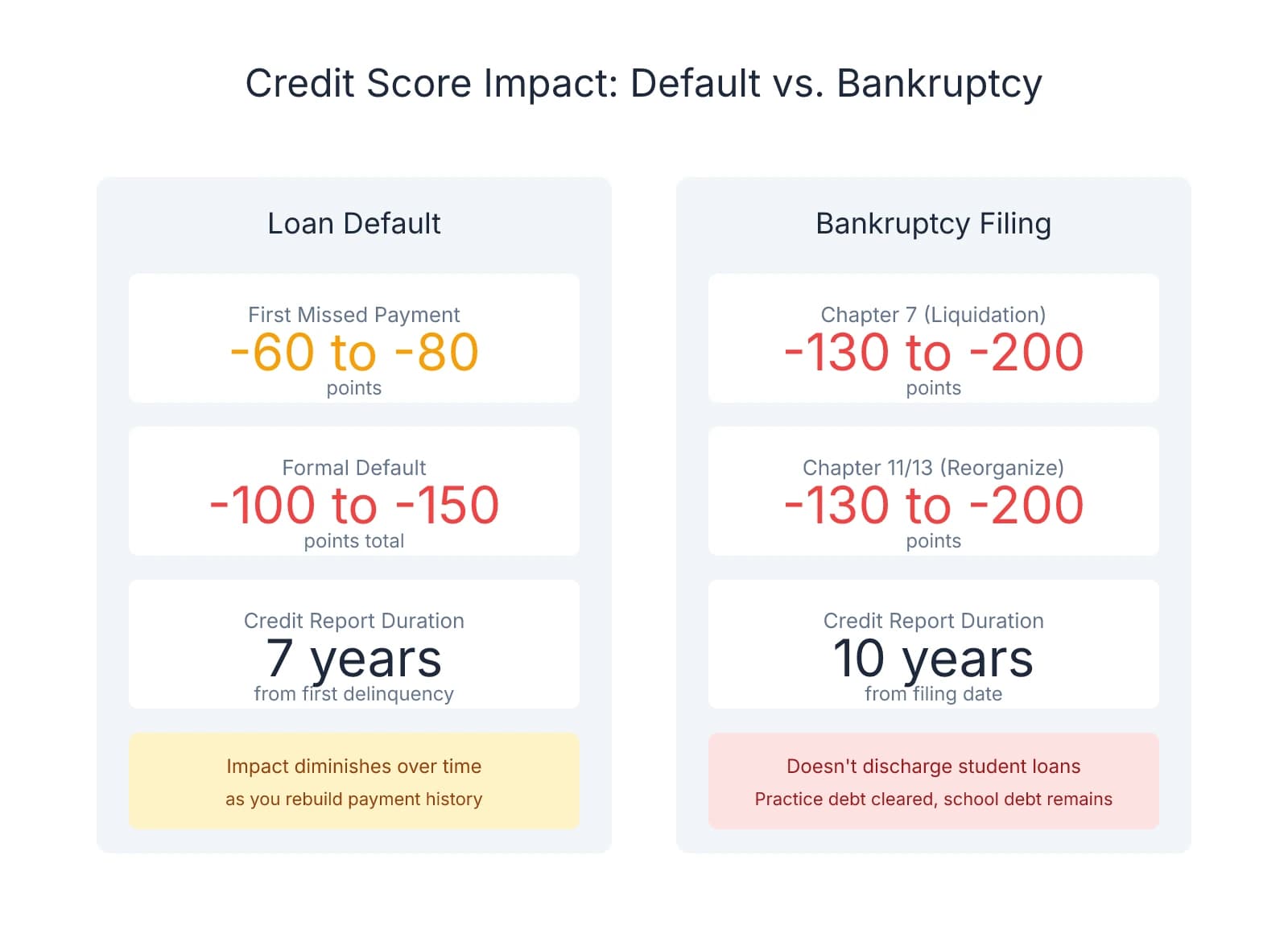
Credit score damage starts immediately and compounds over time. The first missed payment typically drops your score by 60-80 points. By the time you reach formal default, expect a total decline of 100-150 points from your pre-delinquency baseline. This affects both your personal credit (since you signed a personal guarantee) and your business credit profile. The default itself remains on your credit report for seven years from the date of first delinquency. A bankruptcy filing extends that timeline to 10 years. What catches most buyers off guard is how this damage affects unrelated financial decisions: you'll face higher interest rates on auto loans, increased insurance premiums, difficulty qualifying for a mortgage, and even challenges renting commercial space for a future practice.
Future financing becomes significantly harder, even after you've resolved the defaulted loan. Lenders view a practice loan default as evidence that you couldn't manage the financial demands of ownership, which makes them hesitant to extend credit again. If you eventually want to buy another practice, expand into a second location, or finance major equipment upgrades, you'll face higher interest rates, lower loan-to-value ratios, and more stringent collateral requirements. Many lenders have internal policies that automatically decline applicants with a default in the past 5-7 years, regardless of your current financial position.
Bankruptcy options exist, but each comes with specific tradeoffs depending on whether you're trying to save the practice or exit entirely. Chapter 7 bankruptcy liquidates both business and personal assets to pay creditors, then discharges remaining unsecured debt. This is the fastest path to eliminating practice acquisition debt—typically 4-6 months from filing to discharge—but you lose the practice and any non-exempt personal assets in the process. Chapter 11 bankruptcy (or Subchapter V for small businesses) allows you to reorganize debt and continue operating while you repay creditors under a court-approved plan. This keeps the practice open, but requires demonstrating to the bankruptcy court that your reorganization plan is feasible and that creditors will recover more than they would in liquidation. Chapter 11 is expensive—legal fees often run $50,000-$100,000—and the reorganization process can take 3-5 years. Chapter 13 bankruptcy restructures personal debt (not business debt) into a 3-5 year repayment plan, which can be useful if your practice loan is personally guaranteed but the business itself remains viable. One reality that surprises most dental practice owners: bankruptcy doesn't discharge federal student loans, which means if you're carrying $300,000 in dental school debt alongside a defaulted practice loan, bankruptcy eliminates the practice debt but leaves the student loans intact.
The timeline for credit recovery is longer than most buyers expect. Defaults remain on your credit report for seven years, but the score impact diminishes gradually as the default ages and you rebuild positive payment history. Bankruptcy filings stay on your report for 10 years, though the score impact typically peaks in the first 2-3 years and improves as you demonstrate consistent financial management afterward. Rebuilding credit requires opening new credit accounts (often starting with secured credit cards), maintaining on-time payments across all obligations, and keeping credit utilization below 30%.
Acting early—while you're delinquent but not yet in default—preserves the most options and minimizes long-term damage. Once you cross into formal default, the lender's legal rights expand significantly, your negotiating leverage shrinks, and the credit damage accelerates. The difference between a 90-day delinquency that you resolve through forbearance and a full default that leads to foreclosure is often just one phone call to your lender. The moment you realize you can't make a payment, assemble a team: a CPA who can model your cash flow and present a credible workout plan, an attorney who understands your loan agreement and can negotiate with the lender, and possibly a practice broker if selling becomes the better option. These professionals cost money upfront, but they prevent decisions that cost significantly more in the long run.
If you're facing payment trouble right now, the best time to act was three months ago. The second-best time is today, before delinquency becomes default and before your options narrow to bankruptcy or foreclosure. Pull your loan documents, calculate how much runway you have before formal default, and contact your lender with a plan—not an apology.
Sources & References
The data and claims in this article are drawn from the following sources. We prioritize government data, peer-reviewed research, and established industry publications to ensure accuracy.
- Business loan default: What happens if you miss a payment? | Mercury— mercury.comIndustry
- Business loan default: What happens if you miss a payment? | Mercury— mercury.comIndustry
- Navigating the Loan Default Process for Businesses: How to Handle It— www.forvismazars.us
- Understanding the Business Loan Personal Guarantee: A Complete ...— commonsllc.com
- Liquidation Process | U.S. Small Business Administration - SBA— www.sba.govGovernment
- Navigating Defaulted Small Business Administration (SBA) Loans— www.mccmlaw.com
- SBA Loan Default: Credit Score Impact | ClearlyAcquired— www.clearlyacquired.com
- How long does information stay on my credit report?— www.consumerfinance.govGovernment
Frequently Asked Questions
Explore Your Options Beyond Loan Struggles
If loan payments are straining your practice finances, it might be time to consider a fresh start. Minty Plus connects you with experts who can guide you through practice transitions and help you find a sustainable path forward.