Buying a Dental Practice That Does Procedures You Don't Perform

Co-Founder, Minty Dental

In Summary
- Revenue dependency is the critical metric — if 15-20% or more of collections come from procedures you can't perform, you need a concrete transition plan before closing
- Three pathways exist: invest in continuing education to learn the procedures, build a referral network and accept revenue loss, or hire an associate who can perform them
- Each pathway carries different cash flow implications and timelines that directly affect deal structure, financing terms, and your first-year operating budget
- The question isn't whether you should buy — it's how you protect or replace the revenue those procedures generate
A Skill Gap Changes the Acquisition Equation, Not Whether You Should Buy
When you find a practice that checks most of your boxes but generates 25% of its revenue from procedures you don't currently perform, the instinct is often to walk away. But many successful acquisitions involve exactly this scenario. The difference between buyers who make it work and those who don't comes down to one thing: they quantify the revenue exposure before closing and build a specific plan to address it.
The question isn't "Can I do these procedures?" It's "What percentage of revenue depends on them, and what's my plan to protect or replace that income?" Pull three years of production reports and break down revenue by procedure code. Calculate what percentage of collections would disappear if you referred those cases out on day one. If the number sits below 10-12%, the risk is manageable with minimal adjustment. Above 20%, you need a concrete strategy before you sign.
Most buyers navigate this gap through one of three pathways. The first is investing in continuing education and learning the procedures post-acquisition. General dentists can build profitable implant practices by starting with straightforward cases and gradually expanding their scope — but this takes time, and your cash flow needs to hold while you're learning. The second pathway is building a referral network and accepting the revenue loss. You'll need to adjust your valuation expectations and negotiate based on what the practice will collect under your clinical model, not the seller's. The third option is hiring an associate or specialist who can perform those procedures from day one. This protects revenue but adds payroll overhead and requires you to manage another clinician before you've fully settled into ownership.
Each pathway has different cash flow implications, timeline considerations, and risk profiles that affect deal structure and financing. With that foundation in place, the next step is understanding exactly how much revenue is at stake.
How to Quantify Revenue Exposure During Due Diligence
The first step in managing a skill gap is knowing exactly how much revenue depends on procedures you don't perform. You need procedure-level production data broken down by CPT code for the past 24-36 months. Request a report from the practice management system that shows collections by procedure category: restorative, endo, oral surgery, implants, cosmetic. If the seller performs specialty work that other providers in the practice don't, ask for a provider-level breakdown as well.
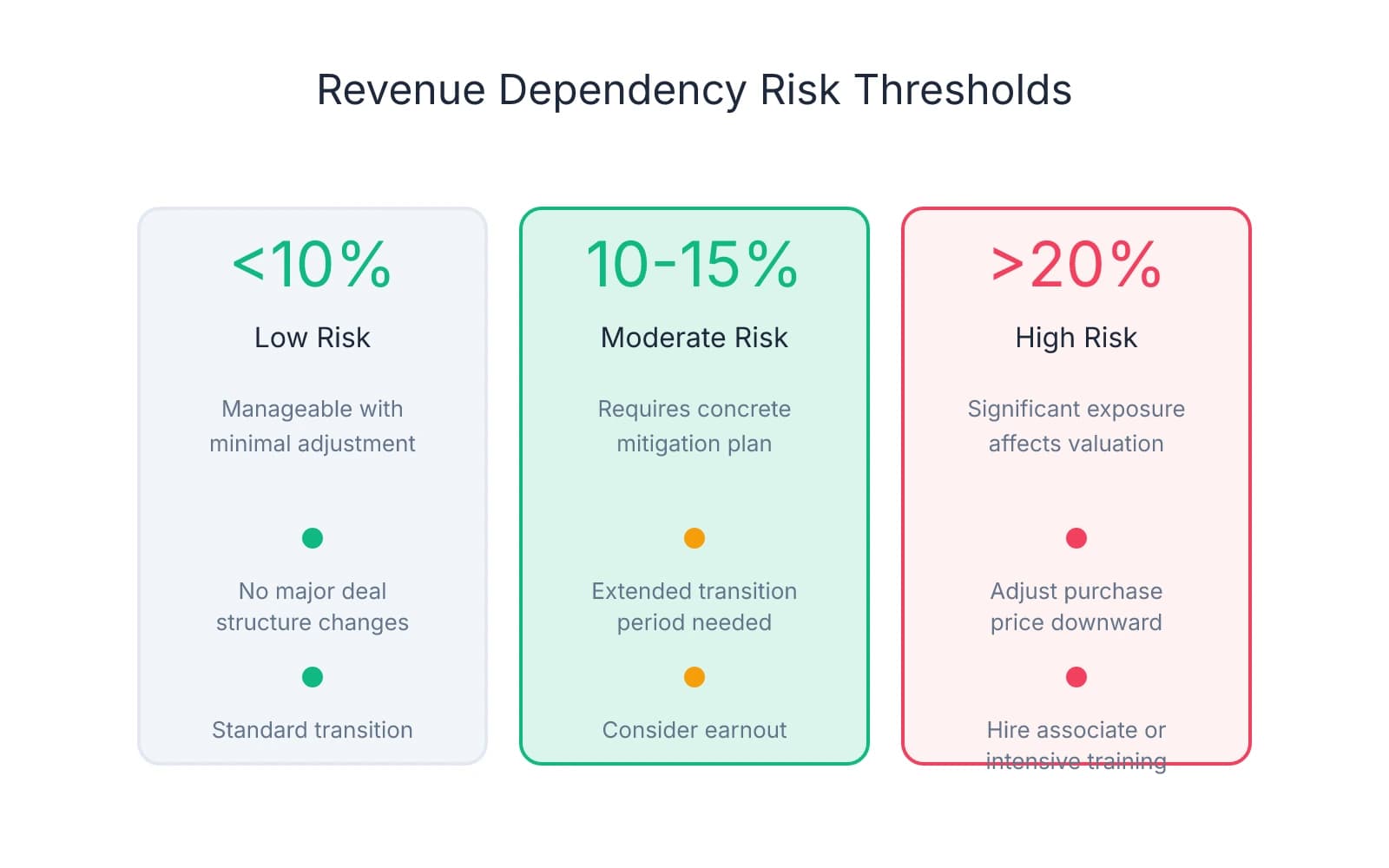
Once you have the data, calculate the percentage of total collections tied to procedures you can't perform. Take the annual collections for those procedure codes and divide by total practice collections. If the practice collected $750,000 last year and $135,000 came from implant placements, that's 18% revenue dependency. Where that percentage lands determines how you approach the deal. Under 10% is manageable with minimal adjustment. Between 10-15% requires a concrete plan but doesn't fundamentally change the deal structure. Above 20%, you're looking at significant exposure that affects valuation, cash flow projections, and whether the deal makes sense without immediate mitigation.
The next layer is distinguishing between seller-dependent procedures and practice-embedded procedures. Seller-dependent means only the selling dentist performs them — if they do all the endo in-house and no one else on the team can, that revenue walks out the door with them. Practice-embedded means patients expect those procedures as part of routine care, regardless of who's providing them. When you suddenly start referring crowns to a lab with a two-week turnaround instead of offering same-day service, patients notice. The distinction matters because embedded procedures carry higher attrition risk even if you can technically perform them — the patient experience changes, and some patients leave.
Patient attrition is the hidden cost most buyers underestimate. When a practice stops offering procedures that were previously done in-house, practices typically lose 15-25% of patients who were receiving those treatments. If 18% of your revenue comes from implants and you start referring them out, you're not just losing the implant revenue — you're losing the patients who came to the practice specifically because they could get comprehensive care in one location. The math gets worse fast: lose 20% of implant patients, and your 18% revenue dependency becomes a 22-23% revenue hit when you account for the hygiene and restorative work those patients also generated.
Run the numbers conservatively. If specialty procedures represent 15% of collections and you plan to refer them out, model a 20-25% attrition rate on those patients and calculate the downstream revenue loss. That adjusted figure is what you should use for cash flow projections and financing applications — not the seller's historical collections. One protection many buyers build in is a performance-based earnout tied to procedure revenue retention. If the practice collected $120,000 annually in endo and you're planning to learn it over 18 months, structure part of the purchase price as an earnout that pays the seller only if endo revenue stays above $90,000 during that transition period.
Your Three Options: Learn, Refer, or Hire
Once you've quantified the revenue exposure, the next decision is how you're going to address it. Each pathway has different financial implications, timeline constraints, and risk profiles that directly affect your first-year cash flow and deal structure.
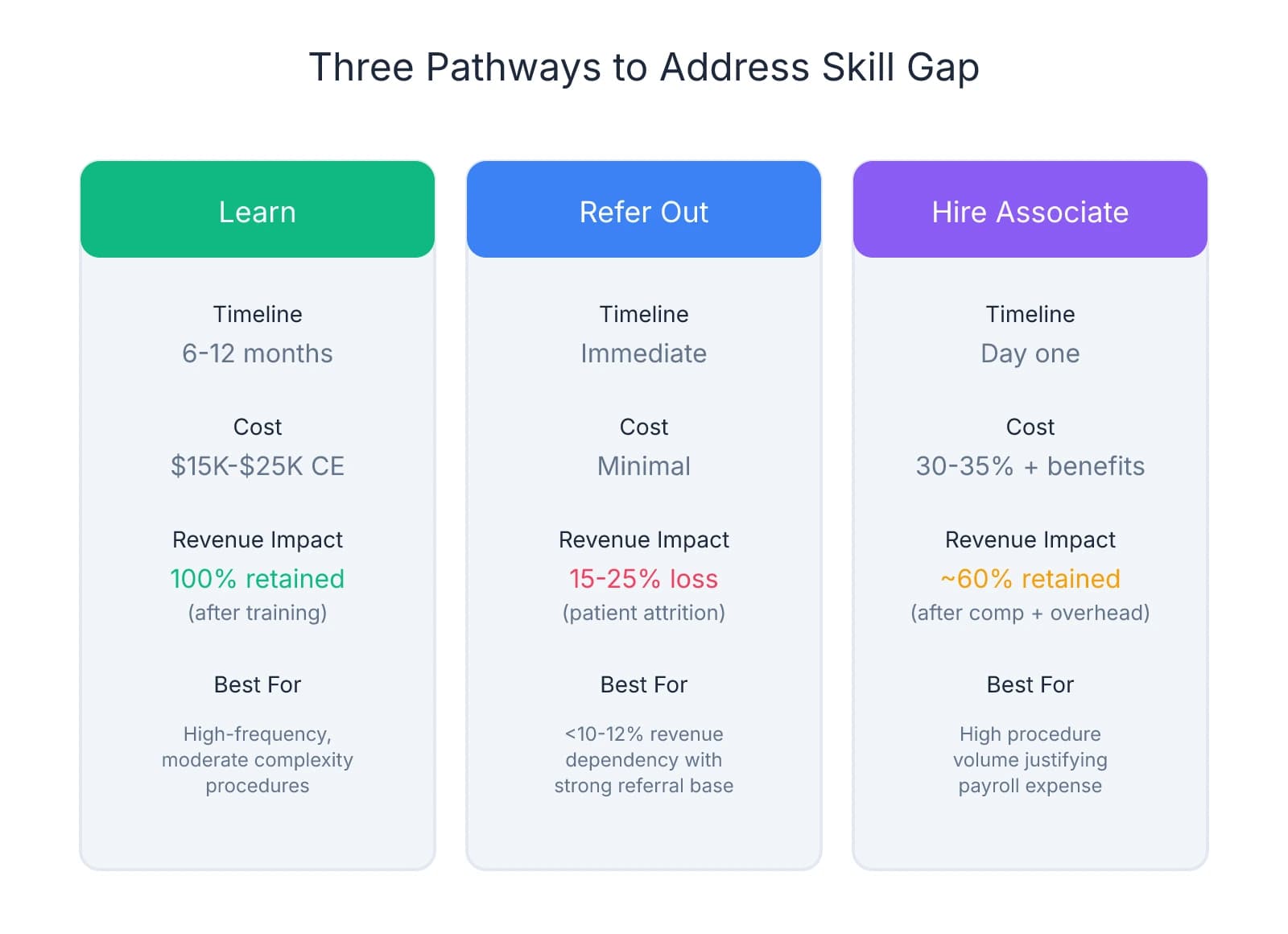
The learning pathway works best when the procedures in question are high-frequency but moderate complexity — think anterior endo, single-tooth implants, or molar buildups. Continuing education for procedures like molar endodontics typically takes 6-12 months of coursework plus supervised practice before you're confident enough to keep cases in-house. Implant training programs for general dentists often follow a similar timeline. The upside is you retain 100% of the revenue once you're proficient. The downside is the revenue gap during that learning period — you're still referring cases out while you're building competency, which means 6-12 months of reduced collections right when your debt service payments are highest.
One pattern that works well is starting with lower-complexity cases and gradually expanding scope. If the practice does 40 single-tooth implants annually and 15 full-arch cases, learn single-tooth placement first and continue referring the complex cases until your volume justifies hiring a specialist. The financial trade-off is straightforward: CE courses and mentorship typically cost $15,000-$25,000 for a full implant curriculum, but if you're recapturing $80,000-$100,000 in annual implant revenue, the ROI is clear within the first year.
The referral pathway makes sense when specialty procedures represent less than 10-12% of collections and the practice's core value sits in hygiene, restorative, and patient relationships — not comprehensive care. Referring out protects you from performing procedures you're not trained for, but the revenue loss is real. Expect to lose 15-25% of patients who valued the convenience of one-stop care, plus 100% of the revenue from those procedures.
Where this pathway works is when you can build a strong referral network that keeps patients loyal to your practice even when they're seeing a specialist. One approach many buyers use is co-managing cases with trusted specialists — you diagnose, refer for the procedure, and bring the patient back for restorative work. This keeps the patient relationship anchored to your practice and reduces attrition. The key is setting expectations early: patients need to understand that you're referring them to a specialist because you want them to get the best possible outcome.
The hiring pathway protects revenue from day one but adds payroll overhead before you've stabilized cash flow. An associate or specialist typically costs 30-35% of their production plus benefits, which means the practice needs enough procedure volume to justify the expense without straining your debt service. If the practice generates $120,000 annually in implant revenue and you hire an associate at 32% of production, you're paying $38,400 in compensation plus another $8,000-$12,000 in benefits and payroll taxes. That leaves you with roughly $70,000 in net revenue from implants — better than losing it entirely, but only if the volume is consistent enough to keep the associate busy.
Before you hire, calculate whether the procedure revenue justifies the cost. If specialty work represents 18% of collections but hiring an associate eats up 12% of collections in compensation and overhead, you're only netting 6% — which may not be worth the complexity of managing another clinician during your first year of ownership.
Most buyers don't pick one pathway exclusively — they use a hybrid approach. Learn high-frequency, lower-complexity procedures like anterior endo or simple extractions while referring complex cases like full-arch implants or surgical endo until volume justifies hiring. If you're planning a hybrid approach, map out which procedures you'll learn first, which you'll refer, and at what revenue threshold hiring makes sense. That roadmap becomes part of your financing application and your first-year operating plan.
Structuring the Deal to Account for the Skill Gap
The skill gap shouldn't just inform your clinical plan — it should directly shape your deal structure, valuation negotiations, and transition terms. When 20% or more of revenue depends on procedures you can't perform, that's not just a post-closing problem. It's a valuation issue that belongs in your letter of intent, a cash flow risk that affects your financing terms, and a transition planning consideration that determines how long the seller stays involved.
Start with valuation. If the practice collected $850,000 last year but $170,000 came from implant placements you'll be referring out, you're not buying an $850,000 practice — you're buying a practice that will collect closer to $680,000-$720,000 under your clinical model once you account for procedure loss and patient attrition. The price should reflect what the practice will realistically generate given your scope of practice, not what it generated under the seller's. When you're negotiating what to include in your letter of intent, lead with adjusted revenue projections and request a valuation based on your expected collections, not the seller's trailing twelve months.
One structure that protects both sides is an earnout tied to procedure revenue retention. If the practice historically generated $140,000 annually in endodontic revenue and you're planning to learn endo over the next 12-18 months, structure part of the purchase price as a performance-based payment that triggers only if endo collections stay above a defined threshold during your transition period. Earnout agreements work particularly well when the seller has clinical expertise you need — they stay financially invested in your success, which often translates to better mentorship and referral introductions.
Transition planning becomes more critical when a skill gap exists. The standard 30-60 day seller transition rarely gives you enough time to build referral relationships, shadow complex cases, or get comfortable with procedures you're learning. Request a 90-120 day transition period with defined responsibilities: the seller stays involved for clinical consultation, introduces you to key referral partners, and remains available for patient communication during the first quarter. This extended timeline protects revenue and reduces patient attrition, but it only works if the seller is genuinely committed — which is why tying part of their payout to transition performance makes sense.
Contingencies in the purchase agreement give you a safety net if revenue drops more than expected. One clause many buyers include is a price renegotiation trigger if patient attrition exceeds normal benchmarks during the first 6-12 months. This isn't about penalizing the seller — it's about protecting yourself from unforeseen attrition that makes the deal unworkable.
Transparency with the seller about your clinical limitations almost always leads to better deal structure. Sellers who know you're planning to refer implants out or spend 12 months learning endo are more likely to offer flexible terms, stay involved longer, or structure earnouts that protect both sides. Be direct in your initial conversations: "I don't currently place implants, but I'm planning to complete training within 18 months. How do you think patients will respond if I refer cases out during that period?" That question opens a conversation about transition support, referral introductions, and deal structure that balances risk and flexibility for both parties.
Before you finalize the deal, map out your first 90 days with specific milestones tied to revenue protection. Which procedures will you start learning immediately? Which referral relationships do you need the seller to facilitate in week one? At what point will you evaluate whether hiring an associate makes sense? Lenders want to see that you've thought through the revenue risk and have a concrete plan to mitigate it — dentists maintain one of the lowest default rates among healthcare borrowers, which helps support favorable lending conditions when buyers demonstrate clear risk mitigation strategies. The clearer your plan, the easier both conversations become.
Sources & References
The data and claims in this article are drawn from the following sources. We prioritize government data, peer-reviewed research, and established industry publications to ensure accuracy.
- How To Start A Profitable Dental Implant Practice— hiossen.comIndustry
- Buying or Selling a Dental Practice, Start with an Accurate Valuation— ada.orgIndustry
- Understanding Deal Structures in Dental Practice Transactions— ctc-associates.com
Frequently Asked Questions
Ready to acquire your ideal practice?
Expanding into new procedures doesn't have to mean going it alone. Minty Plus provides expert guidance through every stage of practice acquisition, helping you navigate skill gaps and build confidence in your new investment.