Declining Revenue Doesn't Always Mean a Bad Dental Practice Buy

Co-Founder, Minty Dental

In Summary
- Practices often show 1-3 years of declining revenue before sale because sellers mentally check out — reduced hours, deferred marketing, and neglected systems create reversible operational problems, not broken fundamentals
- Practices lose 17% of patients annually to natural attrition; when sellers stop replacing them through marketing and recall, decline accelerates rapidly even as overhead costs remain fixed
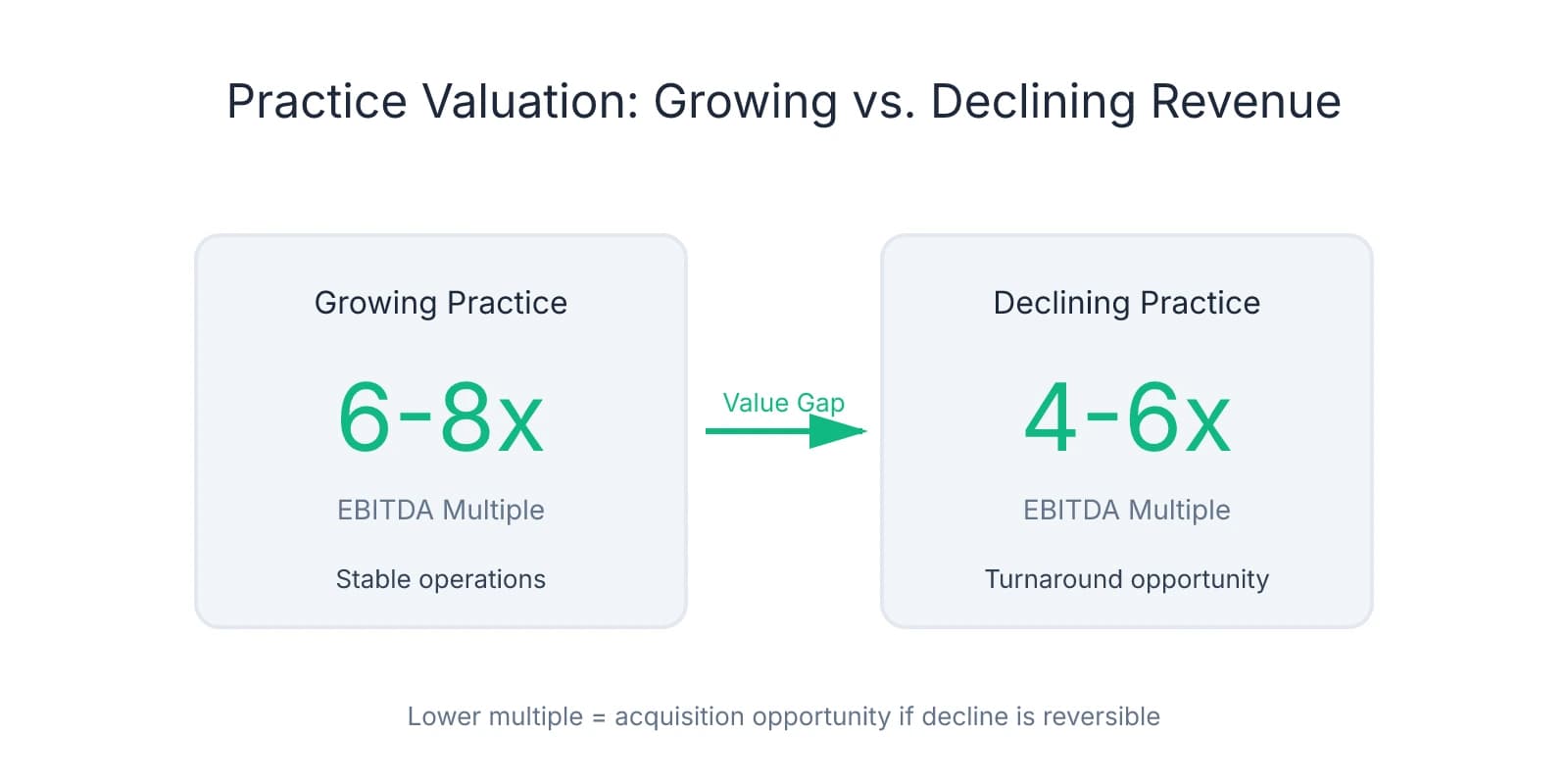
- Declining-revenue practices typically sell at 4-6x EBITDA versus 6-8x for growing practices, creating value opportunities for buyers who can execute operational improvements
- The critical distinction: decline driven by seller behavior (fixable through competent management) versus market contraction (structural problem you can't outwork)
- Due diligence should focus on three questions: Is the patient base intact? Are systems neglected or broken? Is the local market stable or contracting?
Declining Revenue Often Reflects the Seller's Exit, Not the Practice's Potential
When you see three consecutive years of declining production, the instinct is to walk away. Revenue trending down feels like a red flag you can't ignore. But what looks like a failing practice is often a profitable business run by someone who's already left mentally.
The pattern shows up consistently: a seller decides to retire, and in the 18-36 months before listing, production starts sliding. Not because patients are leaving the area or a competitor opened across the street, but because the owner stops doing the work that keeps a practice growing. Clinical hours get reduced. Marketing budgets disappear. Hygiene recall systems that used to run automatically now rely on manual follow-up that never happens. Staff sense the transition coming and start looking elsewhere.
Practices lose roughly 17% of their patient base annually to natural attrition — patients moving, switching insurance, or drifting away. When a practice is actively managed, that loss gets replaced through consistent marketing, referral cultivation, and patient reactivation. When the seller checks out, replacement stops. The 17% annual loss compounds. A practice seeing 35 new patients per month drops to 20, then 15. Existing patients don't get recall reminders. Hygiene schedules thin out. Revenue follows.
What makes this dynamic valuable is that overhead costs remain largely fixed — most expenses don't scale down when production drops. The lease, staff salaries, software subscriptions, and equipment costs stay the same whether the practice produces $800,000 or $650,000 annually. This creates compressed margins for the seller, but it also means a buyer who restores normal operations can see profit margins expand quickly without major capital investment.
The pricing reflects this. Practices with declining revenue typically sell at 4-6x EBITDA, compared to 6-8x for practices showing steady growth. If the decline is driven by seller behavior rather than market fundamentals, that discount represents real acquisition value — you're buying at a lower multiple because the seller created a temporary operational problem, not a permanent structural one.
The distinction matters. A practice declining because the seller reduced hours from five days to three is fundamentally different from one declining because the surrounding neighborhood is emptying out or a DSO opened a high-volume clinic nearby. One is reversible with competent management. The other isn't.
Three Due Diligence Questions That Reveal Whether the Decline Is Fixable
The difference between a turnaround opportunity and a money pit comes down to three diagnostic questions. Each one separates seller-driven decline from structural problems you can't fix.
Is the Patient Base Still Intact, or Has Attrition Been Permanent?
Pull the practice management software and look at two numbers: active patient count over the last 36 months, and patient retention rate for the trailing 18 months. Active patients are defined as anyone who completed a procedure in the last three years. Retention rate measures what percentage of that active base returned for an exam within 18 months.
The average practice retains 57% of its patient base. Top performers hit 99%. If the practice sits at 40% retention but still has 1,200 active patients in the system, that's fixable — those patients haven't left the area, they've just stopped coming in. A structured recall system and consistent outreach can reactivate a significant portion within 6-12 months.
Check the zip code distribution of the patient base against local population data. If 70% of patients live within a five-mile radius and that area's population has remained stable or grown, the decline is likely operational. If the patient base is geographically scattered or concentrated in areas experiencing population loss, reactivation becomes much harder.
One pattern worth watching: practices with declining revenue but stable new patient counts. If the practice is still bringing in 25-30 new patients per month but total active patients are dropping, that signals a retention problem, not a market problem. New patients are still finding the practice — existing patients just aren't staying. That's a system issue, and system issues can be rebuilt.
Are the Systems Neglected but Salvageable, or Fundamentally Broken?
Walk through the practice's operational infrastructure assuming you're inheriting it as-is. Look specifically at three areas: hygiene recall, treatment plan acceptance, and scheduling protocols.
For hygiene recall, ask to see the system in action. Is there an automated recall process, or does someone manually call patients? How many patients are overdue for hygiene visits right now? If the answer is "we're not sure" or "probably a few hundred," that's a neglected system, not a broken one. The infrastructure exists — it's just not being used. Compare that to a practice where no recall system was ever implemented, or where the hygiene schedule has been running at 40% capacity for two years because the hygienist left and was never replaced. The first scenario is a software configuration and staff training problem. The second is a structural gap requiring hiring, onboarding, and rebuilding patient trust.
Treatment acceptance follows a similar pattern. Pull the last 12 months of treatment plans and calculate what percentage were accepted and scheduled. If acceptance rates are sitting at 30-40% when the industry benchmark is closer to 60-70%, ask why. Is it because the seller stopped presenting comprehensive treatment plans and started offering only emergency care? Or is it because the practice never developed a case presentation process in the first place? The former is reversible — you're just restoring a capability the practice used to have. The latter requires building something new.
Hygiene production ratio offers another diagnostic signal. If hygiene is producing 25-30% of total revenue, the infrastructure is intact even if underperforming. If hygiene is producing 10-15%, that suggests either the hygiene schedule has collapsed or the practice never built a preventive care model to begin with.
Is the Local Market Stable, or Are Demographic Forces Driving the Decline?
Revenue decline in a growing market is an opportunity. Revenue decline in a contracting market is a warning. Pull census data for the practice's primary zip codes and look at population trends over the last five years. If the area is growing or stable, the decline is almost certainly practice-specific. If the area has lost 10-15% of its population, or if median household income has dropped significantly, you're fighting demographic headwinds that won't reverse when you take over.
Check for new competition that's materially changed the market. A single new practice opening nearby rarely causes sustained decline — patients don't switch dentists casually. But a DSO opening a high-volume clinic with aggressive marketing and extended hours can pull enough patients to create permanent pressure. Look at how many dental practices have opened within a three-mile radius in the last 24 months, and whether they're targeting the same patient demographic.
One red flag that's hard to overcome: if the practice has lost 30%+ of its revenue over three years and the local market is also contracting, the turnaround becomes significantly harder. You're not just restoring operational discipline — you're trying to grow in an environment where fewer patients exist and more dentists are competing for them. That doesn't mean the deal is impossible, but it does mean your margin for error is much smaller and your timeline to profitability is longer.
Where buyers often get burned is assuming they can outwork a bad market. If the seller reduced hours and revenue dropped 20%, you can reverse that by working full-time. If the seller worked full-time and revenue dropped 20% because the local economy collapsed, working harder won't change the outcome. The market sets the ceiling — your operational skill determines how close you get to it.
What Buyers Can Fix Quickly Versus What Takes Years to Rebuild
Not all turnarounds take the same amount of time or capital. Some operational problems respond to immediate intervention. Others require sustained effort, significant investment, and patience measured in years.
Quick Wins: 6-12 Months
The fastest improvements come from reactivating dormant systems that used to work but stopped being used.
Reactivating lapsed patients sits at the top of this list. Most practices have 200-400 patients who completed treatment within the last three years but haven't scheduled anything in the last 12-18 months. A structured recall campaign — combining automated reminders, personal outreach, and limited-time hygiene promotions — can bring 15-25% of that group back within six months. The cost is minimal: staff time and basic marketing software. The return is immediate: hygiene appointments that lead to restorative treatment.
Filling schedule gaps follows a similar pattern. Many declining practices run with 20-30% of their appointment slots unfilled, not because demand doesn't exist, but because no one is actively managing the schedule. Implementing a same-day confirmation system, building a short-notice list for cancellations, and training front desk staff to offer multiple appointment options can increase utilization by 10-15 percentage points within 90 days.
Treatment acceptance protocols also respond quickly to structured intervention. If the practice is diagnosing treatment but patients aren't moving forward, the problem is usually presentation, not clinical need. Training on case presentation, implementing payment plan options, and creating visual treatment plans can lift acceptance rates from 35-40% to 50-55% within six months.
Fee adjustments to market rates represent another immediate lever. If the practice hasn't raised fees in three years and is sitting 5-10% below regional benchmarks, a phased fee increase brings revenue up without changing patient volume. Most practices can implement a 3-5% increase with minimal patient resistance, especially if paired with improved service quality. This flows directly to the bottom line since the cost structure doesn't change.
One area that looks like a quick win but often isn't: staff compensation. If the seller kept wages flat for two years and you're inheriting underpaid staff, you'll likely need to make immediate adjustments to prevent turnover. This isn't optional — losing key staff during transition can erase any operational gains you make elsewhere.
Medium-Term Fixes: 12-24 Months
The next tier of improvements requires more time because you're rebuilding capabilities, not just reactivating them.
Hygiene production is the clearest example. The industry benchmark sits at 30-40% of total production coming from hygiene. Practices below 25% usually have a structural problem: inadequate hygiene staffing, poor recall systems, or a patient base that views hygiene as optional. Rebuilding this takes 12-18 months because you need to hire and train hygienists, implement recall protocols, educate patients on preventive care, and wait for the compounding effect of regular hygiene visits to show up in production numbers.
Case acceptance improvement from below-average to benchmark performance follows a similar timeline. Moving from 39% acceptance to 60-65% isn't just about better presentations — it requires building trust with patients, establishing consistent treatment planning processes, and creating a practice culture where comprehensive care is the standard.
Insurance fee schedule negotiations also sit in this category. If the practice is locked into low-reimbursement PPO contracts, renegotiating or dropping plans takes time. You need to analyze which plans are profitable, communicate changes to patients, and potentially absorb some patient loss while you transition to a better payer mix. Most practices need 12-18 months to execute this shift without destabilizing revenue.
Long-Term Challenges: 24+ Months
Some problems can't be solved quickly no matter how much capital or effort you apply.
Reputation recovery tops this list. If the practice has negative online reviews, unresolved patient complaints, or a history of poor clinical outcomes, rebuilding trust takes years. You can't delete the past — you can only create enough positive experiences to outweigh it. This means consistently delivering excellent care, actively soliciting reviews from satisfied patients, and waiting for the negative signals to age out of search results.
Equipment replacement creates a different kind of long-term challenge. If the practice is running on 15-year-old operatory equipment, outdated imaging systems, or failing sterilization infrastructure, you're looking at $100,000-$300,000 in capital expenditure. The financial burden isn't just the upfront cost — it's the debt service that reduces cash flow for 5-7 years.
Shifting from high PPO dependency represents one of the hardest operational pivots. If 80-90% of the practice's revenue comes from insurance plans with low reimbursement rates, moving to a fee-for-service or reduced-PPO model takes 2-3 years minimum. You need to build a patient base that values the practice enough to pay out-of-pocket, which requires marketing, service differentiation, and accepting slower growth during the transition. Many practices find that dropping insurance contracts only makes financial sense if they can replace lost patients with higher-value ones — and building that pipeline takes time.
One pattern stands out as particularly difficult: a practice where the seller has already completed all profitable treatment and the patient base is fully restored with no diagnosed work remaining. This happens when a seller decides to exit, works through the existing treatment backlog over 12-18 months, and then lists the practice. You're buying a patient base with clean teeth and no immediate revenue opportunities. This is harder to reverse than a practice with neglected hygiene because you're not reactivating dormant systems — you're waiting for new clinical needs to develop.
Structuring the Deal to Protect Yourself When Revenue Is Declining
The valuation conversation changes completely when revenue is trending down. Where a stable practice might command 6-8x EBITDA, a practice with three years of declining production typically trades at 4-6x — and that discount creates negotiating leverage you should use.
Start with the multiple itself. If the practice is producing $150,000 in EBITDA but revenue has dropped 20% over three years, a 6x multiple assumes you can reverse that decline immediately. A 4.5x multiple assumes you'll need 12-18 months to stabilize operations before growth resumes. The difference — $225,000 in this example — reflects the operational risk you're absorbing and the capital you'll need to fund the turnaround.
One structure that bridges valuation gaps: earnouts tied to revenue recovery milestones. Instead of paying the full purchase price at closing, you agree to pay 80-85% upfront and structure the remaining 15-20% as performance-based payments over the next 12-24 months. The earnout triggers when the practice hits specific revenue targets — typically returning to the baseline production level from 2-3 years ago. This aligns incentives: the seller has confidence you'll restore the practice, and you're protected if the decline turns out to be harder to reverse than due diligence suggested. Earnout structures work particularly well when both parties believe the decline is operational rather than structural, but disagree on how quickly it can be fixed.
Seller transition support becomes critical when systems have been neglected. A practice that's been running on autopilot for 18 months doesn't have documented protocols, trained staff, or institutional knowledge you can reference when problems surface. Structure 60-90 days of seller presence into the purchase agreement, with defined responsibilities: patient introductions, staff training on clinical protocols, system documentation, and availability for questions during the first few months. Where deals go sideways is when the seller shows up twice, answers a few questions, and disappears.
Working capital adjustments matter more in turnaround situations than stable acquisitions. Most purchase agreements include a working capital target — the amount of cash, accounts receivable, and inventory the practice should have at closing to operate normally. For a declining practice, that target needs to account for the capital you'll need to fund reactivation campaigns, marketing spend, and potential short-term cash flow gaps while you rebuild production. If the practice is sitting on $15,000 in working capital but you'll need $40,000 to execute a patient recall campaign and cover payroll during the first 90 days, negotiate a working capital adjustment at closing or structure a seller note that gives you access to capital when you need it.
Price renegotiation after due diligence becomes more common — and more justified — when revenue is declining. If due diligence uncovers issues the seller didn't disclose (equipment failures, unrecorded liabilities, patient complaints, staff planning to leave), those discoveries support a price adjustment. The declining revenue trend gives you additional leverage: you're already taking on operational risk, and newly discovered problems compound that risk.
There are situations where the right move is walking away entirely. If the seller can't explain why revenue declined — or worse, offers explanations that don't match the data — that's a signal the decline may be worse than presented. Financial records that show inconsistencies (production reports that don't reconcile with tax returns, missing months of data, unexplained expense spikes) suggest either poor recordkeeping or intentional obfuscation. Reviewing the seller's tax returns for the past three years confirms reported income and expenses, helping verify if stated revenue matches actual tax filings. Local market contraction — population loss, major employer closures, demographic shifts — creates headwinds you can't overcome through better management. And if you lack the operational experience to execute a turnaround, a declining practice isn't the place to learn. The margin for error is too thin.
The decision framework comes down to three variables: your operational skill, your capital reserves, and the practice's structural position. If you have the management experience to rebuild systems, the cash to fund 6-12 months of turnaround operations, and confidence that the decline is seller-driven rather than market-driven, a declining-revenue practice can deliver significant value. You're buying at a discount, inheriting fixed costs that don't scale with revenue, and positioned to capture margin expansion as production recovers. But if any of those variables is missing — you're a first-time buyer, you're stretching financially to close the deal, or the market fundamentals are deteriorating — the risk outweighs the opportunity.
Sources & References
The data and claims in this article are drawn from the following sources. We prioritize government data, peer-reviewed research, and established industry publications to ensure accuracy.
- How the Top 10% Dominate Dental Care: Patient Retention and ...— www.henryscheinone.comIndustry
- 3 Big Mistakes New Buyers Make When Evaluating a Dental Practice— practicecfo.comIndustry
- How to Turnaround a Practice - Dentistry Today— www.dentistrytoday.comIndustry
- WeCare Practice Management [TRANSFERRED]— www.drwecare.com
Frequently Asked Questions
Ready to turn around an underperforming practice?
Declining revenue doesn't disqualify a practice from being a solid investment. Minty Plus connects you with experienced advisors who specialize in identifying turnaround opportunities and guiding you through acquisition and post-close management to restore profitability.