When Should You Hire Your First Associate After Buying a Practice?

Co-Founder, Minty Dental

In Summary
- The right time to hire an associate is determined by patient demand and financial capacity, not by how overwhelmed you feel working four days a week
- An associate typically costs 45-50% of what they produce when you account for compensation (30-35% of production), additional staff time, supplies, and lab fees
- Key readiness indicators include 2,000+ active patients, 30-40 new patients per month, hygiene booked 4-6 weeks out, and 6-12 months of associate salary in cash reserves
- Hiring before the practice has enough volume means splitting the same revenue across two providers, which compresses your profit margin and can threaten financial stability
Hiring an Associate Isn't About How Busy You Feel—It's About Whether the Practice Can Support It
The instinct to hire when you're overwhelmed is understandable. You're working four or five days a week, the schedule feels packed, and you're wondering if another provider would give you breathing room. But that feeling doesn't tell you whether the practice can actually support an associate. Many new owners hire based on stress rather than capacity, and that's where profitability starts to erode.
An associate isn't just a salary. Compensation typically runs 30-35% of their production, but the real cost sits closer to 45-50% once you factor in additional staff time, supplies, and lab fees. If your practice doesn't have enough patient demand to keep that associate productive, you're not adding capacity—you're splitting the same revenue across two providers, which compresses your margin and puts pressure on the cash flow you need to service acquisition debt.
The question isn't whether you're tired of working full-time. It's whether the practice has clear capacity constraints that an associate would solve. Capacity shows up in specific ways: hygiene booked several weeks out, patients waiting longer than three weeks for restorative appointments, or new patient requests you can't accommodate. If those constraints aren't present, adding a provider won't increase revenue—it will just divide what's already there.
One pattern worth paying attention to is the number of active patients in the practice. Most experts agree that a single general dentist can effectively manage 1,000-2,000 active patients—defined as individuals seen within the last 18-24 months. If your active patient count sits below 2,000 and you're not consistently adding 30-40 new patients per month, the practice likely doesn't have the volume to support another provider yet. New patient flow matters because it signals whether demand is growing or static. A practice adding fewer than 30 new patients monthly may struggle to keep an associate's schedule full, especially in the first 90 days after you take ownership.
Financial readiness is the other half. Even if the practice has the patient volume, you need enough cash reserves to cover an associate's salary for 6-12 months while they ramp up production. That cushion protects you if the associate takes longer to build their schedule or if patient flow dips temporarily. Without it, you're betting on immediate productivity—a risk that can jeopardize how quickly your acquisition breaks even.
The right time to hire is when the practice has the patient demand, operational capacity, and financial margin to make an associate profitable from the start. If those conditions aren't in place yet, focus on growing the practice's volume and strengthening its cash position before adding another provider to the payroll.
Four Capacity Signals That Tell You It's Time
Capacity isn't a feeling—it's a set of measurable conditions that tell you the practice has more demand than one provider can handle. The answer sits in four specific metrics: active patient count, new patient flow, hygiene schedule density, and your restorative booking window. These signals should converge. One full schedule doesn't justify an associate if the other indicators aren't there.
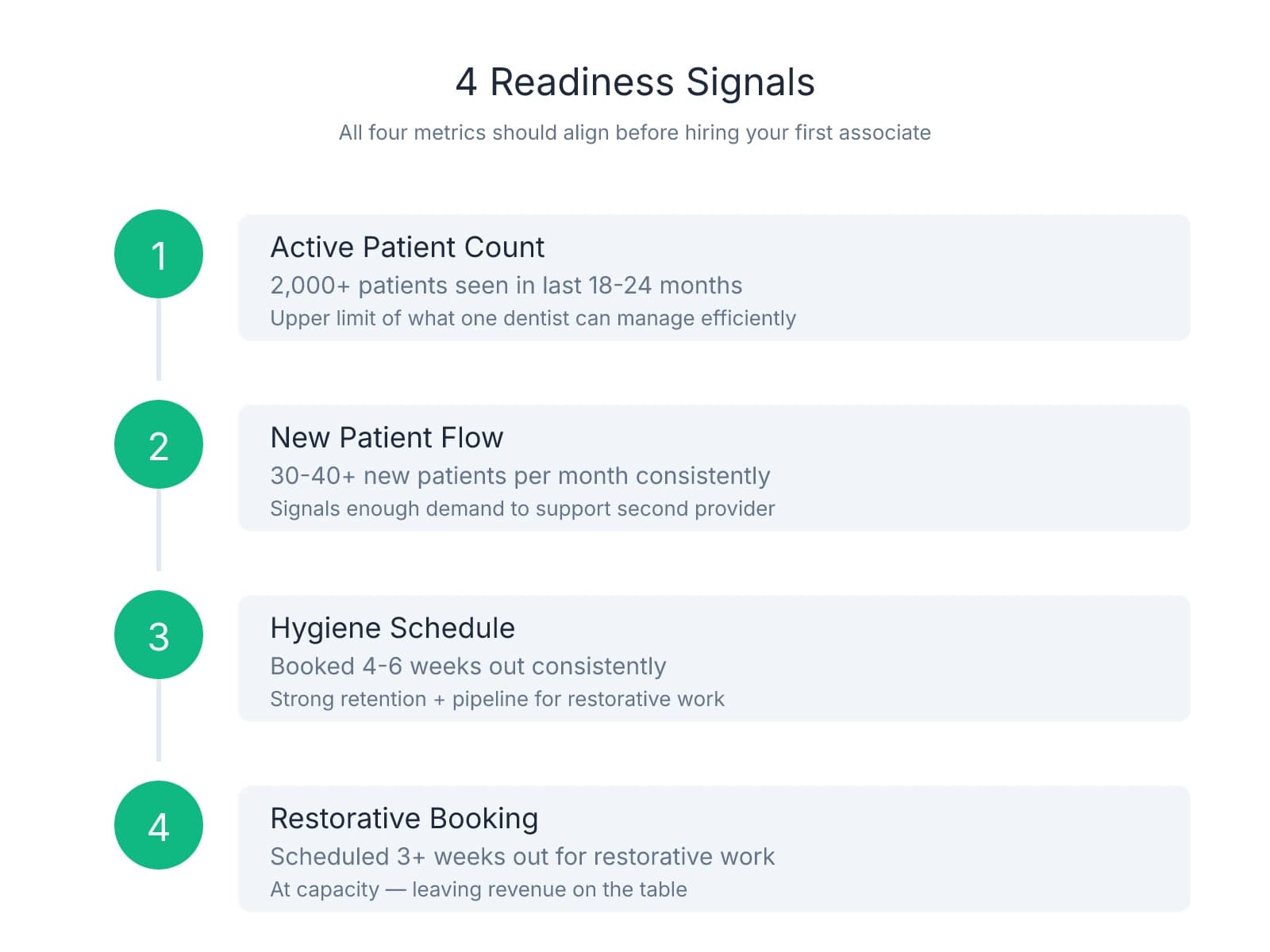
Active patient count: The threshold most practices hit is 2,000+ patients seen in the last 18-24 months. Below that number, a solo provider can typically manage the workload without turning patients away or pushing appointments beyond three weeks. Once you're consistently above 2,000 active patients—and those patients are scheduling regular hygiene and restorative visits—you're approaching the upper limit of what one dentist can handle efficiently. This isn't about total patients of record. It's about the subset actively using the practice, which drives the actual demand on your schedule.
New patient flow: If you're adding 30-40+ new patients per month and can't absorb them without pushing existing patients further out, that's a demand signal. Practices adding fewer than 30 new patients monthly often struggle to keep an associate's schedule full, especially in the first six months. Consistent new patient flow above 35-40 per month suggests the practice has enough inbound demand to support a second provider without cannibalizing your existing schedule. This metric also tells you whether the practice's marketing and referral base are strong enough to sustain growth—or whether you're just redistributing the same patient pool.
Hygiene schedule: When hygiene is booked 4-6 weeks out, it signals two things: strong patient retention and a pipeline for restorative work. Hygiene isn't just a revenue center—it's the engine that feeds your restorative schedule. If hygiene is consistently full and you're losing opportunities to schedule larger cases because there's no room to fit patients in for exams or follow-ups, that's a bottleneck. A practice with hygiene booked only 1-2 weeks out may not have the patient density to justify an associate yet.
Your restorative schedule: If you're booked 3+ weeks out for restorative work and can't accommodate acute needs, emergency cases, or larger treatment plans without delaying other patients, you're at capacity. This is the point where you're leaving revenue on the table—not because you're inefficient, but because there aren't enough hours in the week to see everyone who needs treatment. One pattern worth paying attention to: a practice booked far out may signal inefficiency or poor scheduling, not true capacity. If your schedule is full but your production per day is below benchmark, the issue isn't volume—it's how the day is structured.
These four signals should appear together. A practice with 2,500 active patients but only 20 new patients per month may not have the growth trajectory to keep an associate productive. A practice with hygiene booked six weeks out but a restorative schedule that's only two weeks full may have a treatment acceptance problem, not a capacity problem. When all four metrics align—high active patient count, strong new patient flow, full hygiene schedule, and a restorative booking window beyond three weeks—that's when the practice has the demand to support another provider.
One step many buyers find valuable is tracking these metrics for 3-6 months after taking ownership. Patient flow can shift during a transition, and what looked like capacity during due diligence may stabilize at a lower level once you're running the practice. Before adding an associate, verify that you have enough patients to fill an additional schedule and that systems and staff are in place to support another doctor. If the signals hold steady or strengthen over that period, you're in a stronger position to hire.
The Real Cost of Hiring Too Early (and What It Does to Your Cash Flow)
The headline cost of an associate—30-35% of production—understates what you're actually committing to. When you account for the full expense structure, an associate typically costs 45-50% of what they produce. That includes compensation, but also the additional staff time needed to support them (usually 1-2 assistants at $40,000-$80,000 annually), plus the lab and supply costs that scale with their clinical activity—typically around 13-15% of their production. If your associate produces $400,000 in their first year, you're looking at $180,000-$200,000 in total cost, not just the $120,000-$140,000 in direct compensation.
The problem emerges when the practice doesn't have incremental demand to support that production. If your practice currently produces $1 million annually and you hire an associate who produces $400,000, but there's no new patient volume to drive that growth, you're not adding $400,000 in revenue—you're splitting the same $1 million across two providers. The associate takes $400,000, you keep $600,000, and both of you are now working at a lower margin because the fixed costs of the practice haven't changed. Rent, software, insurance, and base staffing costs are the same whether one dentist or two are producing. You've just added variable costs without adding revenue.
This is where marginal profitability matters. Once your fixed costs are covered—typically in the first 60-65% of monthly collections—incremental revenue can be 80%+ profitable. Each additional dollar collected after that point is subject primarily to variable costs like lab fees and supplies. But if you hire before you have incremental demand, you're not capturing that high-margin revenue—you're reallocating existing revenue at a lower margin. A practice with strong capacity constraints can add an associate and see profit increase even as overhead percentage drops. A practice without those constraints sees profit compress because the same revenue is now supporting two providers instead of one.
The ramp-up period makes this risk more acute. Most associates take 6-12 months to reach full productivity as they build patient relationships and earn referrals from hygiene. During that period, you're paying their salary while they're producing below their potential. If you don't have 6-12 months of associate salary in cash reserves, you're betting on immediate productivity—and that patient flow won't dip during the transition. For buyers still servicing acquisition debt, that's a bet that can threaten debt service coverage if the associate's production doesn't materialize quickly enough.
One pattern that surfaces repeatedly is tension between the owner and the associate when there aren't enough patients to keep both schedules full. The associate sits idle or sees only emergency cases, which creates frustration and often leads to turnover. Recruiting and onboarding a new associate costs $15,000-$30,000 when you factor in advertising, interviews, credentialing, and training time. If the associate leaves within the first year because there wasn't enough work to keep them engaged, you've absorbed that cost without gaining the capacity you needed.
The decision to hire should be driven by whether the practice has enough demand to keep an associate productive from month one—not whether you feel overworked. If your associate compensation structure is tied to production and the practice doesn't have the volume to support it, you're not solving a capacity problem. You're creating a cash flow problem that can take months to recover from.
What to Do First: Build Capacity Before You Hire
The first move isn't to post a job listing. It's to optimize what you already have. Many practices operate with significant inefficiency—gaps in the schedule, low treatment acceptance, hygiene that isn't feeding restorative work to the doctor's chair. If your treatment acceptance rate sits below 80%, you're leaving revenue on the table that an associate won't recover. The same patients who decline treatment from you will likely decline it from an associate. Before you add another provider, focus on improving case presentation, refining your communication around treatment value, and addressing the friction points that cause patients to defer care.
Schedule optimization is the next lever. A practice with consistent gaps, frequent no-shows, or blocks of unproductive time isn't at capacity—it's poorly structured. One step many buyers find valuable is auditing the schedule for patterns: Are certain appointment types consistently running over? Are patients being scheduled too tightly, creating stress for the team and delays? Are emergency slots being used efficiently, or sitting empty most days? Tightening the schedule to reduce gaps and improve patient flow can often add 10-15% more productive time without hiring anyone. That's the equivalent of adding half a day per week—enough to absorb more patients and delay the need for an associate by 6-12 months.
Hygiene productivity is another area where capacity often hides. If hygiene isn't consistently diagnosing and scheduling restorative work, you're not maximizing the patient base you already have. Hygienists should be identifying treatment needs during every visit and handing off warm leads to the doctor's schedule. If that handoff isn't happening—or if patients are leaving hygiene appointments without a clear next step—you're losing opportunities to fill your restorative schedule with work that's already in the practice. Improving this process doesn't require hiring. It requires training, communication protocols, and accountability.
Before you hire, the systems need to be in place. That means clear clinical protocols so the associate knows how you want cases diagnosed and treated. It means a defined onboarding process that integrates the associate into the team and introduces them to patients. It means a compensation structure that aligns with your payer mix and production model—whether that's a percentage of production, a daily rate, or a hybrid model. If you hire before these systems exist, the associate will struggle to integrate, and you'll spend more time managing the hire than you save.
Overhead is the final checkpoint. If your practice is running at 70%+ overhead, adding an associate won't fix the underlying profitability problem—it will amplify it. High overhead signals inefficiency in staffing, supply costs, or operational structure. An associate adds variable costs, which means your overhead percentage will likely increase unless the associate's production is high enough to offset it. If you're already operating on thin margins, address the overhead issue first—whether that's renegotiating supplier contracts, optimizing staffing levels, or improving production per visit—before layering in the cost of another provider.
Once the capacity signals align—active patient count above 2,000, new patient flow at 30-40+ per month, hygiene booked 4-6 weeks out, and your restorative schedule consistently full—and the systems are in place to support an associate, hiring becomes a strategic growth move. At that point, you're not reacting to stress. You're positioning the practice for sustainable expansion that protects the investment you just made. If you're considering whether to grow your first location or acquire a second practice, the same capacity and systems framework applies—growth only works when the foundation is solid.
Sources & References
The data and claims in this article are drawn from the following sources. We prioritize government data, peer-reviewed research, and established industry publications to ensure accuracy.
- Hiring an Associate Dentist: Timing & Key Metrics for Success— whalencpa.comIndustry
- Time for your dental practice to add an associate?— www.burkhartdental.com
- The Economics of Bringing on an Associate Dentist— focuspartners.comIndustry
- Adding an Associate: Up Goes Profit, Down Goes Overhead | Blog— profi2020.comIndustry
- Chaos to Calm: Reimagining Dental Scheduling to Prevent Staff ...— learn.flex.dentalIndustry
Frequently Asked Questions
Ready to scale your newly acquired practice?
Adding your first associate is a major milestone in practice growth. Minty Plus provides expert guidance on timing, hiring, and integration strategies to maximize your investment and patient care.