Can You Buy a Dental Practice with $400K in Student Loans?

Co-Founder, Minty Dental

In Summary
- Lenders approve practice loans based on your monthly debt payments relative to income, not your total student loan balance—a $400K balance with a $300/month income-driven payment creates far less risk than a $2,500/month standard payment
- The typical DTI threshold for practice loan approval sits at 50% or below, meaning your student loan payment plus the projected practice loan payment must stay within half your gross monthly income
- Switching from a standard 10-year repayment plan to an income-driven plan before applying can reduce your calculated monthly obligation by 70-80%, dramatically improving your debt-to-income profile
- The income gap between associate ($180K) and owner ($350K) compensation means buying now and servicing both debts simultaneously builds more wealth over five years than paying off student loans first—often a $350K+ net worth difference
Lenders Evaluate Your Monthly Payment, Not Your Total Balance
When you're carrying $400K in student loans, the number feels disqualifying. What actually happens is different: lenders calculate your debt-to-income ratio by dividing monthly debt payments by gross monthly income, and your student loan balance matters far less than the payment you're making right now.
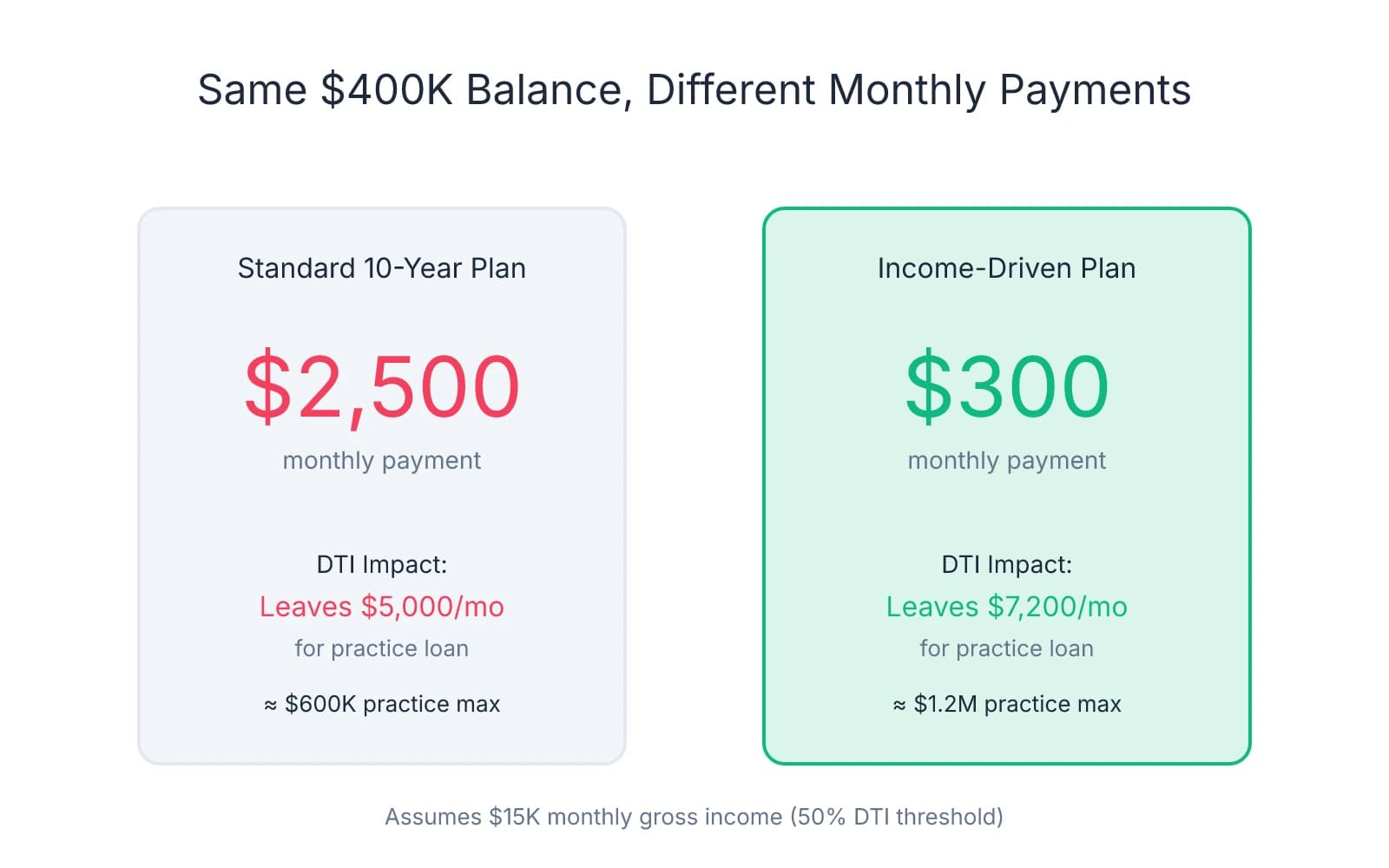
A $400,000 student loan balance on a standard 10-year repayment plan at 6.5% interest generates a monthly payment around $2,500. That same balance under an income-driven repayment plan—PAYE, REPAYE, or IBR—might drop to $300-$500 per month depending on your income and family size. From a lender's perspective, those two scenarios look completely different. The first adds $2,500 to your monthly debt obligations. The second adds $300.
Debt-to-income ratio: Monthly debt payments ÷ gross monthly income. Most dental practice lenders set the approval threshold at 50% or below, meaning your total monthly debt—student loans, car payments, credit cards, and the projected practice loan payment—cannot exceed half your gross monthly income. If you're earning $15,000 per month as an associate, your total debt payments need to stay under $7,500. A $2,500 student loan payment leaves you $5,000 for the practice loan payment. A $300 student loan payment leaves you $7,200. That difference determines whether you can finance a $600K practice or a $1.2M practice.
According to industry guidance on practice loan underwriting, most dental-focused lenders accept your actual monthly payment as reported on your credit bureau or student loan statement, particularly when you're on an income-driven plan with a documented payment amount. This is a significant advantage for buyers on IDR plans—your DTI reflects reality, not a formula.
If you're currently on a standard repayment plan and applying for practice financing in the next 6-12 months, switching to an income-driven plan before the lender pulls your credit can reduce your calculated monthly obligation by 70-80%. Your balance doesn't change. Your interest accrual doesn't stop. But your monthly payment drops, your DTI improves, and your approval odds shift accordingly.
One pattern worth paying attention to: lenders evaluate your DTI at the time of application. If your student loans are currently in forbearance or deferment, some lenders will impute a payment based on a percentage of the balance—usually 0.5% to 1%—which can inflate your DTI artificially. Consolidating into an IDR plan and making at least one payment before applying gives you a documented monthly obligation that's far lower than the imputed amount.
How Income-Driven Repayment Changes Your Approval Odds
Building on that payment structure, income-driven repayment plans calculate your monthly student loan payment as a percentage of discretionary income rather than amortizing the full balance over 10 years. For federal loans, this typically means 10-20% of the difference between your adjusted gross income and 150% of the federal poverty line for your family size. On a $400K balance with an AGI of $180K, that often translates to $300-$500 per month—compared to $2,500+ on a standard plan.
The three most relevant plans for practice buyers are PAYE (Pay As You Earn), SAVE (Saving on a Valuable Education), and IBR (Income-Based Repayment). PAYE caps payments at 10% of discretionary income and never exceeds what you'd pay on a standard 10-year plan. SAVE also uses 10% for undergraduate loans and 5% for graduate loans, with a higher income exclusion threshold that can lower payments further. IBR sets payments at 10-15% depending on when you borrowed, with a similar cap structure.
If you're planning to apply for practice financing in the next 6-12 months, enrolling in an IDR plan 3-6 months beforehand gives you a documented payment history lenders can verify. Most lenders pull your credit report and student loan servicer statements during underwriting. If your account shows an active IDR plan with consistent payments, that's the number they use for DTI calculation. Getting ahead of this—consolidating loans if needed, submitting your IDR application, making at least two payments—removes ambiguity from the process.
A question that comes up frequently: does using income-driven repayment signal financial instability to lenders? The short answer is no. According to industry guidance on practice loan underwriting, what matters is whether your monthly obligations leave enough room for the practice loan payment—not whether you're paying off student debt aggressively or strategically. An IDR plan is a legitimate federal repayment option, and underwriters treat it as such.
The tradeoff sits in the long-term cost structure. Lowering your monthly payment improves approval odds and preserves cash flow during the first 1-2 years of ownership, when revenue is stabilizing and you're covering transition costs. But stretching repayment to 20-25 years increases total interest paid—sometimes significantly. On a $400K balance at 6.5%, a standard 10-year plan costs roughly $140K in interest. An IDR plan that extends to 25 years can push total interest above $300K, depending on income growth and payment recalculations.
Where this gets tactical: if you're not pursuing PSLF and plan to refinance your student loans once practice cash flow stabilizes, enrolling in IDR for 12-24 months gives you the DTI relief you need for approval without locking you into a 25-year repayment timeline. Many buyers use IDR to clear the practice loan hurdle, then refinance student debt to a lower rate and shorter term once they've built 6-12 months of owner income history.
If interest rates are a concern in your broader financing strategy, the timing considerations around when to pursue practice ownership relative to rate environments apply here as well—but the student loan piece is more straightforward. Your IDR payment adjusts based on income, not market rates, so the decision to enroll doesn't hinge on macroeconomic timing. It hinges on whether your current DTI supports practice loan approval.
Production History and Liquidity Requirements Matter More Than Debt
With your DTI calculation squared away, the next factors that determine how much lenders will extend and how confident they feel doing it are what you're producing as an associate and how much accessible cash you have when the deal closes. In most cases, strong production history and modest liquidity outweigh student loan balance in the approval decision—even when that balance sits at $400K or higher.
Annual production of $400K+ is the baseline most dental lenders use to assess revenue-generating capacity. Production history tells the lender you can generate collections sufficient to service both your student loans and the practice debt. If you're producing $500K annually as an associate, the lender sees evidence you can walk into an existing practice and maintain or grow that revenue base.
Documenting production matters more when you're paid on percentage rather than salary. Most lenders will request a letter from your current employer confirming your annual production figure, or they'll accept practice management software reports showing your individual provider production over the past 12-24 months. If you've worked at multiple practices, aggregate production across all locations—what matters is your total annual output.
Where production becomes decisive is in the comparison between two hypothetical candidates. An associate producing $500K per year with $50K in accessible savings and $400K in student loans on an income-driven plan often clears approval more easily than someone with zero student debt, $30K in savings, and $250K in annual production. The first candidate demonstrates revenue capacity that aligns with the practice's historical performance. The second candidate has a cleaner balance sheet but introduces execution risk—can they scale production to match what the seller was doing?
Liquidity requirements typically sit at 10% of the purchase price in accessible cash—savings accounts, taxable brokerage accounts, bonds, or other liquid assets you can convert to cash within 30 days. Retirement accounts don't count unless you're willing to take early withdrawal penalties. The 10% figure isn't always a down payment. Many dental lenders offer 100% financing on the practice itself. The liquidity requirement functions as a safety buffer—proof you can cover 2-3 months of operating expenses, payroll, or unexpected costs without immediately defaulting if revenue dips during the transition.
This structure creates a common misconception: buyers assume they need to come up with $80K cash for an $800K practice and treat that as a down payment hurdle. What actually happens in most deals is the $80K stays in your account. The lender verifies you have it, confirms it's accessible, and uses that verification as part of the approval decision.
If you're producing $450K annually, have $60K in accessible savings, and carry $400K in student loans on a $400/month IDR payment, your profile is often stronger than it appears on paper. Your DTI is manageable. Your production history supports the practice's revenue base. Your liquidity covers the safety buffer most lenders require. Where buyers with high student debt get declined isn't usually the debt itself. It's weak production history or insufficient liquidity, both of which are harder to fix in the short term than a monthly payment structure.
If you're building toward practice ownership in the next 12-24 months and your liquidity sits below 10% of your target purchase price, the path forward is straightforward: direct a percentage of monthly income toward accessible savings rather than accelerated student loan payments. Paying an extra $1,000/month toward a $400K student loan balance barely moves the needle on total interest or payoff timeline. Directing that same $1,000 toward a high-yield savings account for 18 months gives you $18K in liquidity—which can be the difference between qualifying for a $600K practice or waiting another year. Banks would rather see an applicant with $250,000 in student loan debt and $50,000 in savings over a borrower with less debt but minimal liquidity, because accessible cash demonstrates you can weather the transition period.
Why Waiting to Pay Off Loans Usually Costs More Than Buying Now
The instinct to delay practice ownership until student loans are paid down feels financially responsible. It's also, in most cases, mathematically wrong. The income gap between associate and owner compensation is wide enough that buying now and servicing both debts simultaneously builds more wealth over five years than paying off student loans first, then buying later.
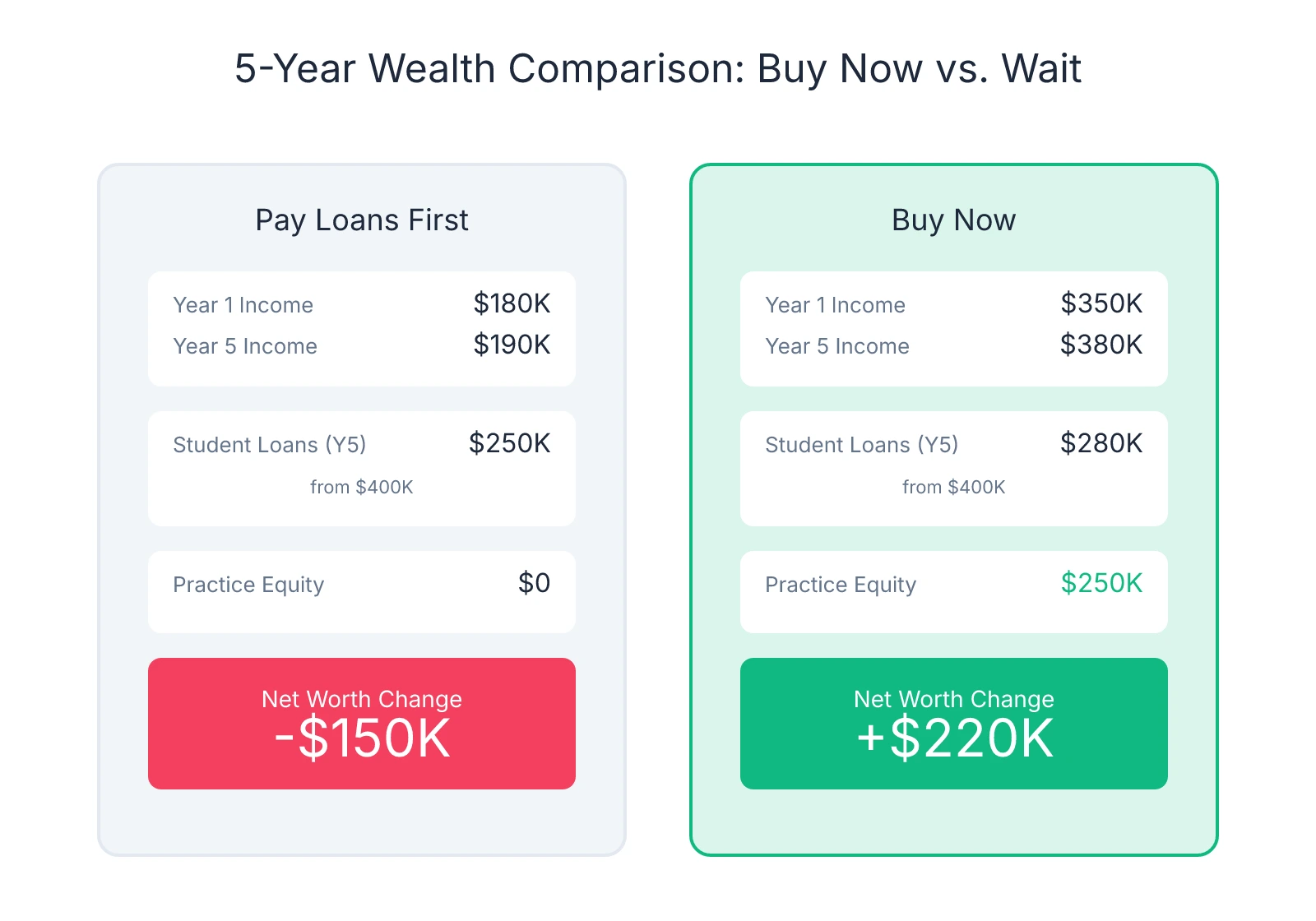
Average practice owner compensation sits around $350K annually, compared to $175K-$200K for full-time associates. That $150K-$175K annual difference means an owner can direct significantly more cash toward student loan payoff while simultaneously building equity in an appreciating asset. An associate earning $180K who aggressively pays down $400K in student debt might clear the balance in 8-10 years, assuming they're directing $3,000-$4,000 monthly toward loans. A practice owner earning $350K can make the same $3,000-$4,000 monthly payment while covering practice debt service, and still has $100K+ in additional annual income to reinvest, save, or accelerate other financial goals.
The wealth-building difference compounds when you account for equity. A dental practice purchased for $800K that grows at a conservative 3% annually is worth $927K after five years. If you've been paying down the loan during that period, your equity position might sit at $200K-$300K depending on loan terms. That equity is real wealth—it's an asset you can borrow against, sell, or use as collateral for expansion. An associate who spends five years paying down student loans builds zero equity. The net worth gap between those two paths after five years often exceeds $250K.
| Path | Year 1 Income | Year 5 Income | Student Loan Balance (Year 5) | Practice Equity (Year 5) | Net Worth Change |
|---|---|---|---|---|---|
| Pay loans first, buy later | $180K | $190K | $250K (from $400K) | $0 | -$150K |
| Buy now, pay loans from owner income | $350K | $380K | $280K (from $400K) | $250K | +$220K |
The associate path reduces student debt by $150K over five years, but builds no equity and earns lower income throughout. The owner path reduces student debt by $120K—slightly slower—but builds $250K in practice equity and earns $170K more annually by year five. The net worth difference after five years typically exceeds $350K.
Where this strategy requires discipline is cash flow management. Taking on practice debt alongside $400K in student loans means you're servicing two large obligations simultaneously, and the first 12-24 months of ownership often involve tighter margins as you stabilize revenue and cover transition costs. The psychological weight of carrying both debts is real. But the math is clear: the income you gain from ownership accelerates every other financial goal, including student loan payoff. Recent buyers have eliminated six-figure student loan balances within 3-4 years of purchase while simultaneously building practice equity—a timeline that would stretch to 8-10 years on an associate salary.
One pattern worth paying attention to: buyers who wait until they're debt-free to pursue ownership often find themselves competing at age 38-42 against younger buyers who moved earlier, built equity through their 30s, and are now looking at second locations or specialty expansions. If you're 32 with $400K in student loans and strong production history, buying now puts you in an ownership position by 33. Waiting until 40 to be debt-free means you're starting wealth accumulation eight years later, and those years compound.
The next step isn't committing to a purchase. It's gathering information that clarifies whether your current financial position supports approval. Talk to three dental-focused lenders and get pre-qualified. The process takes 2-3 weeks, costs nothing, and gives you a concrete answer: what purchase price can you support, what DTI threshold are you hitting, and what liquidity or production gaps need to close before you're approval-ready. If you're not already on an income-driven repayment plan, enroll now—it takes 4-6 weeks to process, and the payment reduction improves your DTI immediately. And start building liquidity toward 10% of your target purchase price.
The decision to buy now versus later isn't about risk tolerance. It's about recognizing that the income and equity you gain from ownership accelerate every financial goal—including paying off the student loans that feel like the barrier.
Sources & References
The data and claims in this article are drawn from the following sources. We prioritize government data, peer-reviewed research, and established industry publications to ensure accuracy.
- Do Student Loans Affect My Ability To Buy A Practice?— panaceafinancial.comIndustry
- 5 Financial Must-Dos Before Buying a Dental Practice— ada.orgIndustry
- Don't Let Dental School Debt Crush Your Ownership Dreams - NDP— ndptransitions.com
- Why You Should Buy a Dental Practice Before Your Student Loans ...— www.dentalbuyeradvocates.com
Frequently Asked Questions
Ready to own despite student debt?
Student loans don't have to derail your practice ownership dreams. Minty Plus connects you with lenders and advisors who understand dental practice financing and can help structure deals that work with your existing debt obligations.