How Many Patients Will Leave After I Buy the Practice?

Co-Founder, Minty Dental

In Summary
- Industry data shows average patient attrition after a practice sale is less than 10% when transitions are properly managed—far below the 30-50% many buyers fear
- Patients typically stay with a familiar location and staff rather than restart the search for a new dentist from scratch
- The patients who do leave are usually the seller's close friends, family members, or those traveling significant distances specifically to see the seller
- Practices already lose 10-12 patients monthly through natural churn (relocations, insurance changes, aging), so post-acquisition attrition should be evaluated against this baseline
- Buyers often replace departing patients within 6-12 months through their own professional networks and referral relationships
Most Practices Lose 5-10% of Patients After a Sale—Not 30%
The fear of mass patient exodus drives more buyers away from otherwise solid practices than any other concern. The reality looks different: average attrition following a dental practice sale sits below 10% when the transition is handled properly. The gap between that number and the 30-50% many buyers imagine represents millions of dollars in deals that never happen.
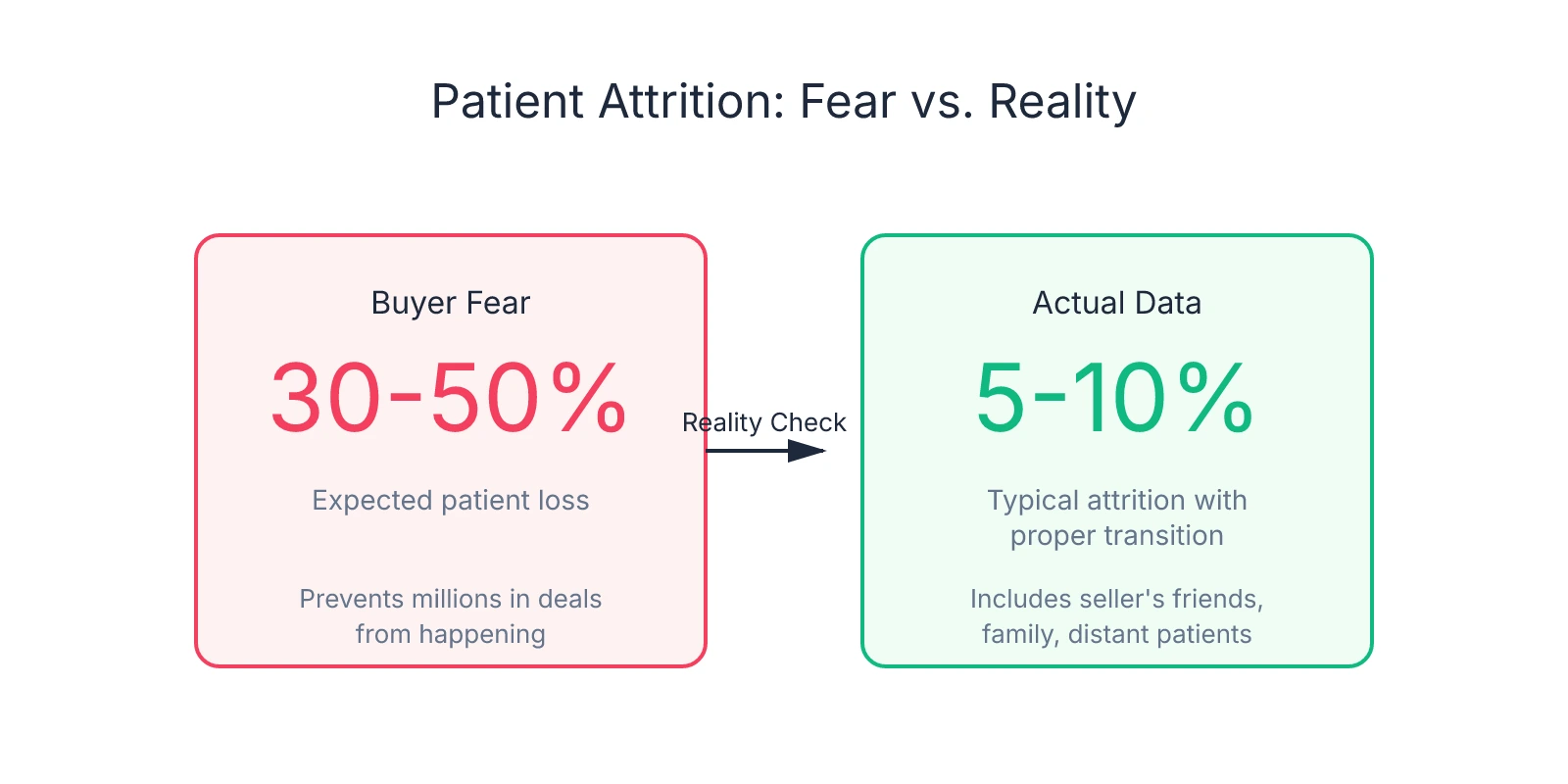
Walk through the patient's decision from their perspective. They receive a letter announcing the sale, introducing the new owner, and asking for their continued support. At that point, they face two options: give the new doctor a chance at a location where they already know the staff, the operating hours, and the insurance policies—or start over searching for a new practice where everything is unfamiliar.
The friction of finding a new dentist is higher than most buyers realize. Patients have to research options, verify insurance acceptance, schedule an initial appointment weeks out, fill out intake paperwork, explain their dental history to strangers, and hope the new office meets their expectations. Most choose to stay put and see how the first visit goes.
Who actually leaves: The seller's close friends and family members often follow the seller into retirement or to their next venture. Patients who were traveling 30-40 minutes specifically to see the seller may decide a closer option makes more sense now. A handful of long-time patients with deep personal loyalty to the seller will make the switch regardless of convenience. These departures are normal and expected—they're already factored into the 5-10% benchmark.
What buyers often miss is that practices lose patients every month regardless of ownership changes. Natural patient churn removes 10-12 patients monthly through relocations, insurance changes, aging, and life transitions. A practice with 1,500 active patients loses 120-144 patients annually just from baseline attrition. Post-acquisition attrition of 75-150 patients (5-10%) sits within that same range—it's not a crisis, it's the normal rhythm of patient flow with a slight uptick during the transition window.
The other variable buyers underestimate is their own network effect. Within the first 6-12 months, most new owners bring in referrals from their professional relationships, former colleagues, and community connections. These new patients often offset the departures before the first anniversary of the sale. The question isn't whether you'll lose some patients—you will. The question is whether you'll execute the transition strategies that keep attrition in the 5-10% range instead of letting it drift toward 20-30% through poor communication, staff turnover, or abrupt operational changes. The first 90 days after closing determine which outcome you get.
What Actually Drives Patient Loss After an Acquisition
The 5-10% attrition benchmark assumes you're executing specific transition strategies—it's not automatic. Most of the factors that cause patients to leave sit within your control during the first 90 days.
Staff retention is the single biggest lever you control. Patients often spend more time with hygienists and front desk staff than they do with the dentist—30-45 minutes in the hygiene chair every six months versus 8-10 minutes with the doctor. When the hygienist who's cleaned their teeth for five years stays, the patient's primary relationship with the practice remains intact. When that hygienist leaves two weeks after the sale, the patient loses their anchor point and starts questioning whether they should stay.
One pattern that surfaces repeatedly: practices that retain the full hygiene team through the first six months see attrition in the 6-8% range. Practices that lose two hygienists in the first 60 days see attrition climb to 18-22%. The front desk carries similar weight—patients call with questions about insurance, billing, and scheduling changes, and if the voice on the other end is unfamiliar and can't answer confidently, uncertainty compounds.
Abrupt operational changes trigger immediate departures. The practice operated on specific hours, accepted certain insurance plans, and charged predictable fees. When buyers walk in and immediately drop Saturday hours, exit two PPO networks, or raise fees 15% across the board, patients interpret those changes as a signal that this practice no longer serves them. The timing matters as much as the change itself—patients are more willing to accept adjustments six months in than they are in week two.
Insurance changes carry the highest attrition risk. If you plan to drop PPO participation in a practice where 70% of patients rely on those networks, expect 15-25% attrition unless you phase the transition carefully. Patients don't leave because they're opposed to fee-for-service—they leave because their insurance suddenly doesn't work and they weren't prepared for the financial shift. The practices that manage this well give 90-120 days notice, offer payment plans, and communicate the change through multiple channels.
Communication gaps create the uncertainty that drives attrition. When patients don't receive a transition letter from the seller endorsing the new owner, they're left to form their own conclusions about what the sale means. When staff can't answer basic questions about whether insurance will still be accepted or whether hours are changing, patients assume the worst. The absence of information doesn't create neutrality—it creates anxiety, and anxious patients start looking for alternatives.
The transition letter isn't a formality—it's the seller's endorsement that gives patients permission to stay. Practices that send a letter with a photo of the new owner and their family, followed by an email reminder, see measurably lower attrition than practices that skip this step or delay it until after closing. Staff training matters just as much: the front desk needs scripted answers to the five questions every patient will ask in the first 30 days.
Patient demographics shape your baseline attrition risk. A practice with an aging patient base—where 40% of active patients are over 65—carries higher attrition risk than one with a younger demographic mix. Older patients are more likely to retire from dental care entirely, move to assisted living, or follow the seller based on decades of personal loyalty. If the seller's patient base includes a high percentage of friends, family, and personal network connections, expect 12-18% of those patients to leave regardless of how well you execute the transition.
Geographic factors matter too. Patients who were already traveling 30-40 minutes specifically to see the seller are more likely to find a closer option now that the seller is gone. A practice in a rural area where patients drive significant distances will see higher attrition than an urban practice where most patients live within a 10-minute radius.
The practices that stay in the 5-10% range treat attrition as a controllable outcome, not an inevitable loss. When hygiene production ratios look weak during due diligence, that's often a signal that staff morale is already fragile—and fragile staff don't stay through ownership transitions. Deciding when to drop insurance contracts is a strategic choice, but the timing and communication around that decision determine whether you lose 8% or 22% of your patient base.
How to Structure the Transition to Protect Patient Retention
The 5-10% attrition benchmark isn't luck—it's the result of executing four specific strategies in the first 90 days. The practices that stay in the target range build these protections into the LOI and execute them immediately after closing.
Transition letter and staff training create the foundation. The seller should mail a letter to all active patients within 7-10 days of closing, introducing and endorsing the new owner. The letter needs to acknowledge the sale, introduce you with a photo (ideally with your family), and explicitly ask patients to continue their relationship with the practice. Many buyers also send a follow-up email to catch patients who overlook physical mail—open rates on transition emails run 40-50%.
The photo matters more than most buyers realize. Patients form an initial impression of you before they ever sit in the chair, and a professional photo with a warm, approachable tone reduces uncertainty. Practices that include a family photo see measurably higher retention than those that send text-only announcements—it signals stability and personal investment in the community.
Staff training runs parallel to the patient communication. Your front desk will field dozens of calls in the first two weeks from patients asking whether their insurance is still accepted, whether hours are changing, and whether their hygienist is staying. Without scripted answers to these questions, even well-intentioned staff create doubt through inconsistent responses. One exercise that works: role-play the five most common patient questions during your first staff meeting and give the team clear, confident language to use in every interaction.
Staff retention for 90-180 days protects the relationships patients actually value. The minimum retention window is 90 days—long enough for patients to complete one full hygiene cycle under your ownership and form an impression of you as the new doctor. Many buyers extend this to 180 days for key staff (lead hygienist, office manager, front desk lead) to ensure continuity through two full hygiene rotations. During this window, maintain current compensation and benefits exactly as they were under the seller. Staff who feel uncertain about their future don't stay, and one of the best ways to retain patients is to first retain existing staff—staff who leave in the first 60 days take patient relationships with them.
Operational continuity means maintaining hours, insurance participation, and branding for 3-6 months. The practice operated on specific hours, accepted certain insurance plans, and used familiar branding. Changing any of these variables in the first 90 days signals to patients that this is no longer the practice they chose.
Insurance participation carries the highest risk. If you plan to drop PPO networks, phase the transition over 6-12 months with clear communication at each stage. Practices that exit insurance abruptly see 15-25% attrition; practices that give 90-120 days notice, offer payment plans, and communicate through multiple channels keep attrition in the 8-12% range. The same principle applies to hours—if the practice has operated Saturdays for ten years, dropping that schedule in month one will cost you the patients who rely on weekend availability.
Branding continuity includes keeping the practice name, signage, and logo unchanged for at least six months. Patients identify the practice by these visual markers, and changing them immediately creates confusion about whether this is still "their" dental office. One compromise that works: add your name to the existing practice name rather than replacing it entirely—"Smith Family Dentistry, now with Dr. Johnson" preserves continuity while establishing your presence.
Seller transition support should be structured in the LOI, not left to goodwill. The most effective arrangement is 30-90 days of availability for patient introductions and staff support—not a full clinical schedule. What you're negotiating is the seller's presence for key patient visits (especially high-value or anxious patients), availability to answer staff questions, and willingness to reinforce the transition message when patients call with concerns.
The structure matters: "30 days of availability, 2-3 days per week, for patient introductions and transition support" is clearer and more enforceable than "seller will assist as needed." Define what "availability" means—physically present in the office, reachable by phone, or both. Also define what it doesn't mean: the seller shouldn't be treating patients independently, making clinical decisions, or undermining your authority with staff.
Monitor retention metrics in the first 90 days to catch problems early. Two numbers tell you whether your transition strategies are working: hygiene reappointment rate and new patient no-show rate. Hygiene reappointment rate should stay above 85%—if it drops below 80% in the first 60 days, patients are choosing not to reschedule, which is the leading indicator of attrition. New patient no-show rate should stay below 15%—if it climbs above 20%, it signals that your front desk communication or online presence is creating uncertainty before patients ever walk in.
Track these weekly, not monthly. A hygiene reappointment rate that drops from 88% to 78% in week four is a problem you can address immediately by retraining staff or adjusting your introduction process. The same drop discovered in month three means you've already lost 40-60 patients who aren't coming back.
Evaluating Attrition Risk Before You Submit an Offer
The 5-10% attrition benchmark assumes you're buying a practice with controllable risk factors. The practices that push attrition into the 20-30% range usually signal that risk before the LOI—through patient demographics, insurance dependency, or existing churn patterns that won't improve just because ownership changed.
Start with the patient age distribution. A practice where 60% of active patients are over 65 carries higher baseline attrition than one with a balanced age mix. Older patients are more likely to retire from dental care entirely, move to assisted living, or follow the seller based on decades of personal loyalty. Request a patient age breakdown during due diligence—if the practice skews heavily toward patients over 70, expect natural attrition of 12-15% annually even without an ownership change. The sale adds 3-5 percentage points on top of that baseline, pushing total first-year attrition toward 15-20%.
The seller's personal network matters just as much. Ask what percentage of active patients are friends, family, or personal referrals from the seller's community involvement. If 20-30% of the patient base falls into this category, those relationships likely won't transfer. One question that surfaces this risk: "How many patients would you expect to follow you if you opened a new practice across town?" The seller's honest answer tells you how much of the patient base is tied to them personally rather than to the practice location and systems.
Geographic spread reveals retention vulnerability. Practices that draw patients from a 20-30 mile radius lose more patients during transitions than hyper-local practices where most patients live within 10 minutes. Request a ZIP code analysis of the patient base—if 40% of patients are traveling 25+ minutes specifically to see the seller, they're more likely to find a closer option now. This is especially true in suburban or rural markets where patients were already making a deliberate drive.
Insurance mix determines how much flexibility you have post-acquisition. If 70% of the patient base relies on PPO networks and you're planning to transition toward fee-for-service, expect 15-25% attrition from those patients unless you phase the change over 12-18 months. Request a breakdown of active patients by insurance type during due diligence. A practice with 80% PPO participation and low fee-for-service volume isn't a bad acquisition—but it's one where your operational plans need to account for higher attrition risk if you're planning network exits.
The inverse matters too: if you're planning to add PPO networks the seller didn't participate in, that's a retention advantage. Patients who were paying out-of-network fees will stay when their insurance suddenly works.
Existing attrition rates signal whether the practice has retention problems that predate your involvement. Healthy practices lose 10-12% of patients annually through natural churn—relocations, insurance changes, aging, and life transitions. If the practice is already losing 17-20% annually, that's a red flag that systems are broken. Poor communication, inconsistent scheduling, billing disputes, or low treatment acceptance all drive attrition above baseline—and those problems don't fix themselves just because you bought the practice.
Request a three-year patient retention analysis during due diligence. If active patient count has declined 15-20% over the past 36 months despite steady new patient flow, the practice has a retention problem you're inheriting. One pattern to watch: practices with high hygiene turnover almost always have high patient attrition.
Use attrition risk to structure your offer and transition terms. High attrition risk doesn't necessarily kill a deal—it changes how you structure it. If the practice shows multiple red flags (aging patient base, high PPO dependency, 20+ mile patient draw, existing 18% annual attrition), that justifies either a lower purchase price or performance-based earnout terms. An earnout structure ties a portion of the purchase price to patient retention benchmarks—if the seller claims 95% of patients will stay, they should be willing to accept payment tied to that outcome.
Extended seller transition support becomes more valuable in high-risk scenarios. If 30% of the patient base is over 70 or tied to the seller's personal network, negotiate 60-90 days of structured transition presence instead of the standard 30 days.
Price renegotiation after due diligence is appropriate when attrition risk wasn't disclosed upfront. If the seller represented a stable, diverse patient base but due diligence reveals 65% of patients are over 70 and 25% are personal friends, that's a material misrepresentation that justifies revisiting the valuation.
Sources & References
The data and claims in this article are drawn from the following sources. We prioritize government data, peer-reviewed research, and established industry publications to ensure accuracy.
- Patient Retention Following a Dental Practice Sale— dentaltransitions.comIndustry
- 29 Dental Patient Attrition Statistics Every Practice Should Know— clerri.comIndustry
- Shhhhh, I'm Selling My Dental Practice— ada.orgIndustry
- How to Retain Patients When Buying or Joining a Practice— www.ada.orgIndustry
Frequently Asked Questions
Navigate Patient Retention in Your Acquisition
Patient transitions are complex, but you don't have to manage them alone. Minty Plus provides expert guidance through the critical post-close period to help stabilize your patient base and maximize practice value.