Collections vs Production: What Matters More When Buying a Practice

Co-Founder, Minty Dental

In Summary
- Production measures what you bill at fee schedule rates; collections measure actual cash received—the money available for debt service and owner compensation
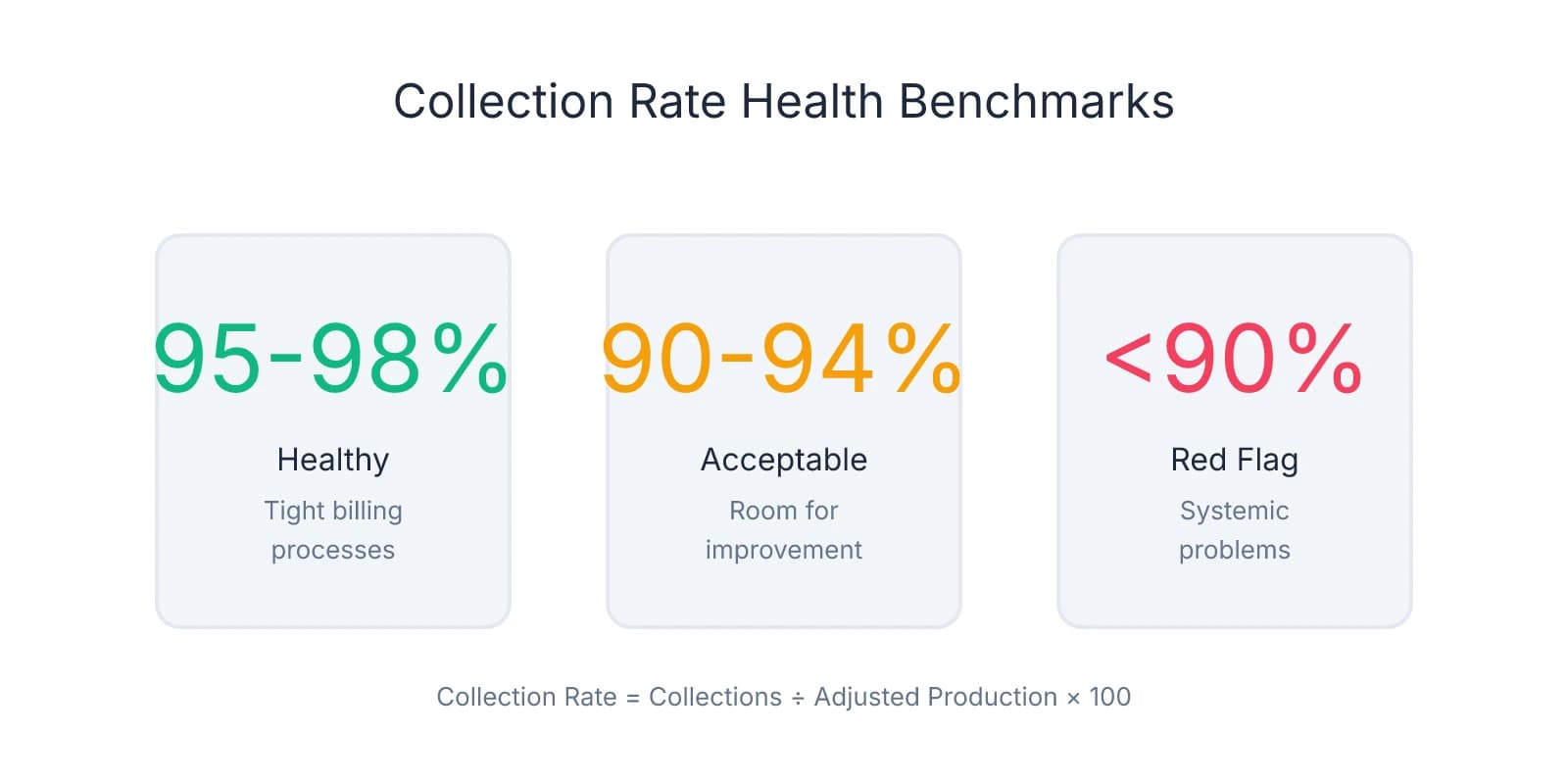
- Healthy practices collect 95-98% of adjusted production; rates below 90% signal front office inefficiency, insurance write-offs, or accounts receivable problems you'll inherit
- The collection rate (collections ÷ production × 100) reveals practice financial health in a single number—it exposes billing accuracy, insurance mix quality, and whether reported revenue is sustainable
- A practice producing $800K but collecting $680K has the same debt capacity as a $680K practice, not an $800K practice
- Most listings emphasize production because it looks bigger, but collections data tells you what you'll actually deposit—and whether the practice can support the asking price
Collections Represent Cash Flow; Production Represents Potential
Production is the total amount billed at fee schedule rates. Collections represent actual payments received. Production tells you what the practice charged; collections tell you what it deposited.
That distinction matters for acquisition decisions. When evaluating a practice, production is a billing target—collections are the cash flow you'll use to service debt, cover payroll, and pay yourself. A practice producing $900,000 but collecting $765,000 doesn't have $900,000 in buying power. It has $765,000. Lenders, appraisers, and your cash flow will all anchor to collections.
The gap between the two reveals front office efficiency, insurance contract quality, and accounts receivable health. Healthy practices collect 95-98% of adjusted production—the amount billed after contractual insurance write-offs. Practices collecting below 90% signal systemic problems: poor billing follow-up, high patient balances going uncollected, or fee schedules misaligned with payer contracts. Those problems don't disappear at closing.
The collection rate—collections ÷ production × 100—compresses practice financial health into a single number. A 96% rate suggests tight billing processes and realistic fee schedules. An 85% rate suggests you'll be chasing receivables, writing off bad debt, or discovering that production numbers were inflated by procedures never fully paid.
Most listings emphasize production because it's a bigger number. A $1.2 million production figure sounds more impressive than $1.08 million in collections, even when the latter is what you'll actually deposit. Practices with strong collections data tend to surface it early. Practices with weak collection rates avoid the topic until due diligence forces the conversation.
When comparing practices, start with collections. Calculate the collection rate from the P&L or tax returns. If the seller can't provide clean collections data for the past three years, that's a signal. Production matters for understanding clinical capacity, but collections determine whether the practice can support the purchase price. A $750,000 collections practice priced at $900,000 (1.2× multiple) is safer than a $1 million production practice collecting $800,000 and priced at $960,000. The first has tighter operations. The second has a 20% leakage problem.
If the collection rate sits below 92%, dig into accounts receivable aging and insurance write-off patterns during due diligence. You're not just buying last year's revenue—you're buying the systems that generated it. A low collection rate means those systems need work, and that work costs time and money you won't have while ramping up. The same front office staff, payer contracts, and patient base that produced an 87% collection rate under the seller will produce an 87% rate under you—until you invest in process changes, staff training, or contract renegotiation.
Why Sellers Lead with Production Numbers
Production numbers are always higher than collections, making them more attractive for marketing. A seller presenting $1.1 million in production sounds more successful than one reporting $950,000 in collections—even when the second practice might be more profitable. Sellers and brokers understand that buyers scan listings quickly, and a bigger top-line number captures attention.
High production with weak collections often indicates PPO write-offs, poor case acceptance, or front office inefficiency. A practice producing $1 million but collecting $850,000 has a 15% leakage problem. That gap comes from contractual insurance adjustments not factored into the fee schedule, treatment plans presented but never accepted, or patient balances that aged out and got written off.
Sellers may quote gross production—before adjustments—to inflate perceived value, while collections reflect actual contractual rates. Gross production includes the full fee schedule amount, even when insurance will only pay 60% of that charge. Adjusted production backs out contractual write-offs and shows what the practice realistically expected to collect. The difference can be substantial: a practice with $1.2 million in gross production might have $1.05 million in adjusted production and $980,000 in actual collections. If the seller quotes the first number and you build a valuation model around it, you're overestimating cash flow by 22%.
A practice producing $1 million but collecting $850,000 has a very different cash flow profile than one producing and collecting $900,000. The first has a 15% gap between what it bills and what it deposits. The second has a 5% gap. For a buyer, that difference determines debt capacity. Lenders base approval on collections. If you're targeting a 3× debt-to-income ratio and the practice collects $850,000, your loan ceiling sits around $2.55 million. If it collects $900,000, that ceiling rises to $2.7 million. A $150,000 difference in borrowing power can determine whether you can afford the practice—or whether you're forced to negotiate a lower price.
One protection many buyers find valuable is requesting both production and collections data for the same three-year period, broken down by month. If production is climbing but collections are flat, that's a red flag. It suggests the seller is diagnosing more treatment without improving case acceptance, or participating in more insurance plans without improving reimbursement rates. Practices with healthy financials show production and collections moving in parallel, with a consistent collection rate year over year.
When a seller emphasizes production but hesitates to share collections data, that hesitation tells you something. Strong practices surface collections early because the numbers support the asking price. Weak practices bury collections in supplemental documents and hope buyers focus on the bigger production figure.
What the Collection Rate Reveals During Due Diligence
The collection rate compresses front office efficiency, insurance contract quality, and accounts receivable health into a single diagnostic number. A practice collecting 96% of adjusted production signals tight billing processes. A practice at 84% signals problems you'll inherit: aged receivables, weak follow-up systems, or insurance contracts that don't align with the fee schedule.
Request 12-24 months of production and collection reports, broken down by month. A single strong month doesn't prove sustainability. If the practice collected 95% in January, 93% in February, and 96% in March, that's stable. If it swings from 88% to 97% to 81% across three consecutive months, something is inconsistent—the billing process, the payer mix, or the data itself. Practices with erratic collection rates often have erratic cash flow, which makes debt service unpredictable.
The accounts receivable aging report shows how much is owed and how long it's been outstanding. Healthy practices keep 90% or more of AR in the 0-60 day buckets. When you see significant balances in the 90+ day category, you're looking at money the practice is unlikely to collect. Aged AR often represents patient balances never followed up on, insurance claims denied and never resubmitted, or billing errors never corrected. The longer a balance sits, the less collectible it becomes. Anything over 120 days is effectively a write-off waiting to happen.
The AR ratio—total accounts receivable divided by average monthly production—tells you whether the practice is collecting at a sustainable pace. A ratio above 1.5 signals collection problems that will become your cash flow problem. If the practice produces $80,000 per month and carries $140,000 in AR, that's a 1.75 ratio. It means the practice is holding nearly two months of production in unpaid balances. You'll spend your first six months either writing off uncollectible balances or chasing patients and insurers for money the seller should have collected.
High PPO participation can create a structural gap between production and collections that has nothing to do with front office performance. If the practice bills $100,000 in a month but contractual insurance adjustments total $18,000, adjusted production is $82,000—and a 95% collection rate means depositing $77,900. That's a 22% gap from gross production, but it's not a red flag. It's the cost of participating in those plans. Where this becomes a problem is when the seller quotes gross production in marketing materials, you build a valuation model around it, and you later discover the practice has never collected more than 78% of that number. Verify whether write-offs are contractual or operational. Contractual write-offs are baked into payer contracts. Operational write-offs—patient balances written off as bad debt, billing errors, or uncollected copays—are fixable, but they require process changes you may not have bandwidth for in year one.
When you request the AR aging report, ask for it as of the most recent month-end and compare it to the same report from 12 months prior. If the 90+ day bucket has grown significantly, that's a red flag. It suggests the practice's collection problems are getting worse. If total AR has grown faster than monthly production, that's another signal that cash isn't flowing efficiently.
If the collection rate sits below 90%, dig into the details. Request a breakdown of write-offs by category: contractual adjustments, patient bad debt, billing errors, and uncollected copays. If contractual adjustments account for most of the gap, you're looking at a PPO-heavy practice where reimbursement rates are structurally lower than the fee schedule. That's manageable if you understand it going in. If patient bad debt and uncollected copays dominate, you're looking at a front office that isn't collecting effectively—and that's harder to solve while ramping up clinically.
The collection rate isn't just a number. It's a window into whether reported revenue is sustainable under your ownership—or whether you're buying a billing problem disguised as a profitable practice. If the seller can't or won't provide clean AR aging data alongside production and collections reports, consider whether incomplete financial records during due diligence might signal broader gaps in practice documentation. And if the numbers reveal a collection problem significant enough to affect valuation, that's the kind of finding that gives you leverage to renegotiate the purchase price.
Structuring Your Offer Around Collections, Not Production
When you're ready to make an offer, apply the valuation multiple to trailing 12-month collections, not production. This reflects actual cash the practice generates and what you'll have available to service debt. A practice listed at 75% of collections with $900,000 in annual collections is a $675,000 offer. If the seller counters by citing $1.05 million in production and suggesting the price should be $787,500, you're being asked to pay for revenue the practice never deposited.
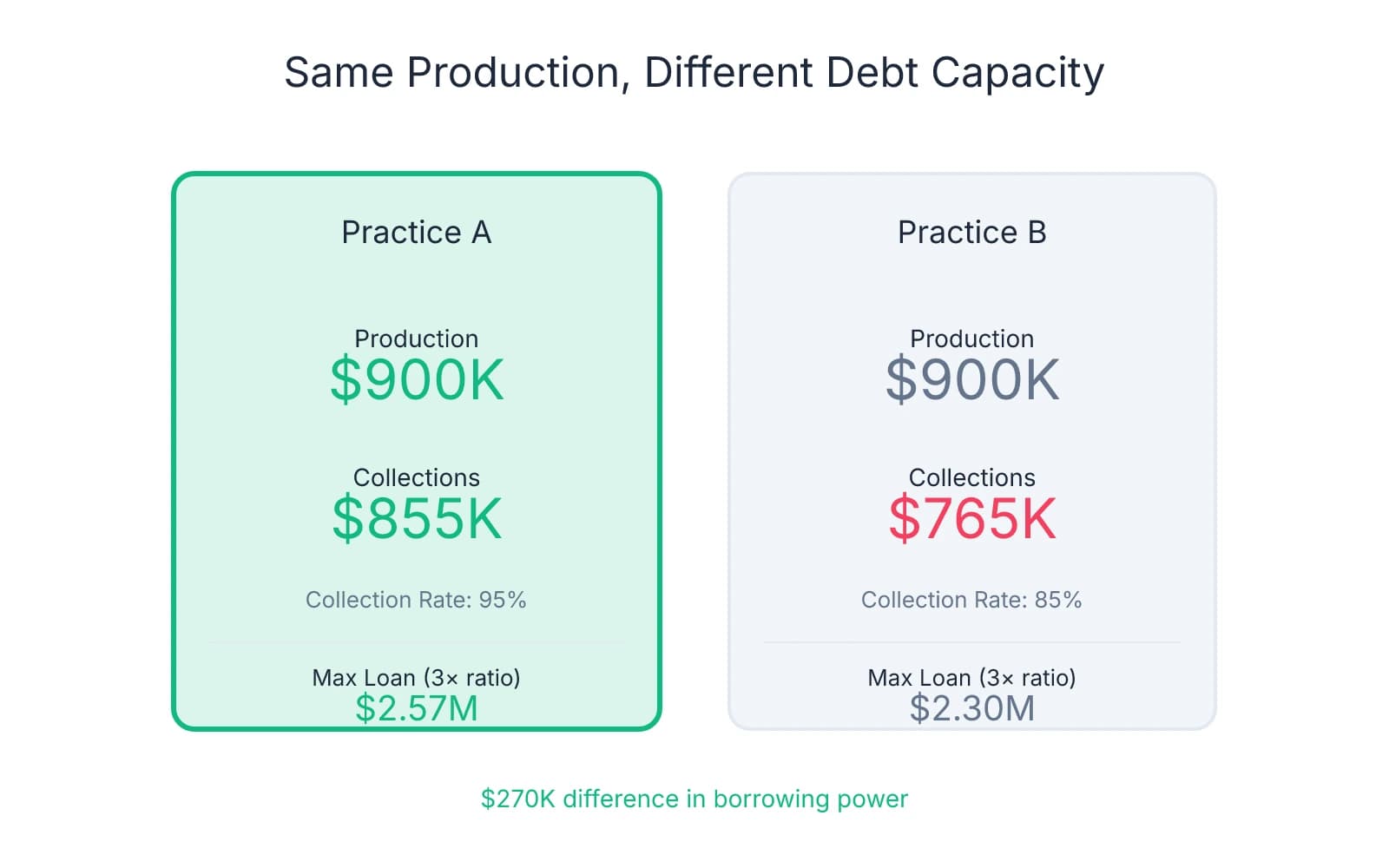
Calculate debt capacity before finalizing an offer. If the practice collects $850,000 annually and you're targeting a 3× debt-to-income ratio, your maximum supportable loan is around $2.55 million. If the asking price is $700,000 and you're putting 10% down, your loan amount is $630,000—well within capacity. If the asking price is $900,000 based on inflated production figures, your loan jumps to $810,000, and you're suddenly operating with thinner margins.
If the collection rate sits below 95%, you have two negotiation paths: reduce the purchase price to reflect actual cash flow, or require the seller to clean up accounts receivable before closing. The first option is cleaner. A practice collecting 88% of adjusted production is generating 7% less cash than a healthy practice. If the asking price is $750,000, a 7% reduction brings it to $697,500—a price that aligns with actual financial performance. The second option—requiring AR cleanup—shifts the burden to the seller but introduces closing delays and potential disputes over what counts as "collectible."
Most buyers don't purchase accounts receivable, which means you're starting with zero cash flow until new production is collected. This creates a working capital gap in your first 30-60 days. If the practice collects $70,000 per month and you close on the first, you won't see meaningful deposits until mid-month—and full collections from that month's production won't hit until 30-45 days out. Plan for this. You'll need cash reserves to cover payroll, rent, supplies, and loan payments before revenue starts flowing.
One protection worth considering is structuring earnouts or seller notes tied to post-closing collections. If the seller claims the practice consistently collects $900,000 annually but you're seeing red flags in the AR aging report, propose a structure where 10-15% of the purchase price is held back and paid out only if collections hold at or above reported figures for the first 12 months. Sellers with strong financials typically accept this structure without issue. Sellers with inflated numbers push back hard—which tells you something about the reliability of their data.
When negotiating seller financing terms, tie the note to collections performance rather than production targets. A seller note that requires $3,000 monthly payments regardless of practice performance puts all the risk on you. A note that adjusts payments based on trailing 90-day collections—or defers payments if collections drop below a defined threshold—protects you if reported revenue doesn't materialize.
If you're working through a letter of intent, include language that makes the final purchase price contingent on verified collections data. A clause like "Purchase price of $X assumes trailing 12-month collections of $Y, subject to verification during due diligence" gives you an out if the seller's numbers don't match reality. The LOI is where you lock in the valuation methodology.
The offer you structure should reflect the cash flow you'll actually receive, not the revenue the seller wishes they'd collected. Apply your valuation multiple to trailing collections, adjust for any collection rate weaknesses, and build in protections—whether through earnouts, seller notes, or contingent pricing—that give you recourse if the numbers don't hold.
Sources & References
The data and claims in this article are drawn from the following sources. We prioritize government data, peer-reviewed research, and established industry publications to ensure accuracy.
- Production & Collections: Two Key Indicators of a Dental Practice's ...— ndptransitions.comIndustry
- Collection Percentage Worth for Dental Practices— professionaltransition.comIndustry
- 3 Big Steps During the Dental Practice Due Diligence Process— www.adstransitions.comIndustry
Frequently Asked Questions
Find Your Ideal Practice Match Today
Whether you prioritize collections, production, or both, Minty helps you discover dental practices aligned with your acquisition goals. Browse verified listings and connect with practices that match your financial criteria.