What Low Hygiene Production Means When Buying a Practice

Co-Founder, Minty Dental

In Summary
- Hygiene production should represent 30–33% of total practice revenue — practices below 25% signal systemic operational problems affecting both current cash flow and future growth potential
- The three most common causes are broken recall systems that fail to bring patients back, underutilized periodontal therapy that leaves revenue on the table, and scheduling inefficiencies that keep hygienists underproductive
- Low hygiene production often correlates with poor patient retention, meaning you're buying a practice that's constantly losing patients rather than building recurring revenue
- During due diligence, request hygiene production as a percentage of total production for the past 36 months, production per hygienist per day, and the percentage of patients on active recall
- These metrics reveal whether the practice has the infrastructure to sustain revenue after the seller leaves — or whether you're inheriting a patient base that's already walking out the door
Low Hygiene Production Usually Points to One of Three Structural Problems
When hygiene production sits below 25% of total practice revenue, most buyers treat it as a minor inefficiency — something they'll fix after closing. What they miss is that the hygiene department's performance reveals structural problems affecting the entire practice, not just one operatory.
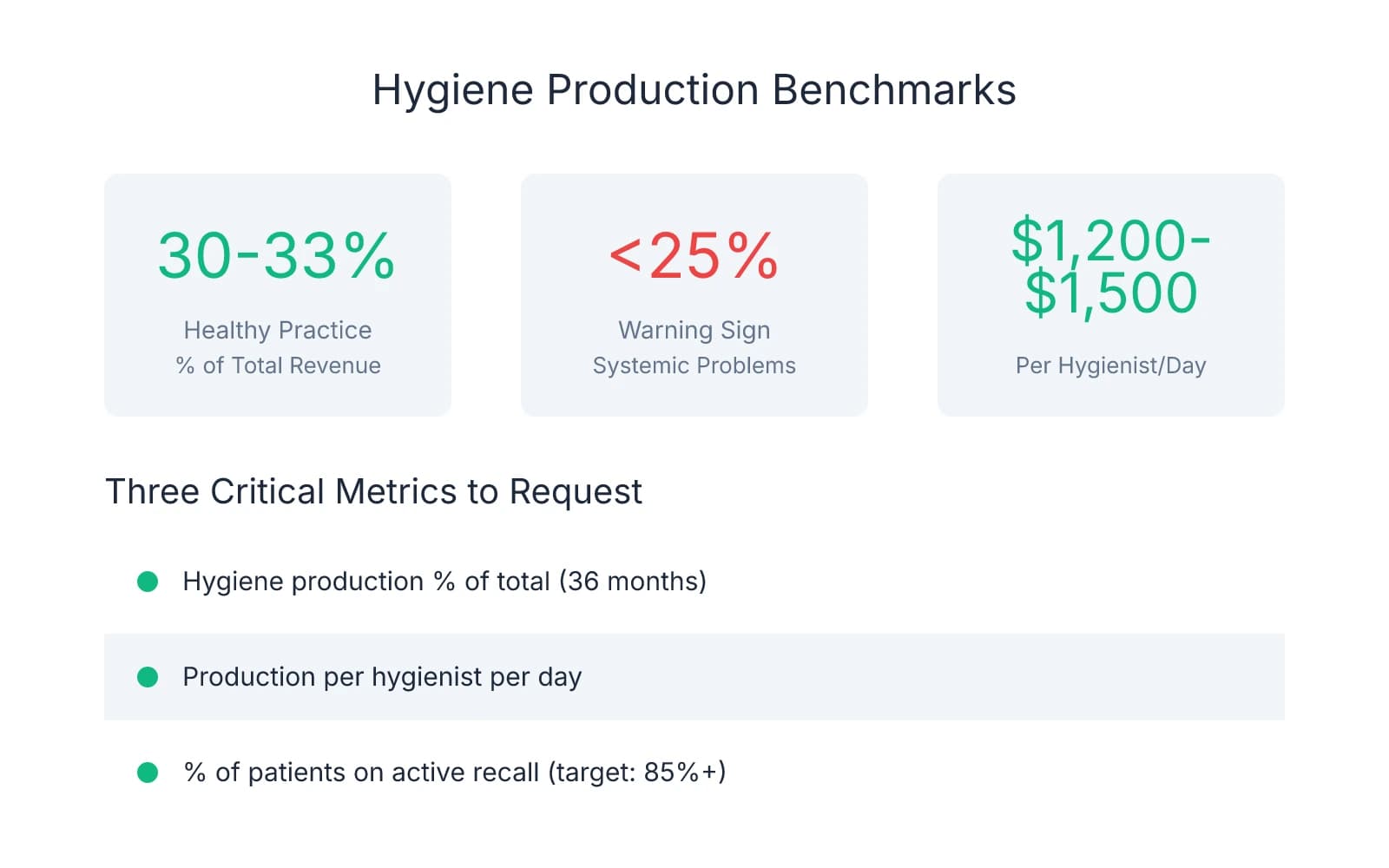
The industry benchmark sits at 30–33% of total production, according to the ADA Health Policy Institute. Practices that fall below 25% aren't just underperforming in hygiene — they're usually failing in one of three critical areas: recall systems, periodontal therapy integration, or scheduling efficiency. Each points to a deeper issue affecting patient retention, treatment acceptance, and the practice's ability to generate predictable revenue.
One pattern worth paying attention to: practices with weak hygiene production tend to have poor patient retention overall. If patients aren't returning for hygiene appointments, they're not staying in the practice long enough to accept restorative treatment either. You're not buying a stable patient base — you're buying a practice that's constantly losing patients and relying on new patient acquisition to replace them.
Pull three years of hygiene production data during due diligence. Calculate it as a percentage of total practice production for each of the past 36 months. If the number has been trending downward, the practice's operational problems are getting worse. If it's been consistently low, the infrastructure to support recurring revenue likely doesn't exist.
Beyond the percentage, request production per hygienist per day. Benchmark practices generate $1,200–$1,500 per hygienist per day. Practices below $1,000 per day usually have scheduling gaps, short appointments, or hygienists who aren't presenting periodontal therapy.
The third metric that reveals the most: what percentage of patients are on active recall? Many sellers claim they have 1,500 active patients, but when you dig into the data, only 60% have been seen in the past 18 months. If fewer than 85% of patients are active in recall, the practice is hemorrhaging patients — and the seller's production numbers are masking the decline.
Where buyers often get burned is assuming they can fix these issues post-acquisition. If the practice doesn't have a functioning recall system, you're not inheriting a patient base — you're inheriting a list of names. If periodontal therapy isn't part of the hygiene workflow, you're buying a practice that's trained patients to expect cleanings without diagnosis.
A Broken Recall System Costs You Patients Before You Even Close
Low hygiene production often shows up first in the recall system — or more accurately, in the absence of one. Many practices claim they have a recall system, but what they actually have is pre-appointment scheduling: booking patients six months out at the end of their current visit.
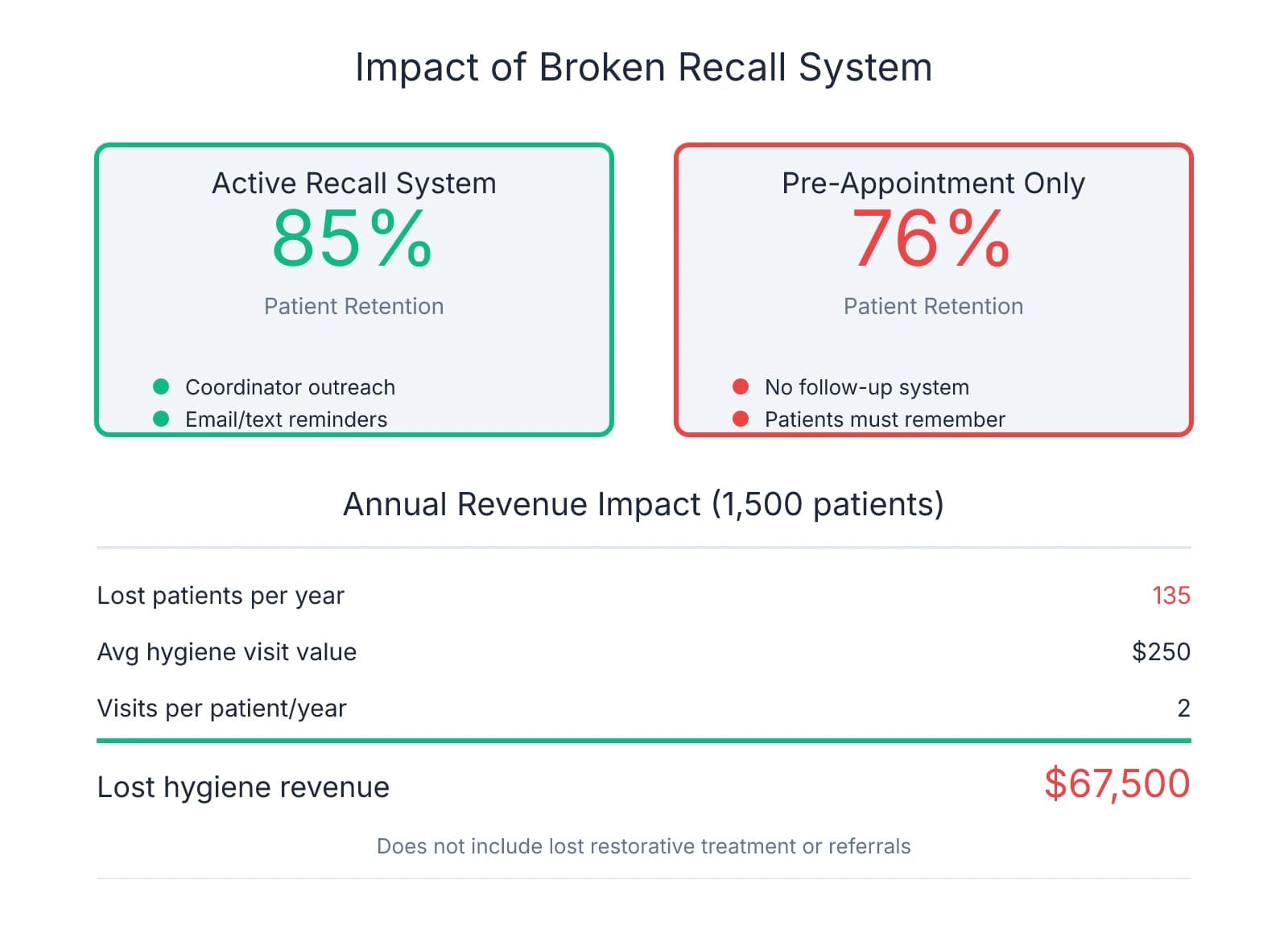
Practices that rely solely on pre-appointment scheduling retain approximately 76% of patients, according to industry benchmarking data. Practices with active recall systems — where a coordinator reaches out to patients who haven't scheduled — retain 85% or higher. That 9-point gap represents patients who never come back, and in a practice with 1,500 active patients, that's roughly 135 patients lost every year.
The math compounds quickly. If the average hygiene visit generates $250 in production and those 135 patients were scheduled for two visits annually, the practice is losing $67,500 in hygiene revenue alone. That doesn't account for the restorative treatment those patients would have accepted, or the referrals they would have generated.
During due diligence, request three specific data points. First, what percentage of active patients are currently scheduled for their next hygiene visit? In well-run practices, this number sits above 90%. If it's below 70%, the practice isn't retaining patients — it's hoping they remember to call. Second, ask for a list of patients who are overdue for recall by six months or more. If that list represents more than 15% of the active patient base, the practice has already lost significant revenue potential. Third, request documentation of recall outreach efforts — call logs, email campaigns, text reminders. If the practice can't produce this documentation, the system doesn't exist.
One red flag that appears repeatedly: practices that can't generate a recall report at all. If the seller can't tell you how many patients are overdue, or which patients haven't been contacted, the practice isn't tracking recall — it's guessing. That means no visibility into patient retention, no process for recovering lost patients, and no infrastructure to prevent future attrition.
The post-acquisition opportunity here is significant, but only if you recognize the problem during due diligence. Implementing a structured recall system with a dedicated coordinator can recover 10–15% of lost production within 12 months, according to practice management consultants who specialize in recall optimization. That recovery assumes the patients are still reachable — if they've been dormant for 18+ months, many have already found another dentist.
Where this becomes a negotiation point: if the practice's recall system is broken, the seller's production numbers are artificially inflated by patients who won't return under new ownership. The seller benefited from years of patient relationships that kept some patients coming back despite the lack of a formal system. You won't have that advantage. The patient base you're buying is smaller than the numbers suggest.
One step many buyers find valuable is calculating the revenue impact of a broken recall system before making an offer. Take the percentage of patients not on active recall, multiply by the average hygiene production per patient per year, and subtract that figure from the practice's stated hygiene revenue. That gives you a more realistic baseline for what the practice will produce under new ownership — and a concrete number to reference during price negotiations.
Missing Periodontal Revenue Signals Clinical and Training Gaps
The second structural problem that drives hygiene production below benchmark shows up in the procedure codes. Pull a production report filtered by hygiene codes and calculate what percentage comes from periodontal procedures — specifically D4341 (scaling and root planing, per quadrant), D4342 (periodontal maintenance), and D4910 (periodontal maintenance). In practices with proper diagnosis and treatment protocols, periodontal procedures represent 40–60% of hygiene department production. Practices where that number sits below 30% are defaulting to prophylaxis for nearly every patient — which means they're both undertreating disease and leaving significant revenue on the table.
What this reveals isn't just a billing issue. It's a clinical protocol gap. Practices that code every patient as a prophy aren't diagnosing periodontal disease appropriately, which creates two problems you inherit as the new owner. First, you're buying a patient base with untreated disease — patients who should have been on perio maintenance for years but were never diagnosed or presented with treatment. Second, you're buying liability exposure. If those patients develop advanced periodontal disease under your ownership, the clinical record shows years of prophylaxis codes without periodontal charting or treatment.
During due diligence, request a breakdown of hygiene production by procedure code for the past 24 months. If D1110 (adult prophy) represents more than 60% of hygiene revenue, the practice isn't integrating periodontal therapy into the hygiene workflow. Ask how often full periodontal charting is performed — not just probing depths, but comprehensive charting with bleeding indices and mobility assessments. Many practices chart only at the initial exam and never update, which means the hygienist has no clinical data to support a perio diagnosis years later.
The next question that reveals the most: who presents periodontal treatment to the patient? In practices where the hygienist defers to the doctor, perio treatment acceptance drops significantly. Patients trust the hygienist who just spent 45 minutes in their mouth more than the doctor who walks in for a 90-second exam. If the practice's protocol requires the doctor to present all perio treatment, you're buying a system designed to underdiagnose and undertreat.
One pattern that appears in practices with low perio integration: hygienists who were never trained to present treatment. They can identify disease, but they don't have the language or confidence to explain why the patient needs scaling and root planing instead of a prophy. The fix is straightforward — structured case presentation training and scripting — but it requires recognizing the problem exists.
Practices that implement proper periodontal diagnosis and treatment protocols can increase hygiene production 20–30% within 18 months, according to consultants who specialize in hygiene department optimization. That assumes the patient base has untreated disease, which is almost always the case in practices with low perio integration.
Where this becomes a due diligence red flag: if the practice has been coding prophylaxis for patients with documented periodontal disease, you're buying a compliance problem that could trigger insurance audits post-acquisition. Pull a sample of patient charts and compare the periodontal charting to the procedure codes billed. If patients with 5mm+ pockets are being coded as prophylaxis, the practice has been undercoding.
The post-acquisition fix requires three components: updated clinical protocols that mandate annual periodontal charting, hygienist training on case presentation and coding compliance, and a doctor who supports the hygienist's treatment recommendations rather than overriding them. Without all three, the practice will continue to undertreat disease and underperform financially.
How to Evaluate Hygiene Metrics and Negotiate Accordingly
Pull four specific metrics during due diligence, and calculate them across 36 months rather than relying on a single year. First, hygiene production per day per hygienist — divide total hygiene production by the number of days each hygienist worked. Benchmark practices generate $1,200–$1,500 per hygienist per day. Practices below $1,000 signal scheduling gaps or underutilized appointment time. Second, calculate hygiene wages as a percentage of hygiene production. This should sit at or below 33% — if it's higher, the department isn't generating enough revenue to cover its own cost.
Third, request the percentage of patients on active recall. Active means seen within the past 18 months and scheduled for their next visit. Target 85% or higher — anything below 75% indicates the practice is losing patients faster than it's replacing them. Fourth, calculate the percentage of hygiene production from periodontal procedures (D4341, D4342, D4910). Healthy practices generate 40–60% of hygiene revenue from perio — practices below 30% are defaulting to prophylaxis and leaving revenue uncaptured.
To calculate the hygiene production ratio, divide total hygiene production by total practice production for each of the past 36 months. Plot the trend. If the ratio has been declining, the practice's operational problems are accelerating. If it's been consistently below 25%, the infrastructure to generate recurring revenue doesn't exist.
Where this becomes negotiation leverage: practices with hygiene production below 25% and broken recall systems are worth less because they require immediate operational investment and carry patient retention risk. The seller's production numbers reflect patients who won't return under new ownership, relationships that won't transfer, and systems that don't exist. Calculate the revenue gap by multiplying the percentage of patients not on active recall by average hygiene production per patient per year. Subtract that figure from the seller's stated hygiene revenue to establish a more realistic baseline — then reference that number when negotiating price or structuring contingencies in the purchase agreement.
One approach that gives buyers protection: structure part of the purchase price as an earnout tied to patient retention. If the seller claims 85% of patients are active but your analysis shows only 65%, propose that a portion of the purchase price be contingent on those patients scheduling appointments within the first six months post-acquisition.
If you proceed with acquisition despite low hygiene metrics, build system improvements into your first 90 days. Hire or designate a recall coordinator whose sole responsibility is patient retention. Implement hygienist training on periodontal diagnosis and case presentation. Audit scheduling protocols to eliminate gaps and optimize appointment length.
The buyer advantage here is significant: identifying these gaps means you capture the upside of fixing them rather than paying the seller for potential they never realized. A practice with 25% hygiene production that you bring to 32% through structured recall and perio integration generates an additional $150,000–$200,000 annually in a $1M practice. That's equity you build, not value you overpaid for. The key is recognizing the problem during due diligence, negotiating accordingly, and entering ownership with a realistic transition plan.
Sources & References
The data and claims in this article are drawn from the following sources. We prioritize government data, peer-reviewed research, and established industry publications to ensure accuracy.
- 4a. Key Performance Indicators (KPIs) | American Dental Association— ada.orgIndustry
- [PDF] Dental Benchmarks:— na.eventscloud.comIndustry
- 3 reasons your hygiene production is down— drbicuspid.comIndustry
- Hygiene Recalls: An Essential Metric to Track - How to Improve— www.jarvisanalytics.comIndustry
- Five Characteristics of a Profitable Dental Hygiene Department— speareducation.comIndustry
- 3 Secrets To Maximizing Hygiene Production— www.theteamtraininginstitute.comIndustry
Frequently Asked Questions
Uncover Hidden Practice Profitability Issues Today
Low hygiene production often signals deeper operational challenges that impact your investment returns. Minty Plus provides expert due diligence and post-acquisition guidance to identify and resolve these critical metrics before you buy.