What to Negotiate in a Dental Practice Agreement Beyond Price

Co-Founder, Minty Dental

In Summary
- Payment structure—interest rate, term length, earnouts, and working capital adjustments—often adds $50,000 to $100,000 beyond the headline price and determines whether your cash flow survives the first year
- Seller transition terms (60–90 days, defined responsibilities, performance-based pay) directly protect patient retention, which is where most post-closing revenue loss occurs
- Indemnification caps, baskets, and survival periods determine who pays when problems surface—negotiate these before signing, not after discovering $40,000 in undisclosed liabilities
- Your negotiation priorities should match your specific risk profile: cash-strapped first-time buyers need different protections than experienced owners acquiring a second location
Payment Structure Determines Your Real Cost More Than Price Does
A $750,000 practice paid in cash costs you $750,000. The same practice with $150,000 down, $400,000 in seller financing at 7% over five years, and a $200,000 earnout tied to revenue retention costs you closer to $850,000—and that's before accounting for the risk that the earnout never materializes.
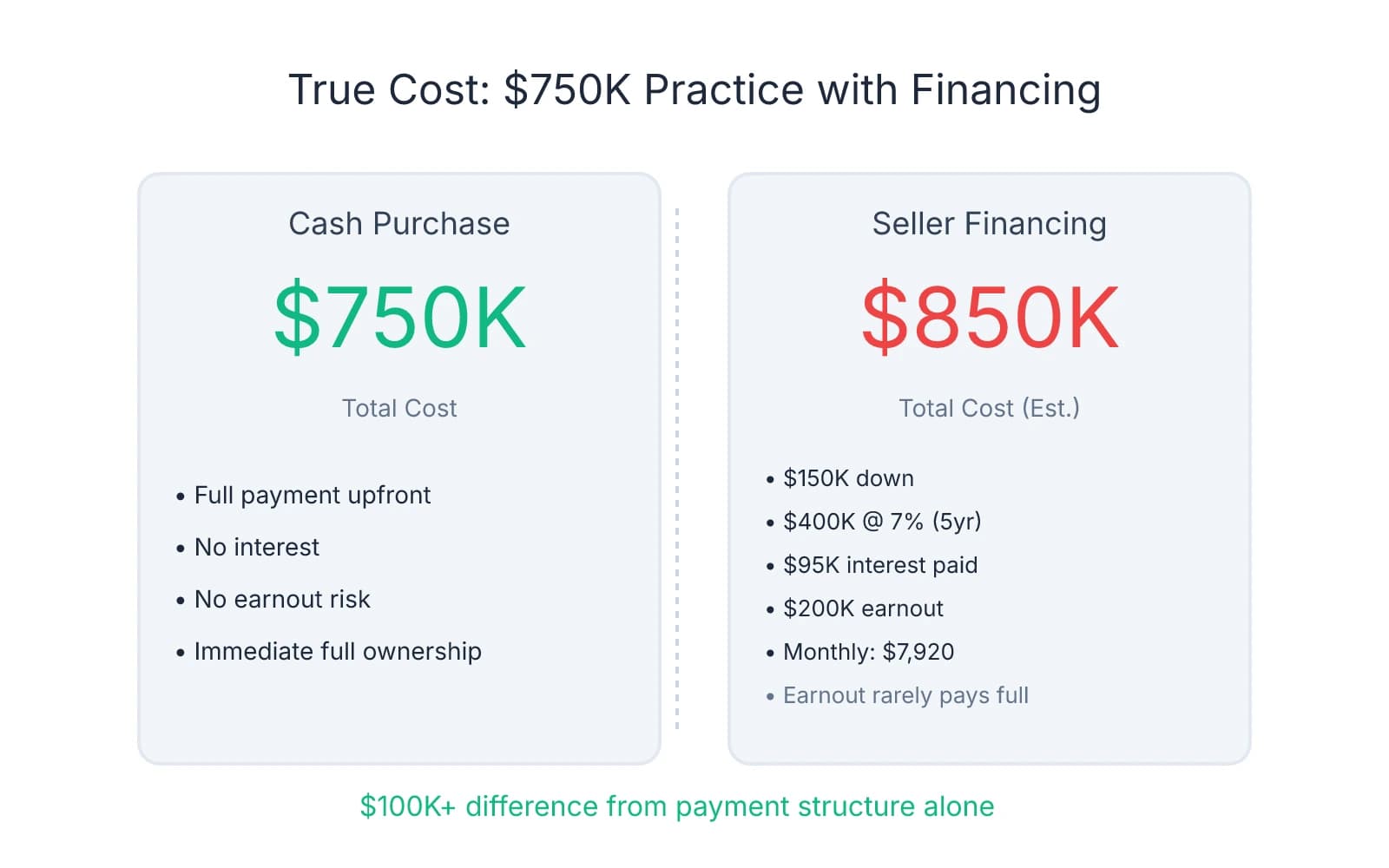
Seller financing changes both your monthly cash flow and your total outlay. A five-year note at 7% interest means you're paying roughly $7,920 per month on a $400,000 balance—nearly $95,000 in interest over the life of the loan. Extend that term to seven years and your monthly payment drops to $5,940, but total interest climbs to $98,160. The difference between a 6% and 9% interest rate on the same balance is about $30,000 over five years. When you're already managing student debt and practice overhead, understanding how much cash you actually need to buy a dental practice becomes critical—not just for the down payment, but for sustaining operations while servicing debt.
Earnout structures shift risk entirely to you. If the seller's $200,000 earnout is contingent on maintaining $1.2 million in collections over three years, you're now responsible for factors you don't yet control: associate retention, patient loyalty, payer mix stability, and referral patterns. Earnout triggers in dental sales often include metrics like revenue targets, associate retention, and patient list stability—all of which can shift after the seller exits. One pattern worth watching: earnouts rarely pay out in full. Negotiate performance metrics you can directly influence, set clear measurement criteria, and cap the earnout period at 12–18 months if possible.
Working capital adjustments—a line item many buyers discover only after signing—represent the practice's short-term liquidity: accounts receivable, inventory, and prepaid expenses minus accounts payable and accrued liabilities. The purchase agreement typically includes a target working capital figure based on historical averages. Ninety days after closing, the buyer and seller reconcile actual working capital against that target. If receivables are lower than expected or payables higher, the buyer owes the seller the difference. These adjustments can shift $20,000 to $50,000 depending on the practice's billing cycle and payer mix. Negotiate a narrow working capital band and require the seller to provide a preliminary calculation before closing.
Structure your payment terms around two variables: your cash reserves and your growth timeline. If you're entering with minimal liquidity, prioritize lower monthly payments over shorter loan terms—even if it costs you more in interest. If you have strong reserves and expect rapid revenue growth, negotiate a larger upfront payment to reduce seller financing exposure and eliminate earnout risk entirely.
Seller Transition Terms Protect Patient Retention and Revenue Stability
Patient attrition accelerates when the seller disappears immediately after closing. The handoff period—typically 60 to 90 days—gives patients time to meet you, build trust, and decide to stay. Without it, you're asking patients to accept a new provider they've never met, which is exactly when they start shopping for alternatives or simply stop scheduling.
The transition period should define three things: duration, responsibilities, and compensation. For most general practices, 60 to 90 days provides enough time for the seller to introduce you to active patients and complete any pending treatment plans. Specialty practices often require longer transitions—sometimes 120 days or more—because referral relationships take time to transfer and patients may have multi-visit treatment sequences already in progress.
Define what the seller actually does during those 60 to 90 days. A vague "transition support" clause leaves room for a seller who shows up twice and considers the job done. Instead, structure specific responsibilities: the seller introduces you to patients during appointments, completes any treatment they started, attends staff meetings to signal continuity, and remains available for clinical questions during business hours. One protection many buyers overlook is requiring the seller to work a minimum number of days per week—typically three to four—so the transition doesn't drag out with sporadic appearances.
Compensation during transition keeps the seller engaged without overpaying for what's essentially a handoff role. Many agreements pay the seller a daily rate or a percentage of collections they generate during the transition period—often 30% to 40% of production. This aligns incentives: the seller benefits from staying active, and you're only paying for actual clinical work. Tie compensation directly to days worked or collections produced, and cap the total payout so you're not funding a semi-retirement.
Retreatment clauses protect you from inheriting the seller's clinical issues. These clauses typically require the seller to either redo failed work at no charge or reimburse you for the cost of having another provider handle it—usually 50% to 70% of your standard fee. The clause should cover work completed within 12 months before closing and remain in effect for 12 months after. If a crown the seller placed six months before the sale fails three months after you take over, the seller compensates you for the retreatment.
When the seller refuses to participate in any transition, patient retention risk increases significantly. Practices without a structured transition period often see higher attrition rates, particularly among long-term patients who feel abandoned by the sudden change. If the seller won't commit to a transition, adjust your offer to reflect that risk—either by lowering the purchase price or negotiating other protections like extended non-compete terms or stronger patient list guarantees.
Indemnification and Liability Terms Determine Who Pays When Problems Surface
Indemnification provisions answer a question most buyers don't think about until it's too late: who pays when the seller's representations turn out to be wrong? If you discover $40,000 in unpaid payroll taxes three months after closing, or if a patient lawsuit emerges from treatment the seller completed before the sale, the indemnification clause determines whether you absorb that cost or recover it from the seller.
These provisions include three mechanisms that limit your ability to collect: caps, baskets, and survival periods. A cap sets the maximum amount the seller will pay for all claims combined—often 10% to 25% of the purchase price. A basket establishes the minimum threshold before indemnification kicks in, typically $10,000 to $25,000 depending on deal size. The survival period defines how long you have to bring a claim after closing. Most non-fundamental representations survive 12 to 24 months, while fundamental representations—taxes, ownership, authority—often survive for the applicable statute of limitations or three to six years.
Here's how these limits play out. You buy a $600,000 practice with a 15% indemnification cap ($90,000) and a $15,000 basket. Six months after closing, you discover $12,000 in equipment repairs the seller didn't disclose. You can't recover that amount—it's below the basket. Then you find $8,000 in unpaid vendor invoices. That brings your total losses to $20,000, which exceeds the basket, so now you can file a claim. But if your total discovered losses eventually reach $110,000, you can only recover $90,000—the cap limits the seller's exposure even when actual damages exceed it.
The basket structure matters as much as the dollar amount. A "deductible" basket means you only recover losses above the threshold—if the basket is $15,000 and your claim is $20,000, you collect $5,000. A "tipping" basket means once you cross the threshold, you recover the full amount—cross $15,000 and you collect the entire $20,000. Sellers typically push for deductible baskets to limit small claims, while buyers prefer tipping baskets that don't penalize them for the first dollar of loss.
Which representations matter most? Financial accuracy, equipment condition, and undisclosed liabilities are where post-closing problems typically surface. If the seller represented that all accounts receivable were current and collectible, but 30% turn out to be over 90 days old, that's a financial accuracy breach. If the seller claimed all equipment was in working order and you discover the sterilizer needs a $15,000 replacement, that's an equipment condition issue. Fundamental representations—taxes, ownership, no undisclosed liabilities—typically survive longer because they address core legal and financial risks that can emerge years after closing.
Negotiate caps that cover meaningful losses without making the seller walk away. A 10% cap on a $500,000 deal gives you $50,000 in protection—enough to cover most post-closing surprises like undisclosed liabilities or equipment failures, but not so high that the seller views the deal as open-ended risk. Push the cap to 20% or 25% if the practice has red flags during due diligence—inconsistent financial records, high staff turnover, or deferred maintenance.
Survival periods should match the risk timeline for each category of representation. Tax liabilities can surface three to six years after closing, so fundamental tax representations should survive for the full statute of limitations period. Operational representations—employee matters, contracts, patient records—rarely produce claims beyond 18 months, so a shorter survival period makes sense for both parties. Separate fundamental representations into their own survival category and negotiate longer protection where the risk justifies it.
Building Your Negotiation Strategy Around What Actually Protects You
The terms you push hardest on should match the risks you're least equipped to absorb. A first-time buyer with limited reserves needs different protections than an experienced owner acquiring a second location. If you're entering with minimal cash beyond the down payment, prioritize terms that protect your monthly cash flow—lower seller financing rates, longer payment terms, and a structured transition period that reduces patient attrition risk. If you're buying a practice where 60% of production comes from the seller, non-compete scope and transition length matter more than earnout structure.
Start by identifying where your risk sits. Practices with high seller dependency—where the selling dentist generates most of the revenue or holds key referral relationships—require stronger transition commitments and tighter non-compete language. If the seller plans to stay in the area and could easily pull patients to a new location, a non-compete radius of 10 to 15 miles becomes critical. Practices with established associate production and diversified referral sources carry less transition risk, which means you can afford to be more flexible on seller involvement and focus instead on financial terms like working capital adjustments or indemnification caps.
Sellers typically have flexibility on three categories of terms: transition length, non-compete scope, and equipment warranties. Most sellers are willing to extend a 60-day transition to 90 days if it doesn't require them to relocate plans or delay retirement. Non-compete radius and duration are often negotiable—sellers may accept a 10-mile radius over 15 miles if the time restriction stays at two years instead of three. Equipment warranties and retreatment clauses usually don't affect the seller's immediate plans, so they're easier to negotiate than price or payment structure. Where sellers resist movement is on fundamental representations, price allocation, and indemnification caps—these terms carry tax implications or long-term liability exposure that most sellers won't adjust without a corresponding change in purchase price.
Bring in your advisors at specific decision points, not just for final review. Your attorney should review the indemnification provisions, non-compete language, and lease assignment terms before you agree to them—not after the purchase agreement is drafted. Your CPA should evaluate the price allocation and working capital calculation early in the process, ideally during due diligence, so you understand the tax impact and cash flow implications before committing to a structure. Questions you ask during due diligence often reveal which terms need the most protection—if the seller hesitates when explaining accounts receivable aging or equipment maintenance history, that's a signal to tighten your indemnification language and equipment warranties.
Lease assignment terms, non-compete scope, and contingency periods form the foundation of your protection strategy because they address the three most common post-closing failures: losing the location, losing the patient base, and discovering undisclosed liabilities. A lease with less than five years remaining and no renewal options puts you at risk of relocation costs or rent increases that destroy your cash flow projections. A non-compete that allows the seller to open a practice two miles away six months after closing undermines the goodwill you just paid for. Contingency periods that end before you've completed financial verification or lease assignment leave you committed to a deal before you know whether the fundamentals hold.
When you're deciding which terms to prioritize, use this framework: protect cash flow first, then patient retention, then liability exposure. Cash flow determines whether you can service debt and cover overhead in the first 90 days—if your payment structure or lease terms drain liquidity faster than the practice generates it, nothing else matters. Patient retention determines whether the revenue you projected during due diligence actually materializes—if 30% of the patient base leaves because the seller disappeared immediately after closing, your cash flow projections collapse. Liability exposure determines whether you're absorbing costs for problems the seller created—unpaid taxes, equipment failures, or retreatment claims that surface months after you take ownership.
If the negotiation stalls on a specific term, step back and ask whether the issue signals a deeper problem. A seller who refuses any transition period or resists a reasonable non-compete may not believe the patient base will stay. A seller who won't provide basic financial documentation or pushes for a 5% indemnification cap on a $700,000 deal may know about liabilities they haven't disclosed. Knowing when to walk away often comes down to recognizing when the seller's resistance to standard protections reveals risks you can't mitigate through negotiation alone.
Sources & References
The data and claims in this article are drawn from the following sources. We prioritize government data, peer-reviewed research, and established industry publications to ensure accuracy.
- Earn-Out Structures In Dental Practice Sales - DentPulse Glossary— www.dentpulse.comIndustry
- Transition Period in Dental Acquisitions - Kamkari Law— www.dentalmedicalattorney.comIndustry
- 20 Essential Negotiation Terms - Dental Practice Purchase Agreement— practiceorbit.comIndustry
- 3 Indemnification Terms and Concepts to Know in an M&A ...— www.mclane.comIndustry
- Negotiating the Sale of a Dental Practice - DDS Lawyers— ddslawyers.comIndustry
- What to Do When Selling a Practice | American Dental Association— ada.orgIndustry
Frequently Asked Questions
Ready to negotiate your practice purchase?
Beyond price, there are numerous terms and protections to negotiate in your dental practice purchase agreement. Minty Plus provides expert guidance through every stage of acquisition, ensuring you secure favorable terms that protect your investment.