Dental Practice Post-Closing Adjustment: What Buyers Need to Know

Co-Founder, Minty Dental

In Summary
- The purchase price you negotiate is almost never your final number—most dental practice deals include a working capital adjustment that reconciles the agreed target against actual closing conditions
- Working capital adjustments compare a negotiated baseline (the "peg") to what actually exists at closing—if the practice delivers less working capital than expected, you receive a refund; if more, you owe additional payment
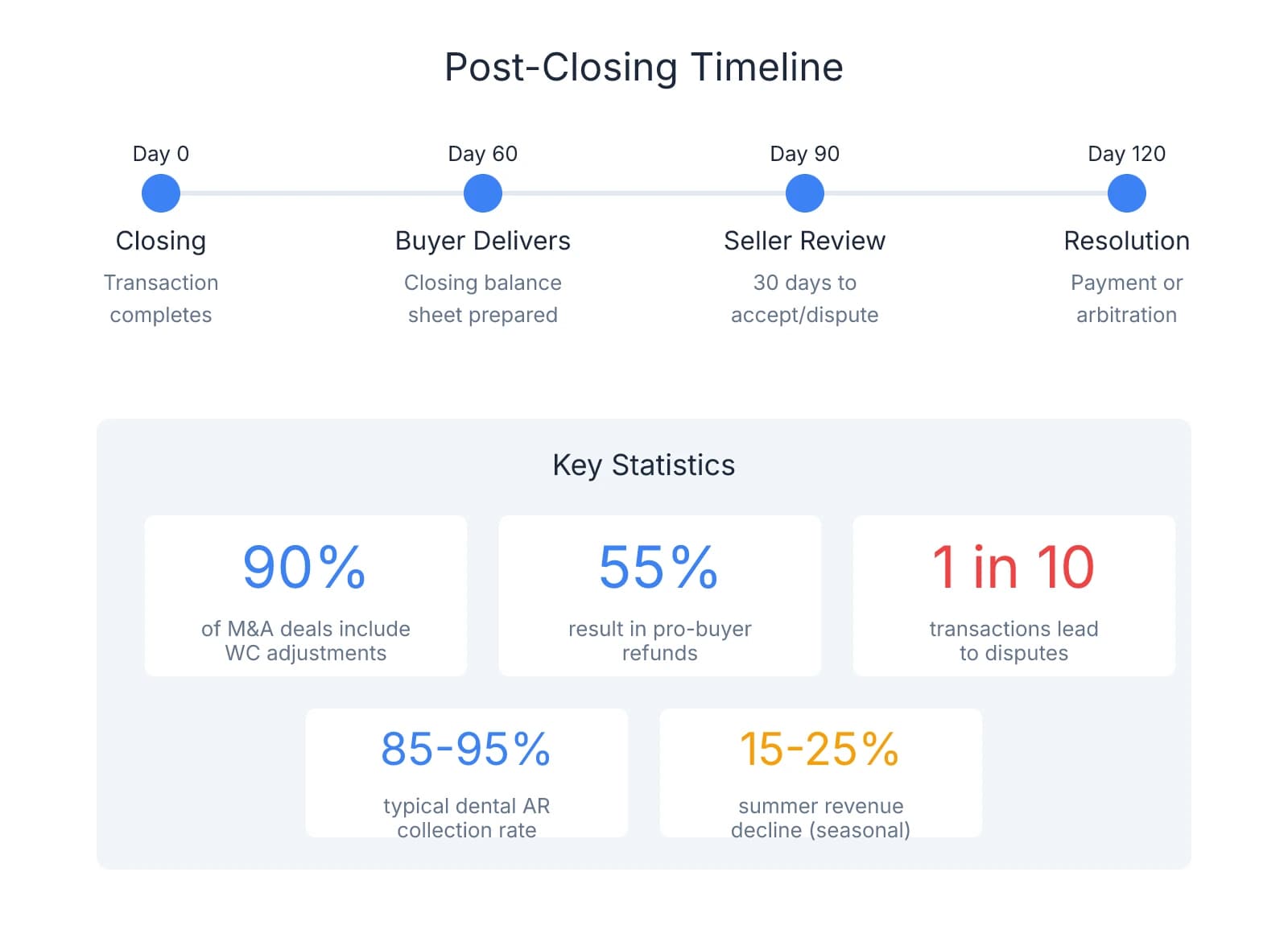
- Over 90% of private M&A deals now include working capital adjustments, with 55% resulting in pro-buyer refunds—making this a standard protection mechanism, not an adversarial process
- Most disputes trace back to vague purchase agreement language about which accounts are included and how the peg is calculated, not the adjustment concept itself
Post-Closing Adjustments Reconcile What You Negotiated Against What You Actually Received
The purchase price in your letter of intent is a starting point, not a final number. Most dental practice acquisitions include a working capital true-up mechanism that adjusts the price based on what actually exists at closing. If the practice delivers less operating liquidity than expected—fewer supplies, lower receivables, higher payables—you receive money back. If it delivers more, you owe the seller additional proceeds.
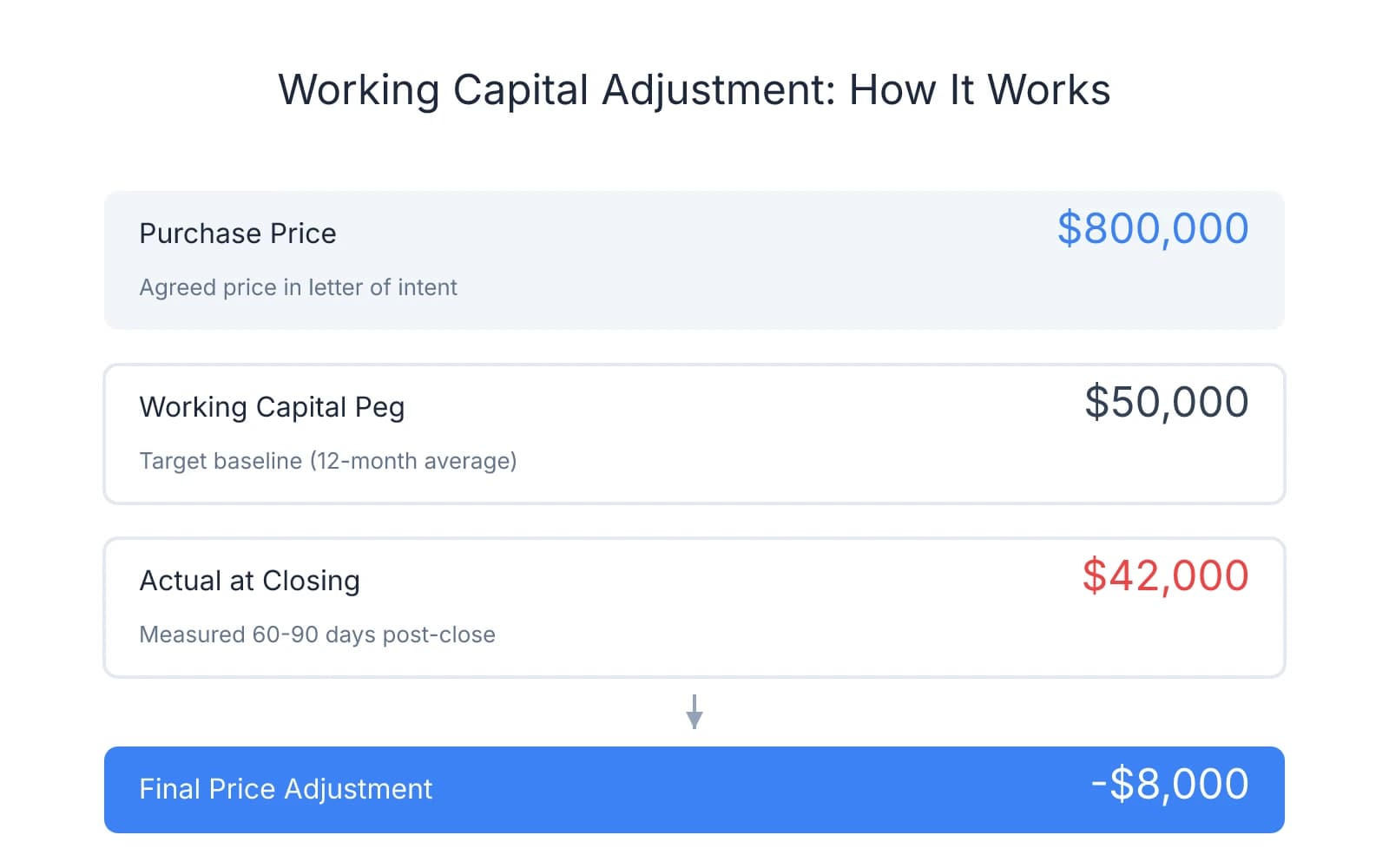
This isn't a penalty or a renegotiation. It's a contractual reconciliation that protects both parties from changes between the day you agree on a price and the day you take ownership. Over 90% of private M&A deals now include working capital adjustments, up from 50% a decade ago. The mechanism has become standard because it solves a timing problem: you negotiate based on historical financials, but you're buying the practice as it exists on closing day.
The adjustment compares two numbers. The first is the "peg"—a negotiated target for working capital, typically based on a trailing 12-month average or the most recent month-end balance. The second is actual working capital at closing, calculated from a balance sheet prepared shortly after the transaction. The difference between these two figures adjusts your purchase price dollar-for-dollar.
Here's how the math works. You agree to buy a practice for $800,000 with a working capital peg of $50,000. At closing, the practice delivers $42,000 in working capital—$8,000 less than the target. You receive an $8,000 refund from escrow or the seller's proceeds. If the practice had delivered $58,000, you would owe the seller an additional $8,000. The adjustment flows both ways, though 55% of adjustments result in pro-buyer refunds, suggesting sellers often overestimate closing liquidity.
The reconciliation happens 60 to 90 days after closing, once you've had time to prepare closing financials and calculate the difference. Most purchase agreements give the buyer 60 days to deliver a closing balance sheet, then allow the seller 30 days to review and dispute the calculation. If both parties agree, the adjustment is processed through escrow or direct payment. If they don't, the dispute moves to an independent accountant for resolution.
What tends to create problems is the purchase agreement language that defines the adjustment. Working capital in M&A doesn't follow GAAP definitions—it's a negotiated list of accounts. A typical dental practice adjustment includes accounts receivable (net of reserves), inventory, prepaid expenses, accounts payable, accrued expenses, and deferred revenue. It excludes cash, debt, and deal-related items like transaction bonuses or legal fees. If your purchase agreement doesn't specify which accounts are included, you're vulnerable to a seller who interprets "working capital" differently than you do.
One protection many buyers overlook is the methodology for calculating the peg. A trailing 12-month average smooths out seasonal fluctuations, but it can also mask a declining trend. If the practice's working capital has been dropping for six months, a 12-month average will overstate what you're actually receiving. Some buyers negotiate a peg based on the most recent month-end balance or the average of the last three months, which reflects current operations more accurately.
Most conflicts arise from disagreements about which receivables are collectible, how to value inventory, or whether certain liabilities should be included. These disputes are avoidable if you define the calculation methodology clearly in the purchase agreement and conduct a thorough pre-closing audit of the accounts that will drive the adjustment.
What Gets Included in Working Capital—and What Buyers Should Negotiate
Working capital in M&A is defined as current assets minus current liabilities, but the specific accounts included are negotiable—not a GAAP standard. The purchase agreement must explicitly list which balance sheet items count toward the calculation, because ambiguity in this definition is where most post-closing disputes originate.
The typical dental practice adjustment includes accounts receivable (net of reserves), supply inventory, prepaid expenses, accounts payable, accrued payroll, and accrued vacation on the asset side. On the liability side: accounts payable to suppliers, accrued expenses like utilities or lab fees, and deferred revenue from prepaid treatment plans or membership programs. Cash, debt, intercompany balances, and transaction-related expenses—legal fees, broker commissions, deal bonuses—are excluded. The buyer is purchasing the operating liquidity of the business, not the seller's bank account or loan obligations.
Accounts receivable treatment is where buyers often give away leverage. A seller might present total AR as $120,000, but dental practices typically collect 85-95% of production, depending on payer mix and billing efficiency. One protection many buyers negotiate is aging-based reserves: 90-95% for current balances, 80-85% for 31-60 days, 50-60% for 61-90 days, and lower percentages for older accounts. If your purchase agreement treats all AR at face value, you're assuming the seller's collection rate is perfect—which it rarely is.
Inventory should be valued at the lower of cost or market value, with explicit language about obsolete or expired supplies. A practice might carry $15,000 in inventory on its books, but if $3,000 of that is expired composite or discontinued implant components, you're overpaying for unusable stock. Some buyers negotiate a joint inventory count 30 days before closing, with both parties agreeing on what gets included at what value.
Deferred revenue—prepaid treatment plans, unused membership fees, or advance payments for orthodontic cases—can swing the adjustment significantly. If the practice collected $20,000 in prepaid treatment but only delivered $5,000 of that work before closing, you inherit a $15,000 liability. That liability reduces your working capital at closing, which means you receive a refund if the peg didn't account for it. The challenge is that many sellers don't track deferred revenue accurately, so the number that appears on the closing balance sheet surprises both parties.
Here's how different definitions change the outcome. You agree to a $50,000 working capital peg. At closing, the practice has $110,000 in AR, $12,000 in inventory, $8,000 in prepaid expenses, $45,000 in accounts payable, $10,000 in accrued payroll, and $15,000 in deferred revenue. Under a face-value definition, working capital is $60,000 ($130,000 assets minus $70,000 liabilities), so you owe the seller $10,000. But if you negotiated aging-based AR reserves and the practice has $15,000 in balances over 90 days, your adjusted AR is $95,000. Now working capital is $45,000, and you receive a $5,000 refund instead of paying $10,000. The $15,000 swing came entirely from how you defined one account.
The purchase agreement should also specify how to handle accounts that change between signing and closing. If the seller pays down $10,000 in payables the week before closing, does that reduce working capital or get treated as a distribution? Many buyers include a provision that working capital should be calculated "in the ordinary course of business," meaning the seller can't manipulate balances by accelerating collections or delaying payments just to hit the peg.
Where buyers lose leverage is in accepting the seller's historical accounting as the basis for the adjustment. If the practice has been capitalizing supplies as fixed assets instead of expensing them, or if it hasn't been accruing vacation liability, the closing balance sheet will look different from the historical financials you reviewed during due diligence. One step many buyers find valuable is conducting a pre-closing audit of the accounts that will drive the adjustment—AR aging, inventory counts, payable balances, and deferred revenue schedules.
How the Working Capital Peg Gets Set—and Where Buyers Lose Money
The working capital peg is the baseline against which your closing balance gets measured, and how that peg is calculated can create significant swings in what you ultimately pay. Most purchase agreements default to a trailing 12-month average, which sounds reasonable until you realize that methodology can lock you into paying for working capital levels the practice no longer maintains.
Here's the problem with a 12-month average: it treats every month equally, even when the business has clear seasonal patterns or recent operational changes. A practice that generates 40% of its revenue between January and April—insurance maximums driving year-end treatment—will show artificially high working capital during those months. If you close in July using a 12-month average that includes those peak periods, your peg reflects liquidity the practice doesn't need during summer months when revenue typically drops 15-25%.
The calculation period matters as much as the methodology. A practice that's been growing rapidly over the past year needs more working capital today than it did 12 months ago—but a trailing average will understate current requirements. Conversely, a practice that's been declining will show a peg that's higher than what the business actually needs now. One approach many buyers negotiate is matching the lookback period to the expected closing timeframe: if you're closing in Q3, use Q2 and Q3 of the prior year plus Q1 and Q2 of the current year.
Where buyers lose money is in accepting a peg without seeing the monthly working capital trend that produced it. A $50,000 average could represent twelve months of stable $48,000-$52,000 balances, or it could represent six months at $65,000 followed by six months at $35,000. The first scenario suggests a reliable peg; the second suggests a business in transition where the average no longer reflects reality. During due diligence, request monthly balance sheets for the trailing 12-18 months and calculate working capital for each period using the same account definitions that will apply at closing.
Red flags that signal a problematic peg include seller resistance to providing monthly data, large unexplained swings between periods, or a peg that sits significantly above the most recent three to six months. If the practice's working capital has averaged $42,000 over the last six months but the seller is proposing a $55,000 peg based on a 12-month average, you're being asked to deliver liquidity the business hasn't maintained recently. Push back with data: "Your proposed peg reflects Q1 and Q2 of last year, when the practice was running higher inventory and slower payables. The last six months average $42,000, which better reflects current operations."
Seasonal practices need peg calculations that match the closing month, not an annual average that includes peak periods. One protection many buyers negotiate is a "normalized" peg that adjusts for known seasonal patterns: if the practice historically runs 20% below its annual average during summer months, the peg should reflect that.
One-time events that distort the peg should be normalized out, but only if you identify them before signing. A large equipment purchase that temporarily spiked payables, a one-time insurance refund that inflated receivables, or a staff bonus that elevated accrued expenses—all of these should be excluded from the peg calculation if they don't reflect ongoing operations. The challenge is that sellers often don't volunteer this information, so buyers need to ask: "Were there any unusual transactions in the past 12 months that affected working capital?"
Protecting Yourself: Due Diligence and Purchase Agreement Language That Prevents Disputes
The adjustment itself isn't the risk—vague contract language and incomplete due diligence are. Nearly 1 in 10 M&A transactions leads to post-closing disputes, with working capital adjustments representing the most common source of conflict. The pattern is consistent: buyers who invest time in clear definitions and thorough pre-closing audits avoid costly reconciliation battles later.
Start by auditing the accounts that will drive the adjustment during due diligence, not after closing. Pull the accounts receivable aging report and compare it against the seller's historical collection rates—if the practice claims 95% collectibility but the aging shows $40,000 in balances over 90 days, that's a discrepancy you need to address in the peg calculation or AR reserve methodology. Physically count supply inventory and identify expired or obsolete items that shouldn't be valued at cost. Review prepaid expenses to confirm they're actually recoverable. Walk through accrued liabilities with the practice's bookkeeper to identify any unrecorded obligations: unpaid lab bills, outstanding vacation balances, or deferred revenue from membership programs.
The purchase agreement should include explicit definitions for every account included in working capital, with a sample calculation in an exhibit that shows exactly how the math works. Define "accounts receivable" as gross balances less specific aging-based reserves (e.g., 5% for 0-30 days, 15% for 31-60 days, 40% for 61-90 days, 75% for over 90 days). Define "inventory" as supplies physically present at closing, valued at the lower of cost or market, excluding expired or obsolete items. Define "deferred revenue" as prepaid treatment plans, unused membership fees, and advance payments for services not yet delivered.
Include a sample calculation as Exhibit A that walks through the working capital formula using actual numbers from a recent balance sheet. When you prepare the closing statement 60 days later, you'll use this exact methodology with updated balances—no surprises, no reinterpretation. Most disputes arise from inconsistent accounting treatment, not calculation errors.
Dispute resolution provisions should specify review periods and escalation procedures before anyone mentions litigation. A typical structure gives the buyer 60 days after closing to prepare the closing balance sheet and working capital calculation, then allows the seller 30 days to review and submit objections. If the seller disputes the calculation, both parties have 15 days to negotiate a resolution. If they can't agree, the dispute moves to an independent accounting firm—selected jointly or through a predetermined process—whose determination is final and binding.
Some deals include tolerance bands or "collars" that prevent adjustments below a certain threshold—typically $10,000 to $25,000 depending on deal size. If the difference between the peg and closing working capital is less than the collar amount, no adjustment is made. This eliminates disputes over immaterial differences and reduces the administrative burden of processing small payments.
Work with a transaction-experienced CPA to prepare the closing working capital statement using the exact methodology defined in the purchase agreement. This isn't a task for the practice's bookkeeper or your general accountant—it requires someone who understands M&A mechanics and can apply the contract definitions consistently.
The post-closing process typically unfolds over 90 to 120 days. You close the transaction and take ownership. Within 60 days, you prepare the closing balance sheet and calculate actual working capital using the purchase agreement methodology. You deliver this statement to the seller, who has 30 days to review and either accept the calculation or submit written objections with supporting detail. If the seller accepts, the adjustment is processed through escrow or direct payment within 10 business days. If the seller objects, both parties negotiate for 15 days, then escalate to the independent accountant if no resolution is reached.
Where buyers lose leverage is in treating the adjustment as an afterthought during purchase agreement negotiations. The time to define working capital, specify the peg methodology, and establish dispute resolution procedures is before you sign—not when you're preparing the closing statement and realize the contract is silent on how to value aged receivables. Push for clear definitions, conduct thorough pre-closing audits of the accounts that will drive the adjustment, and work with advisors who understand M&A mechanics.
Sources & References
The data and claims in this article are drawn from the following sources. We prioritize government data, peer-reviewed research, and established industry publications to ensure accuracy.
- Over 90% of private M&A deals now include working capital adjustments— srsacquiom.com
- Working Capital Adjustments and Tips to Mitigate M&A Disputes— www.lincolninternational.com
- revenue typically drops 15-25%— ada.org
- Avoiding post-close M&A disputes: Practical strategies to reduce risk ...— www.elliottdavis.com
- [PDF] Post-closing disputes: Key issues and ways to avoid them - RSM US— rsmus.comIndustry
Frequently Asked Questions
Navigate Your Post-Close Adjustment Successfully
Post-closing adjustments can be complex, but you don't have to handle them alone. Minty Plus provides expert guidance through the adjustment process and ongoing practice management support to ensure a smooth transition.