Should You Make a Backup Offer on a Second-Choice Dental Practice?

Co-Founder, Minty Dental

In Summary
- Small business acquisitions fail 20-40% of the time after signing a letter of intent, with dental practices falling squarely in this range—most collapses happen during due diligence or financing
- Every month you wait costs roughly $8,300 in lost income differential (if moving from $180K associate to $280K owner), plus you're not building equity or capturing appreciation
- Your second-choice practice isn't "settling" if it hits 80-90% of your criteria—comparative scoring against an idealized first choice distorts decision-making more than the actual numbers
- A backup offer protects your position only if structured with expiration clauses, full due diligence rights, and no exclusivity demands that freeze your timeline
Dental Practice Deals Fall Through More Often Than Most Buyers Expect
Small business acquisitions fail quietly. When a $7 million professional services firm falls out of contract three weeks before closing, no press release goes out. The seller re-lists months later or doesn't re-list at all. The buyer moves on. This pattern holds across industries, and dental practice transitions are no exception.
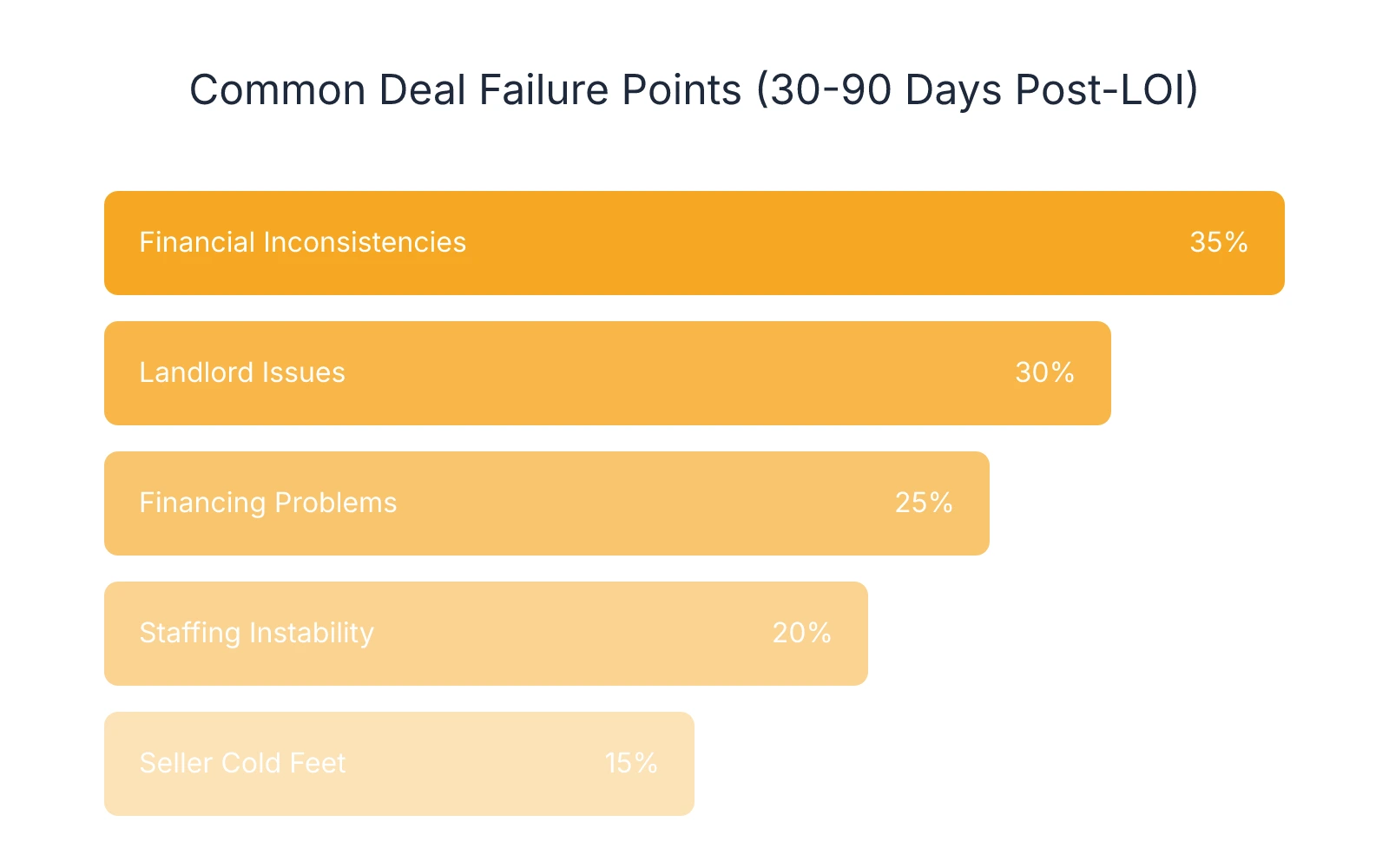
Deal failure rates in small M&A: Industry estimates place the failure rate for small business acquisitions between 20-40% after the letter of intent is signed. The deal doesn't collapse at the handshake stage—it collapses during due diligence, financing approval, or in the final weeks before closing when one party discovers something that changes the equation.
Financial inconsistencies surface during review—tax returns that don't match profit and loss statements, production reports that don't align with deposits, personal expenses mixed into business accounts. A buyer who questions the numbers begins questioning everything else. Accounts receivable problems follow: aged balances over 90 days, unresolved insurance claims, unclear refund liabilities. Buyers discount the value of those receivables or request escrow holdbacks to cover potential write-offs.
Landlord issues kill deals with surprising frequency. A seller may have operated under a lease for 15 years with no problems, but when the landlord reviews the assignment request, they refuse—or demand rent increases, personal guarantees, or lease modifications the buyer can't accept. When a landlord won't assign the lease, the deal often dies on the spot unless the seller owns the building or can negotiate a resolution quickly.
Staffing instability creates another common failure point. If key team members resign during the transition, or if a buyer discovers high turnover, weak systems, or unresolved HR issues, confidence erodes. Buyers evaluate not just collections, but quality of earnings—and a practice with operational red flags gets repriced or abandoned.
Seller cold feet appears more often than most buyers expect. A dentist who seemed committed at the LOI stage begins second-guessing the decision as closing approaches. They delay document requests, stop responding to emails, or suddenly want to renegotiate terms. If a seller accepts your offer then changes their mind, you're left with sunk costs and no clear path forward.
Timeline reality: If a deal is going to collapse, it typically happens 30-90 days post-LOI. That's the window where due diligence uncovers problems, financing hits roadblocks, or one party loses conviction. A buyer waiting for a first-choice deal to fail is waiting months with no guarantee of a second chance. Sellers who pull out often relist six months later—or a year later—or not at all. When they do return, the terms may have changed, the staff may have turned over, or another buyer may already be in contract.
The pattern worth paying attention to: deals fail more often than they close smoothly, and the "wait and see" strategy assumes your first choice will both fail and come back available under the same conditions. That assumption carries more risk than most buyers realize.
What You're Actually Giving Up While You Wait
Waiting feels passive, but it's an active financial decision with a price tag that compounds daily. The cost isn't just the practice you're not buying—it's the income you're not earning, the equity you're not building, and the market opportunities disappearing while you're on hold.
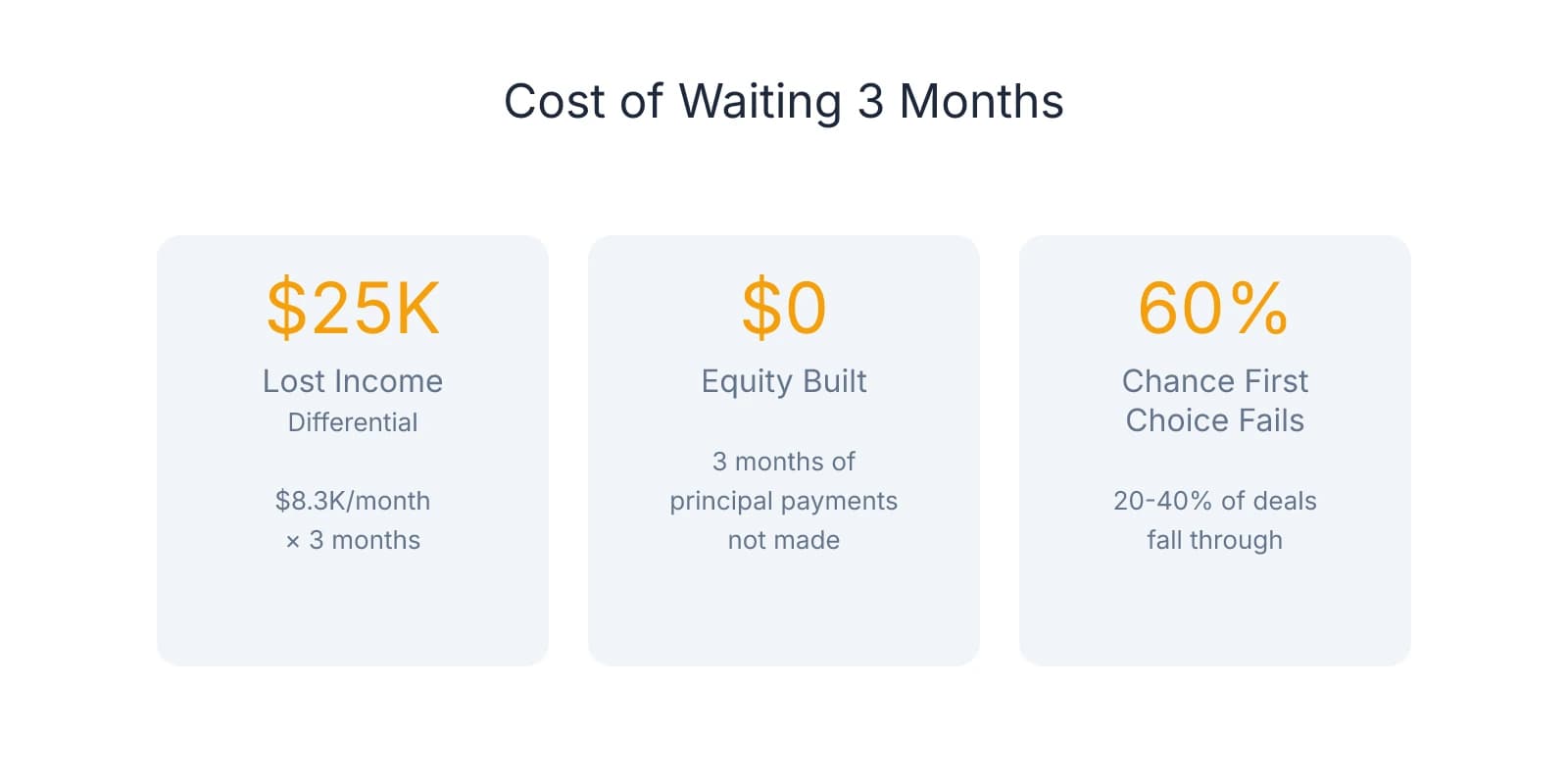
The ownership income differential: If you're earning $180,000 as an associate and a practice would generate $280,000 in owner compensation after debt service, every month you wait costs roughly $8,300 in income differential. Three months of waiting—a realistic timeline if your first-choice deal collapses during due diligence—represents $25,000 in lost cash flow. That's money you could have deposited this quarter.
The equity-building clock matters more than most buyers weight it. Dental practice loans amortize over 10-15 years, and every payment builds ownership stake in a cash-flowing asset. Three months of waiting means three months you're not reducing principal, not capturing appreciation, and not starting the timeline toward a debt-free practice. If you're 32 and planning to own for 25 years, delaying by a quarter shifts your debt-free date and reduces your total years of unencumbered ownership income.
Market opportunity cost: While you're holding out for a first choice that may never return, other listings are moving through the pipeline. Your second-choice practice could receive another offer next week. Comparable alternatives in your target geography may not surface for six months. The assumption that "something better will come along" works only if deal flow in your market supports it—and in many regions, quality practices list once every 12-18 months, not once a quarter.
The market doesn't stay static. If your second choice disappears and your first choice never returns, you're back to square one—scanning new listings, rebuilding relationships with brokers, and restarting due diligence from scratch. That reset costs months, and in a market where interest rates can shift quickly, timing risk becomes real. A 1% rate increase on a $750,000 loan adds roughly $7,500 annually to debt service. If rates rise while you're waiting, your buying power shrinks even if the practice price stays flat.
Momentum cost: Lender pre-approvals typically expire after 60-90 days. If you're waiting on a first-choice deal and your approval lapses, you'll need to resubmit financials, update credit pulls, and restart underwriting—adding weeks to your timeline. Your attorney, accountant, and transition consultant are juggling other clients. The longer you wait, the more their attention shifts elsewhere.
The psychological cost shows up in decision fatigue and lost conviction. Buyers who wait too long start questioning whether ownership is the right move at all. The energy required to restart a search after months of waiting is significant—and some buyers never restart. They talk themselves into staying an associate for "one more year," which becomes two, then five. If you've already lost one bidding war, the risk of losing momentum entirely is higher than most buyers expect.
One framework for calculating your personal opportunity cost: multiply the monthly income differential by the number of months you expect to wait, add the cost of any rate increases or market shifts during that period, and factor in the probability that your first choice never returns. If waiting 90 days costs you $25,000 in lost income, $5,000 in higher debt service from rate changes, and a 60% chance your first choice doesn't come back, you're risking $30,000 for a coin-flip outcome.
How to Evaluate Whether Your Second Choice Is Actually Good Enough
The question isn't whether your second choice matches your first—it's whether it meets your criteria independently. Many buyers fall into the trap of comparative scoring: this practice is "worse" than that one. But if your second choice delivers 85% of what you need and is available now, the certainty may outweigh the marginal upside of waiting indefinitely for a deal that may never close.
Run the same diligence framework you applied to your first choice. Start with financial performance. Pull three years of collections and production data and calculate the trend line. Is the practice growing, flat, or declining? A practice with $800,000 in collections that's grown 4% annually for three years looks different from one that's dropped from $850,000 to $780,000 over the same period—even if both are priced identically. Profitability matters more than top-line revenue. If your second choice runs at 68% overhead while your first choice runs at 62%, that's a $48,000 annual difference on $800,000 in collections. Material, but not necessarily disqualifying if other factors compensate.
Location and patient demographics deserve the same scrutiny. Is the commute manageable long-term? Does the patient base align with the clinical work you want to do? A practice 15 minutes farther from your home but with a stronger insurance mix and better retention rates may deliver better economics than a closer practice with high Medicaid volume and 30% annual patient churn. Quantify the trade-offs where possible.
Identify the specific gaps between your first and second choice. Write them down. Is the first choice better because of location, profitability, patient volume, clinical scope, or transition support? Or is it better because it was first? Scarcity creates perceived value. A practice under contract often looks more attractive than it objectively is because you can't have it yet. This is idealization bias, and it distorts decision-making more than most buyers realize.
One exercise worth doing: score both practices across the criteria that matter to you—financial performance, location, patient base, staff quality, facility condition, deal structure. Use a 1-10 scale for each category and weight them by importance. If your second choice scores 82 out of 100 and your first choice scores 94, you're looking at a 13% gap. Now ask: is that 13% worth three months of lost income, the risk that your first choice never returns, and the possibility that your second choice disappears while you wait?
Consider the 80/20 rule in practice acquisition. If your second choice delivers 80-90% of what you want and is available now, the certainty may outweigh the marginal upside of waiting. A practice that meets your financial criteria, fits your lifestyle, and has clean due diligence is a strong position—even if it's not perfect. Perfect is often the enemy of good, and in a market where quality practices don't list frequently, "good enough" with certainty beats "perfect" with a 40% chance of never happening.
Deal structure deserves equal weight in your evaluation. A second-choice practice priced at 75% of collections with 90 days of structured transition support may be a better deal than a first-choice practice priced at 82% of collections with minimal seller involvement. Estimating practice value isn't just about the headline number—it's about what you're getting for that price and how much risk the structure leaves on your side of the table.
Where buyers often misjudge quality is in overweighting the emotional attachment to their first choice. If you toured that practice first, spent more time imagining yourself there, and built a relationship with the seller, it will feel like the right answer even if the numbers don't fully support it. The second choice didn't get that emotional investment, so it feels like settling. But settling implies compromise on criteria that matter. If your second choice hits your financial targets, fits your clinical goals, and offers a clean transition, that's not settling—that's executing on a sound acquisition strategy.
Structuring a Backup Offer That Protects Your Position Without Overcommitting
A backup offer isn't a binding commitment—it's a contingent position that becomes active only if the primary deal collapses. The structure determines whether you're protecting optionality or locking yourself into a weak position while the first buyer controls the timeline.
What a backup offer actually commits you to depends entirely on how it's written. In its cleanest form, a backup offer states: "This offer is contingent on the failure of the current accepted offer and subject to buyer's completion of due diligence, financing approval, and final acceptance by both parties." That language keeps you in the queue without binding you to anything until the first deal officially terminates and you've had the chance to reconfirm the practice condition.
Where backup offers become problematic is when they require exclusivity without reciprocal protection. If a seller asks you to stop pursuing other practices while you wait in backup position, you're taking on all the risk—your timeline is frozen, your opportunity cost is running, and you have no guarantee the first deal will fail or that the seller will honor your backup position if it does. One protection many buyers overlook is an expiration clause. Structure your backup offer with a 60-90 day window. After that point, if the primary deal hasn't closed or terminated, your backup position expires and you're free to pursue other opportunities.
Include the same buyer protections you'd negotiate in a primary offer. Your backup position should preserve your right to conduct full due diligence once you're elevated to primary status—financial review, lease assignment confirmation, staff interviews, patient records analysis. Standard purchase contingencies apply: financing approval, satisfactory due diligence findings, and the right to walk away if material conditions have changed since your initial evaluation. If the practice sat under contract for 90 days with another buyer, staff may have left, patients may have transferred, or the seller's motivation may have shifted.
Financing contingencies matter more in backup scenarios because your lender's pre-approval may expire while you're waiting. Structure your backup offer to include a financing contingency period that starts when you're elevated to primary position, not when you submit the backup offer. This gives you time to reconfirm loan terms, update financials, and ensure your approval is still valid.
The trade-off worth understanding: backup positioning may limit your flexibility. Some sellers will only accept a backup offer if you agree not to pursue competing practices during the waiting period. This makes sense from their perspective—they want a committed fallback, not someone casually window shopping. But it only makes sense from your perspective if you're genuinely prepared to move forward immediately if called upon.
One pattern that signals weak positioning: a seller or broker who won't allow reasonable contingencies in a backup offer. If they insist you waive due diligence, commit to financing without a contingency period, or accept the practice "as-is" without the right to reassess after months of waiting, that's not a backup offer—it's a trap. A seller confident in their deal and their backup positioning should have no problem granting standard buyer protections.
When to walk away from backup positioning entirely: if the seller won't grant a reasonable expiration timeline, if they demand exclusivity without reciprocal commitment, or if waiting would compromise your financing or career timeline. A backup offer should preserve your optionality, not eliminate it. If the structure leaves you worse off than continuing your search, the right move is to keep searching.
Where backup offers work well is when both parties understand the contingent nature and structure it accordingly. You signal serious intent to the seller, you preserve your position if the deal collapses, and you maintain the flexibility to pursue other opportunities if the wait stretches too long. That's strategic positioning. Anything else is just waiting in a weak spot while someone else controls your timeline.
Frequently Asked Questions
Ready to secure your ideal dental practice?
Whether you're pursuing your first choice or exploring backup options, having expert guidance through the acquisition process ensures you don't miss opportunities. Minty Plus provides hands-on support to help you navigate multiple offers and close the right practice for your career.