How to Win a Dental Practice with Multiple Competing Offers

Co-Founder, Minty Dental

In Summary
- Sellers weigh four factors when choosing between offers: price, deal structure, financing certainty, and personal rapport — and the highest bid often loses when other elements introduce risk
- A $50,000 premium rarely offsets the uncertainty created by extended contingencies, unclear financing terms, or transition plans that burden the seller
- Common structural weaknesses that kill competitive offers include 90-day due diligence periods, vague lender pre-approvals, and payment structures that shift all risk to the seller
- The pattern that costs buyers the most deals: front-loading aggressive due diligence requests into the LOI phase, which signals distrust before the relationship even begins
Sellers Rarely Choose the Highest Offer When Other Factors Create More Certainty
When three buyers submit offers within $40,000 of each other, the seller almost never picks the highest number. What decides the deal is which offer removes the most uncertainty from the seller's side of the transaction.
Most buyers assume competitive situations come down to price. In practice, sellers optimize for four factors simultaneously: offer price, payment structure and contingencies, buyer financing readiness, and personal rapport around practice legacy. A financially sound practice where the buyer can succeed matters to sellers because failed deals cost them months of lost momentum.
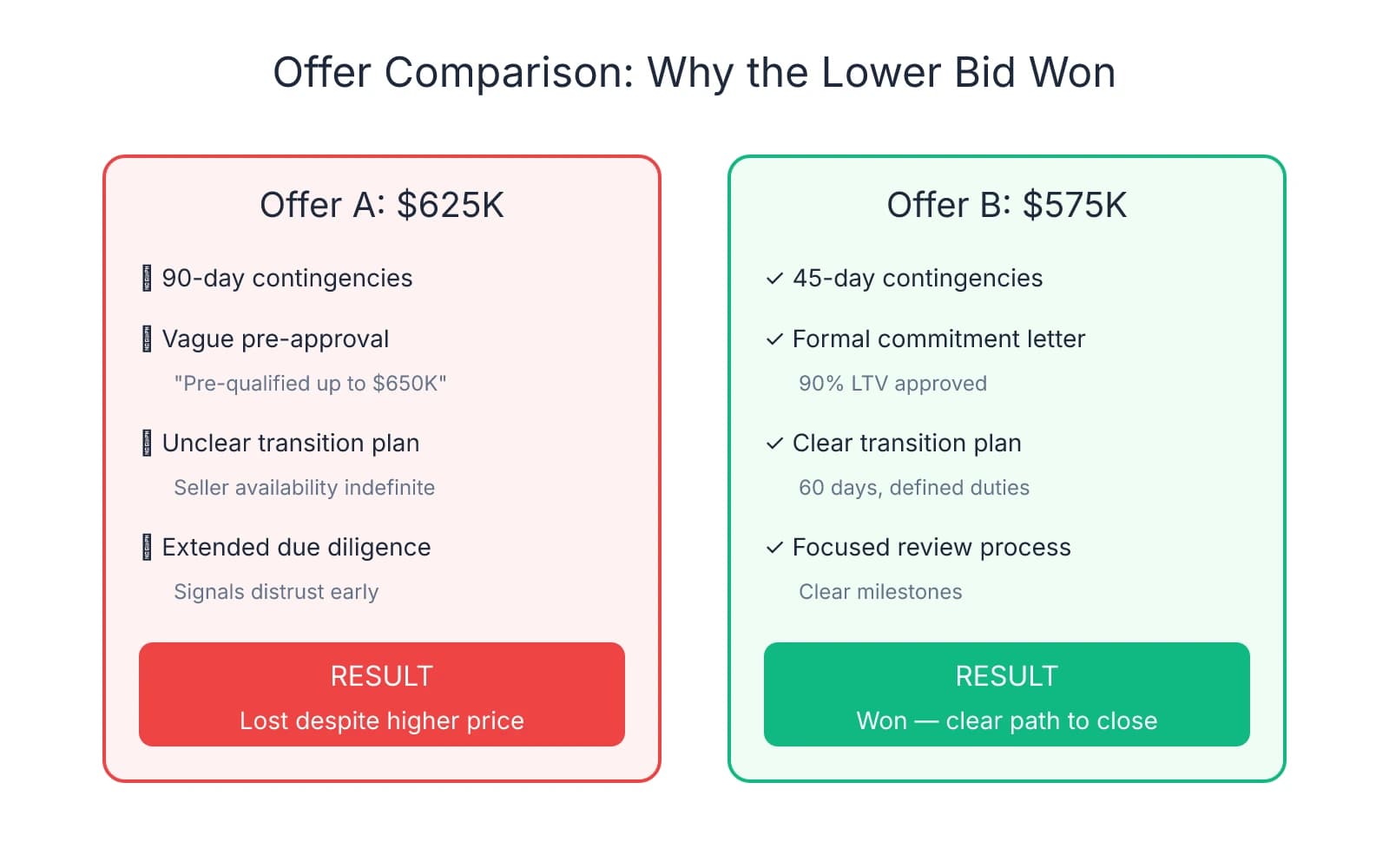
A $50,000 higher offer loses to a cleaner deal when the premium doesn't offset structural risk. One buyer offers $625,000 with 90-day contingencies and a vague pre-approval letter. Another offers $575,000 with 45-day contingencies, a formal commitment letter showing 90% loan-to-value approval, and a transition plan that keeps the seller involved for 60 days with defined responsibilities. The second offer wins because the seller can see a clear path to closing.
Where buyers repeatedly lose deals is in how they structure uncertainty. Extended contingency periods signal that the buyer expects to find problems. Vague financing terms — "pre-qualified for up to $650,000" instead of a commitment letter tied to this specific practice — tell the seller the lender hasn't actually underwritten the deal yet. Transition plans that assume the seller will remain available indefinitely, with no compensation structure or end date, shift all the post-closing risk onto the seller's schedule.
One pattern costs buyers more deals than any other: front-loading due diligence requests into the LOI phase. Asking for three years of patient charts, staff employment agreements, and vendor contracts before the seller has agreed to terms signals that you're treating the relationship as adversarial from the start. The time for detailed review is after the LOI is signed and both parties have committed to the deal structure.
Get Pre-Approved Before You Submit—Not After the Seller Asks
The fastest way to lose a competitive deal is to show up with financing you haven't actually secured. Sellers and brokers can spot the difference between a buyer who's ready to close and one who's still figuring out whether a lender will say yes.
Pre-approval isn't the same as pre-qualification. Pre-qualification is a lender's generic assessment based on a phone conversation about your income and debt load. Pre-approval means the lender has reviewed your tax returns, student loan balances, production history, and liquidity documentation — and confirmed they're prepared to lend on a practice acquisition in your target range.
In competitive situations, pre-approval demonstrates you're ready to move quickly and reduces the seller's risk of deal collapse. Sellers know that roughly 60% of a lender's decision hinges on the practice itself — cash flow, patient retention, lease terms — but the other 40% depends on your financial profile. If you haven't cleared that 40% before submitting an offer, the seller has no reason to believe you'll clear it during due diligence.
The work happens before you find the right practice. Approach two or three dental-specialized lenders and ask them to review your financials. Prepare two years of personal tax returns, a breakdown of your student loan balances and monthly payments, your production history if you've been an associate, and documentation of your liquidity. Most dental lenders will provide a pre-approval letter within a week if your profile is clean.
When you reference financing in your LOI, include the pre-approval letter or your lender's contact information. Specify the loan structure you're pursuing — SBA 7(a) vs. conventional — and clarify your expected timeline to closing. A sentence like "Financing is secured through [Lender Name], with pre-approval confirmed for up to 90% LTV on practices in this revenue range; expected closing timeline is 60 days from executed LOI" tells the seller you've done the work.
Structure Your Contingencies to Protect Yourself Without Scaring the Seller
The tension in any competitive offer is this: you need contingencies that protect your investment, but every contingency you add signals to the seller that you're not fully committed. The buyers who win structure contingencies that feel decisive rather than open-ended.
Three contingencies are standard in nearly every dental practice acquisition: financing approval, lease assignment or landlord consent, and verification of financial records through due diligence. Sellers expect these. A fourth — equipment condition assessment — is reasonable when the practice includes significant capital assets like a CBCT, digital scanner, or recent buildout.
Where many buyers lose ground is in how they frame timelines. A 90-day due diligence period tells the seller you're planning to spend three months looking for problems. A 45-day period with clear milestones — financial review complete by day 15, lease assignment confirmed by day 30, equipment inspection by day 40 — signals that you're moving with purpose. Shortening contingency windows without sacrificing substantive review is one of the clearest ways to differentiate your offer when multiple buyers are in play.
One structure worth considering: tie your contingency release to specific criteria rather than subjective judgment. Instead of "Buyer may terminate if due diligence reveals material concerns," specify the thresholds that would trigger termination — collections declining more than 15% year-over-year, undisclosed lease restrictions that prevent assignment, or equipment requiring more than $30,000 in immediate capital investment. This protects you while showing the seller exactly what you're evaluating.
Earnouts and seller financing can strengthen your offer when structured correctly, but they introduce risk if the terms aren't clear. Seller financing signals confidence because it shows the seller believes in the practice's future performance — but only when the note terms are straightforward and the buyer retains operational control. When you propose these structures, include specific performance metrics, a defined measurement period, and clarity on who controls operational decisions during the earnout window.
Sellers watch for three red flags: contingency language vague enough to justify walking away for any reason, requests for the seller to remain involved indefinitely without clear compensation or end date, and payment structures that defer significant portions of the purchase price to post-closing performance the buyer controls. A $600,000 offer with $150,000 contingent on hitting production targets you define isn't the same as a $600,000 offer with clear payment terms at closing.
The framework that works: identify the 2-3 risks that would genuinely change your decision to buy, structure contingencies around those specific risks with clear criteria and timelines, and remove everything else.
Lead with What You Value About the Practice—Not Just What You'll Pay
After 20 or 30 years of building patient relationships and training staff, most sellers care deeply about what happens to the practice after they leave. When your offer opens with a number and a list of terms, you're competing purely on transaction mechanics. When it opens with specific observations about what the seller has built, you're competing on alignment.
The pattern that separates winning offers: buyers who reference specific elements of the practice they noticed during the walkthrough or in conversations with the seller. One buyer writes, "I was impressed by your hygiene program's 92% recall rate and plan to maintain the same six-month recare intervals and patient education protocols you've built." Another writes, "I'm excited to continue the excellent care you've provided to this community." The first buyer demonstrates they paid attention.
What sellers respond to is evidence that you understand what made their practice successful. Reference clinical strengths you observed: a well-run perio program, strong case acceptance on restorative work, or a reputation for pediatric care that draws families from surrounding towns. Mention staff tenure if it's notable. If the practice has a specific community role — sponsoring youth sports, participating in school health fairs, or serving a patient base that includes multiple generations of the same families — name it.
One structure that works well: open the LOI with 2-3 sentences about what drew you to the practice, then transition into the offer terms. The tone should be genuine, not performative. Sellers can tell when you're manufacturing enthusiasm to win the deal.
Where buyers lose credibility is in overpromising changes they can't deliver or ignoring the seller's stated priorities. If the seller mentioned during the walkthrough that they're proud of their low staff turnover and you write an LOI that talks about "bringing in a new team to modernize operations," you've just told them you're planning to fire everyone. Understanding what the seller values about their patient base helps you frame your plans in a way that respects their legacy.
The other mistake that kills rapport: writing an LOI that reads like a form letter with only the price and practice name changed. If your letter could apply to any practice, it tells the seller you didn't invest the time to understand what makes theirs distinct.
One tactical consideration: if you're already working as an associate in the practice you're buying, you have a built-in advantage on the cultural fit dimension — but you still need to articulate it clearly. Use the LOI to make that alignment explicit: reference specific systems you've learned from them, patient relationships you've built, or clinical approaches you plan to continue.
The goal isn't to manipulate the seller with flattery. It's to show them you see the practice the way they do — as something worth preserving, not just acquiring. Communicating respect for what the seller built doesn't guarantee you'll win the deal, but skipping it almost guarantees you won't.
Sources & References
The data and claims in this article are drawn from the following sources. We prioritize government data, peer-reviewed research, and established industry publications to ensure accuracy.
- What Dental Practice Buyers Want - American Dental Association— www.ada.orgIndustry
- Why Dental Practice Buyers Should Be Pre-Qualified— www.menlotransitions.com
- What makes a successful sale | American Dental Association— ada.orgIndustry
- How Earnouts Work in Dental Practice Sales - Jaffe Law— www.jaffelawpllc.com
- Writing a Letter of Intent for a Dental Practice Purchase— www.dentalbuyeradvocates.com
Frequently Asked Questions
Ready to win your ideal dental practice?
Navigating competitive offers requires more than just a high bid. Minty Plus provides expert guidance to strengthen your offer and close the deal, with ongoing support after acquisition.