Dental Practice Seller Employment Agreement: What to Negotiate

Co-Founder, Minty Dental

In Summary
- A post-closing employment agreement governs the seller's continued presence in the practice after ownership transfers — it's a separate document from the purchase agreement and often more consequential
- Goodwill typically represents 75–85% of a dental practice's sale price, and a meaningful portion of that goodwill is personal — tied to the seller's relationships, not the business itself
- Average patient attrition after a well-handled transition is under 10%, but that outcome depends heavily on how the seller's role is structured in writing
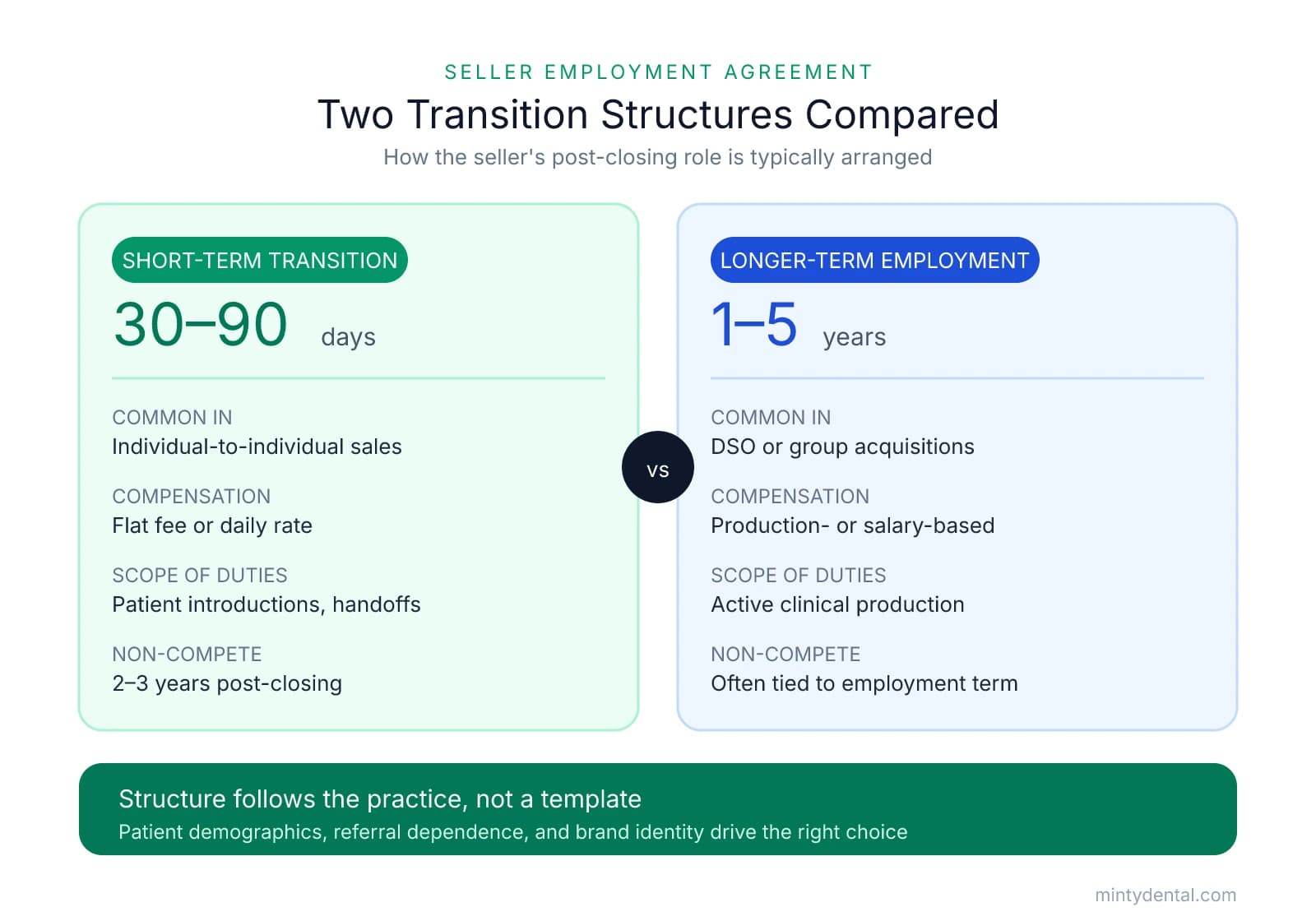
- Buyers typically encounter two scenarios: a short-term transition of 30–90 days (common in individual-to-individual sales) or a longer-term arrangement of 1–5 years (more common in DSO or group acquisitions)
- Leaving this agreement vague is one of the more costly mistakes in a dental practice acquisition — it creates authority conflicts rather than continuity
The Seller's Post-Closing Role Determines Whether Goodwill Actually Transfers
A post-closing employment agreement is a contract that governs the selling dentist's continued presence in the practice after ownership has transferred. It is a separate document from the purchase agreement — which handles price, assets, and closing mechanics — and in many ways it's the more consequential of the two.
Here's why: the ADA's valuation guidance puts goodwill at roughly 75–85% of a dental practice's sale price. That's the asset you're primarily buying. But goodwill isn't monolithic. Enterprise goodwill — the location, systems, staff, and recall engine — transfers the day you take ownership. Personal goodwill — the patients who come because they trust Dr. Smith, the referral relationships built over decades — doesn't. It walks out with the seller unless the employment agreement is structured to convert it.
That conversion is the real function of this document. A well-structured seller role gives patients time to form a relationship with you before the seller disappears, creates a formal endorsement mechanism, and transfers operational knowledge that never made it into the practice management software. Without it, the goodwill you paid for may not follow.
According to Dental Transitions, average patient attrition following a practice sale is less than 10% — but that outcome assumes the transition is handled properly. The seller's written role is a significant part of what "handled properly" actually means.
Most buyers encounter one of two arrangements:
| Short-Term Transition | Longer-Term Employment | |
|---|---|---|
| Typical term | 30–90 days | 1–5 years |
| Common in | Individual-to-individual sales | DSO or group acquisitions |
| Compensation | Flat fee or daily rate | Production- or salary-based |
| Scope of duties | Patient introductions, handoffs | Active clinical production |
| Non-compete duration | 2–3 years post-closing | Often tied to employment term |
The right structure depends on the practice's patient demographics, how referral-dependent the revenue is, and how much of the seller's identity is woven into the brand. A solo practitioner who has treated the same families for 30 years presents a very different retention risk than a high-volume practice with multiple associates already in place — where buyers may also want to review how existing associate relationships affect the transition.
What tends to go wrong isn't choosing the wrong structure — it's leaving the agreement vague. When the seller's authority, schedule, and responsibilities aren't defined in writing, what starts as a helpful transition can drift into competing clinical philosophies, staff confusion about who's actually in charge, and a seller who's present in name but disengaged in practice. The sections that follow walk through the specific terms worth negotiating before you sign.
How to Structure the Seller's Duties, Schedule, and Authority
Once you've decided on the general structure, the real work begins: translating that decision into contract language specific enough to hold up when expectations diverge. Most post-closing disputes don't stem from bad intentions on either side — they stem from vague agreements that each party reads differently six weeks after closing.
ADS Transitions notes that if a seller stays on after closing, several elements must be explicitly agreed upon — including working days, hours, and compensation structure. That list is a useful starting point, but it understates how granular these terms need to be. Five structural elements are worth negotiating carefully:
1. Defined working days, hours, and a hard end date "Available as needed" language sounds cooperative but creates ambiguity that tends to favor the seller. A well-drafted agreement specifies days per week, minimum hours per day, and a fixed end date. If the seller wants flexibility, build it in explicitly (e.g., "three clinical days per week through month six, reducing to one day per week through month nine").
2. Scope of clinical duties Is the seller seeing their own scheduled patients, assisting with introductions to yours, or both? Who controls the schedule after closing? These aren't details to work out informally — they determine whether the seller is actively supporting the transition or passively occupying chair time. The buyer should control scheduling from day one, with the seller's clinical role defined around that structure.
3. Administrative authority transfers completely at closing Staffing decisions, purchasing approvals, vendor relationships, and patient communication policy belong to the buyer the moment the sale closes. A pattern worth watching: sellers who continue directing staff out of habit — not malice — simply because the agreement never drew a clear line. If you're concerned about what that dynamic can look like, the signs of a seller undermining the transition are worth reviewing before you finalize terms.
4. Patient introduction protocol as a contractual expectation The seller's most valuable contribution during transition is personally introducing long-term patients to you — not just being present in the building. This should be a defined obligation: specific language about how introductions are handled, whether the seller communicates the transition in writing to their patient base, and what that communication says.
5. Compensation tied to production, not guaranteed salary Per Marti Law Group's guidance on post-sale employment agreements, sellers are typically compensated at 30–35% of collections or a daily rate during the transition period. A guaranteed salary with no production floor removes the seller's incentive to stay engaged clinically — which is the one thing you're actually paying for. If a daily rate is used, consider tying continued eligibility to defined participation benchmarks.
Taken together, these five elements give the agreement enough structure to function as a management tool, not just a legal formality.
Non-Compete, Non-Solicitation, and Termination: The Clauses That Protect Your Investment
With the seller's duties and schedule defined, the next layer of negotiation shifts to protection — what happens if the relationship ends early, or if the seller's post-closing behavior undermines the value you paid for.
The Non-Compete: Still Fully Enforceable for Practice Sales
There's been meaningful confusion in the market since the FTC announced its non-compete ban in April 2024. The rule was blocked by a federal court in August 2024, and the FTC dismissed its appeal in September 2025 — but even if the rule had taken effect, it wouldn't have applied here. The FTC's rule explicitly exempts non-competes entered into as part of the sale of a business. Sale-based non-competes remain fully enforceable and are a standard buyer protection in dental practice transactions.
Typical terms run 2–5 years with a geographic radius of 5–10 miles — though both dimensions vary by market density and state law.
One structural point many buyers miss: the non-compete should appear in the purchase agreement, not only in the employment agreement. An employment-based non-compete expires or becomes contestable when employment ends. A purchase agreement non-compete survives termination entirely — it's tied to the transaction, not the working relationship. If the seller is terminated for cause on day 45, the restriction holds regardless.
State law governs enforceability and varies significantly, so working with a dental-specific attorney on geographic scope and duration is worth the investment.
Non-Solicitation: Two Separate Protections
Non-solicitation is distinct from the non-compete and covers two categories that should each be addressed explicitly:
- Patient solicitation: Prevents the seller from contacting former patients to direct them to a new practice after the transition ends
- Staff poaching: Prevents the seller from recruiting your team — a real risk when a departing seller has long-standing relationships with key employees
These clauses are often bundled loosely or omitted entirely. A pattern worth watching: agreements that include a non-compete but leave non-solicitation vague — which can allow a seller to technically comply with geographic restrictions while still pulling patients and staff through direct outreach.
Termination Provisions: Where Buyers Most Often Leave Themselves Exposed
A well-drafted termination clause defines what constitutes "for cause" removal — and what happens to any deferred compensation or holdback when it's triggered. Vague language here tends to default in the seller's favor.
Specific "for cause" triggers worth defining include:
- Undermining the buyer's clinical or administrative authority with staff or patients
- Contacting patients outside the agreed introduction protocol
- Failure to meet minimum production or attendance expectations
- Disparaging the buyer or the practice to patients or referring providers
The financial stakes matter too. If part of the purchase price is held in escrow — as is common in structured deals, and covered in more detail in the dental practice escrow holdback framework — the agreement should specify whether a for-cause termination forfeits that holdback, and whether a without-cause termination releases it. Leaving that undefined creates the conditions for a dispute at exactly the moment you least want one.
Negotiating the Agreement Before You Close — Not After
Everything covered so far — the seller's duties, the authority boundaries, the non-compete placement, the termination triggers — is significantly easier to negotiate before the LOI is signed than after. Once a seller is under exclusivity, the deal has momentum and both parties feel pressure to close. That's not the moment to introduce new employment terms or push back on a compensation structure that doesn't work for you.
The leverage window is early. Use it.
The Seller Who Doesn't Want to Leave
One pattern worth recognizing before you get deep into negotiations: a seller who proposes extended guaranteed employment terms is often signaling something more than a preference — they may not be emotionally ready to exit. Practice Financial Group documents two real examples of sellers who were financially set but couldn't let go — one requesting an 8-year employment guarantee with a minimum salary, another asking for 10 years at $1,750 per day with a 120-day annual minimum. Both deals collapsed.
A reasonable transition arrangement benefits both parties. An unreasonable one transfers ownership risk back to the buyer — you're now responsible for a business whose former owner is contractually entitled to a guaranteed income stream regardless of how the practice performs. When you see terms like these, the right question isn't how to negotiate them down. It's whether the seller has genuinely decided to exit.
Pre-Closing Checklist
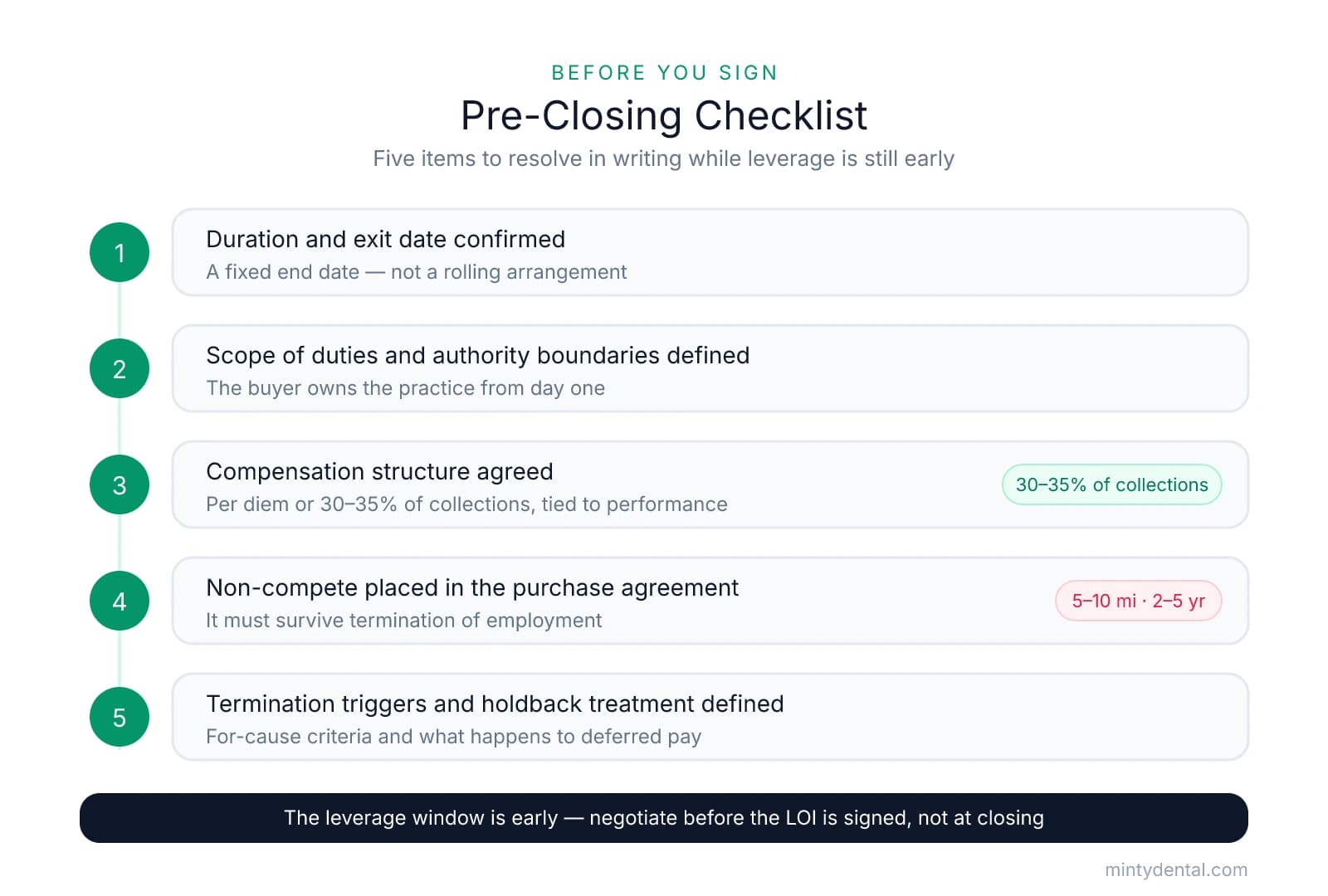
Before you sign, these five items should be resolved in writing — not left for the attorneys to work out at closing:
- Duration and exit date confirmed — A fixed end date, not a rolling arrangement. If a phase-down schedule is appropriate, define it explicitly.
- Scope of duties and authority boundaries defined — Clinical role, scheduling control, and administrative authority all documented. The buyer owns the practice from day one.
- Compensation structure agreed — Per diem rate or production percentage, with or without a floor. Guaranteed salary with no performance tie removes the seller's incentive to stay engaged.
- Non-compete placed in the purchase agreement — Not only in the employment agreement, where it expires with the working relationship. The restriction should survive termination.
- Termination triggers and deferred compensation treatment defined — What constitutes for-cause removal, and what happens to any holdback when it's triggered.
A dental-specific attorney should review both the purchase agreement and the employment agreement together — non-compete placement across both documents matters, and gaps between the two are where post-closing disputes tend to originate. The same review that protects you here can also catch issues like accounts receivable treatment that surface after closing if left unaddressed.
The Goal Is Alignment, Not Adversarial Positioning
Buyers who negotiate these terms clearly tend to have smoother transitions, better patient retention, and fewer post-closing disputes — not because the agreement is combative, but because clear expectations protect both sides. The seller knows what's expected. You know what you're getting. Patients experience a transition that feels intentional rather than abrupt.
The employment agreement is where the goodwill you paid for either transfers or doesn't. Treat it accordingly.
Sources & References
The data and claims in this article are drawn from the following sources. We prioritize government data, peer-reviewed research, and established industry publications to ensure accuracy.
- Personal Goodwill: Why a Dental Buyer Can Withhold Your Cash— precisiondentalanalytics.comIndustry
- Patient Retention Following a Dental Practice Sale— dentaltransitions.comIndustry
- The Dental Practice Transition Period— www.adstransitions.comIndustry
- What to Expect in an Employment Agreement After Selling Your ...— martilawgroup.comIndustry
- FTC Announces Rule Banning Noncompetes— www.ftc.govGovernment
- 4 Common Dental Practice Transition Mistakes and How to Avoid ...— practicefinancialgroup.comIndustry
Frequently Asked Questions
Ready to navigate your practice sale successfully?
Selling a dental practice involves complex negotiations around employment terms, non-competes, and transition periods. Minty's acquisition experts guide you through every step of the sale process, ensuring your interests are protected from initial search through closing.