Dental Practice Escrow Holdback: How Much Money Is Held at Closing

Co-Founder, Minty Dental

In Summary
- Escrow holdbacks set aside 10-15% of the purchase price in a neutral account to fund claims if the seller's representations prove false after closing
- Funds remain in escrow for 12-18 months and release to the seller if no valid claims arise, or compensate the buyer for verified losses like undisclosed liabilities or billing compliance issues
- The terms—percentage held, release schedule, and claim thresholds—are most negotiable before signing the LOI, not during the purchase agreement stage 60-90 days later
- Holdbacks are standard in most dental practice sales and function as negotiable risk management tools rather than red flags
Escrow Holdbacks Protect Buyers Against Post-Closing Surprises
When you close on a dental practice, you're betting the seller's representations are accurate—revenue matches tax returns, equipment works as described, the hygienist isn't leaving, billing practices comply with insurance contracts. Most sellers are honest, but surprises often stem from gaps in their own knowledge or record-keeping.
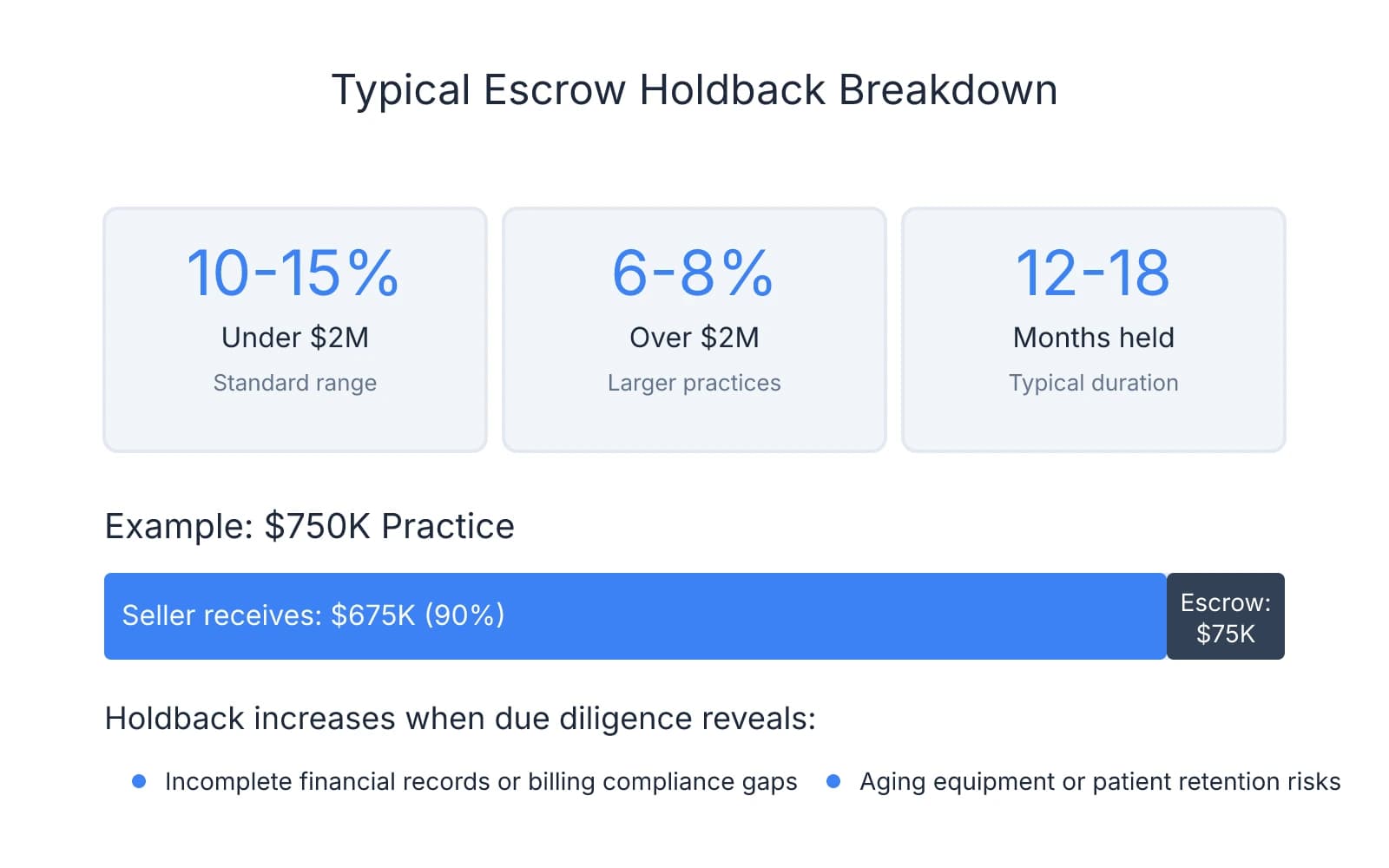
An escrow holdback gives you recourse when those representations prove wrong. It's a percentage of the purchase price—typically 10-15%—held by a neutral third-party escrow agent to fund indemnification claims if problems surface after closing. On a $750,000 practice with a 10% holdback, $75,000 sits in escrow for 12-18 months. If you discover undisclosed tax liabilities, billing compliance issues, or equipment failures during that window, you file a claim against the escrow rather than chasing the seller through litigation.
The holdback protects you from risks due diligence can't fully eliminate: financial misstatements that don't surface until you file the first post-closing tax return, patient retention issues when the seller's personal relationships don't transfer, equipment that fails within weeks despite representations of "good working order," billing errors that trigger insurance audits six months later. Many buyers encounter at least one post-closing issue that would have cost them money without an escrow cushion.
The mechanics are straightforward. At closing, the buyer wires the full purchase price to the escrow agent. The agent releases most funds to the seller immediately but holds the escrow amount in a separate account. If no valid claims arise during the holdback period, the escrow releases the funds to the seller. If you file a claim and verify the loss through documentation, third-party invoices, or settlement agreements, the escrow compensates you directly from the holdback before releasing any remaining balance.
Escrow holdbacks are distinct from earnouts, which tie future payments to performance milestones. A holdback isn't contingent on hitting revenue targets—it's a security deposit against the seller's promises. Contingencies protect you during due diligence; escrow protects you after you've wired the money. In DSO acquisitions, where buyers manage dozens of practices and can't monitor every post-closing issue in real time, holdbacks are nearly universal and often run higher than the 10-15% range common in private sales.
The leverage in escrow negotiation is highest before you sign the LOI, not during the purchase agreement stage 60-90 days later. Once both sides have invested time and legal fees, pushing for material changes to the holdback structure becomes harder. If the LOI's indemnity provisions are vague or missing, the buyer has reserved the right to set them at signing. Renegotiating after due diligence is possible, but locking in favorable escrow terms upfront is easier than clawing them back later.
What Determines How Much Gets Held Back
Escrow holdback size: For dental practices under $2M, 10-15% of the purchase price is the working baseline. On a $750,000 practice, that's $75,000-$112,500 held at closing. On a $1.5M practice, $150,000-$225,000. The percentage typically decreases as deal size increases—practices selling for $2M+ often see 6-8% holdbacks, reflecting the assumption that larger, more established practices carry less post-closing risk.
The baseline shifts based on what due diligence reveals. A practice with three years of audited financials, complete patient records, documented equipment maintenance logs, and clean billing compliance typically negotiates toward the lower end—8-10% in many cases. One buyer accepted an 8% holdback on a $1.2M practice after the seller provided audited statements, a third-party equipment appraisal, and a pre-closing compliance review. The documentation reduced perceived risk, and the holdback reflected that.
Holdbacks move higher when due diligence uncovers gaps. Incomplete financial records—tax returns only, no P&L detail, inconsistent revenue tracking—push buyers toward 15% or more. Practices with inflated profitability claims or unexplained revenue fluctuations face similar pressure. Billing compliance concerns—undocumented write-offs, inconsistent insurance verification, or a history of claim denials—often trigger 15-20% holdbacks because the buyer is pricing in the risk of post-closing audits or clawbacks.
Patient retention concerns also drive holdback size. If the seller's personal relationships dominate the practice and there's no associate to bridge the transition, buyers worry about attrition. Equipment condition issues—aging operatory chairs, outdated imaging systems, HVAC units nearing end-of-life—create similar pressure. Pending litigation, unresolved employment disputes, or outstanding tax liabilities can push holdbacks to 20% or higher, especially if the seller can't quantify the exposure during due diligence.
Some deals structure multiple escrow accounts rather than a single holdback. A general indemnification escrow covers representations and warranties across the board—financial accuracy, compliance, equipment condition. A separate accounts receivable holdback protects the buyer if collections on pre-closing production fall short of projections. Working capital adjustments—inventory, prepaid expenses, outstanding payables—sometimes get their own reserve if the final numbers won't be known until 30-60 days post-closing. Practices with incomplete patient records may face a specific holdback tied to chart reconstruction costs or compliance remediation.
One variable that can reduce holdback size is representations and warranties insurance. When the buyer purchases an R&W policy—typically 3-5% of the purchase price as a one-time premium—the insurance carrier assumes much of the indemnification risk. The escrow holdback drops to cover only the policy's retention (often 0.5-1% of deal value) rather than the full indemnification exposure. R&W insurance is more common in DSO acquisitions and larger private sales, less common in sub-$1M deals where the premium doesn't justify the cost.
The holdback percentage is typically negotiated in the letter of intent, not deferred to the purchase agreement stage. By the time you're 60-90 days into due diligence, both sides have invested legal fees and time, and the buyer has less incentive to negotiate down from their initial position. If the LOI specifies "10-15% escrow, final amount to be determined," the buyer has reserved the right to set it at 15% based on what due diligence reveals. If you want an 8% holdback, lock it into the LOI before you sign—don't assume you'll negotiate it later when your leverage has diminished. The valuation process itself is shaped by what banks are willing to lend, and lenders often push boundaries to win competitive deals, which means a bank's willingness to finance the asking price doesn't necessarily mean the holdback terms are favorable or that you're not overpaying.
How Long Funds Stay in Escrow and What Triggers Release
Standard escrow holdback periods run 12-18 months, with 12 months becoming more common in recent dental practice sales. The timeline covers one full tax cycle, allows patient retention patterns to emerge, and aligns with the survival period of most representations and warranties in the purchase agreement. On a practice closing in January, a 12-month holdback means funds release the following January if no claims are filed. An 18-month holdback pushes release to June of the second year.
The 12-month structure has gained traction because it captures the most common post-closing issues without unnecessarily tying up the seller's funds. Patient attrition typically stabilizes within 90-120 days, giving you enough data by month six to identify retention problems. Accounts receivable collection shortfalls surface within 60-90 days as aging reports reveal write-offs or denials. Equipment failures—operatory chairs, compressors, imaging systems—usually manifest within the first six months. A 12-month holdback gives you time to file claims on these issues while releasing funds faster than the 18-month standard that dominated deals five years ago.
Some buyers still push for 18 months, particularly when due diligence reveals compliance concerns or incomplete financial records. The extended period allows for a full year of operations plus a buffer for tax filing deadlines and insurance audit cycles. If the seller's representations about revenue or expenses can't be fully verified until the first post-closing tax return is filed—typically 3-4 months after year-end—an 18-month holdback ensures you have time to identify discrepancies and submit claims before the escrow expires.
Release structures fall into two categories: single-event or staged. A single-event release means all funds transfer to the seller at the end of the holdback period if no claims are pending. A staged release splits the holdback—50% at 12 months, the remaining 50% at 18 months—giving the seller access to half the funds earlier while preserving a cushion for late-emerging issues. Staged releases are more common in deals where the buyer wants extended protection but the seller negotiates for faster partial access.
Buyers must submit indemnification claims before the holdback period expires. The purchase agreement specifies the claims process: written notice to the seller and escrow agent, documentation of the loss (invoices, third-party reports, settlement agreements), and a calculation of damages. If you discover a billing compliance issue at month 10, you file a claim with supporting documentation—insurance audit findings, clawback notices, remediation costs—before the 12-month deadline. The escrow agent doesn't release funds on pending claims until the dispute is resolved through negotiation, mediation, or arbitration as outlined in the purchase agreement.
Common claim triggers during the holdback period include accounts receivable collection shortfalls—when pre-closing production collects at rates below the seller's representations. If the seller claimed a 95% collection rate but actual collections run 80%, the shortfall becomes a valid claim. Patient attrition exceeding projections—losing 20% of active patients when the seller represented stable retention—triggers claims for lost revenue. Billing compliance issues—insurance audits, claim denials, or undocumented write-offs—create exposure if they result in clawbacks or penalties. Equipment failures within the holdback period, particularly for items the seller represented as "recently serviced" or "in good working order," generate claims for repair or replacement costs.
Fundamental representations often have longer survival periods than the general 12-18 month holdback. Representations about ownership, authority to sell, and tax compliance typically survive 3-5 years or until the statute of limitations expires. If a tax liability surfaces two years post-closing—an unpaid payroll tax assessment, an IRS audit adjustment, or a state sales tax deficiency—you can still file a claim even though the general escrow has been released. Some purchase agreements structure a separate escrow for fundamental reps, holding 2-3% of the purchase price for the extended period. Others rely on the seller's ongoing indemnification obligation without additional escrow, which shifts collection risk back to you if the seller's financial situation deteriorates.
What you track during the holdback period determines whether you can file a valid claim. If you suspect accounts receivable issues but don't document collection rates monthly, you'll struggle to prove the shortfall when the deadline approaches. If equipment starts showing signs of wear but you delay third-party inspection until month 11, the claim becomes harder to substantiate. The holdback period isn't passive—it's the window where you're actively monitoring the representations the seller made and gathering evidence to support claims if issues emerge.
When claims are pending at the end of the holdback period, the escrow agent holds the disputed amount until resolution. If you file a $30,000 claim against a $100,000 escrow at month 11, the agent releases the undisputed portion to the seller and retains the disputed amount pending the outcome. Dispute resolution typically follows the purchase agreement's process—direct negotiation first, then mediation, then binding arbitration. Most claims settle before arbitration because both sides want to avoid legal fees that can exceed the disputed amount, but the threat of arbitration creates leverage for buyers with well-documented claims.
Negotiating Holdback Terms That Protect Your Investment
The leverage in escrow negotiation is highest before you sign the letter of intent—not during the purchase agreement stage 60-90 days later. Once both sides have invested legal fees and time, the deal has momentum, and pushing for material changes to holdback percentage, duration, or release conditions becomes harder. Treating escrow as a negotiable risk management tool during LOI discussions, not accepting it as boilerplate that gets "figured out later," is where buyers gain the most ground.
One protection many buyers overlook is the relationship between the holdback amount and the general indemnification cap. In most purchase agreements, the escrow holdback equals the general indemnification cap—meaning your recourse for most post-closing claims is limited to the escrowed funds, not the seller's personal assets. On a $750,000 practice with a 10% holdback, your maximum recovery for financial misstatements, billing compliance issues, or equipment failures is $75,000. If a claim exceeds that amount, you're absorbing the difference unless the issue falls under a fundamental representation with a separate cap. Understanding this structure before signing helps you calibrate whether the proposed holdback actually covers the risks you've identified during due diligence.
Buyers with clean due diligence results can negotiate lower holdback percentages or shorter holdback periods. A practice with three years of audited financials, documented equipment maintenance, and a pre-closing compliance review justifies an 8-10% holdback rather than the 15% baseline. Similarly, a 12-month holdback becomes easier to defend when patient retention patterns are stable and accounts receivable aging shows consistent collection rates. Connecting the holdback terms to the specific risk profile of the practice—framing the negotiation around "here's what due diligence revealed, here's the corresponding protection we need"—tends to get more traction than simply pushing for lower numbers without justification.
Partial release schedules reduce seller resistance while maintaining buyer protection. Instead of holding 15% for 18 months, structure 10% released at 12 months and 5% at 18 months. The seller gets access to two-thirds of the holdback earlier, and you preserve a cushion for late-emerging issues like tax liabilities or insurance audits that surface in year two. This structure works particularly well when seller financing terms are already in place—the seller is receiving ongoing payments, so the psychological impact of the holdback is lower, and they're more willing to accept staged releases.
Higher holdbacks may be acceptable when they're offset by a lower purchase price. If the seller agrees to drop the price by $50,000 in exchange for a 15% holdback instead of 10%, the net economics may favor you—particularly if due diligence is clean and you're confident no claims will arise. Similarly, when significant risks are identified during due diligence—incomplete patient records, billing compliance gaps, aging equipment—a higher holdback protects your investment without walking away from a practice that's otherwise a good fit. The calculation is straightforward: does the additional holdback amount adequately cover the quantified risk, and are you willing to accept that the funds may not be recoverable if the issue exceeds the escrow balance?
The escrow agreement should include clear claim procedures: documentation requirements, notice periods, dispute resolution mechanisms, and timelines for claim resolution. Vague language like "buyer may submit claims for breaches of representations" leaves room for conflict when you're trying to recover funds at month 10. Stronger language specifies what constitutes valid documentation (third-party invoices, audit findings, settlement agreements), how many days you have to submit a claim after discovering an issue (typically 30-60 days), and whether disputes go to mediation or binding arbitration. These procedural details matter—without them, you're negotiating claim validity in real time when the seller has every incentive to delay or dispute.
Caps and baskets—thresholds below which claims can't be made—are equally negotiable. A $10,000 basket means the buyer absorbs the first $10,000 of losses before the escrow becomes accessible. A $10,000 basket with a tipping provision means once losses exceed $10,000, the buyer recovers the full amount including the first $10,000. A $10,000 deductible means the buyer always absorbs the first $10,000, even if total losses run $50,000. The distinction matters: a tipping basket protects you from small nuisance claims while preserving full recovery on material issues; a deductible reduces your recovery on every claim. Most buyers push for tipping baskets or no basket at all when due diligence reveals risks that could generate multiple smaller claims—billing errors, equipment repairs, patient retention shortfalls—that individually fall below the threshold but collectively exceed it.
Escrow negotiation is one piece of the broader risk allocation puzzle alongside purchase price, seller financing, transition support, and non-compete terms. A seller who agrees to a lower holdback may push harder on non-compete radius or transition duration. A seller who accepts a 15% holdback may resist seller financing or demand a higher purchase price. The goal isn't to win every negotiation point—it's to structure a deal where the risk allocation matches the practice's actual risk profile and your tolerance for post-closing exposure. Buyers get burned when treating escrow as a standalone provision rather than part of the overall deal structure, or assuming they'll negotiate it later when their leverage has already diminished.
Sources & References
The data and claims in this article are drawn from the following sources. We prioritize government data, peer-reviewed research, and established industry publications to ensure accuracy.
- Escrow holdback: How it can help you close on time | Rocket Mortgage— www.rocketmortgage.com
- The Art of a Dental Practice Valuation— www.dentalbroker.com
- What Is an Escrow Holdback in Real Estate? A Seller's Guide - Redfin— www.redfin.com
- Escrow Holdbacks & Indemnification Explained - CT Acquisitions— ctacquisitions.comIndustry
Frequently Asked Questions
Ready to Navigate Your Practice Sale?
Understanding escrow holdbacks is crucial when selling your dental practice. Minty Plus provides expert guidance through every step of the acquisition process, ensuring you maximize value and minimize surprises at closing.