How to Tell If a Dental Practice Can Grow Before You Buy

Co-Founder, Minty Dental

In Summary
- A practice producing $700K at 70% schedule capacity has more growth potential than one producing $800K at 95% capacity—current revenue alone doesn't reveal upside
- Growth potential falls into three measurable categories: unused schedule capacity, untapped market demand, and fixable operational inefficiencies
- Practices with genuine growth potential let you build equity through operational improvements rather than requiring major capital investment in new operatories or locations
- The evaluation framework combines schedule utilization analysis, market demographic assessment, and operational performance gaps (case acceptance rates, hygiene recare systems, treatment plan conversion)
- Distinguishing between a practice at its ceiling and one with room to scale directly affects both purchase price justification and your ability to increase practice value over time
Growth Potential Separates Practices You Can Scale from Practices Already Maxed Out
Current revenue tells you what the practice is doing today. Growth potential tells you what it could do under different management—and that distinction matters more than most buyers realize.
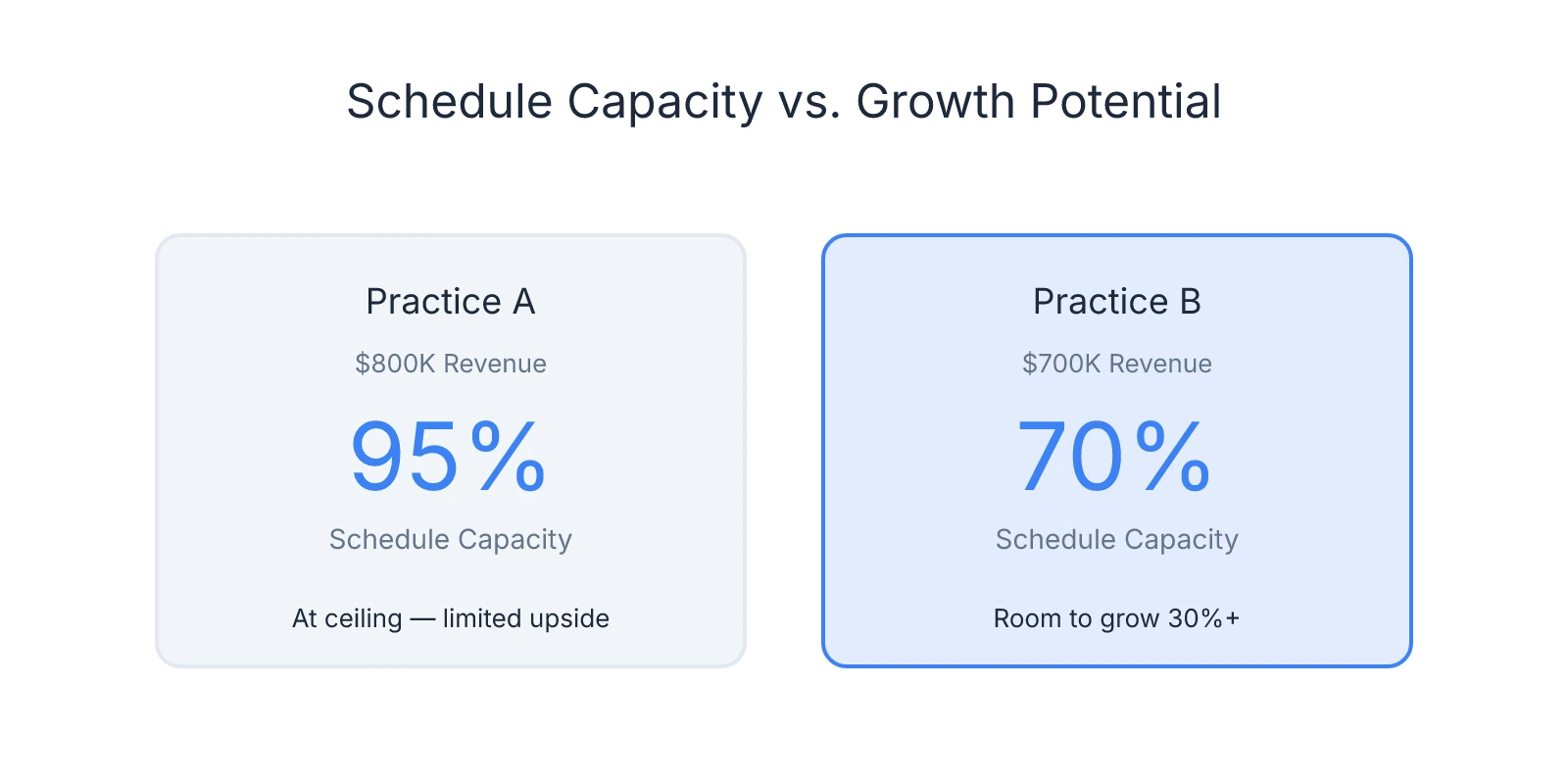
A practice producing $800,000 annually with a schedule booked at 95% capacity and strong case acceptance has a ceiling problem. The seller has already extracted most available revenue from the existing patient base and schedule structure. You're buying current performance, not future upside. A practice producing $700,000 at 70% schedule capacity with weak recare systems and inconsistent treatment plan follow-up has opportunity. The revenue gap isn't a market problem—it's a management problem, and management problems are fixable without adding operatories or relocating.
Where buyers often get burned is treating growth potential as a vague seller promise rather than a measurable operational reality. Active patient counts relative to schedule capacity reveal whether the practice has room to see more patients without infrastructure changes. Market demographics show whether local demand supports higher patient volume. Case acceptance rates and hygiene recare percentages expose whether the practice is converting the patients it already has.
Growth potential falls into three categories, each with concrete indicators you can measure during due diligence. Schedule capacity answers whether the practice can physically accommodate more patient visits without adding chairs or provider hours. Market conditions determine whether untapped demand exists in the surrounding area—population growth, competitor saturation, insurance penetration rates. Operational inefficiencies identify fixable gaps in how the practice runs—low case acceptance, weak hygiene recall systems, inconsistent treatment planning, poor insurance verification processes.
Practices with genuine growth potential let you build equity through operational improvements rather than capital investment. You're not writing checks for new equipment or buildouts—you're implementing better systems, tightening scheduling protocols, improving case presentation, and converting existing patient demand into production.
The evaluation framework starts with three questions. First: How much unused capacity sits in the current schedule? Pull appointment data for the past 12 months and calculate what percentage of available chair time is actually booked with patient visits. Second: Does the local market support higher patient volume? Analyze population density, household income distribution, competitor proximity, and insurance coverage rates within a 5-mile radius. Third: Where are the operational performance gaps? Compare the practice's case acceptance rate, hygiene recare percentage, and treatment plan conversion against industry benchmarks to identify low-hanging revenue opportunities.
One protection many buyers overlook is distinguishing between growth potential that requires your clinical skill and growth potential that requires better systems. A practice with low production because the seller only performs basic restorative work has clinical upside—but only if you're comfortable placing implants, doing endo, or offering cosmetic services. A practice with low production because 40% of hygiene patients don't schedule their next recall appointment has systems upside, and that's fixable regardless of your clinical interests.
Schedule Capacity and Patient Flow Reveal How Much Room You Have to Grow
Pull 12 months of appointment data and calculate what percentage of available chair time is actually filled with patient visits. A practice that feels "busy" to the seller may be running at 65% schedule utilization—meaning one-third of potential appointment slots sit empty or underused. That's not a capacity problem. That's a scheduling system problem, and it represents immediate growth opportunity without adding infrastructure.
Start by determining the practice's true active patient count—unique patients seen in the last 12 months, not the total number of records ever entered into the practice management system. Most software platforms report inflated patient counts because they include inactive records from patients who haven't been seen in five or more years. A practice claiming 2,500 active patients may have only 1,400 who actually visited in the past year. That gap matters when projecting future revenue, because you can't grow production from patients who no longer come in.
Schedule utilization below 80–85% signals untapped capacity; above 90% means you're near the ceiling without adding providers or extending hours. Calculate utilization by dividing total booked appointment hours by total available chair hours across all operatories. If the practice has four operatories but only 2.5 are consistently used during core hours, you have room to grow production by 40% without capital investment—just better scheduling protocols and patient flow management.
A practice can feel busy and still have significant open capacity if same-day cancellations run high, hygiene pre-booking rates are weak, or the schedule has gaps between appointments that could be filled with shorter procedures. Pull the last 90 days of daily schedules and look for patterns: Are Fridays consistently light? Do certain operatories sit unused during peak hours? Are there recurring gaps in the doctor's schedule that could accommodate same-day treatment starts?
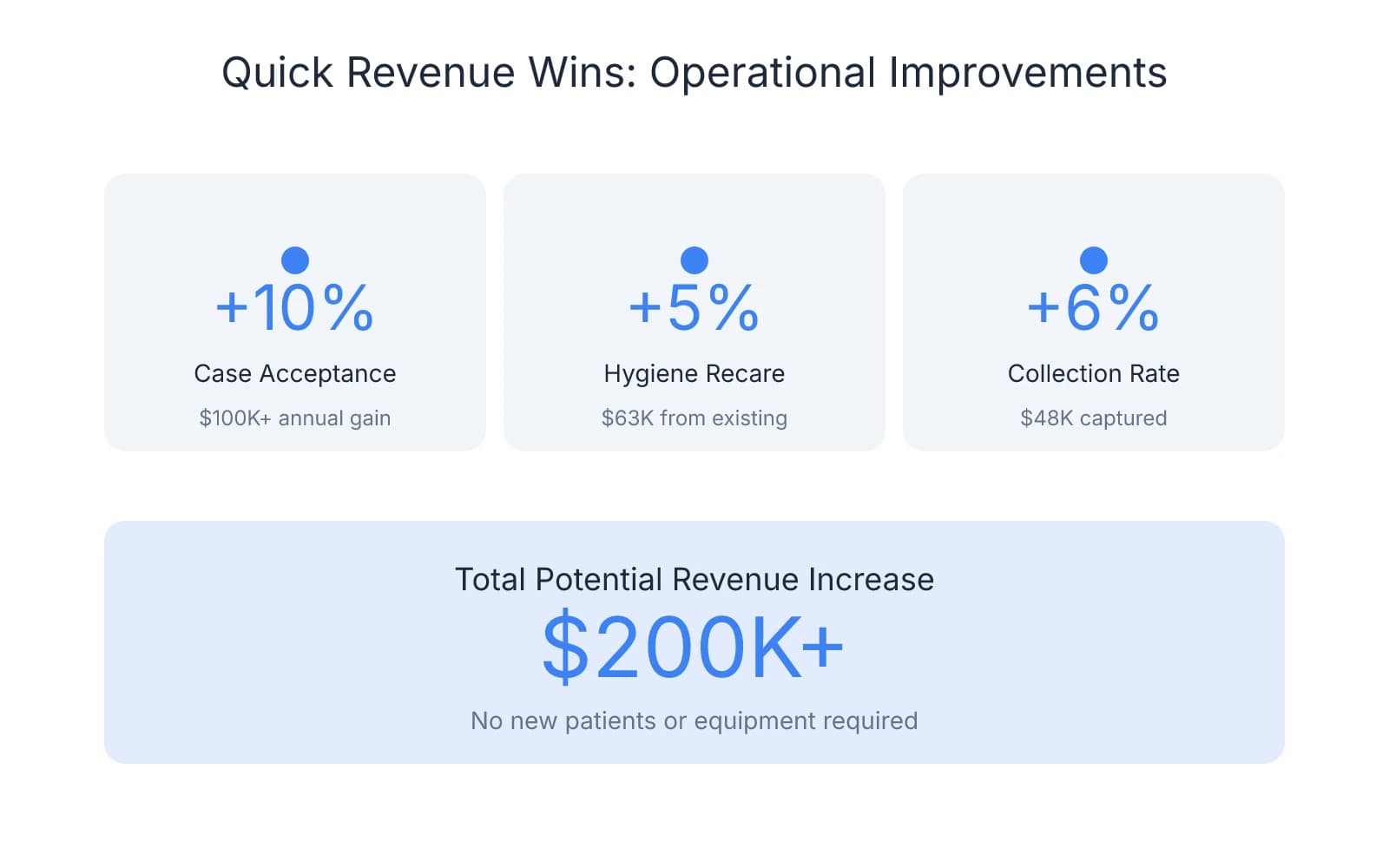
Hygiene reappointment rates below 85% represent immediate growth opportunity—every 5% improvement in pre-booking adds significant recurring revenue without acquiring a single new patient. A practice with 1,200 active hygiene patients and a 70% reappointment rate is leaving 180 recall visits on the table annually. At an average hygiene production of $350 per visit, that's $63,000 in lost revenue from patients already in the system. Tightening the recare process—scripting, same-day scheduling, automated reminders—captures that revenue without changing anything else about how the practice operates.
New patient flow of 20–30 per month is baseline for maintaining current volume; below that signals either acquisition problems or market saturation. Growing practices often attract between 20 and 30 new patients monthly, which offsets natural attrition and supports incremental production growth. If the practice is bringing in fewer than 15 new patients per month, dig into whether that's a marketing issue (fixable) or a market demand issue (structural). Pull the new patient source report and see where they're coming from—if referrals have dropped but the practice isn't running digital campaigns or optimizing its online presence, that's a systems gap, not a ceiling.
Same-day cancellations and unfilled appointment slots indicate scheduling system problems, not capacity limits. A practice with 12% same-day cancellations isn't full; it's poorly managed. Implementing confirmation protocols, waitlist systems, and financial policies that reduce last-minute cancellations can recapture 5–8% of lost appointment time, which translates directly to production growth.
When evaluating schedule capacity, compare doctor production versus hygiene production. Healthy practices generate at least 75% of production from the doctor and 25% from hygiene. If hygiene is producing less than 20% of total revenue, the recare system likely isn't functioning—patients aren't being scheduled consistently, recall intervals are too long, or hygienists aren't presenting treatment effectively. If hygiene is producing more than 30%, the doctor may not be converting hygiene diagnoses into restorative treatment, which signals a case acceptance or treatment planning gap.
If the practice has open chair time, weak reappointment systems, or schedule utilization below 80%, you can grow revenue 15–25% without adding providers, operatories, or hours. That's the growth potential that justifies a purchase price and builds equity through operational improvements rather than capital investment.
Market Demographics and Competition Determine Whether Local Demand Can Support Expansion
Schedule capacity tells you whether the practice can physically handle more patients. Market demographics tell you whether those patients actually exist—and whether they can afford the services you plan to offer.
A practice with 40% open chair time in a saturated market isn't sitting on growth potential. It's sitting in a market where demand has already been captured by competitors, and filling those empty slots means taking patients from established practices rather than serving unmet need. Core patient availability per dentist—the number of residents who match the demographic and insurance profile most likely to seek regular dental care—cuts through the noise. Markets with 400+ core patients per general dentist offer better growth runway than those with fewer than 300, even if total population numbers look similar.
Start by pulling population density and household income data within a 5-mile radius of the practice. Most patients travel less than 15 minutes for routine dental care, so the relevant market isn't the entire metro area—it's the immediate surrounding neighborhoods. A practice in a suburb with 45,000 residents and a median household income of $85,000 has a fundamentally different growth ceiling than one in a rural area with 12,000 residents and a median income of $52,000.
Population growth alone doesn't guarantee opportunity—composition matters more than raw numbers. An area adding 2,000 residents annually sounds promising until you realize those residents are transient workers in rental housing with high turnover and minimal attachment to local providers. A stable market with 500 new families buying homes and enrolling kids in local schools builds a long-term patient base; a market adding apartment complexes near a corporate campus sees higher churn and weaker patient retention. Look at housing starts, school enrollment trends, and median home values to distinguish between growth that builds equity and growth that just cycles through.
Demographic fit assessment means matching the local population's insurance mix, income level, and dental utilization rate to the practice's current service offerings. If 70% of the surrounding area relies on Medicaid or low-reimbursement PPO plans, but the practice's fee schedule assumes commercial insurance or fee-for-service patients, you're either repricing the entire practice downward or accepting that most of the local market isn't accessible to you. Pull census data on insurance coverage rates and compare them to the practice's current payer mix—if there's a 20+ percentage point gap, growth means either repositioning the practice or targeting a narrower patient segment.
Competitive saturation shows up in dentist-to-population ratios and geographic clustering. If there are 5+ general practices within a 3-mile radius serving similar demographics, growth requires either differentiation or market share capture—you're not serving unmet demand, you're convincing patients to switch. Calculate the number of general dentists per 1,000 residents in the immediate area; the national average sits around 1.7 dentists per 1,000 residents, but urban markets often run higher. A ratio above 2.0 dentists per 1,000 residents signals saturation unless the practice offers specialized services or targets a distinct demographic niche that competitors aren't serving.
Fee-for-service versus PPO dependence in the local market affects pricing power and margin expansion. Heavily PPO-dependent markets limit your ability to raise fees—you can grow patient volume, but reimbursement rates cap revenue per visit. If 80% of practices in the area participate in the same three PPO networks, fee increases mean losing patients to competitors who accept lower reimbursements. Check the practice's current payer mix against local insurance penetration data to see whether pricing power exists or whether you're locked into contracted rates.
Market trend analysis separates transient growth from sustainable growth. Is the area adding families with school-age children, or is it adding single professionals in rental housing? The first builds a patient base that stays for 10+ years and generates ongoing restorative and orthodontic revenue; the second churns every 2–3 years and skews toward emergency visits and basic preventive care. Pull school district enrollment projections and new housing permit data—if single-family home construction is outpacing multifamily units, the market is attracting long-term residents.
If the market is saturated, demographics don't match the practice's service mix, or the area is growing with transient, price-sensitive patients, growth will require either repositioning the practice or accepting that upside is limited. A practice in a market with strong core patient availability, stable family demographics, and moderate competition can grow 20–30% through better operations alone.
Operational Performance Gaps Show Where You Can Increase Revenue Without Adding Volume
The easiest growth to capture doesn't come from seeing more patients—it comes from converting the patients already in your chairs. Case acceptance rates below 70% represent immediate revenue opportunity; every 10-point improvement can add $100,000+ annually to a practice producing $700,000, and you unlock that revenue by changing how treatment is presented, not by changing the patient base.
Start by pulling the practice's case acceptance rate for the past 12 months—the percentage of treatment dollars presented that patients actually schedule and complete. Most practice management systems track this as "treatment plan acceptance" or "diagnosed vs. scheduled production." Industry average sits between 50–60%, meaning nearly half of all diagnosed treatment never gets scheduled. Top-performing practices consistently achieve 75–80%+ acceptance, not because they pressure patients, but because they've built systems around patient education, financial clarity, and same-day treatment starts.
Unscheduled treatment sitting in patient charts—diagnosed work that was presented, never declined outright, but also never booked—represents money left on the table. Pull a report of treatment plans older than 90 days with no scheduled appointment. A practice with $150,000 in unscheduled treatment isn't facing a demand problem; it's facing a follow-up problem. Implementing a structured reactivation process—scripted outreach, text reminders, financial plan options—converts 20–30% of that backlog into scheduled revenue without presenting a single new treatment plan.
Hygiene production below $200 per visit signals missed periodontal diagnosis and preventive service opportunities—not because hygienists should be selling, but because consistent perio charting, patient education, and treatment planning protocols aren't in place. Healthy hygiene departments generate roughly a quarter of total practice production, with per-visit averages between $250–$350 when periodontal maintenance, fluoride treatments, and diagnostic imaging are integrated into standard workflows.
Collection rates below 96% indicate front office inefficiencies, insurance follow-up gaps, or fee schedule problems that are bleeding revenue every month. Most practices collect between 91–94% of adjusted production; top performers collect 98%+. The difference between 92% and 98% collection on $800,000 in annual production is $48,000—revenue you're already producing but not capturing. Tightening insurance verification, implementing payment-at-time-of-service policies, and improving accounts receivable follow-up closes that gap without adding a single patient visit.
Payer mix optimization creates margin growth without volume growth—practices heavily dependent on low-reimbursing PPOs can increase profitability by renegotiating contracts, reducing network participation, or shifting toward fee-for-service over time. If 80% of your production comes from PPO plans reimbursing at 60–70% of your fee schedule, every percentage point you shift toward higher-reimbursing plans or fee-for-service patients adds directly to the bottom line. Many practices discover that 20% of their PPO contracts generate 60% of their insurance-based revenue, while the remaining 80% of contracts contribute minimal volume at significantly lower margins.
If the practice refers out implants, endodontics, or orthodontics that patients want, adding those services creates growth without new patient acquisition. Pull the referral log for the past year and calculate how much production is being sent to specialists. A practice referring $120,000 annually in endo and implant cases is handing revenue to other providers that could be captured in-house—either by developing those clinical skills yourself, hiring an associate who performs them, or bringing in a specialist one day per week. Expanding service mix to match what the market demands turns existing patient relationships into higher-value treatment opportunities without requiring new patient marketing.
Seller burnout often creates these operational gaps—a motivated buyer can capture revenue the seller left on the table simply by showing up consistently and following through on treatment plans. A retiring dentist working three days a week, skipping complex cases, and avoiding difficult conversations about treatment cost isn't running at capacity—they're running at comfort level. When you take over with full-time commitment, structured case presentation protocols, and consistent follow-up systems, production increases not because the market changed, but because management changed.
Distinguish between operational gaps you can fix quickly and those requiring significant system overhauls. Improving case acceptance from 55% to 70% takes better scripting, financial options, and same-day treatment starts—changes you can implement in 90 days. Rebuilding a broken hygiene recare system with 40% pre-booking rates takes 6–12 months of patient reactivation, schedule restructuring, and team retraining.
Operational inefficiencies are the easiest growth lever to pull because they don't require market conditions to change or capital investment. A practice with 55% case acceptance, $180 hygiene production per visit, and 92% collections has $150,000+ in annual revenue sitting on the table—revenue you unlock by implementing better systems, not by adding chairs, hiring providers, or relocating.
Sources & References
The data and claims in this article are drawn from the following sources. We prioritize government data, peer-reviewed research, and established industry publications to ensure accuracy.
- Determine the True Production Potential of Your Dental Practice— dentalconsultingexperts.comIndustry
- Understanding Dental Metrics for Practice Growth - Weave— getweave.comIndustry
- Understanding Dental Metrics for Practice Growth - Weave— getweave.comIndustry
- [PDF] Q3 2025 State of the US Dental Economy Report - ADA— ada.orgIndustry
- How Demographics Can Make or Break Your Dental Practice— crimsonmediagroup.comIndustry
- Population Growth Around Your Dental Practice is Overrated— dentagraphics.comIndustry
Frequently Asked Questions
Ready to acquire a high-growth dental practice?
Finding a practice with real growth potential is just the first step. Minty Plus provides expert guidance through the entire acquisition process and helps you maximize that growth potential after closing.