Buying a Dental Practice with Mostly Older Patients

Co-Founder, Minty Dental

In Summary
- Many practices on the market have aging patient bases because retiring dentists' rosters aged alongside them—this is a common reality, not an automatic dealbreaker.
- By 2030, adults 65+ will represent nearly 20% of the U.S. population, making older demographics increasingly relevant to practice sustainability.
- The critical question isn't current age distribution—it's whether you can maintain cash flow during your ownership timeline while building a younger patient pipeline.
- Older patients often have higher treatment needs, with 68% of adults 65+ experiencing periodontitis, but may face insurance gaps and financial barriers that affect case acceptance.
- A practice with 70% of patients over 60 requires different due diligence—focus on attrition timelines, Medicare coverage gaps, and local community growth trends.
An Aging Patient Base Changes Your Risk Profile, Not Your Opportunity
When you see that most active patients are over 60, the instinct is often to move on. It feels like inheriting a problem—a patient base with a built-in expiration date. But many practices available for sale have aging rosters because the selling dentist is retiring after 30+ years, and their patients aged right alongside them. This isn't a red flag unique to troubled practices—it's a structural reality of the acquisition market.
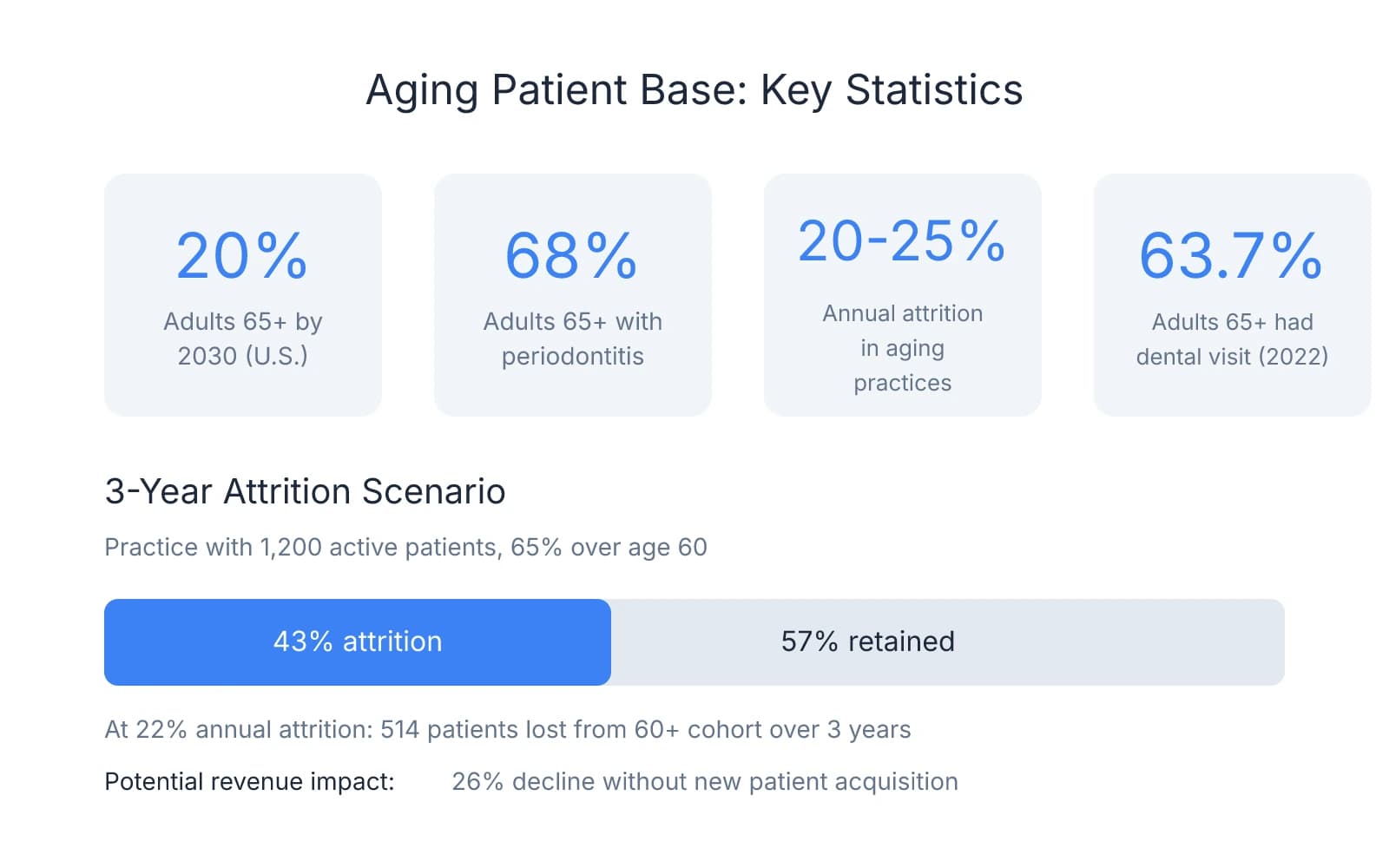
The Federal Interagency Forum on Aging-Related Statistics projects that by 2030, adults 65+ will represent nearly 20% of the U.S. population—nearly double the number from 2000. The demographic shift isn't something you can avoid by waiting for a "better" practice. The question worth asking: can this practice sustain revenue during your ownership timeline, and do you have a realistic path to refresh the patient mix?
Start by separating two variables buyers often conflate—current revenue and future attrition risk. A practice generating $800K annually with 70% of patients over 60 isn't the same risk as one generating $500K with the same age distribution. The first has margin to absorb gradual attrition while you build a younger base; the second may not. One pattern worth paying attention to is how quickly revenue could erode if 10–15% of the patient base becomes inactive over three years. Run that scenario during due diligence—if the practice can't sustain your debt service and operating costs under moderate attrition, the age mix is a structural problem, not just a marketing challenge.
Older patients often carry higher treatment needs. Periodontitis affects 68% of adults 65+, and retained natural teeth mean ongoing restorative and maintenance work. But treatment acceptance depends heavily on insurance coverage and financial capacity. Medicare doesn't cover routine dental care, and supplemental coverage varies widely. If a large portion of your older patients are on fixed incomes without robust dental benefits, high treatment needs don't automatically translate to high collections.
The due diligence framework for a practice with an aging patient base requires tighter focus on specific variables. Model attrition timelines based on historical patient retention data, assess the insurance mix to understand how many patients have coverage that supports comprehensive treatment, and evaluate whether the surrounding community has demographic tailwinds or headwinds. A practice in a retirement-heavy area with limited young family growth requires a different strategy than one in a mixed-age suburb where location demographics signal expansion potential.
What the Numbers Actually Tell You About Attrition and Revenue Sustainability
Request active patient count broken down by age brackets—specifically, patients seen within the last 18 months segmented into under 40, 40–59, 60–74, and 75+. If 60%+ of active patients fall above age 60, you're working with a compressed timeline for natural attrition. Where deals tend to go sideways is when buyers treat total patient count as a static asset rather than a population with predictable turnover rates.
Average dental practice patient attrition sits around 17% annually across all age groups, but practices with aging demographics often see 20–25% as patients transition to assisted living, experience health declines, or pass away. Project three-year cumulative attrition: if the practice has 1,200 active patients and 65% are over 60, assume 780 patients in the higher-risk bracket. At 22% annual attrition, you're looking at roughly 170 patients lost per year from that cohort—514 over three years if no replacement occurs. That's 43% of your higher-risk segment. If those patients represent 60% of current revenue, you're modeling a potential 26% revenue decline without aggressive new patient acquisition.
The insurance gap becomes material here. Medicare does not cover routine dental care, meaning patients 65+ often lack dental insurance unless they've purchased standalone plans or Medicare Advantage coverage with dental riders. In 2022, 63.7% of adults 65+ had a dental visit in the past year, but visit frequency drops significantly among those with fair or poor health. Pull the practice's insurance breakdown—if 40%+ of patients are self-pay or on limited supplemental plans, case acceptance for comprehensive treatment may be lower than clinical need suggests.
Hygiene production as a percentage of total collections offers a proxy for patient retention health. If hygiene sits below 36% of collections, the practice may already be struggling with recare compliance. Request hygiene recare rates specifically for patients over 60. If that cohort is showing up for hygiene at rates 15–20% below the practice average, you're seeing early attrition signals before they hit the revenue line. This is where collections vs production analysis becomes critical—production numbers can mask declining patient engagement if the practice has been writing off uncollected treatment.
Ask for new patient counts by age over the past three years. If the practice added 180 new patients last year but only 25 were under 40, the demographic skew is worsening, not stabilizing. Compare new patient age distribution to the existing patient base. A healthy replacement pattern shows new patients skewing 10–15 years younger than the current average. If new patients mirror the existing age profile, you're acquiring a practice that will require immediate marketing investment to shift the trajectory.
Stress-test the revenue model under realistic attrition scenarios. Take trailing twelve months of collections, subtract 20% to model three years of attrition at an accelerated rate, then add back your projected new patient revenue based on realistic acquisition costs and conversion rates for your market. If the resulting number still covers your debt service, operating costs, and a reasonable owner salary, the practice has enough margin to absorb the transition. If it doesn't, you're buying a practice that requires flawless execution on growth from day one.
How Community Demographics Shape Your Growth Potential
The patient base you inherit tells you where the practice has been—the surrounding community tells you where it can go. A practice with 65% of patients over 60 in a growing suburban area with young families presents a fundamentally different opportunity than the same patient mix in a retirement community with flat population.
Start with U.S. Census Bureau population estimates for ZIP codes within a 5-mile radius. Look for three-year population growth trends—not just current headcount. A community that added 8–12% population over the past five years signals sustained demand for healthcare services. That growth absorbs natural attrition and creates new patient acquisition opportunities without requiring you to pull patients from competitors. Areas showing population decline or stagnation below 2% growth mean you're fighting for share in a fixed market.
Age distribution within the community matters as much as total population. Pull the Census Bureau's age and sex data tables—specifically, the percentage of residents aged 25–54 and the percentage under 18. Communities where 40%+ of the population falls into the 25–54 bracket tend to have higher concentrations of working adults with employer-sponsored dental insurance and school-age children. If the area skews heavily toward retirees—common in parts of Florida, Arizona, and coastal retirement destinations—you may see sustained demand from older patients, but limited opportunity to build a younger base.
Household income levels shape treatment acceptance in ways that age alone doesn't capture. Median household income data by ZIP code is publicly available through the Census Bureau's American Community Survey. In higher-income areas—typically $75K+ median household income—older patients are more likely to carry supplemental dental insurance or pay out-of-pocket for comprehensive treatment. In lower-income communities, even patients with high clinical need may defer treatment due to cost, regardless of age.
Competition density determines how much local growth you'll capture by default versus how much you'll need to earn through active marketing. Use Google Maps to count general dental practices within a 10-mile radius, then calculate the dentist-to-population ratio. The national average sits around 1.7 dentists per 1,000 residents, but this varies significantly by region. In rural or underserved areas where you're one of two practices within 15 miles, new residents will find you through proximity alone. In saturated suburban markets with 8–10 practices within 5 miles, you're competing for every new patient.
If the surrounding area shows population growth above 5% over three years, a balanced age distribution with strong representation in the 25–54 bracket, and household income levels that support treatment acceptance, the practice's current patient demographics become a tactical challenge rather than a strategic constraint. If the community mirrors the patient base—aging, stagnant, and income-constrained—growth requires either expanding your geographic reach or fundamentally repositioning the service model, both of which carry higher execution risk.
Your Post-Acquisition Strategy for Refreshing the Patient Base
The demographic composition you inherit on day one doesn't define what the practice looks like in year three—but the shift won't happen passively. Many buyers assume that simply being younger than the retiring dentist will naturally attract younger patients. What actually happens is the existing patient base continues their established patterns while new patient acquisition stalls because the practice's marketing, technology, and service mix still reflect the preferences of a 68-year-old dentist who retired in 2024.
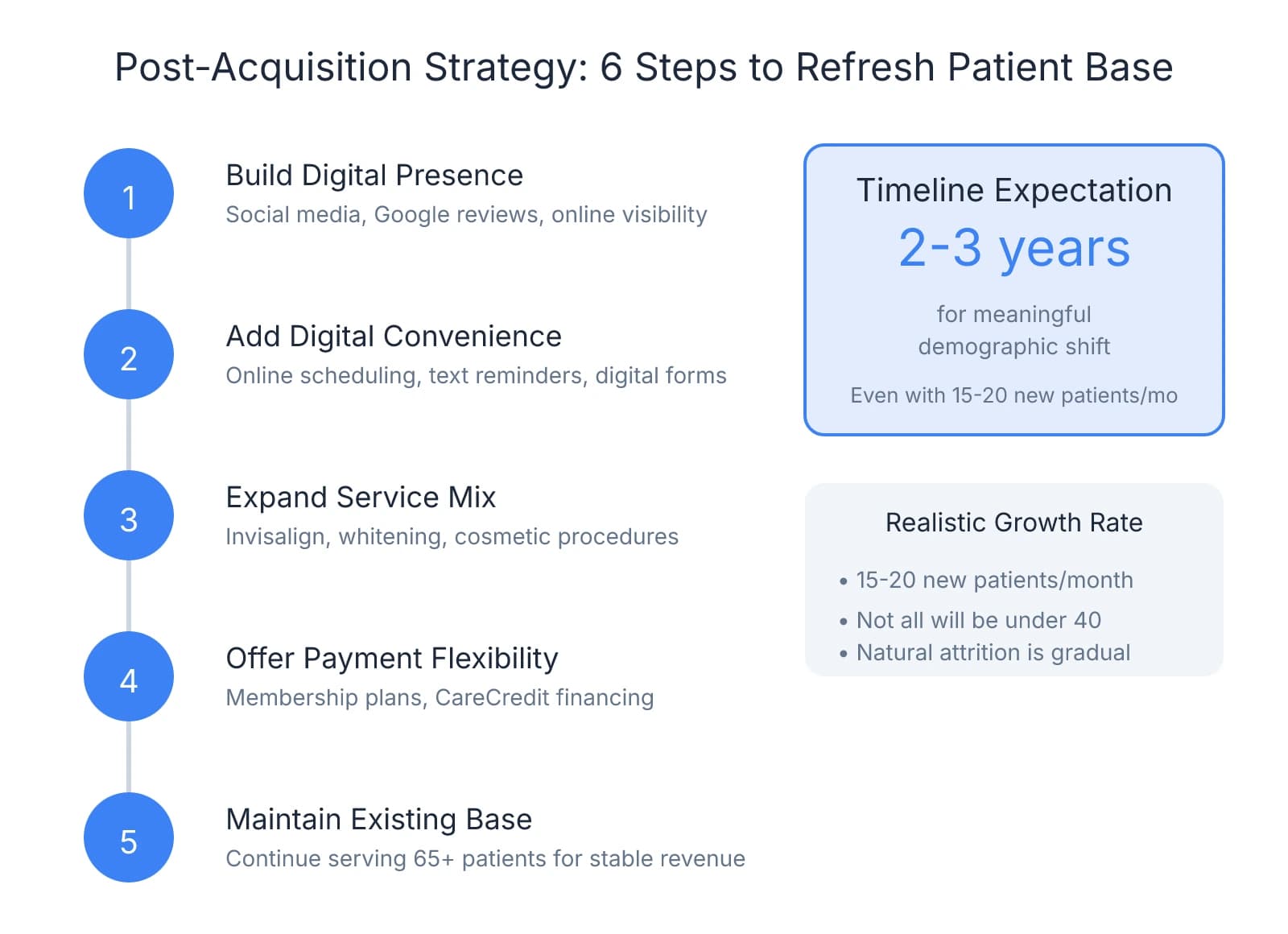
Start with the channels younger patients use to find healthcare providers. Millennials (ages 29-44) and Gen Z (ages 18-28) research providers primarily through social media and online reviews—Instagram, TikTok, and Google Business Profile matter more to this demographic than Yellow Pages listings or direct mail. If the practice has no social media presence or a dormant Google listing with 12 reviews from 2019, you're invisible to the patients you're trying to reach. One step many buyers find valuable in the first 90 days after closing is auditing the practice's digital footprint and building a content calendar that showcases the practice's personality, team, and patient outcomes.
Digital convenience isn't optional for younger patients—it's table stakes. Online scheduling, text appointment reminders, digital intake forms, and patient portals are features this demographic expects from every service provider. If your inherited practice still relies on phone calls for scheduling and paper clipboards in the waiting room, you're creating friction that drives younger patients to competitors. Most practice management systems offer these features as add-ons or integrations—the investment is modest, but the impact on new patient conversion is significant.
Service mix determines whether younger patients see the practice as relevant to their needs. If the practice offers only general dentistry with limited cosmetic or orthodontic options, you're missing the procedures that drive younger patient interest—Invisalign, teeth whitening, composite bonding, and implant restorations. Many buyers start by adding clear aligner therapy, which appeals to adults who avoided braces as teenagers. Cosmetic dentistry—particularly whitening and bonding—carries high margins and attracts patients willing to pay out-of-pocket for elective procedures.
Payment flexibility addresses the financial barriers that prevent younger, often underinsured patients from accepting treatment. Many patients in their 20s and 30s either lack dental insurance or carry high-deductible plans. Offering in-house membership plans—where patients pay an annual fee for preventive care and receive discounts on treatment—removes the insurance barrier and creates predictable recurring revenue. Third-party financing through CareCredit or similar platforms allows patients to spread treatment costs over time, which improves case acceptance for larger procedures.
One mistake that derails demographic transitions is neglecting the existing patient base in pursuit of younger patients. The 65+ patients you inherited are generating the cash flow that services your debt and covers payroll. What you say to patients when you take over matters, but so does how you continue to serve them in the months that follow. Maintain the recare systems, communication preferences, and treatment approaches that kept these patients engaged. They'll continue to provide stable revenue during your transition period, and many will refer friends and family members who may skew younger.
Set realistic expectations for how long demographic diversification takes. A practice that's 70% patients over 60 won't become 50% patients under 50 in twelve months. Even with aggressive new patient marketing, you're adding 15–20 new patients per month, and not all will be under 40. Natural attrition removes older patients gradually. Most practices see meaningful demographic shifts over 2–3 years of consistent marketing, service expansion, and operational improvements. The transition is a marathon, not a sprint—and the practices that execute it successfully balance growth initiatives with operational stability from day one.
Sources & References
The data and claims in this article are drawn from the following sources. We prioritize government data, peer-reviewed research, and established industry publications to ensure accuracy.
- Aging and Dental Health - American Dental Association— www.ada.orgIndustry
- [PDF] The Most Important Number– The Active Patient Count - Henry Schein— henryschein.comIndustry
- Dental service coverage - Medicare— www.medicare.govGovernment
- Dental Care Among Adults Age 65 and Older: United States, 2022— www.cdc.govGovernment
- U.S. Census Bureau population estimates— census.gov
- Median household income data by ZIP code— data.census.gov
- How to Retain Patients When Buying or Joining a Practice— ada.orgIndustry
- Effective Dental Marketing for Millennials and Gen Z Patients— greatdentalwebsites.com
Frequently Asked Questions
Ready to acquire your ideal dental practice?
Whether you're targeting a practice with an established older patient base or exploring options nationwide, Minty connects you with vetted practice listings and provides expert guidance through every step of acquisition.