How to Evaluate Dental Practice Staff Before Closing

Co-Founder, Minty Dental

In Summary
- Patients trust the hygienist they've seen for years more than a new owner they just met—staff relationships drive retention far more than clinical credentials
- High turnover before closing signals systemic issues like poor compensation or toxic culture that won't disappear with new ownership
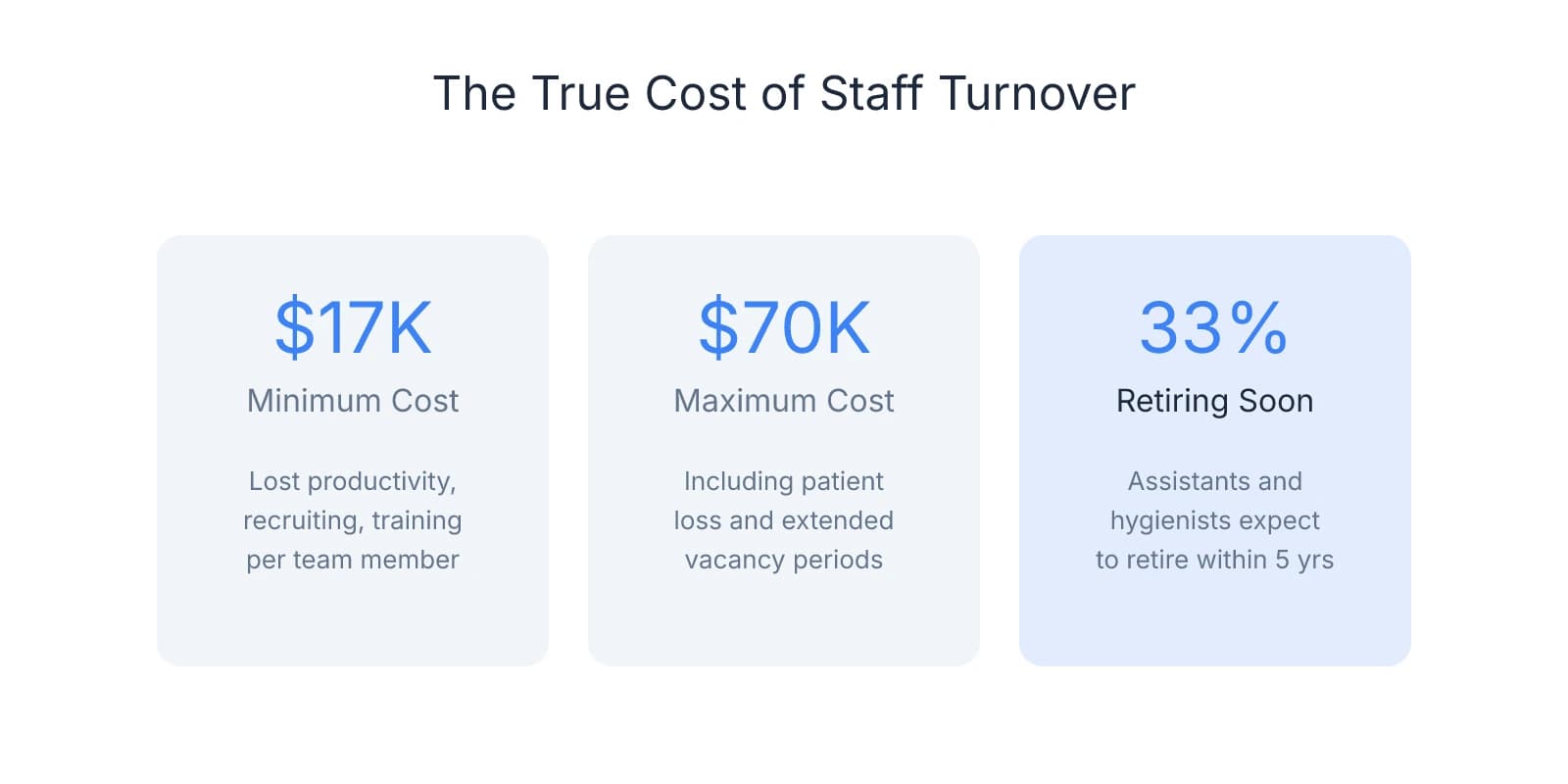
- One-third of dental assistants and hygienists expect to retire within five years, meaning an older team translates to immediate replacement costs
- Replacing a single team member costs $17,000 to $70,000 when accounting for lost productivity, not just hiring expenses
- Staff evaluation is financial due diligence—understanding team stability before closing protects your investment and transition success
Staff Stability Determines Patient Retention More Than Your Clinical Skills
The hygienist who's been cleaning Mrs. Johnson's teeth for eight years carries more weight in her decision to stay than your résumé ever will. Patients form relationships with the people they see most often—front desk staff who remember their kids' names, hygienists who know their health history without checking the chart. When you buy a practice, you're inheriting those relationships. If the team walks, those patients often follow.
High staff turnover before closing signals deeper practice issues—below-market pay, poor management, or a culture that won't improve just because the owner changed. Staff stability deserves the same scrutiny you'd give patient charts and equipment condition. A practice with three front desk changes in two years is telling you something about what you're walking into.
The workforce data makes this urgent. According to the ADA Health Policy Institute's workforce research, one-third of dental assistants and hygienists expect to retire within five years. If your inherited team skews older, you're buying into immediate turnover. Replacing a single team member costs between $17,000 and $70,000 when you account for lost productivity, not just hiring expenses. Multiply that across a team of five, and you're looking at six figures in hidden costs that never appeared in the purchase price.
Staff assessment identifies retention risks, compensation gaps, and what keeps the team functional. The sections that follow give you a framework for doing that—whether you're meeting the team face-to-face or evaluating from a distance when the seller won't allow direct contact.
What to Ask and Observe When You Meet the Team
Request the meeting after your offer is accepted but before due diligence closes. Frame it as essential to your investment decision. Most sellers resist this—they've been told to keep the sale secret until the last possible moment, worried staff will quit if a deal falls through. That concern isn't baseless, but you're about to commit hundreds of thousands of dollars. Push back: "I understand the risk, but I can't finalize this purchase without meeting the people who run the practice day-to-day." In many cases, that's enough. If it's not, note it as a red flag and move to remote evaluation tactics covered in the next section.
When you meet the team, start with tenure and role clarity. Ask each person how long they've been at the practice and what their primary responsibilities are. Answers longer than five years signal stability. Answers under two years—especially if multiple people fall into that range—suggest recent turnover you need to understand. Follow up with, "What do you like most about working here?" and "What would you change if you could?" The first question reveals what's working. The second reveals what's broken. If someone says, "I wish we had better scheduling software," that's fixable. If they say, "I wish there was more respect between the front and back office," you're inheriting a cultural problem that won't resolve itself under new ownership.
Pay attention to compensation signals without asking directly about salary. If someone mentions they haven't had a raise in three years, or that benefits are minimal, you're looking at a retention problem the moment you take over. Staff who feel underpaid don't wait—they leave within six months of a transition, often taking patients with them. Ask, "Do you have any career goals or certifications you're working toward?" This tells you whether people see a future here or are just riding it out. A hygienist pursuing CRDH certification is invested. A front desk staffer who says, "I'm just here until something better comes along," is not.
Watch team dynamics as closely as you listen to answers. Do people interrupt each other? Defer to one dominant personality? Seem genuinely collaborative, or just polite? Dysfunction doesn't fix itself when ownership changes—it often gets worse as people test new boundaries. If the office manager speaks for everyone and others stay quiet, that's either strong leadership or control you'll need to unpack. If two people exchange glances when you ask about scheduling, there's tension you're not hearing about yet.
One question that surfaces hidden turnover: "Has the team changed much in the last year or two?" If the answer is yes, ask why people left. "We've had a lot of changes lately" without specifics means either the seller is hiding something or the team doesn't trust the situation enough to be honest. Either way, it's a problem. High turnover isn't always a dealbreaker, but it is a cost you need to account for—and a signal that your first six months will involve more hiring than patient care. The timing of staff notification itself carries risk: disclosing a sale too early can create unnecessary stress and turnover, particularly if the deal extends longer than expected or falls through entirely.
How to Assess the Team When the Seller Won't Let You Meet Them
Many sellers refuse pre-closing staff meetings, citing confidentiality concerns or fear that employees will quit if they learn about the sale. Staff who hear about a potential sale often start job hunting immediately, especially if they've been through a transition before. But the seller's risk doesn't eliminate yours. You're still buying a practice where staff stability determines whether patients stay or leave.
Start by requesting personnel files during due diligence. Ask for tenure records, salary history, performance reviews, and any disciplinary actions for each team member. Most sellers will push back on this, claiming it's invasive or unnecessary. Push back harder: "I need to understand compensation structure and retention patterns before I finalize this purchase." What you're looking for are patterns the seller won't volunteer. A front desk employee who's been written up three times for attendance issues is a retention risk. A hygienist who hasn't received a raise in four years is a flight risk the moment you close. If the seller refuses to provide any personnel documentation, that refusal itself tells you something—either the records don't exist (which means no formal HR system), or they contain information the seller doesn't want you to see.
Ask the seller directly about recent compensation decisions. When was the last raise given? Who asked for one and didn't get it? Are there any pending HR issues, complaints, or accommodations you should know about? These questions make most sellers uncomfortable, which is exactly why they're worth asking. A seller who says, "Everyone's happy, no issues" is either lying or oblivious. A seller who says, "The office manager asked for a raise six months ago and I told her to wait until after the sale" just handed you a problem you'll inherit the day you close.
Check job posting history for the practice. If the same position—hygienist, dental assistant, front desk—has been advertised repeatedly over the past year, you're looking at either chronic turnover or unrealistic expectations. Pull listings from Indeed, ZipRecruiter, or local job boards. If you see three hygienist postings in 12 months, ask the seller why. The answer will either be reasonable ("We expanded and needed more coverage") or evasive ("We've had some staffing changes"). Evasive answers mean turnover the seller doesn't want to explain.
Research compensation benchmarks for your region and compare them to what the seller discloses. According to ADA workforce data, staff wages should run roughly 20–25% of collections in a healthy practice. If payroll sits at 18% and collections are strong, someone is being underpaid. Staff paid 15–20% below market are flight risks the moment you close—they've been waiting for a reason to leave, and new ownership gives them one. If the seller won't share specific salary figures, ask for total payroll as a percentage of collections. If that number is unusually low, you're inheriting a compensation problem that will cost you within six months.
Ask around discreetly. Other practice owners, local dental society members, or even the broker may know the practice's reputation as an employer. Frame it carefully: "I'm looking at a practice on [street name] and trying to get a sense of the team culture—have you heard anything about how they treat staff?" Most people won't volunteer negative information unprompted, but they'll confirm what they've heard if you ask directly. If multiple sources mention high turnover or poor morale, that's not gossip—it's market intelligence.
Review the organizational chart and recent hiring patterns. If key roles—office manager, lead hygienist, treatment coordinator—are vacant or recently filled, you're inheriting instability. A practice that's been searching for an office manager for three months either can't find someone willing to take the job at the offered rate, or has a reputation that makes qualified candidates pass.
When the seller won't let you meet the team, you're not powerless—you're just working with different data. Personnel files, compensation benchmarks, job posting history, and third-party intelligence give you enough to assess retention risk and identify gaps you'll need to address post-closing. If the seller refuses to provide any of this information, that refusal is itself a data point. You're either walking into a practice with no formal HR systems, or one where the seller knows the team situation is bad enough to tank the deal. Either way, you need to adjust your offer accordingly or walk.
Building Your Post-Closing Retention Plan
Your assessment findings don't matter unless they translate into action. The staff you inherit will decide within 60 days whether they're staying or leaving—and that decision hinges on what you do immediately after closing, not what you promise to do eventually.
Start by identifying your must-retain staff. In most practices, that's the lead hygienist, experienced assistants with strong patient relationships, and front desk staff who know the scheduling system and insurance processes. These are the people patients ask for by name, the ones who can run the practice without you for a day if needed. If your assessment revealed that the lead hygienist is underpaid by 15% compared to regional benchmarks, plan to correct that within 30–60 days. Waiting six months to "see how things go" is how you lose the person who holds the patient base together. According to Curve Dental's retention research, replacing a single team member costs $17,000 to $70,000 when accounting for lost productivity—paying a $10,000 annual raise to prevent that departure is the cheaper option.
Budget for immediate compensation adjustments before you close. If your assessment identified staff paid 10–15% below market, build those raises into your first-year operating budget. This isn't generosity—it's risk mitigation. Staff who feel underpaid don't wait for you to figure out your cash flow. They leave within six months, often taking patients with them. If you can't afford to bring everyone up to market rate immediately, prioritize the roles with the highest patient contact and the longest tenure.
Don't make sweeping changes in the first 90 days. Staff need stability during a transition, even if your assessment identified inefficiencies or cultural problems. The office manager who micromanages scheduling might be annoying, but if she's been running the practice for a decade, patients and staff are used to her. Replacing her in month two creates chaos you're not ready to manage yet. The time to make changes is after you've built trust and understand what's actually broken versus what just looks broken from the outside.
Schedule one-on-one conversations with each team member in your first two weeks. Not a group meeting—individual conversations where people can speak candidly. Ask three questions: What do you need to stay? What concerns do you have about the transition? What do you hope changes? The answers tell you what's negotiable and what's not. A hygienist who says, "I need Fridays off to care for my parent" is giving you a retention condition. A front desk staffer who says, "I hope we finally get better software" is signaling a fixable frustration. These conversations also signal that you see staff as individuals, not inherited assets—which matters more than most buyers realize when building trust with patients and staff.
Plan for turnover you can't prevent. If your assessment revealed that the lead hygienist is retiring in six months, or that a dental assistant is clearly disengaged, start recruiting before they leave. Scrambling to fill a key role after someone quits creates gaps that cost you revenue and patient trust. Proactive hiring means you can overlap the departing employee with their replacement, preserving continuity and knowledge transfer.
Document your retention plan before closing. Which roles get raises, and how much? What benefits are you adding—PTO, continuing education stipends, performance bonuses? What's your 90-day communication strategy—weekly check-ins, monthly team meetings, open-door office hours? Writing this down forces you to commit to specific actions rather than vague intentions. It also gives you a benchmark to measure against. If your plan was to retain 80% of the team and you're at 60% after six months, you know something didn't work. Without a documented plan, you're just reacting to problems as they surface, which is how you end up hiring your first associate sooner than you planned because you couldn't keep the team intact.
The staff you inherit will determine whether your first year is about growth or survival. Treat retention as financial due diligence, not HR paperwork. Build your compensation adjustments into your closing budget, document your 90-day plan, and start those one-on-one conversations the week you take over.
Sources & References
The data and claims in this article are drawn from the following sources. We prioritize government data, peer-reviewed research, and established industry publications to ensure accuracy.
- Dental Employee Turnover Rate | Dental Employee Retention— actdental.comIndustry
- What to Do When Closing a Practice | American Dental Association— ada.orgIndustry
- When Is the Right Time to Tell Staff You're Selling Your Dental ...— ameriprac.com
- A Modern Guide to Dental Team Hiring and Retention— www.curvedental.comIndustry
Frequently Asked Questions
Ready to evaluate your next practice team?
Assessing staff is crucial before closing on a dental practice. Minty Plus provides hands-on guidance through every step of acquisition, including thorough team evaluation and post-close management to ensure a smooth transition.