Transitioning from PPO to Fee-for-Service After Buying a Practice

Co-Founder, Minty Dental

In Summary
- Most acquired practices carry 30-45% collection losses from PPO contracts, but those agreements generated the patient volume that justified your purchase price
- Lenders typically recommend 6-12 months of operational stability before major insurance changes—patient attrition after ownership transfer runs 10-15% even without policy shifts
- The transition decision should be driven by schedule capacity, debt coverage ratios, and competitive positioning—not frustration with write-offs
- Timing matters more than ideology: practices with full schedules and debt service coverage above 1.5x have flexibility to transition; those still building volume don't
- Calculate break-even attrition before deciding—if you're adjusting 40% for a plan, you can lose up to 40% of those patients and maintain the same revenue at full fees
Inherited PPO Contracts Create a Financial Paradox—High Volume, Thin Margins, and Debt Obligations That Demand Stability
You've just closed on a practice generating $800,000 in annual production. The seller's books show consistent patient flow, minimal marketing spend, and a schedule that's 85% full most weeks. Then you pull the insurance breakdown: 60% of revenue comes from three major PPO networks, and average collection losses sit around 35-40% when you compare billed production to actual deposits.
The math feels wrong. If the practice is writing off $280,000 annually to insurance adjustments, why did you just pay 75% of collections for it?
Those PPO contracts didn't just suppress profitability—they created the patient volume that made the practice viable. The seller stayed in-network for the same reasons most dentists do: avoiding patient confrontation, maintaining referral relationships, and benefiting from passive patient acquisition that comes with directory listings. Many sellers never evaluated whether the trade-off made financial sense—they inherited the contracts and kept renewing them out of inertia.
What that means for you: the practice you bought was priced as a PPO-participating operation. The valuation assumed those contracts would remain in place, and the patient base was built on the expectation of in-network benefits. If you transition to fee-for-service in the first six months, you're testing whether the goodwill you paid for can survive a structural shift in how patients access care.
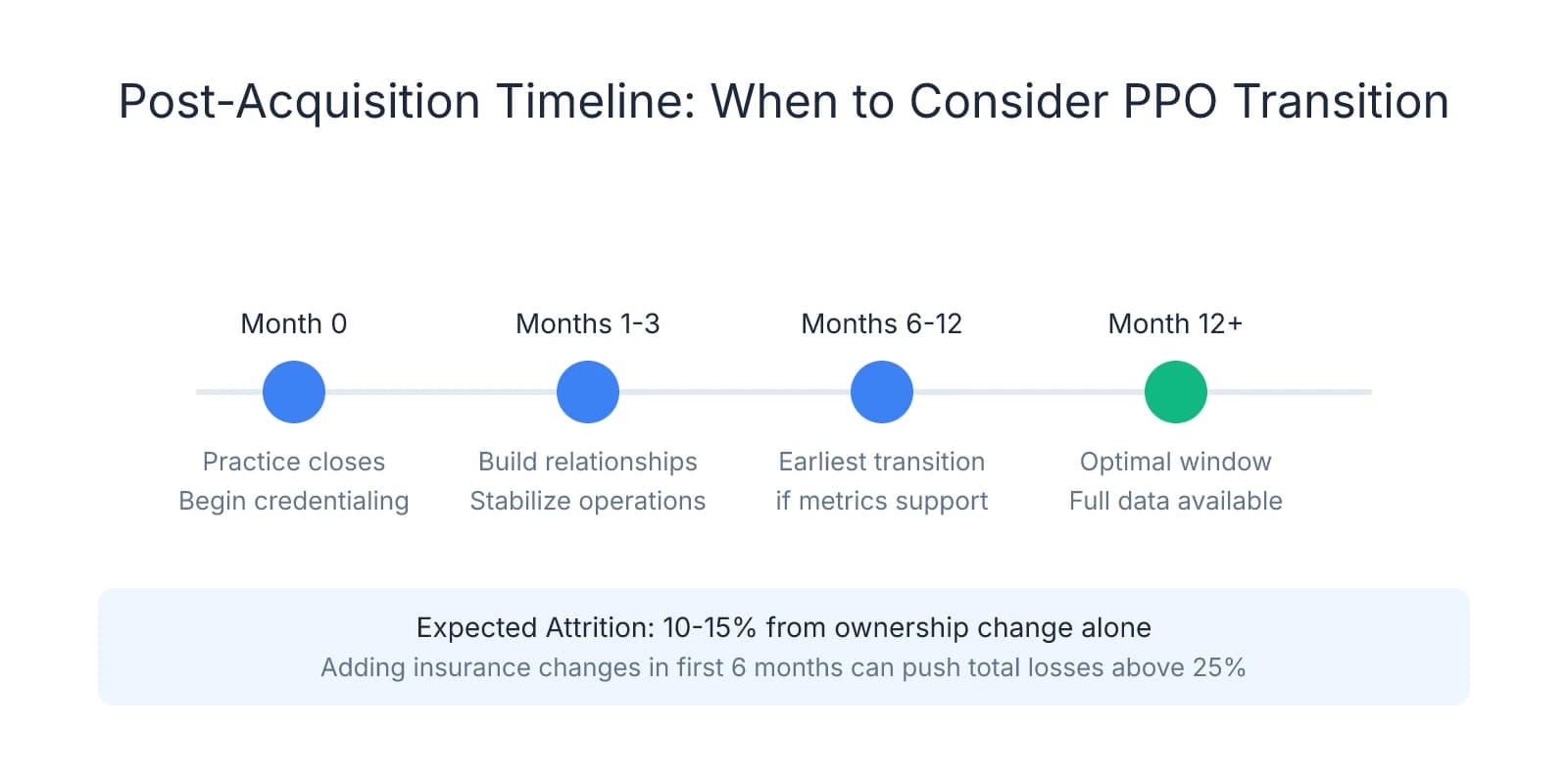
Most lenders and practice advisors recommend stabilizing operations for 6-12 months before making major changes to insurance participation. Patient attrition after ownership transfer typically runs 10-15% in the first year even without policy changes. Add an insurance transition on top of that, and you're compounding risk during the period when your debt service obligations are highest and your operational knowledge is lowest.
The decision should be driven by three factors: schedule capacity, debt service coverage, and competitive positioning. If your schedule is consistently full and you're turning away new patients, you have the volume buffer to absorb attrition. If your debt service coverage ratio is above 1.5x—meaning your practice generates 50% more cash flow than required to cover loan payments—you have the financial cushion to weather a temporary revenue dip. If your market has limited fee-for-service competition and strong demographics, you have the positioning to retain patients who value continuity of care over insurance discounts.
Where buyers get burned is treating the transition as an ideological decision rather than a financial one. The 35% write-off feels viscerally wrong, especially when you're calculating how much faster you could pay down debt at full fee. But the question isn't whether PPO participation is optimal—it's whether your practice can sustain the transition right now, given your debt load, schedule capacity, and market dynamics.
The practices that navigate this successfully treat the first year as a diagnostic period: tracking which procedures generate positive margins under PPO reimbursement, identifying which patient segments are most likely to stay if you go out-of-network, and building the operational systems that make a fee-for-service model sustainable. The ones that struggle make the decision in month three, driven by frustration rather than data.
When Transition Timing Makes Sense (and When It Doesn't)
The decision to drop PPO participation is a question of when your practice can absorb the change without jeopardizing debt service or patient retention. Practices that transition successfully share specific operational characteristics that signal readiness.
Schedule density matters. Practices booked consistently 4-6 weeks out with new patient flow above 30 per month can typically absorb 10-20% patient attrition without creating open capacity that threatens revenue. The math is straightforward: if you're seeing 120 patients per week and lose 15% when you drop a plan, you're down to 102 patients—still enough to maintain collections if your schedule was previously full. Where buyers misjudge this is assuming their schedule will stay full after the transition. Patient attrition compounds during ownership changes, and adding an insurance policy shift can push total first-year losses above 25%.
The first 6-12 months post-acquisition should focus on stabilizing operations, building patient relationships under your ownership, and ensuring debt service is comfortably covered. Many buyers underestimate how much operational knowledge they're still acquiring during this period—learning staff workflows, identifying which procedures the practice does well, understanding which patient segments drive profitability. Making a major insurance change before you've mapped those fundamentals means navigating two transitions simultaneously.
A complication many buyers don't anticipate is the insurance credentialing timeline. Getting credentialed with PPO carriers takes 60-90 days per plan, and you had to complete that process for every carrier the seller participated with just to maintain continuity of care after closing. Dropping those plans immediately after credentialing creates operational confusion—billing staff who just learned the new provider numbers now have to communicate out-of-network status to patients, and claims submitted during the transition period often get rejected or delayed.
A phased approach makes sense when you're testing patient response without committing to a full exit. Dropping one low-reimbursing plan at a time over 12-18 months allows you to measure attrition, adjust communication strategies, and identify which patient segments are most likely to stay. Start with the plan that represents the smallest percentage of your patient base and has the worst reimbursement rates. Track patient retention for 90 days. If attrition stays below 15% and your schedule remains full, you've validated that your market can support the transition. If attrition exceeds 20% or you start seeing open appointment slots, you've learned that your practice isn't ready for a broader shift.
Market saturation plays a larger role than most buyers expect. Practices in areas with 10+ competitors within 2 miles face higher attrition risk than those in underserved markets, particularly if several nearby practices accept the plan you're dropping. Patients who've been with the practice for years may stay out of loyalty, but newer patients acquired in the last 12-24 months—who never built a relationship with the seller—are more likely to switch to a nearby in-network provider. If most new patients come from insurance directories rather than referrals or organic search, dropping the plan removes your primary acquisition channel.
The practices that time this well treat the transition as a financial decision with measurable criteria. They wait until debt service coverage is above 1.5x, schedule capacity is consistently full, and they've built enough patient relationships under the new ownership that loyalty outweighs insurance convenience.
Managing Patient Communication Without Losing Trust
Patients are already adjusting to new ownership—adding an insurance change in the first 90 days compounds transition anxiety and increases attrition risk. The challenge isn't just explaining the policy shift; it's asking patients to accept a new dentist and a change in their financial relationship with the practice within the same narrow window.
One pattern that consistently reduces attrition is separating the relationship-building phase from the policy-change announcement. Let patients meet you first. Schedule their first appointment under your ownership as a continuity visit—same insurance benefits, same financial expectations they had with the seller. Use that visit to demonstrate clinical competence, build rapport, and show that the quality of care hasn't changed. Once they've experienced the practice under your ownership and decided to return for their next appointment, you've earned enough trust to introduce a policy shift without triggering an immediate search for a new provider.
The timing window that works for most practices is 60-90 days after closing. Earlier than that, and you're asking patients to make a decision about you before they've formed an opinion. Later than six months, and you've delayed the financial benefit while continuing to absorb PPO write-offs during your highest debt service period. The goal is to let patients experience one full appointment cycle under your care before announcing the change.
Staff training determines whether the message lands as a practice improvement or a financial burden being passed to patients. The most effective messaging focuses on what insurance still covers, not what you're dropping. Instead of "We're no longer in-network with Delta, so your cleanings won't be fully covered," train staff to say, "Your Delta plan still provides out-of-network benefits—typically 50-80% of preventive care. We'll help you maximize those benefits and file claims on your behalf."
Avoid anything that positions the insurance company as the villain or implies patients should pressure their employers. Phrases like "Insurance companies don't care about quality care" or "Tell your HR department you want better coverage" create friction without solving the patient's immediate concern: "How much will this cost me?" Patients don't care about your overhead or your frustration with claims processing. They care whether they can still afford the care they need.
What works better is emphasizing continuity, flexibility, and alternatives. "You've been with this practice for years, and we want to make sure that continues. Here's what we're offering to help bridge the gap." That framing shifts the conversation from "the practice is making a change that costs me more" to "the practice is offering solutions to keep me as a patient."
In-house membership plans provide a structured alternative for patients losing in-network benefits. These plans typically run $300-500 annually and cover two cleanings, exams, and X-rays, plus 10-20% discounts on restorative work. For patients whose insurance primarily covered preventive care, the membership plan often costs less than their annual premium and delivers comparable value. Present it as an option, not a replacement—some patients will prefer to use their out-of-network benefits, others will find the membership plan simpler and more predictable.
Third-party financing options like CareCredit should be part of the conversation for patients facing larger treatment plans. If a patient has $3,000 in recommended work and their insurance will cover $1,500 out-of-network, offering 12-month interest-free financing on the remaining balance removes the immediate affordability barrier. Train staff to introduce financing proactively, not as a last resort when a patient balks at the cost.
The logistical question of how to notify patients depends on the size of the affected patient base and the depth of their relationship with the practice. Practices dropping a plan that represents 30%+ of their patient base should send written notification 60-90 days before the effective date, followed by phone calls to high-value patients. Practices dropping a smaller plan (10-15% of patients) can handle it case-by-case as patients schedule appointments.
High-value patients—those with active treatment plans, 5+ years of tenure, and low dependency on insurance for routine care—deserve personal outreach before any mass notification. A phone call from you or the office manager, explaining the change and offering to discuss their specific situation, signals that you value the relationship. Patients who've been with the practice for a decade and have $5,000 in planned restorative work are far more likely to stay than newer patients whose only connection to the practice is insurance convenience.
The tone should be matter-of-fact and solution-focused: "We're making a change to how we work with insurance. Here's what that means for you, and here's what we're offering to make the transition smooth."
The practices that retain the most patients during a PPO transition treat communication as relationship management, not policy announcement. They give patients time to adjust to new ownership before introducing financial changes, train staff to handle questions with empathy and clarity, and offer concrete alternatives that make staying with the practice the easier choice.
Running the Numbers: Will the Transition Support Your Debt?
The decision to drop a PPO plan is about whether your practice can financially survive the transition while covering debt service, payroll, and your personal draw. The practices that navigate this successfully run the numbers before making the decision, not after.
Start by calculating your current collection rate by PPO plan. Pull 12 months of production and collection data from your practice management software, broken down by insurance carrier. What you're looking for is the gap between what you billed and what you actually collected after contractual adjustments. Many practices discover that 1-2 plans account for 60-70% of total write-offs but represent only 30-40% of patient volume. That's the signal that a specific plan is disproportionately eroding profitability—and the first candidate for elimination.
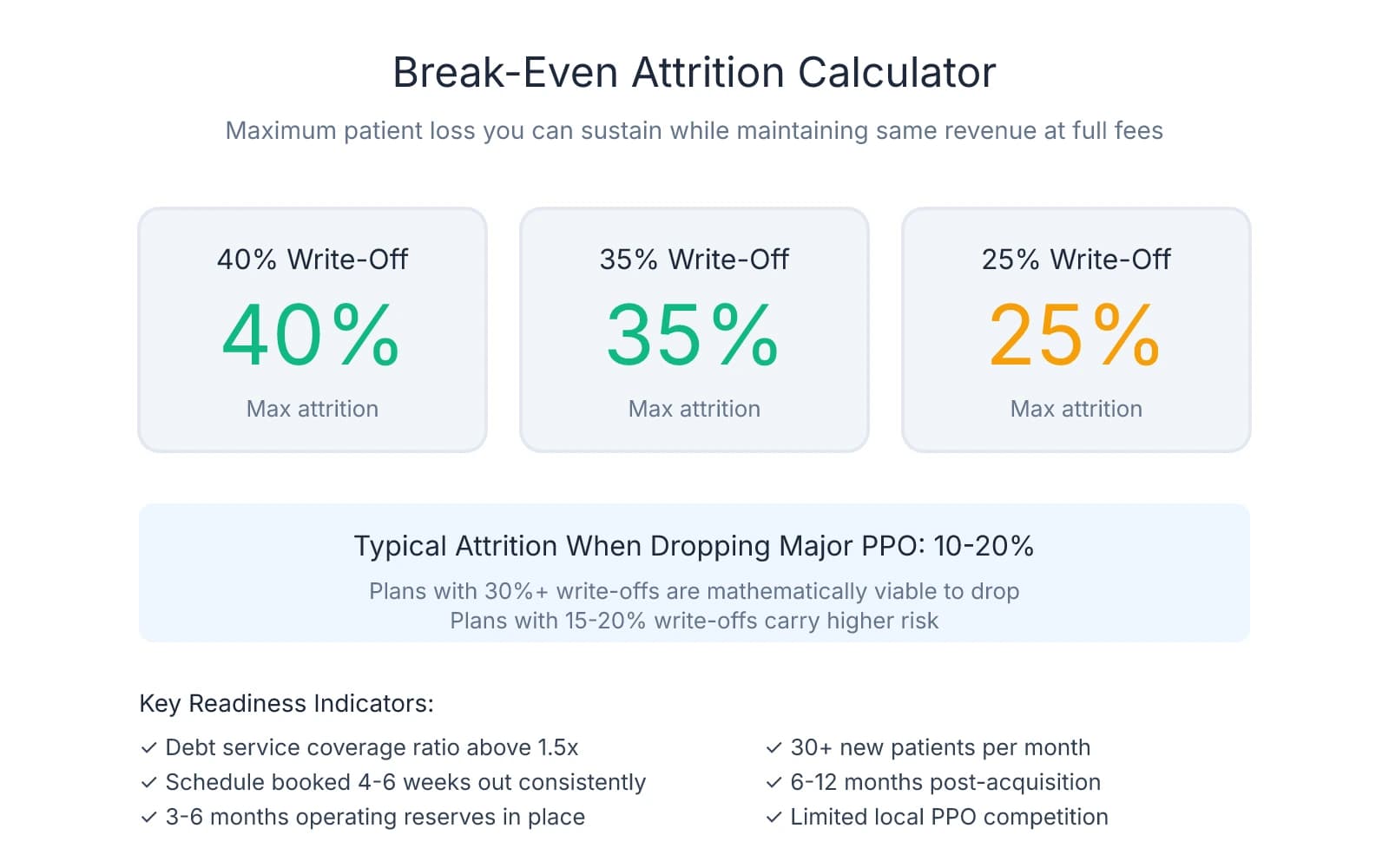
The break-even attrition rate depends entirely on your write-off percentage. If you're adjusting 40% for a plan, you can lose up to 40% of those patients and maintain the same revenue at full fees—the remaining 60% paying full price generates the same collections as 100% paying the discounted rate. If your write-off is 35%, your break-even is 35% attrition. The margin for error tightens as your write-off percentage drops. A plan with 25% adjustments only tolerates 25% patient loss before you're collecting less than you were in-network. Most practices see 10-20% attrition when dropping a major PPO, which means plans with 30%+ write-offs are mathematically viable to drop—plans with 15-20% write-offs carry more risk.
Where buyers underestimate the challenge is the cash flow gap. Even if the math works long-term, there's a 60-90 day period between dropping the plan and seeing the financial benefit. Patients who leave do so immediately. Patients who stay don't generate the increased revenue until their next appointment, which may be 3-6 months out for recall patients. New patients who replace the attrition take time to acquire, schedule, and convert to treatment. During that window, you're operating with reduced collections while your debt payment, payroll, and overhead remain constant.
Model this scenario: if your practice collects $65,000 per month and you drop a plan representing 30% of your patient base, assume collections drop to $52,000 for 90 days while the schedule adjusts. Can you cover your loan payment, staff salaries, lab bills, and minimum personal draw on $52,000? If your monthly debt service is $12,000, payroll is $25,000, and fixed overhead is $15,000, you need $52,000 just to break even before taking any income. That leaves zero margin for error.
The stress test that matters most: if collections drop 20% for six months, can you still cover your loan payment, payroll, and minimum personal draw? If the answer is no, you don't have the financial cushion to transition yet. Build your operating reserves first—ideally 3-6 months of fixed expenses in a business savings account—before making a change that introduces this level of revenue volatility.
Track leading indicators during the transition, not just lagging revenue numbers. New patient call volume, schedule fill rate two weeks out, treatment acceptance percentage, and average production per patient all signal whether the transition is working before it shows up in your bank account. If new patient calls drop 30% in the first month after the announcement, that's a warning sign that your market isn't absorbing the change as well as projected. If treatment acceptance holds steady and production per patient increases because you're no longer constrained by PPO fee schedules, that's evidence the transition is on track.
One calculation many buyers skip is the debt service coverage ratio. Take your monthly net income (collections minus all expenses except debt service and owner compensation) and divide it by your monthly loan payment. If that number is below 1.25x, you're operating with minimal cushion—any revenue disruption threatens your ability to make loan payments. A ratio above 1.5x gives you the buffer to absorb a temporary dip in collections without jeopardizing debt service. Practices with coverage ratios below 1.3x should focus on increasing profitability within their current insurance mix before attempting a transition that introduces additional risk.
The final piece is understanding which procedures still generate positive margins under PPO reimbursement and which are losing money. Pull a procedure code report showing your top 20 procedures by volume, along with your standard fee and the PPO reimbursement rate for each. Calculate the margin: if a crown costs you $400 in lab fees and chair time, and the PPO reimburses $650, you're netting $250. If your full fee is $1,200, going fee-for-service increases that margin to $800—but only if the patient accepts treatment. The procedures where PPO reimbursement approaches or falls below your cost—typically high-complexity endo, surgical extractions, or implant work—are the ones where fee-for-service makes the most immediate financial sense.
The practices that make this decision well treat it as a financial model, not a philosophical stance. They calculate break-even attrition, stress-test cash flow scenarios, build operating reserves, and track leading indicators that signal whether the transition is sustainable. Run the numbers first. If they don't work today, focus on building the financial cushion that makes them work in 12-18 months.
Sources & References
The data and claims in this article are drawn from the following sources. We prioritize government data, peer-reviewed research, and established industry publications to ensure accuracy.
- [PDF] Dental PPO Collection Loss Analysis— cdr.lib.unc.eduAcademic
- The Hidden Challenge in Dental Practice Transitions — Insurance ...— ameriprac.comIndustry
- Dropping PPOs? How To Communicate To Keep Your Patients | APM— advancedpracticemanagement.comIndustry
- 6 Steps to Successfully Dropping Your Favorite PPO - AADOM— www.dentalmanagers.com
- Dentists: Should you Drop Dental PPOs? - Adams Brown— adamsbrowncpa.com
Frequently Asked Questions
Ready to transition your newly acquired practice?
Converting from PPO to fee-for-service requires strategic planning and operational expertise. Minty Plus provides hands-on guidance through every step of your practice transition, from patient communication to financial restructuring.