Lost a Dental Practice Bidding War: What to Do Next

Co-Founder, Minty Dental

In Summary
- A dental practice bidding war occurs when multiple qualified buyers submit formal offers on the same practice—most accepted offers balance price with cleaner terms, stronger financing, and better cultural fit
- Sellers rarely choose the highest offer when other factors create more certainty—structural weaknesses in contingencies, earnout terms, or transition expectations often matter more than the headline number
- The first 48 hours after losing a deal are when the most useful feedback is still accessible—request specific insights from the broker about price gaps, contingencies, financing structure, and transition timeline alignment
- Strengthening your next offer means removing uncertainty from the seller's decision: upgrade to firm pre-approval, reduce contingency timelines while keeping substantive protections, and align terms with what the seller actually needs
- One lost deal is a data point; three losses for the same reason is a pattern requiring strategy adjustment—maintain your criteria and improve execution unless clear patterns show you're competing outside your financial tier
Losing a Bidding War Usually Means Your Offer Had a Structural Weakness
A dental practice bidding war happens when multiple qualified buyers submit formal offers on the same practice. The distinction matters because once you're competing at the offer stage, you've already cleared the initial hurdles. You're financially credible. The practice fits your clinical model. The seller took you seriously enough to review your proposal alongside others.
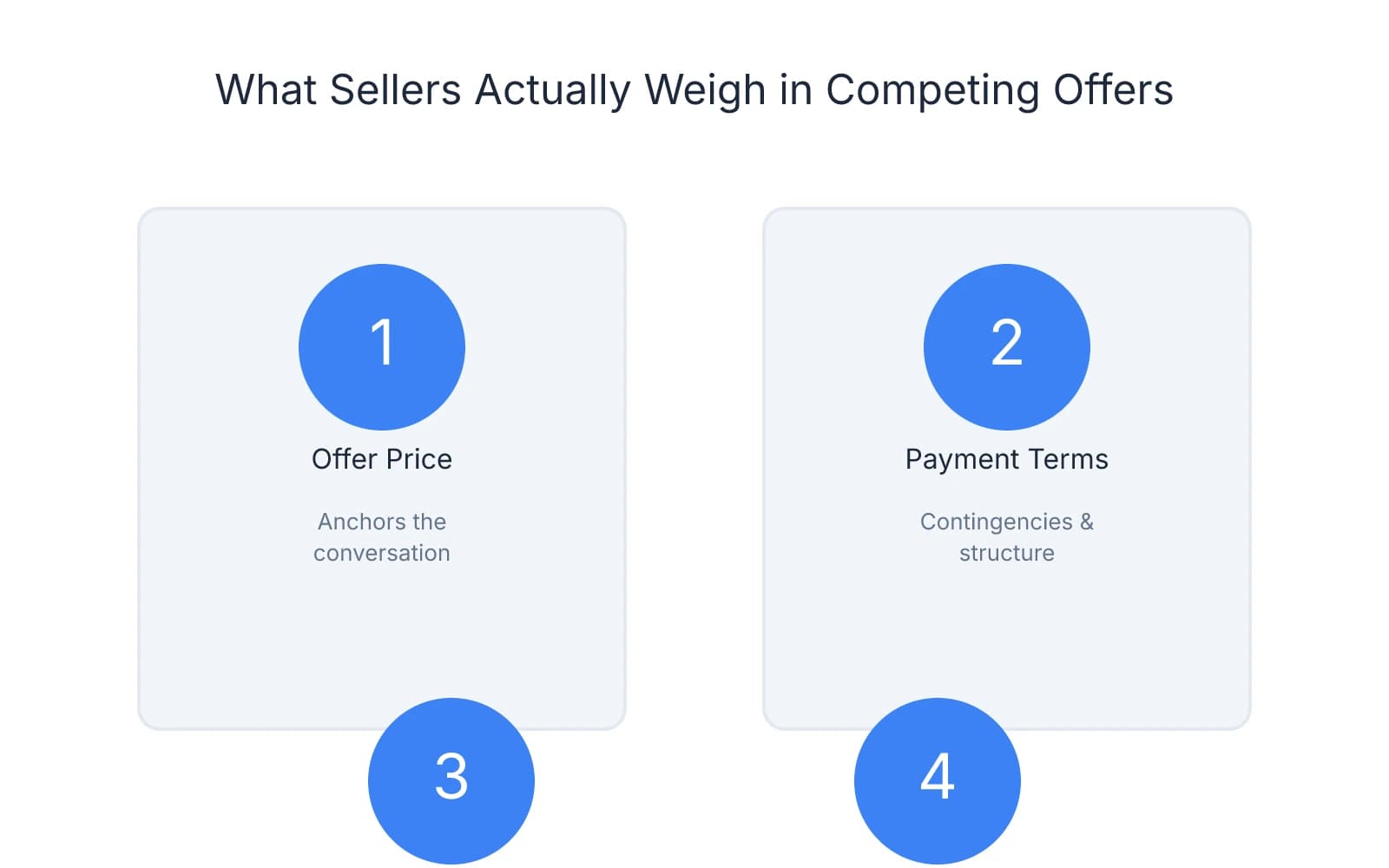
What separates the winning offer from the rest usually isn't the price.
Sellers rarely choose the highest number when other factors create more certainty. A $50,000 premium doesn't offset the risk of a buyer who needs 90 days of contingencies, unclear financing terms, or a transition plan that leaves the seller working full-time for six months. The real gap often sits in offer structure, financing readiness, or the rapport built during negotiations.
The four factors sellers actually weigh: offer price, payment structure and contingencies, buyer credibility and financing readiness, and personal rapport and practice legacy concerns. Price anchors the conversation, but the other three determine whether the deal closes without drama. A seller who's spent 20 years building patient relationships will often accept $75,000 less from a buyer who demonstrates clinical alignment and a clear transition plan.
One pattern that shows up repeatedly: buyers who front-load due diligence requests into the LOI phase or who structure payment terms that shift risk entirely onto the seller. These offers read as uncertain, even when the price looks strong.
Losing a deal is diagnostic feedback. It reveals what you need to strengthen before the next opportunity—whether that's tightening your financing presentation, reducing contingencies, or building stronger rapport during negotiation. Buyers who treat a loss as a learning tool rather than a rejection tend to win the second or third deal they pursue.
What to Do in the First 48 Hours After Losing the Deal
The first two days after losing an offer are when the most useful information is still accessible. Brokers and sellers remember the specifics of why they chose another buyer. Your own offer details are fresh enough to analyze clearly.
Request specific feedback from the broker or seller. Most buyers skip this step entirely, assuming the conversation will be awkward or uninformative. In practice, brokers are often willing to share why your offer didn't win—especially if they think you'll be a serious buyer on future listings. The questions that tend to get useful answers:
- Was the price gap significant, or were we close?
- Did our contingencies create uncertainty compared to the winning offer?
- Was financing structure a factor—loan type, down payment, or pre-approval strength?
- Did our transition timeline not align with what the seller needed?
Frame the request as learning, not challenging the decision. A broker who sees you as coachable is more likely to give you direct insight—and more likely to call you first when the next strong listing comes through.
Document what you learned about your own offer while the details are still clear. Pull up your LOI and mark the sections that may have created friction. Common weak points: contingencies that extended due diligence beyond 60 days, earnout structures that tied too much compensation to future performance, or transition expectations that required the seller to stay involved longer than they wanted. If your offer had three contingencies and the winner had one, that's not a price problem—it's a certainty problem.
Contact your lender to understand if your financing structure created doubt. Sellers and brokers evaluate financing credibility even when you have pre-approval. A conventional loan with 20% down and a strong credit profile reads differently than an SBA loan with minimal liquidity reserves and a 680 credit score. Both can close, but one signals more risk. Ask your lender directly: did our loan structure look weaker than a typical competing offer?
Ask the broker to keep you as a backup if the deal falls through during due diligence. This is not a long-shot strategy—20-30% of accepted offers don't make it to closing. Financing falls apart, lease assignments get blocked, or the buyer discovers something in the records that changes the valuation. Being the informed second choice means you're positioned to move quickly if the primary deal collapses, often with less competition and more negotiating leverage.
Resist the urge to immediately raise your offer ceiling or abandon your search criteria. The most common mistake buyers make after losing a deal is emotional recalibration—deciding they need to bid higher, accept worse terms, or expand into markets they weren't originally targeting. If your offer was financially sound and the practice fit your model, the loss doesn't mean your strategy was wrong. Changing your criteria in the 48 hours after a loss often leads to overpaying on the next opportunity or buying a practice that doesn't actually fit your long-term goals.
How to Strengthen Your Next Offer Without Overpaying
The gap between losing and winning usually isn't about adding $50,000 to your price—it's about removing uncertainty from the seller's decision. What buyers actually need is a cleaner offer that reduces the seller's perceived risk without increasing their own financial exposure.
Upgrade your financing from conditional to firm pre-approval. A pre-qualification letter tells the seller you talked to a lender. A firm pre-approval means the lender reviewed your tax returns, credit profile, liquidity reserves, and debt-to-income ratio—and committed to the loan pending property appraisal. Sellers know the difference. When two offers are within 10% on price, the one backed by firm financing wins. Ask your lender what documentation they need to issue a firm commitment. The process takes 7-10 days but eliminates one of the biggest reasons deals fall apart during due diligence.
Reduce contingency risk without giving up protection. Contingencies exist for good reasons—you need time to verify financials, inspect equipment, and confirm lease terms. But a 90-day due diligence window with broad renegotiation triggers reads as uncertain compared to a 45-day window with defined exit criteria. One approach: shorten the overall timeline but keep the substantive protections. Instead of "buyer may renegotiate price based on any findings during due diligence," specify the conditions that would trigger renegotiation—material misrepresentation in financials, undisclosed legal liabilities, or equipment failures exceeding $15,000. This gives you the same protection while signaling you're not planning to nickel-and-dime the seller over minor issues.
Another lever: offer a non-refundable deposit after the first 15 days of review. If initial financial verification and lease confirmation look clean, you commit $10,000-$25,000 that you forfeit if you walk away for reasons outside your defined contingencies. This tells the seller you're serious without increasing your actual risk—you're still protected on the issues that matter.
Adjust offer terms to align with what the seller actually needs. The winning offer often addresses the seller's specific situation. A seller retiring to another state cares more about a fast closing than extended transition support. A seller who's emotionally attached to the practice legacy wants to see a 60-90 day transition with defined responsibilities. A seller dealing with a difficult landlord may value a buyer willing to negotiate the lease assignment directly over someone who makes it a contingency.
Ask the broker what mattered most to the seller in the deal you lost. If the answer is "they wanted someone who'd preserve the practice culture," your next offer should demonstrate clinical philosophy alignment. If it's "they needed to close in 45 days for tax reasons," your financing timeline becomes more important than your price.
Consider earnout structures that bridge valuation gaps without increasing your risk. When you're $75,000 apart on price and neither side wants to move, an earnout can close the gap—but only if it's structured around metrics you'll control post-closing. Tying additional payments to revenue retention, patient visit volume, or collections over 12-24 months aligns the seller's payout with practice performance you can verify. Avoid earnouts based on subjective criteria or factors outside your control. A well-designed earnout protects both sides: the seller gets upside if the practice performs as represented, and you only pay the premium if the revenue actually materializes. For more on how these agreements work in practice, earnout structures can bridge valuation disagreements when both parties are negotiating in good faith.
Build seller rapport before submitting your next offer. The buyers who win competitive deals often meet the seller in person during the tour, ask about practice culture and legacy concerns, and demonstrate genuine interest beyond financials. A seller who's spent 20 years building patient relationships wants to know you'll respect what they built. This doesn't mean fabricating alignment, but it does mean showing up prepared to discuss clinical philosophy, patient care approach, and long-term vision for the practice.
Understand which improvements matter most for your situation. Not every offer needs every enhancement. A seller nearing retirement cares more about transition support and cultural fit than a seller relocating for family reasons, who may prioritize closing speed and minimal involvement. The diagnostic feedback you gathered in the first 48 hours should tell you which levers to adjust—don't strengthen everything, strengthen what actually lost you the deal.
When to Adjust Your Search Criteria vs. When to Stay the Course
One lost deal doesn't mean your search strategy is wrong. It means a specific practice had a buyer who was better positioned—financially, structurally, or relationally. The decision to adjust your criteria versus improving your execution comes down to pattern recognition. If you've lost one deal, focus on strengthening your next offer. If you've lost three deals for the same reason, you're dealing with a structural constraint that requires strategy adjustment.
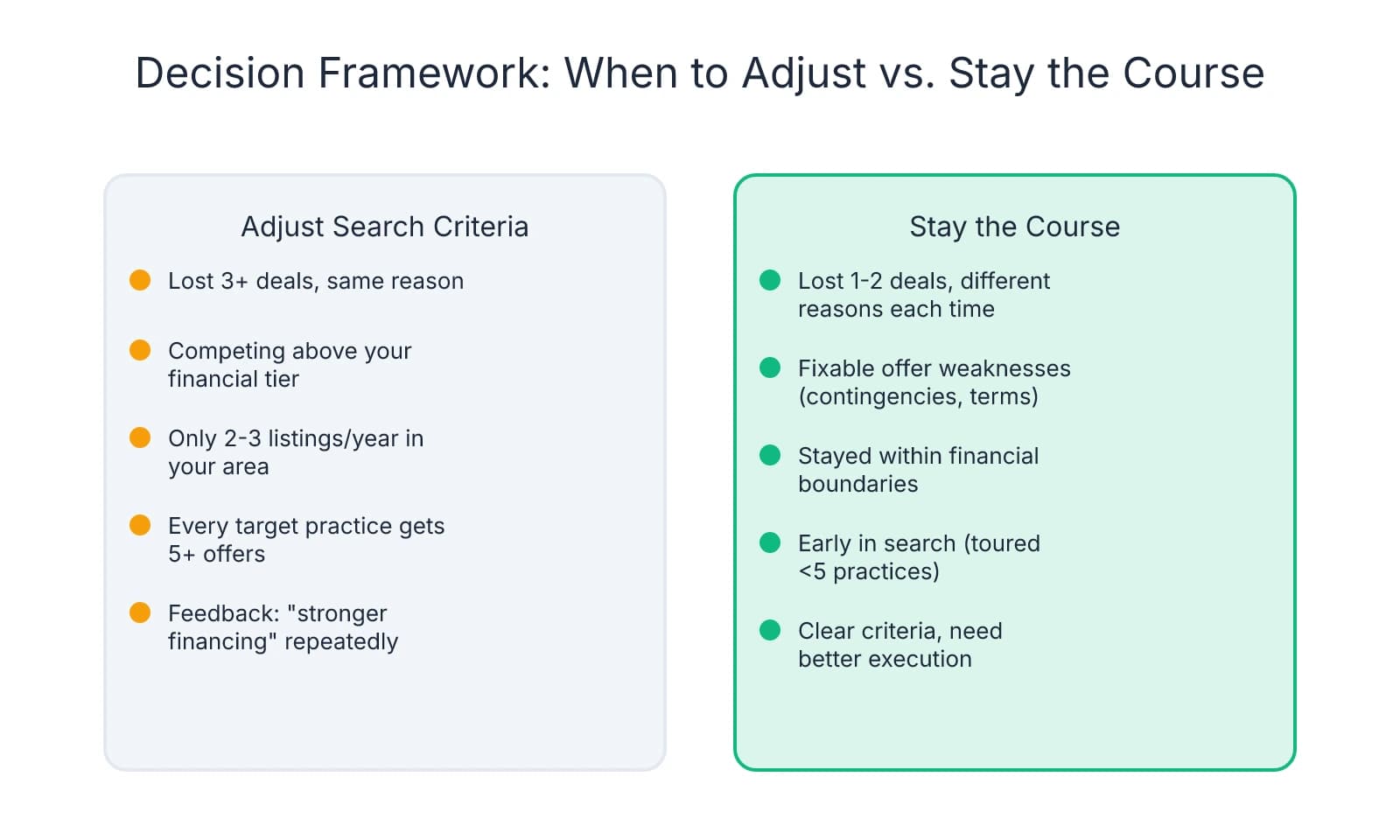
Signals that suggest broadening your search parameters:
If you're consistently losing to buyers with stronger financial positioning—larger down payments, higher liquidity reserves, or conventional financing when you're using SBA loans—and you can't close that gap in the next 60-90 days, you may be targeting practices outside your competitive range. A $1.2M practice in a desirable suburb attracts buyers with $300K in liquid assets and 780+ credit scores. If your profile sits at $100K liquidity and a 690 score, you're competing in a tier where other buyers have structural advantages you can't match immediately.
Geographic constraints that limit you to 2-3 viable listings per year create the same problem. If you're locked into a 20-mile radius around a specific city and every practice that fits your criteria generates 4-5 offers, you're fighting inventory scarcity rather than offer quality issues. Expanding your radius by 30-60 minutes often opens significantly more opportunities without requiring you to lower clinical or financial standards. Practices 45 minutes outside major metros tend to list 15-20% below urban benchmarks while maintaining similar production levels and patient bases.
Targeting practice types with limited inventory—high-production fee-for-service in affluent suburbs, specialty-heavy general practices, or turnkey locations with new equipment and strong associate teams—means you're competing for the same 10-15 listings every serious buyer in your market is watching. If you've lost two deals in this category and the feedback centers on "multiple strong offers," consider whether adjacent practice types might fit your goals. PPO-heavy practices often have optimization potential that fee-for-service buyers overlook, and rural practices typically come with lower acquisition costs while maintaining solid profitability if you're willing to build in a smaller market.
Signals that suggest maintaining your criteria and improving execution:
If you lost because of fixable offer weaknesses—contingencies that extended too long, unclear financing terms, or weak rapport with the seller—changing what you're looking for won't solve the problem. The next practice you pursue will have the same structural issues if your offer presentation hasn't improved. Buyers who lose on earnout disagreements or transition timeline mismatches often assume they need to find a "less complicated" practice, when the real issue is learning to structure those terms more effectively.
Having clear financial boundaries that prevent overpaying is a feature, not a constraint. If you lost a deal because you wouldn't go above $950K and the winning offer was $1.05M, that's not a signal to raise your ceiling—it's confirmation your discipline is working. Overpaying to win a competitive deal creates problems that show up 12-18 months into ownership when cash flow doesn't support the debt service you committed to.
Being early in your search process with limited data points means you don't yet have enough information to know what needs adjusting. If you've toured three practices and lost one offer, you're still in the learning phase. Most buyers who go on to close successfully lose 1-2 deals before they find the right fit—not because their strategy was wrong, but because deal experience improves offer quality and negotiation instincts.
A decision framework for when to pivot:
One lost deal is a data point. Two lost deals for different reasons—one on price, one on transition terms—suggests you're navigating normal market dynamics. Three lost deals for the same reason is a pattern that requires strategy adjustment.
If the consistent feedback is "another buyer had stronger financing," take 60-90 days to improve your financial positioning before resuming the search. Build liquidity reserves, address credit issues, or secure firmer pre-approval terms. If the pattern is "we went with someone who aligned better with practice culture," the issue isn't your search criteria—it's how you're building rapport during tours and negotiations.
If you're losing because practices in your target market consistently generate 5+ offers and you can't structurally compete, geographic expansion or alternative practice types become worth exploring. Moving to another state opens markets where your financial profile is more competitive. Lower-production practices you can grow, rural locations with less buyer competition, or practices that need operational improvements all reduce the bidding war dynamic while still offering solid ownership opportunities.
The buyers who close on practices they're happy with two years later tend to be the ones who stayed disciplined on financial boundaries, improved their offer execution after early losses, and adjusted search parameters only when clear patterns emerged across multiple deals. Losing a bidding war feels like failure in the moment. Treated as diagnostic feedback, it's often the most valuable part of the learning process.
Sources & References
The data and claims in this article are drawn from the following sources. We prioritize government data, peer-reviewed research, and established industry publications to ensure accuracy.
- 20-30% of accepted offers don't make it to closing— dentaleconomics.com
Frequently Asked Questions
Find Your Next Dental Practice Opportunity
Losing a bidding war doesn't mean missing out on practice ownership. Explore available dental practices nationwide or get expert guidance to navigate competitive markets strategically.