Moving to Another State to Buy a Dental Practice: What to Know

Co-Founder, Minty Dental

In Summary
- License transfer takes 60-90 days minimum, with some states requiring additional exams that extend timelines to six months — and insurance credentialing adds another 60-90 days after licensing, meaning you can't bill in-network for 4-6 months
- Most sellers exit within 30-60 days, forcing you to treat patients out-of-network during credentialing — creating immediate cash flow pressure when you need revenue most
- Buying a home before securing practice financing drains liquidity and increases debt-to-income ratios, often reducing loan approval amounts or forcing larger down payments
- The Dentist and Dental Hygienist Compact won't issue privileges for 18-24 months, offering no relief for current buyers — traditional state-by-state licensing remains the only path
- Starting licensing 6-12 months before closing and structuring contingencies for approval delays, extended transitions, and lease assignment are the only protections against relocation risk
Licensing and Credentialing Timelines Determine Your Entire Schedule
The constraint most buyers underestimate isn't financing or due diligence — it's the administrative timeline between signing and being able to bill insurance. You cannot generate revenue until you're licensed in the new state and credentialed with the insurance carriers your patients rely on.
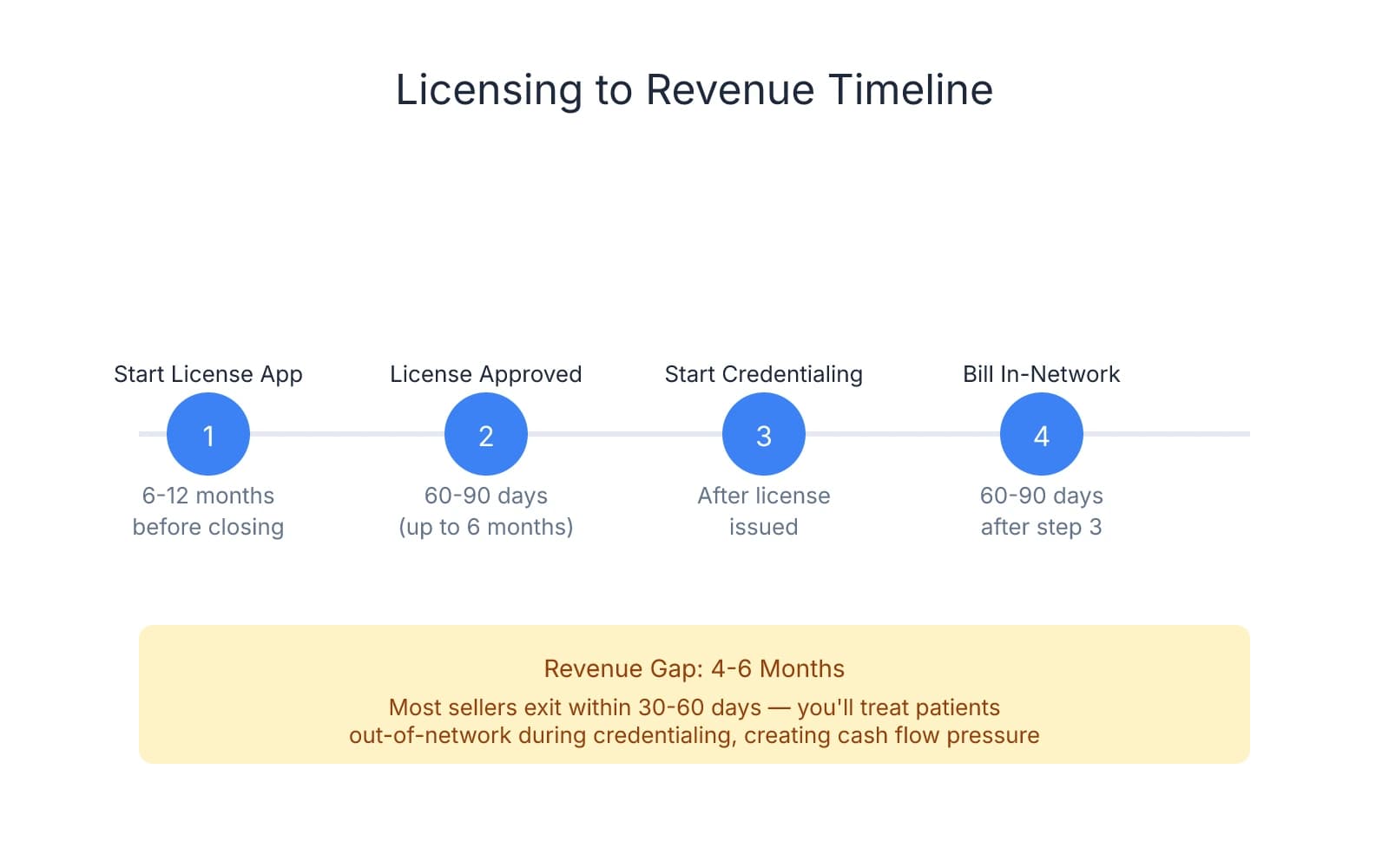
License transfer timelines vary significantly by state. Most states process dental license applications within 60-90 days, assuming complete documentation submitted upfront. States with additional requirements — re-examination for jurisprudence, fingerprint-based background checks, proof of continuing education — can extend the process to four or six months. Some require you to pass a state-specific exam even with an active license elsewhere, adding preparation time and testing windows.
The Dentist and Dental Hygienist Compact reached activation in seven states but won't issue compact privileges for 18-24 months. For buyers relocating now, the traditional state-by-state licensing process remains the only path.
Insurance credentialing is linked to the individual dentist at a specific location, not the practice: Even if you're credentialed with Delta Dental or Cigna at your current position, you must re-credential at the new practice location. Insurance carriers treat each location as a separate credentialing event, typically taking another 60-90 days after you receive your state license.
The gap between closing and credentialing completion creates immediate cash flow pressure. Most sellers don't stay long enough to cover your credentialing delay — they're gone within 30-60 days, leaving you to treat patients out-of-network until your credentials process. Patients accustomed to in-network benefits suddenly face higher out-of-pocket costs, leading to confusion, delayed treatment acceptance, and lost revenue during the period you need it most.
Starting the licensing process 6-12 months before your target closing date protects against this timeline crunch. Submit your application as soon as you've identified a region or narrowed your search to two or three states. If you wait until you're under LOI, you're already behind — the licensing clock doesn't start until your application is complete, and credentialing can't begin until your license is active. The first 90 days after closing are already operationally demanding without adding a credentialing backlog.
How to Research a Market You Don't Live In
The challenge with out-of-state acquisition isn't just unfamiliarity with the market — it's that you can't validate assumptions through repeated exposure. You're making a multi-year commitment to a location based on compressed research windows and remote data sources.
Many buyers treat market research as a single pre-offer task rather than a staged process continuing through due diligence. One trip to tour the practice isn't enough to understand whether the community fits your clinical interests or your family's lifestyle needs. The buyers who regret their purchase most often cite location incompatibility — they bought a solid practice in a place they didn't want to live.
Population and economic fundamentals come first: Before scheduling a site visit, pull demographic data to confirm the market can support the practice long-term. The U.S. Census Bureau's QuickFacts tool gives you population growth trends, median household income, age distribution, and educational attainment at the county level. Look for stable or growing populations with median incomes above $60,000 — lower income levels often correlate with higher Medicaid patient mixes and lower treatment acceptance rates.
Local economic indicators provide context Census data doesn't capture. Check whether major employers are expanding or contracting, whether new housing developments are under construction, and whether the school district is growing. A practice in a town losing its largest employer faces different constraints than one in a suburb adding 200 homes annually.
Competitive density shapes your growth ceiling: Dentist-to-patient ratios vary widely by region, with the national average around 60 dentists per 100,000 residents. Rural markets often fall below that threshold, meaning less competition but also limited population density to support growth. Pull a list of nearby practices within a 10-mile radius and note their specialties, hours, and online presence.
One pattern worth attention is whether nearby practices are independently owned or DSO-affiliated. Corporate-backed practices often compete aggressively on marketing and pricing, which can pressure independent practices on patient acquisition costs. If the market is heavily DSO-penetrated, you'll need clear differentiation — clinical specialization, patient experience, or community reputation — to avoid competing purely on price.
Multiple site visits reveal what data can't: Budget for at least two trips before you commit — one to tour the practice and meet the seller, one to spend time in the community without a formal agenda. Walk the downtown area, visit the local coffee shop, attend a community event if timing allows. The goal is confirming you can see yourself and your family living there for 5-10 years.
During your practice visit, observe patient flow during business hours if the seller allows it. Are patients showing up on time? Are they engaged and friendly with staff, or do interactions feel transactional? Pay attention to the neighborhood condition — is the office surrounded by thriving businesses or vacant storefronts?
One approach that balances securing a good deal quickly with validating the market thoroughly is making your offer contingent on a satisfactory market validation period during due diligence. This gives you the option to walk away if on-the-ground research contradicts what the financials suggested. Structuring contingencies that protect your ability to validate assumptions is especially important when buying from a distance.
Financing Gets More Complicated When You're Relocating
The financing challenge most relocating buyers underestimate isn't qualifying for the practice loan — it's the sequence of major purchases and how each one affects your borrowing capacity for the next.
Buying a home before securing practice financing reduces your liquidity and borrowing capacity: Lenders evaluating practice acquisition loans look at three primary factors — your credit profile, your liquidity (typically 10% of the purchase price in accessible cash), and your debt-to-income ratio. A home purchase strains all three. Your down payment pulls cash out of reserves, your new mortgage increases monthly debt service, and credit inquiries temporarily lower your credit score.
Lenders typically require 10% of the purchase price in liquid reserves, meaning a $600,000 practice requires $60,000 in accessible cash after closing costs. If your home purchase consumed most of your savings, you may no longer meet the liquidity threshold even if your income supports the loan. Most lenders cap total debt service at 40-50% of projected gross income. Adding a mortgage before the practice loan can push you over that threshold, forcing you to either reduce your offer price or bring a larger down payment.
One protection many buyers overlook is securing practice financing approval before making major purchases. Many lenders will provide pre-qualification based on your financial profile and a target purchase price range. That pre-qualification tells you how much liquidity you need to preserve and what debt load you can carry before the practice loan becomes unworkable.
Some lenders view out-of-state buyers as higher risk, especially without established community ties: The concern is whether you'll stay. A buyer relocating from across the country with no prior connection to the area represents higher risk of abandonment if the transition doesn't go as planned. Lenders prefer buyers who already live in the area or have established ties, viewing relocation as an additional variable that could derail the investment.
Some regional banks and credit unions are more conservative about out-of-state buyers, while national lenders with dental-specific lending programs are more accustomed to relocation scenarios. Comparing financing options early in the process helps you identify which lenders are comfortable with relocation and which will penalize you for it.
Timing matters — secure practice financing approval before major purchases, but be prepared to move quickly: The ideal sequence is getting pre-qualified for practice financing first, then using that approval to set boundaries on your home purchase. If the lender says you can carry $3,200 in monthly practice debt with your current financial profile, you know that a $2,800 mortgage leaves only $400 of cushion.
One approach that balances both needs is renting temporarily in the area while you establish the practice and evaluate the market. Renting for 6-12 months gives you time to confirm the practice is performing as expected, build up liquidity from practice income, and research neighborhoods without pressure of making a permanent housing decision before you've lived in the community.
The cash you actually need to buy a dental practice includes not just the down payment and closing costs, but also the liquidity buffer lenders require and working capital to cover your first few months of expenses. If you're also relocating, add moving costs, temporary housing, and the reality that you may be treating patients out-of-network during your credentialing gap.
Structuring the Deal to Protect Against Relocation Risk
The deal structure that works for a local buyer often leaves an out-of-state buyer exposed. When you're relocating, you're navigating dependencies the seller doesn't face — licensing approval that could be denied, a landlord who's never met you, credentialing delays that push back revenue, and a community you're still learning to navigate.
Licensing approval should be a contingency in your letter of intent, not an assumed outcome: Most sellers expect buyers to have their license in hand before making an offer, but that timeline doesn't align with how out-of-state licensing actually works. If you're still waiting on approval when you sign the LOI, you need an exit path if the application is denied or delayed beyond the closing window. Including a licensing contingency that allows you to withdraw without penalty if your license isn't issued within a defined timeframe — typically 30-60 days before the scheduled closing date — keeps you from being locked into a purchase you can't legally execute.
Where this lands well is when you demonstrate progress — submit your application early, provide the seller with confirmation that it's under review, and set a clear deadline for when you'll know the outcome.
Negotiate a longer seller transition period to offset your lack of local relationships: The standard 30-day transition works when the buyer already knows the staff, the referral sources, and the patient base. When you're relocating, you're starting from zero. A 60-90 day transition period with defined responsibilities gives you time to build trust with the team, meet referring specialists, and establish yourself in the community before the seller exits entirely.
Where buyers often get burned is assuming the seller will naturally stay involved without formalizing expectations. Sellers who promise to "help out as needed" often disappear within weeks. The protection here is specificity — define how many days per week the seller will be present, what their responsibilities include, and what compensation structure applies during the transition.
Verify that the lease allows assignment to an out-of-state buyer before you make an offer: Landlords evaluate lease assignments based on the financial strength and local presence of the incoming tenant. When you're relocating with no established credit history in the area, some landlords require personal guarantees or additional security deposits that weren't part of the seller's original lease.
The risk isn't just that the landlord refuses assignment — it's that they approve it with terms that make the deal unworkable. A landlord who demands a $50,000 security deposit or a five-year personal guarantee changes your cash requirements and long-term exposure. Requesting lease assignment approval within 30 days of signing the LOI gives you time to negotiate terms or walk away if the landlord's requirements are unreasonable.
Non-compete enforceability varies significantly by state, and relocation adds complexity: Some states limit non-compete clauses to narrow geographic scopes or short durations, while others enforce them broadly. According to the American Dental Association, non-compete enforceability depends on whether the restriction is deemed reasonable in scope, duration, and geographic reach.
Where this becomes relevant for out-of-state buyers is when the non-compete extends across state lines. If the practice is located near a state border and the non-compete prohibits you from practicing within 15 miles, that restriction may cross into another state — raising questions about enforceability. Having your attorney review the non-compete language for enforceability in the specific state and negotiate narrower terms if the restriction is broader than what local courts typically uphold protects against ambiguity.
Extended due diligence timelines accommodate the logistical challenges of evaluating from a distance: The standard 30-day due diligence period assumes you can visit the practice multiple times without major travel constraints. When you're relocating, every site visit requires flights, hotels, and time away from your current position. Negotiating a 45-60 day due diligence window allows for multiple trips without rushing the evaluation.
The structure that tends to work is front-loading the most critical validation tasks — financial review, lease terms, staff interviews — in the first two weeks, then using the remaining time for deeper operational assessment and community research.
Sources & References
The data and claims in this article are drawn from the following sources. We prioritize government data, peer-reviewed research, and established industry publications to ensure accuracy.
- Interactive licensure map | American Dental Association— ada.orgIndustry
- Dentist and Dental Hygienist Compact— ddhcompact.orgIndustry
- The Hidden Challenge in Dental Practice Transitions — Insurance ...— ameriprac.comIndustry
- U.S. Census Bureau's QuickFacts tool— census.gov
- Interactive licensure map | American Dental Association— ada.orgIndustry
- How to Analyze the Competitive Landscape Before Buying a Dental ...— mydentalbroker.comIndustry
- Challenges of Relocating and Purchasing a Dental Practice— menlotransitions.comIndustry
- Challenges of Relocating and Purchasing a Dental Practice— www.menlotransitions.comIndustry
- Interactive licensure map | American Dental Association— ada.orgIndustry
Frequently Asked Questions
Ready to relocate and acquire your practice?
Moving to a new state to buy a dental practice requires strategic planning and local market knowledge. Minty Plus connects you with experienced advisors who understand multi-state acquisitions and can guide you through licensing, valuation, and integration in your new location.