Regretting Your Dental Practice Purchase? Here's What to Do

Co-Founder, Minty Dental

In Summary
- Cash flow pressure hits when new owners take 30%+ of collections as compensation before the practice stabilizes—keeping pay closer to associate-level salary during transition prevents the crunch that makes every other problem feel worse.
- Production gaps emerge when the seller's revenue came from procedures you don't perform, aggressive treatment planning you don't match, or a patient base already fully restored with limited restorative work remaining.
- Operational chaos—credentialing delays, staff turnover, broken recall systems—creates the sensation of drowning even when practice fundamentals are sound, and distinguishing normal turbulence from structural problems determines whether you need patience or intervention.
- The 90-day diagnostic tracks three metrics weekly: net cash position, active patient count versus six months prior, and production per clinical day—if targeted fixes move these numbers, you're dealing with fixable problems; if they don't respond after six months, explore exit options before damage compounds.
Most First-Year Regret Falls Into Three Fixable Categories
Buyer's remorse in practice ownership doesn't signal failure—it signals a mismatch between expectations and reality. The regret you're feeling in months two through six is extremely common, and it rarely means the purchase itself was wrong. What it usually means is that the transition plan was incomplete, the financial structure was too aggressive, or the operational handoff didn't happen.
The struggle typically falls into one of three categories. Identifying which applies determines whether you need a cash flow adjustment, a production strategy shift, or an operational overhaul.
Cash Flow Pressure: Taking Too Much, Too Soon
New owners frequently take compensation at 30% or more of collections right out of the gate, treating ownership like an immediate income upgrade. The practice can't absorb that level of draw while also covering debt service, payroll variability, and transition surprises.
What tends to happen: you hit month three, collections dip slightly due to normal seasonal variation or staff changes, and suddenly there's not enough to cover both your draw and the loan payment. The practice feels like it's failing when the real issue is compensation timing.
Practices that stabilize successfully keep owner compensation closer to associate-level salary during the first 12 months. This isn't permanent—it's a bridge. Once collections stabilize and you've built a cash reserve equal to two months of fixed expenses, compensation can rise. But pulling too much too early creates a cash crunch that amplifies every other problem.
If you're consistently short on cash despite steady production, the fix isn't working harder—it's adjusting your draw and building a buffer.
Production Gaps: The Seller's Numbers Don't Translate
Production gaps surface when buyers realize the seller's revenue came from procedures you don't perform, aggressive treatment planning you don't match, or a patient base that's already fully restored. Your revenue drops the moment you take over.
One scenario: the seller placed 1,000 crowns in a year, and the patient base is now fully restored. You walk in expecting similar production, but there's nothing left to diagnose. Your hygiene schedule is full, but restorative work has dried up. Collections fall 20-30%, and it feels like the practice was misrepresented—when in reality, the seller's production reflected their clinical style, not the practice's inherent capacity.
Another version: the seller's revenue came from procedures you don't perform—implants, ortho, endo—and you didn't account for that gap during due diligence. Patients start leaving to find providers who offer those services.
If your production is lagging, the question is whether the gap is temporary (you're still building speed and patient trust) or structural (the practice's revenue model doesn't align with your clinical approach). The former resolves with time. The latter requires adding services, adjusting case acceptance protocols, or targeting new patient demographics.
Operational Chaos: Broken Systems and Transition Gaps
Insurance credentialing takes 60-90 days, so you're working out-of-network and watching reimbursements tank. Staff members leave during transition because they were loyal to the seller. The recall system is broken, so hygiene schedules have gaps you didn't notice during due diligence.
None of these issues are fatal, but they create the sensation of drowning. You're spending 15 hours a week on administrative tasks you didn't expect, and clinical time starts feeling like the only break you get.
What helps: distinguishing between normal first-year turbulence and structural problems. Learning a new practice management system is turbulent. Adjusting to ownership stress is turbulent. Building patient trust after transition is turbulent. All of these resolve with time.
But if your recall system is fundamentally broken, if staff turnover exceeds 30% in the first six months, or if insurance credentialing is still incomplete four months post-closing, those are operational gaps that won't fix themselves. They require hiring a practice administrator, rebuilding your recall protocol, or renegotiating transition support terms with the seller.
The question to ask: Is this a learning curve, or is this a system that was never functional? The answer determines whether you need patience or a process overhaul.
The 90-Day Diagnostic: Separate Fixable Problems from Deal-Breakers
The difference between a practice you can turn around and one you should exit isn't always obvious in month two. The diagnostic that matters is whether targeted fixes move the numbers—or whether problems persist despite intervention.
Track three core metrics weekly for 90 days. Net cash position after all expenses tells you whether the practice can sustain itself. Active patient count versus six months prior tells you whether the patient base is stable or eroding. Production per clinical day compared to the seller's trailing 12 months tells you whether your clinical output is approaching what the practice historically supported.
Track Cash Position Weekly, Not Monthly
Start with your current account balance. Subtract everything due in the next seven days: payroll, lab bills, loan payment if it's coming up, supplier invoices, your own draw. What's left is your net cash position. If that number is positive and growing week over week, you have breathing room. If it's flat or declining despite steady production, you're either overcapitalizing expenses or pulling too much in owner compensation.
One protection many buyers overlook: keeping owner pay at or below associate-level salary until net cash stabilizes above two months of fixed expenses. Practices that survive the first year without emergency loans typically hold owner compensation to 25-30% of collections during transition, then increase it once reserves are built.
If your cash position is negative or barely positive by month four despite cutting your draw to associate levels, the practice was either overvalued, or your clinical speed and case acceptance aren't matching the patient base's expectations. Both are fixable—but they require different interventions.
Patient Attrition: Where the 15-20% Threshold Sits
Research on dental practice transitions shows that 5-10% attrition is typical in the first six months, even with a well-executed handoff. Patients move, switch insurance, or decide the new owner isn't the right fit.
What's not normal: losing 20-25% or more of the active patient base in the first six months. When attrition crosses that threshold, it signals transition failures needing immediate intervention. Common causes include the seller leaving too early (30 days instead of 60-90), staff members badmouthing the new owner, or insurance credentialing gaps forcing patients out of network.
The fix depends on the cause. If patients are leaving because the seller disappeared, accelerate relationship-building—personal calls to high-value patients, handwritten notes, extended chair time during first visits. If staff are undermining transition, that's a personnel issue requiring direct confrontation or replacement. If credentialing is the problem, expedite in-network status or offer temporary fee adjustments.
Track active patient count weekly using your practice management system. Compare it to the seller's patient count from six months prior to closing. If you're down 10% by month three, that's within normal range. If you're down 20% or more, that level of attrition often indicates deeper issues with the transition plan or staff alignment that won't resolve without targeted fixes.
Production Per Clinical Day: The Clinical Speed Reality Check
Pull the seller's production reports for the trailing 12 months. Calculate their average production per clinical day by dividing total production by the number of days they worked.
Now track your own production per clinical day for 90 days. If you're within 70-80% of the seller's average by month three, you're on track—most buyers take 6-12 months to match the seller's speed. If you're consistently below 60% despite working the same hours, either your clinical approach is fundamentally different, or the patient base doesn't have the restorative needs you expected.
Where buyers often get burned: assuming the seller's production was sustainable when it actually came from aggressive treatment planning, procedures you don't perform, or a patient base that's now fully restored. If the seller placed 80 crowns a month and you're placing 30, the question isn't whether you're a bad clinician—it's whether the practice's revenue model was dependent on a clinical style you can't or won't replicate.
This is fixable if the gap is temporary. You can increase production by improving case acceptance, adding services, or adjusting your treatment philosophy. But if the gap persists after six months of effort, it may indicate the practice was overvalued based on production you can't match.
When to Bring in Outside Help—and When to Start Exit Planning
If you've tracked these three metrics for 90 days and the numbers are moving in the right direction—cash position stabilizing, patient attrition slowing, production per day climbing—you're dealing with normal first-year turbulence.
But if one or more metrics is stuck or declining despite targeted fixes, bring in outside expertise. A dental-focused CPA can audit your books to verify whether the seller's financials were accurate and whether your current expense structure is sustainable. A practice management consultant can diagnose broken systems—scheduling, recall, case acceptance—and implement fixes faster than you can alone.
If multiple red flags persist after six months of intervention—cash flow problems despite cutting owner pay, patient attrition above 20%, production per day stuck below 60% of the seller's average—start exit planning conversations. That doesn't mean you're giving up. It means you're evaluating whether the practice can become profitable under your ownership, or whether the acquisition was fundamentally mispriced.
The decision tree: if targeted fixes move the metrics within 90 days, keep going. If the metrics don't respond to intervention, bring in expert help. If expert help doesn't move the numbers within six months, explore exit options before financial damage compounds.
Turnaround Strategies That Work When the Practice Is Salvageable
Once you've diagnosed fixable problems, the next 12-18 months become a structured execution phase. Turnarounds happen through disciplined cash management, targeted operational fixes, and realistic production planning.
Immediate Cash Flow Triage: Stop the Bleeding First
If you're taking 30% or more of collections while the practice is struggling, cut your draw immediately to associate-equivalent salary—typically 25-28% of collections. This isn't permanent. It's a bridge that gives the practice room to absorb variability and build reserves.
Next, build a cash reserve equal to two months of operating expenses. This includes loan payments, payroll, rent, lab bills, and supplies. Until that reserve exists, defer all non-critical capital expenditures. Practices that stabilize successfully prioritize liquidity over upgrades during the first 12-18 months, then reinvest once cash flow is predictable.
Set aside roughly 30% of your owner compensation for taxes as income is earned. Quarterly estimated payments prevent year-end surprises and keep cash planning realistic.
If you're consistently short on cash despite cutting your draw and building reserves, the issue is either collections efficiency or expense bloat. Pull your accounts receivable aging report. If more than 15% of receivables are over 90 days, you're leaving money on the table. Tighten your billing process, follow up on outstanding claims weekly, and consider hiring a billing specialist if insurance reimbursement is lagging.
Operational Fixes: Prioritize Revenue Blockers Over Efficiency Gains
Once cash is stabilized, shift focus to operational fixes—but prioritize them based on revenue impact. The three highest-leverage fixes: insurance credentialing completion, recall system activation, and scheduling optimization.
If you're still working out-of-network four months post-closing, credentialing is your top priority. Contact each insurance company directly, escalate incomplete applications, and consider hiring a credentialing service if the process is stalled.
Second priority: activate or rebuild the recall system. Existing patients are your fastest path to production recovery. If your hygiene schedule has gaps, it's usually because the recall system broke during transition. Pull a list of patients who haven't been seen in 7-12 months and start calling. A structured recall protocol can fill 10-15 hygiene appointments per week within 60 days.
Third priority: eliminate scheduling inefficiencies that waste clinical time. Practices that recover production quickly implement aggressive same-day fill protocols—maintaining a short-call list of patients willing to come in on short notice, and training staff to offer same-day slots proactively when openings appear.
Production Recovery: Train Up or Pivot the Practice Model
If your production gap stems from procedures you don't perform, you have 90 days to decide whether to add those skills or pivot the practice toward services you're confident delivering.
Option one: get training and mentorship to add the procedures the practice historically relied on. If the seller's revenue came from molar endo and you're referring it out, either take a weekend CE course and find a mentor willing to coach you through your first 20 cases, or accept that you'll need to replace that revenue another way. Many buyers successfully add clinical skills in year one, but it requires committed effort.
Option two: pivot the practice toward hygiene-driven growth and bread-and-butter restorative. If the seller's production came from implants or ortho and you're not planning to offer those services, shift your marketing and patient communication toward preventive care, cosmetic dentistry, and high-volume restorative. This path takes longer to show results—12-18 months instead of 6-9—but it's sustainable if your clinical strengths align with it.
What doesn't work: referring out high-value procedures indefinitely without replacing that revenue. If you're sending 15% of diagnosed treatment to specialists, you need a plan to either bring those procedures in-house or grow hygiene and restorative volume enough to offset the loss.
Expect 12-18 Months of Disciplined Execution—and Build Support Systems
Most practices that recover from first-year struggles require 12-18 months of disciplined execution before cash flow stabilizes and production matches expectations. The emotional toll during this period is real, and isolation makes it worse.
Buyers who engage peer support early—study clubs, online communities, or informal groups of recent practice owners—report lower burnout and faster problem-solving. The loneliness of ownership compounds every other challenge, and having peers who've navigated similar struggles provides both tactical advice and emotional validation.
If peer support isn't enough, consider hiring a practice management consultant or coach. The cost—typically $2,000-5,000 for a 90-day engagement—feels significant when cash is tight, but the ROI is measurable if they help you fix broken systems faster than you could alone.
When to Exit—and How to Do It Without Destroying Your Finances
Not every struggling practice is salvageable, and recognizing when to exit protects your long-term financial health more than grinding through years of unsustainable losses. The decision to sell within the first 12-24 months is emotionally brutal, but it's often the least destructive option when the alternative is bleeding cash until the practice collapses or personal guarantee enforcement destroys your financial foundation.
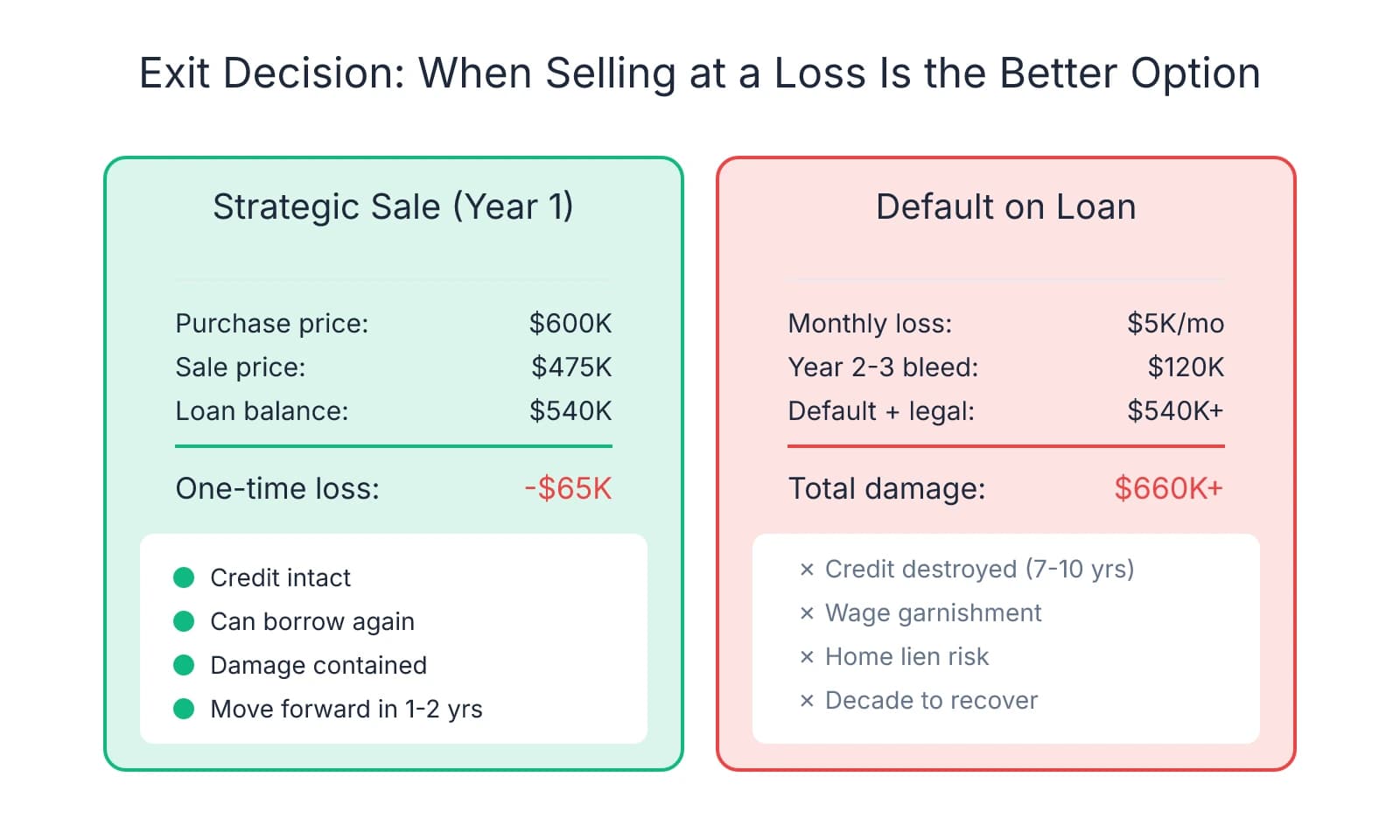
Where buyers get trapped: staying too long in a fundamentally broken acquisition because walking away feels like failure. The practice loses another $50,000 in year two. Then $75,000 in year three. By the time you're ready to exit, you've compounded the loss and depleted the savings you'll need to recover.
Selling at a Loss: The Financial Reality of Early Exit
If you're selling within 12-24 months of purchase, expect to take a loss. Revenue decline under new ownership, visible operational problems, and lack of performance track record under your management all compress what buyers are willing to pay. A practice you bought for $600,000 might realistically sell for $450,000-500,000 if collections have dropped 20% and patient attrition is visible.
The math is straightforward but painful. If you financed 90% of the purchase price, you owe roughly $540,000 on a practice now worth $475,000. Selling means writing a check for $65,000 to cover the gap between sale price and loan balance—plus broker fees, legal costs, and outstanding payables.
What makes this harder: many buyers don't have $65,000 in liquid reserves after spending their savings on the down payment and working capital. The temptation is to delay the sale, hoping production will recover enough to close the valuation gap. But if the practice's problems are structural, waiting just increases the loss.
One decision framework: calculate your monthly cash burn rate. If the practice is losing $4,000-6,000 per month and you're subsidizing operations from personal savings, multiply that by 12-18 months. If staying costs you $60,000-90,000 in additional losses over the next year, selling at a $65,000 loss today is the better financial outcome—even though it feels worse emotionally.
Positioning the Practice Honestly: Turnaround Opportunity, Not Deception
When you're ready to sell, work with a broker who can position the practice honestly as a turnaround opportunity. Buyers will discover operational issues during due diligence, and attempting to conceal them kills deals and wastes months of listing time.
The positioning that works: frame the practice as underperforming due to transition challenges that a more experienced operator or better-capitalized buyer could solve. If collections dropped because you couldn't perform the procedures the patient base expected, that's a solvable problem for a buyer with those clinical skills.
Consider offering seller financing or price reductions to move the deal. If you're selling for $475,000 and the buyer can only secure $400,000 in bank financing due to the practice's recent performance, consider holding a $50,000 note at favorable terms—5-7 years, interest-only for the first 12 months. This gets the deal done, gives you partial liquidity now, and spreads the remaining proceeds over time.
Transparency builds trust with the next buyer and shortens time to sale. Practices listed with honest disclosure of challenges typically sell within 6-9 months. Practices where sellers try to hide problems often sit on the market for 12-18 months, then sell at even steeper discounts.
The Personal Guarantee Reality: Why Default Is Almost Never the Answer
Walking away from the practice and defaulting on the loan might feel like the simplest exit, but personal guarantee enforcement makes this the most financially destructive option. When you signed the loan documents, you personally guaranteed repayment—which means the lender can pursue your home equity, retirement accounts, savings, and future wages if you stop making payments.
The enforcement process is predictable and brutal. The lender accelerates the loan, demanding full repayment immediately. When you can't pay, they file a lawsuit and obtain a judgment. That judgment allows them to place liens on your home, garnish your wages, and freeze bank accounts. Your credit score drops 200+ points, making it nearly impossible to secure financing for another practice, a home, or even a car for the next 7-10 years.
The least-bad option when the practice is unsustainable: sell strategically at a loss, take the financial hit now, and preserve your credit and future borrowing capacity. A $65,000 loss today is painful. A defaulted loan, ruined credit, and wage garnishment for the next decade is catastrophic.
The Emotional Toll of Exit—and Why It's Still the Right Decision
Admitting the purchase was a mistake is emotionally devastating. You told your family, friends, and former colleagues that you were buying a practice. Walking away feels like public failure.
But staying in a practice that's destroying your financial health and mental well-being for years is worse. The stress of unsustainable debt, the shame of declining production, the isolation of struggling alone—these compound over time and erode your ability to recover.
One perspective that helps: framing exit as a strategic business decision rather than personal failure. Businesses fail. Acquisitions don't work out. The buyers who recover fastest are the ones who recognize the situation clearly, execute the exit decisively, and move forward without letting the experience define their entire career.
If you're six months into ownership and the practice is fundamentally broken, start exit planning now. Talk to a broker. Run the numbers on what a sale would net after paying off the loan. Calculate how much longer you can subsidize losses from personal savings. Make the decision based on financial reality, not emotional attachment to the idea of ownership.
The goal isn't to avoid failure—it's to minimize the damage so you can rebuild. Selling at a loss in year one is painful. Defaulting on the loan and spending the next decade recovering from financial ruin is worse.
Sources & References
The data and claims in this article are drawn from the following sources. We prioritize government data, peer-reviewed research, and established industry publications to ensure accuracy.
- 3 Big Mistakes New Buyers Make When Evaluating a Dental Practice— practicecfo.comIndustry
- The Dental Practice Life Cycle: Navigating the Purchase and Early ...— www.jrcpa.comIndustry
- [PDF] Practice Ownership Trends in Dentistry A New Look at Old Data— ada.orgIndustry
- New Dental Practice Owner? Master Your First 90 Days Of Cash Flow— www.dentpulse.comIndustry
- How to Turnaround a Practice - Dentistry Today— www.dentistrytoday.comIndustry
- Best Time to Sell a Dental Practice: Market Timing and Personal ...— www.usdentalpractices.comIndustry
Frequently Asked Questions
Ready to Turn Your Practice Around?
If you're struggling in your first year of practice ownership, you don't have to navigate it alone. Minty Plus provides hands-on guidance and post-close support to help you stabilize operations and build the thriving practice you envisioned.