Tax Deductions in Your First Year Owning a Dental Practice

Co-Founder, Minty Dental

In Summary
- First-year practice owners typically claim $150,000–$250,000 in deductions depending on purchase price and asset allocation, reducing tax liability by $50,000–$100,000 or more
- Five major deduction categories drive this benefit: equipment depreciation (Section 179), goodwill amortization, loan interest, startup costs, and retirement contributions
- Tax planning must happen during acquisition—the asset allocation negotiated in your purchase agreement determines which deductions you can claim
- A $600,000 practice purchase with proper structuring can generate roughly $200,000 in year-one deductions when equipment, accounts receivable, goodwill, and interest are allocated correctly
- These deductions reduce taxable income, not practice revenue—the cash flow advantage comes from lower tax payments when you need capital most
The First-Year Tax Advantage Most Buyers Miss
Most buyers treat the purchase agreement as a legal formality and save tax planning for their accountant after closing. That sequence costs them tens of thousands of dollars. The asset allocation you negotiate during acquisition—how the purchase price splits between equipment, goodwill, accounts receivable, and other components—determines the deductions available in year one. Get the allocation right, and a $600,000 practice purchase can generate $200,000 in first-year deductions. Miss it, and you leave money on the table that you can't recover later.
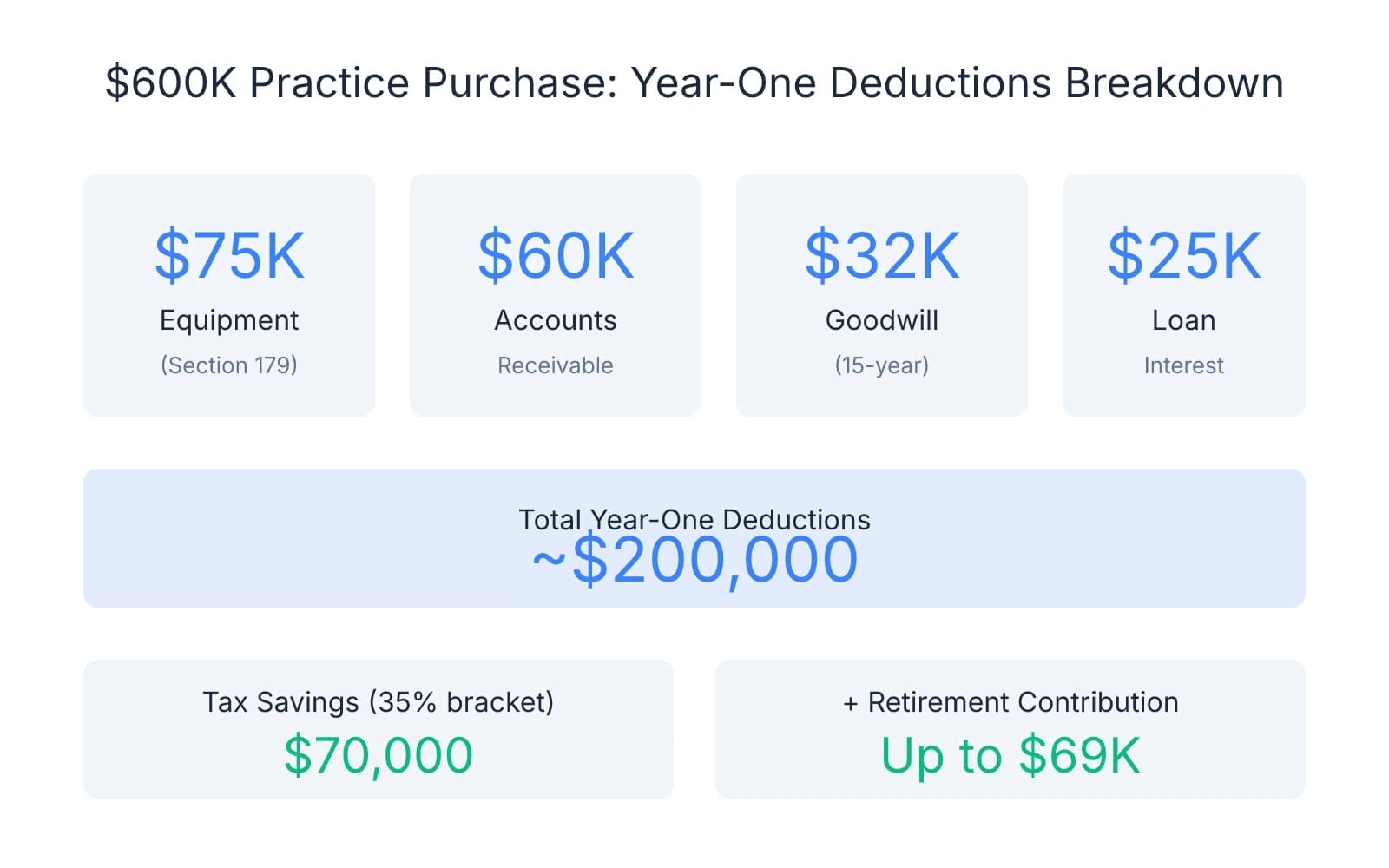
Five categories drive this benefit: equipment (Section 179), goodwill amortization, loan interest, startup costs, and retirement contributions. Each follows different IRS rules, but together they create substantial cash flow advantage during the transition period when revenue may be uncertain and working capital is tight.
Equipment depreciation (Section 179): If your purchase agreement allocates $75,000 to equipment—chairs, imaging systems, handpieces—you can deduct the full amount in year one rather than spreading it over five or seven years. In the 35% tax bracket, that's $26,250 in tax savings. The allocation must reflect fair market value. Overstate equipment value to inflate the deduction, and you risk an audit. Understate it, and you lose deductions you're entitled to claim.
Accounts receivable: When you acquire A/R at a discount—say, $60,000 in face value purchased for $50,000—the IRS allows you to deduct the $60,000 as you write off uncollected balances. This typically happens in the first 12–18 months as older accounts age out. The $60,000 deduction in the 35% bracket saves $21,000 in taxes.
Loan interest: The interest portion of your acquisition loan is fully deductible. On a $600,000 loan at 7%, first-year interest runs around $25,000, generating $8,750 in tax savings. This deduction continues annually as long as the loan is outstanding, but it's largest in year one when the principal balance is highest.
Goodwill amortization: The portion of the purchase price allocated to goodwill—typically the largest component—amortizes over 15 years under Section 197. A $450,000 goodwill allocation generates $30,000 in annual deductions, or $10,500 in tax savings at the 35% rate. While this benefit extends across 15 years, it starts immediately and compounds with the other deductions.
Retirement contributions: As a practice owner, you can contribute up to $66,000 annually to a SEP-IRA or solo 401(k) (2024 limits), deducting the full amount. Many buyers overlook this in year one, assuming they need to stabilize revenue first. But the deduction is available whether you contribute in month two or month eleven—and the tax benefit is immediate.
These aren't aggressive strategies or loopholes. They're IRS-sanctioned provisions designed to support business ownership. But they require proper documentation and allocation during the deal. The purchase agreement should specify dollar amounts for each asset category, and those amounts should tie to the valuation report. If your agreement lists a lump-sum purchase price without allocation, you lose control over how deductions are claimed.
The cash flow advantage matters most in year one. Lower tax payments free up capital for working expenses, equipment upgrades, or loan principal reduction during the period when you're learning the practice and revenue may dip as patients adjust to the transition. A $70,000 reduction in tax liability—the result of $200,000 in deductions at the 35% rate—can cover three months of overhead or fund the associate you need to maintain production during the learning curve.
Equipment and Asset Deductions: Section 179 and Bonus Depreciation
The equipment allocation in your purchase agreement determines your largest first-year deduction. Section 179 allows dental practices to expense up to $2.5 million in qualifying equipment for 2026, meaning you deduct the full cost in year one rather than depreciating it over five to seven years. Bonus depreciation—restored to 100% under recent legislation—works alongside Section 179, letting you immediately write off qualifying assets that exceed the Section 179 limit or create tax losses that offset other income.
Section 179 is limited by taxable business income—if your practice generates $80,000 in taxable income, you can't deduct more than $80,000 under Section 179. Bonus depreciation has no income limitation and can create losses that reduce tax liability from W-2 income, investment gains, or other sources. For buyers with income outside the practice, bonus depreciation becomes the more valuable tool.
What qualifies as equipment? Dental chairs, imaging systems, X-ray units, computers, practice management software, sterilization equipment, and even used equipment acquired in the purchase. The IRS doesn't distinguish between new and used assets—what matters is that the equipment is new to your business and placed in service by December 31. "Placed in service" means installed and operational, not just delivered. If you purchase a CBCT scanner in November but installation doesn't finish until January, the deduction moves to the following year.
This timing becomes critical for Q4 closings. Many buyers close in December and assume equipment deductions automatically apply to the current tax year. They don't—unless the equipment is functional before year-end. One pattern that creates problems is purchasing a practice in December with equipment still under warranty or service contracts that delay installation. The buyer pays for the equipment in year one but can't claim the deduction until year two, missing the cash flow benefit when it's most needed.
The asset allocation negotiation determines how much of the purchase price you can assign to equipment. Buyers benefit from higher equipment allocations because they generate immediate deductions. Sellers prefer allocating more to goodwill, which receives capital gains treatment at a lower tax rate than ordinary income. A $600,000 purchase might allocate $75,000 to equipment, $50,000 to accounts receivable, and $475,000 to goodwill. Shift $25,000 from goodwill to equipment, and the buyer gains an additional $8,750 in year-one tax savings (at the 35% rate). The seller loses roughly the same amount, which is why allocation becomes a negotiation point during the deal.
The IRS expects allocations to reflect fair market value. The Dental Practice Purchase Price Allocation Calculator helps buyers model different allocation scenarios and see how equipment values affect first-year deductions. Most dental CPAs recommend obtaining an independent equipment appraisal during due diligence—it costs $1,500–$3,000 but provides defensible documentation if the IRS questions your allocation.
Work with a dental-focused CPA during purchase agreement negotiation, not after closing. The allocation language in your agreement becomes the basis for your tax return. If the agreement doesn't specify equipment values, your accountant will default to conservative estimates that may undervalue deductible assets. One approach many buyers find effective is requesting a draft allocation from the seller's accountant, then having your CPA review and propose adjustments based on fair market value.
The combination of Section 179 and bonus depreciation means a $75,000 equipment allocation can generate the full $75,000 deduction in year one—$26,250 in tax savings at the 35% rate. That's cash you keep rather than send to the IRS, available for working capital, loan payments, or equipment upgrades during the transition period.
Goodwill Amortization, Loan Interest, and Acquisition Costs
Beyond equipment, three additional deduction categories combine to create substantial year-one tax benefits: goodwill amortization, loan interest, and acquisition costs. Together they often represent $50,000–$70,000 in first-year deductions—meaningful cash flow relief during the transition period.
Goodwill amortization represents the portion of the purchase price allocated to intangible value—patient relationships, reputation, location, referral networks—after subtracting tangible assets like equipment and receivables. In most dental practice acquisitions, goodwill accounts for 60–75% of the total purchase price. A $600,000 practice with $75,000 in equipment and $50,000 in receivables leaves $475,000 allocated to goodwill.
Under Section 197, goodwill amortizes over exactly 15 years, generating equal annual deductions throughout ownership. That $475,000 allocation produces $31,667 in deductions each year ($475,000 ÷ 15). At the 35% tax rate, that's $11,083 in annual tax savings—not as dramatic as equipment expensing, but consistent and reliable. The deduction begins in the year you acquire the practice, prorated by the number of months you own it.
The allocation negotiation matters here too. Sellers prefer higher goodwill allocations because goodwill receives long-term capital gains treatment (typically 15–20% federal rate). Buyers benefit from shifting value toward equipment or receivables, which generate faster deductions. But goodwill can't be eliminated—the IRS expects it to reflect the practice's intangible value.
Loan interest creates the second-largest deduction in this category. The interest portion of your acquisition loan payments is fully deductible as a business expense. On a $600,000 loan at 7% interest, first-year interest typically runs $25,000–$30,000 depending on your payment schedule. That $25,000 deduction saves $8,750 in taxes at the 35% rate.
This deduction continues annually as long as the loan is outstanding, but it's highest in year one when the principal balance is largest. As you pay down the loan, the interest portion shrinks and the principal portion grows—meaning your annual interest deduction decreases over time.
One detail worth noting: only the interest portion is deductible, not the principal. If your monthly payment is $4,000 and $2,000 goes to interest, you deduct $2,000 per month. The principal repayment reduces your loan balance but doesn't affect your tax return.
Startup and acquisition costs cover the professional fees and due diligence expenses incurred before you open the practice under your ownership. Legal fees, accounting, valuation reports, consulting, and broker commissions all fall into this category. The IRS allows a $5,000 immediate deduction for startup costs, with any remaining costs amortized over 15 years.
If you spend $20,000 on legal and accounting fees during the acquisition, you deduct $5,000 in year one and amortize the remaining $15,000 over 15 years ($1,000 annually). That's $6,000 in first-year deductions from acquisition costs alone—$2,100 in tax savings at the 35% rate.
The distinction between startup costs and capital expenditures trips up many first-time buyers. Startup costs are expenses incurred to investigate or create the business—due diligence, legal structuring, initial consulting. Capital expenditures are purchases that add value to the practice—equipment, renovations, technology upgrades. Startup costs get the $5,000 immediate deduction plus amortization. Capital expenditures follow Section 179 or depreciation schedules.
Combine these three categories, and the numbers add up quickly. Using the $600,000 practice example:
- Goodwill amortization: $31,667 (full-year) or $15,833 (six months if mid-year closing)
- Loan interest: $25,000
- Startup costs: $6,000 ($5,000 immediate + $1,000 amortization)
That's $46,833 in additional year-one deductions if you close mid-year, or $62,667 if you close in January. At the 35% tax rate, that's $16,392 to $21,933 in tax savings—on top of the equipment and receivables deductions covered earlier.
Maximizing Year-One Deductions Through Retirement Contributions
The acquisition-specific deductions create the foundation of your year-one tax strategy, but retirement plan contributions often deliver the final $40,000–$60,000 in deductions that push total tax savings past six figures. Many first-time buyers skip them entirely in year one, assuming they need to stabilize revenue first. But the deduction is available whether you contribute in month two or month eleven—and the tax benefit is immediate.
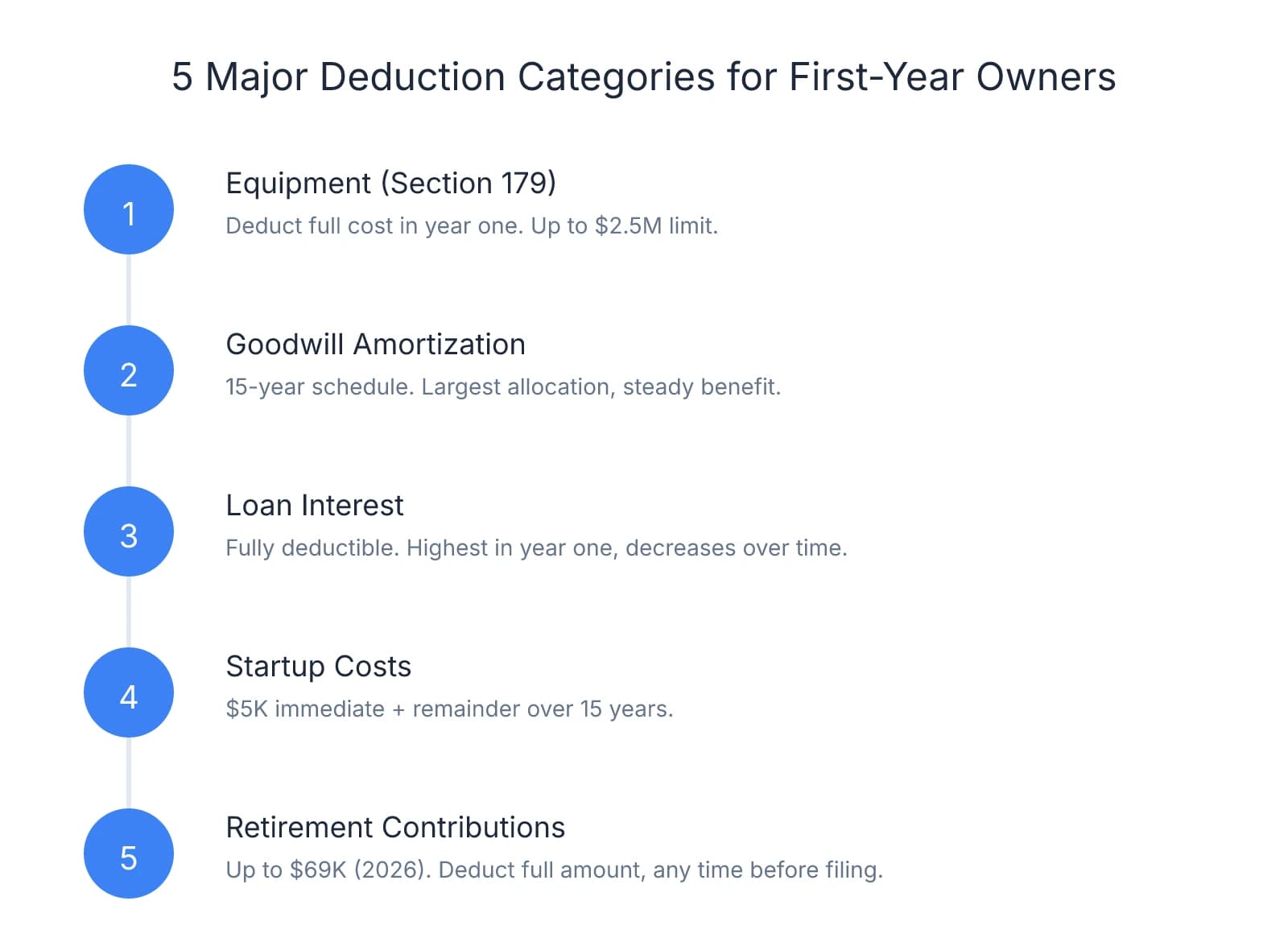
Retirement contributions represent one of the highest-value deductions available to practice owners, particularly in year one when other deductions already reduce taxable income. The three most common structures for dental practice owners are SEP-IRAs, Solo 401(k)s, and defined benefit plans.
A SEP-IRA allows contributions up to 25% of net self-employment income, with a maximum of $69,000 for 2026. If your practice generates $250,000 in net income after expenses, you can contribute $62,500 and deduct the full amount. At the 35% tax rate, that's $21,875 in tax savings. The contribution deadline is your tax filing deadline, including extensions—meaning you can wait until October 15 to finalize the contribution and still claim it for the prior tax year.
A Solo 401(k) works differently. You contribute as both employee and employer, allowing $23,000 in employee deferrals (2026 limit) plus up to 25% of compensation as profit-sharing. Total contributions can reach the same $69,000 ceiling as a SEP-IRA, but the structure offers more flexibility. Employee deferrals must be made by December 31, but profit-sharing contributions follow the same extended deadline as SEP-IRAs. One advantage: Solo 401(k)s allow Roth contributions, letting you pay tax now at potentially lower rates and withdraw tax-free in retirement.
Defined benefit plans—essentially cash balance or traditional pension plans—allow substantially higher contributions, often $150,000–$200,000+ annually depending on age and income. These plans require actuarial calculations and administrative costs that make them impractical for many first-year owners, but they become viable once the practice stabilizes and income exceeds $400,000 consistently.
Where retirement contributions become particularly valuable in year one is the interaction with other deductions. If acquisition-related deductions already reduce your taxable income to $100,000, a $60,000 retirement contribution drops it to $40,000—moving you from the 24% federal bracket to the 12% bracket on the marginal dollars. That's $7,200 in additional tax savings beyond the base deduction value.
One pattern worth noting: retirement contributions are based on net income after business expenses, not gross revenue. If your practice generates $800,000 in collections but $550,000 in expenses, your net income is $250,000—and that's the base for calculating contribution limits. This is why tracking operating expenses accurately matters for both tax planning and retirement funding.
Work with a dental CPA quarterly, not annually. Quarterly check-ins let you track deductions in real time, adjust estimated tax payments to avoid underpayment penalties, and plan year-end moves when they still matter. A November meeting might reveal that you're $15,000 short of maximizing your retirement contribution, giving you six weeks to adjust cash flow and fund the account.
The framework many buyers find useful is treating first-year deductions as a cash flow tool, not a tax minimization game. The goal isn't to eliminate all taxable income—it's to reduce tax liability enough that you preserve working capital during the transition period when revenue may dip, patient retention is uncertain, and you're learning the practice's operational rhythm. A $70,000 reduction in tax payments—the result of $200,000 in combined deductions at the 35% rate—can cover three months of overhead, fund the associate you need to maintain production, or accelerate loan principal reduction when interest rates are high.
The deductions covered in this article aren't loopholes or aggressive strategies. They're provisions designed to support business ownership, but they require proper structuring during the deal and consistent tracking throughout the year. Get the asset allocation right in your purchase agreement, document expenses as they occur, maximize retirement contributions when other deductions already reduce your rate, and work with a CPA who understands dental practice economics.
Sources & References
The data and claims in this article are drawn from the following sources. We prioritize government data, peer-reviewed research, and established industry publications to ensure accuracy.
- Five Tax Breaks This Dentist Received After Buying the Practice— jesimmons.comIndustry
- Dental Practice Acquisition Tax Implications - Dental Buyer Advocates— www.dentalbuyeradvocates.comIndustry
- Tax Deductions Every Dentist Should Know in 2026 | Duckett Ladd— duckettladd.comIndustry
- 2026 Tax Deductions for Dentists: What Changed, What Didn't, and ...— eandassociates.comIndustry
Frequently Asked Questions
Ready to maximize your practice ownership benefits?
Understanding tax deductions is just one piece of owning a successful dental practice. Minty Plus provides comprehensive guidance through your first year of ownership, helping you navigate financial decisions and practice management with expert support.