What to Say to Patients When You Buy Their Dental Practice

Co-Founder, Minty Dental

In Summary
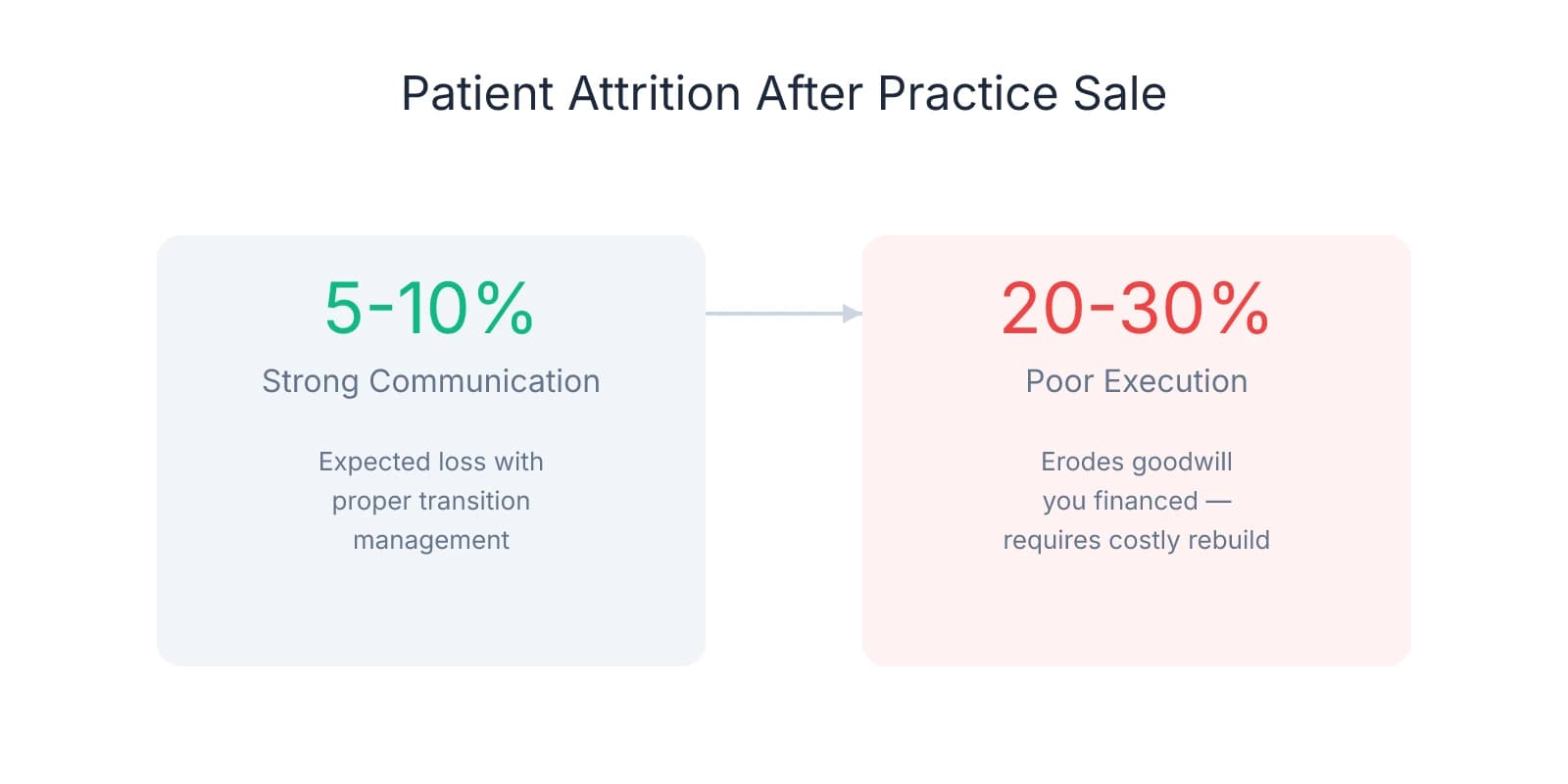
- Patient attrition after a practice sale averages 5-10% with strong communication, but poor execution can push losses to 20-30% — directly eroding the goodwill you financed
- Patients decide whether to stay within their first 2-3 appointments based on face-to-face interactions, not the transition letter
- The questions patients ask ("Are you keeping the staff?" "Do you take my insurance?") are proxies for deeper concerns about cost, continuity, and whether you'll pressure them into unnecessary treatment
- Honoring existing treatment plans and validating the previous dentist's work builds trust faster than showcasing your credentials or improvements
Patient Communication Protects the Asset You Just Paid For
When you buy a dental practice, you're purchasing goodwill — the intangible value tied to active patient relationships. That goodwill only retains value if patients continue showing up and accepting treatment under your care. Patient attrition following a practice sale averages less than 10% when managed well, but poor communication can push that to 20-30% or higher. At that level, you're eroding the asset you financed.
Most buyers focus heavily on the transition letter, but that's the seller's responsibility. Your job begins when patients walk through the door for their first appointment after closing. Patients make their stay-or-leave decision within the first 2-3 visits based on how you handle their questions, acknowledge concerns, and demonstrate continuity. The letter introduces you; the in-person interaction determines whether they trust you enough to schedule their next hygiene visit.
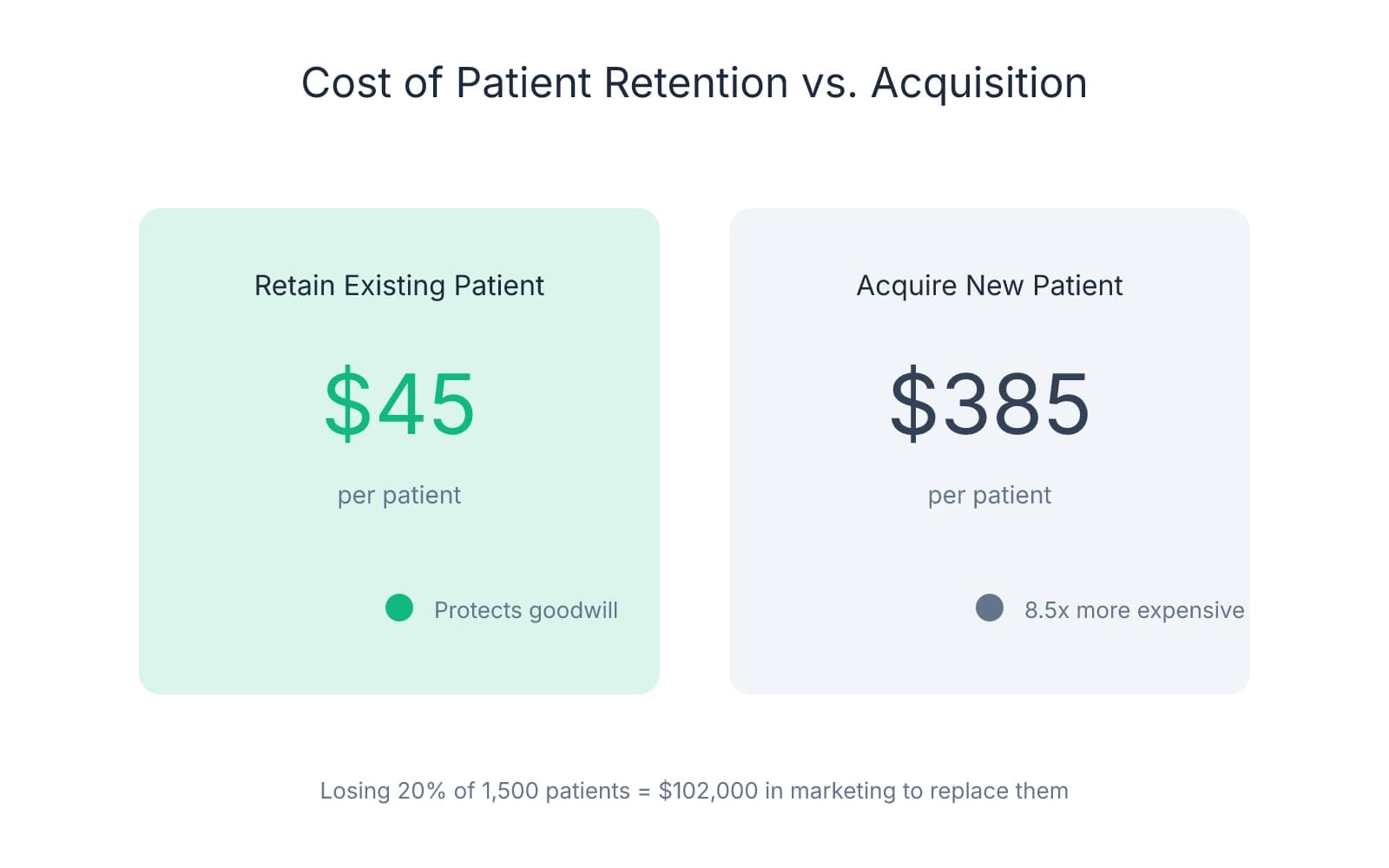
The financial stakes are significant. Acquiring a new patient costs roughly $385, while retaining an existing one costs around $45 — an 8.5x difference. If you lose 20% of a 1,500-patient practice in the first year, you're replacing 300 patients at acquisition cost. That's $102,000 in additional marketing spend to rebuild what you already paid for. Worse, new patients don't immediately generate the same production as established ones.
Where many buyers stumble is assuming the transition letter does the heavy lifting. Patients skim the letter, then show up for their next appointment with unspoken questions: Will this person rush me? Do they do the same procedures Dr. [Seller] did? Are they going to push expensive treatment I don't need? If you don't address those concerns directly in the operatory, patients leave uncertain. Uncertainty doesn't convert to loyalty.
What follows are specific language frameworks for the conversations that matter most: what to say during the first patient interaction, how to handle questions about the seller's departure, and how to position treatment continuity. These aren't scripts to memorize — they're structures to adapt based on what the patient in front of you needs to hear. How patients respond in the first 90 days determines whether the goodwill you purchased holds its value.
What Patients Actually Want to Know (And How to Answer)
Patients rarely voice their actual concerns directly. When someone asks, "Are you keeping the staff?" they're asking whether this practice will still feel familiar, whether the hygienist who knows their kids' names will still be there. When they ask about your background, they're looking for reassurance that you're competent and chose this practice intentionally. The questions patients ask are proxies for deeper fears about cost, continuity, and whether you'll pressure them into treatment they don't want.
The most common unspoken concern is whether you'll recommend expensive procedures the previous dentist never mentioned. One protection that works: honor existing treatment plans first. If Dr. [Seller] diagnosed a crown on #19 and the patient scheduled it for next month, complete that crown exactly as planned. When you follow through on what the previous dentist recommended, patients interpret that as continuity — you're picking up where Dr. [Seller] left off, not starting over with a new agenda.
If you identify something the previous dentist didn't catch — a cracked filling, early perio involvement — frame it as collaborative rather than corrective. Instead of "I noticed Dr. [Seller] missed this," try: "I'm seeing some early changes here that we should monitor. Let's keep an eye on it and talk about options at your next visit if it progresses." This acknowledges the finding without implying negligence, which patients interpret as criticism of their judgment.
The staff question signals whether the practice will still feel like the same place. Patients build relationships with front desk staff and hygienists over years — those relationships often matter more than the dentist's clinical skill. If you're keeping the team, say so directly: "Yes, [Hygienist Name] is staying, and so is the rest of the team. I'm here to support what they've been doing." If you've made changes, acknowledge them without over-explaining: "A couple of team members moved on, but [Hygienist Name] is still here, and we've brought in [New Team Member] who has [relevant experience]."
Insurance questions are almost always proxies for "Will this cost me more money?" When a patient asks, "Are you still taking [Insurance Plan]?" answer both the stated question and the underlying concern: "Yes, we're in-network with [Plan], and your benefits work exactly the same way they did before. Nothing changes on your end." If you're planning to drop a plan in six months, don't disclose that in the first appointment — it introduces uncertainty when the patient is already evaluating whether to stay.
When patients ask about your background, keep answers focused on why you chose this practice, not your credentials. "I trained at [Program], but what brought me here was the quality of care Dr. [Seller] built and the chance to serve this community long-term" lands better than a list of CE courses. Patients interpret "I chose this practice" as commitment; they interpret "I'm highly trained" as a sales pitch.
The phrase that consistently builds trust: "I'm here to continue the quality of care Dr. [Seller] provided." This positions you as a steward, not a disruptor. Patients don't want to hear that you're going to modernize the practice or improve outcomes — those statements imply the previous care was substandard. Continuity reassures patients more than promises of improvement. Save discussions of new equipment for the second or third visit, once trust is established.
Where buyers often misstep is over-answering. When a patient asks, "How long have you been practicing?" a two-sentence answer is enough. Longer responses read as nervousness. The patient isn't conducting an interview; they're calibrating whether you feel like a safe choice. Confidence shows up in brevity.
The First Appointment Framework: What to Say in the Chair
The first time you see a patient in the operatory, you have roughly 20 minutes to demonstrate continuity, competence, and respect for the relationship they had with the previous dentist. This isn't the moment to showcase your clinical philosophy — it's the moment to make the patient feel like the practice is in capable hands. The interaction breaks into three phases: the greeting, the exam, and the treatment discussion.
The greeting sets the emotional tone. When you walk into the room, lead with "I'm glad you're here" or "It's great to finally meet you" — not "I'm Dr. [Name], the new owner." Patients already know you bought the practice; opening with ownership sounds transactional. If the patient has been with the practice for years, acknowledge that: "I know you've been coming here a long time — I'm looking forward to getting to know you." Greeting patients warmly and addressing them by their first name helps put them at ease.
If the seller is still present during the transition period, use that to your advantage. "Dr. [Seller] mentioned you've been managing [specific condition] really well" shows the patient that you've been briefed, that there's continuity between what the seller knew and what you're stepping into. This works even if the seller didn't actually brief you — pulling a detail from the chart and attributing it to the seller creates the perception of a handoff, not a replacement.
During the exam, narrate what you're seeing and validate the previous dentist's work when you can. Silence during an exam makes patients anxious. Instead, talk through what you're observing: "This crown on #14 looks great, no issues there" or "Your home care is really solid — gums look healthy." When you encounter work the seller completed, acknowledge it: "Dr. [Seller] did a nice job with this restoration." This reassures the patient that their trust in the previous dentist was well-placed.
If you identify something that needs attention and it wasn't previously diagnosed, frame it as new information, not a missed diagnosis. "I'm noticing some wear on this filling that we should keep an eye on" works better than "This filling should have been replaced a while ago." The former is clinical observation; the latter implies negligence.
When you disagree with a previous treatment decision, frame it as a difference in clinical philosophy. If the seller recommended watch-and-wait on a tooth you'd restore immediately, you might say: "Dr. [Seller] noted this area in your chart and wanted to monitor it. I tend to be a bit more proactive with these situations, so I'd recommend addressing it now — but let's talk through the options." This acknowledges the previous plan without positioning the seller as wrong.
When discussing treatment, start with continuity before adding your perspective. If the seller documented a treatment plan, reference it first: "Dr. [Seller] noted in your chart that we should consider a crown on #19. I agree with that assessment, and here's what I'm seeing..." This shows you've reviewed their history and you're building on the previous dentist's work. If you're recommending something the seller didn't mention, explain why it's coming up now: "This is something that's developed since your last visit" or "I'm seeing early signs of [condition] that we should address before it progresses."
Avoid promising that things will be "better now" or that you'll "take better care of them." These statements imply the previous care was inadequate. If you've upgraded equipment, mention it as an expansion of capability: "We've added [technology], which gives us a clearer view of [specific area]" is factual. "Now we can finally see what's really going on" is a criticism.
End every first appointment by opening the door for unspoken concerns. The phrase that works: "Do you have any questions about the transition or anything we discussed today?" This gives patients permission to voice concerns they didn't bring up earlier. Many patients will say "No, I'm good," but the ones who do have concerns will use this opening.
If you're buying a practice that performs procedures you don't do, address referrals proactively if the patient has a history of those services. "I saw Dr. [Seller] referred you to [Specialist] for [procedure] last year. I work with the same specialist, so if that comes up again, we'll continue that relationship."
The goal of this first appointment isn't to impress the patient — it's to make them feel like the practice is stable, the care is continuous, and their decision to stay was the right one. Patients who leave thinking This feels like the same practice, just a different dentist are the ones who schedule their next hygiene appointment before walking out.
When Patients Push Back: Handling Resistance and Building Trust Over Time
The patient who says "Dr. [Seller] never told me I needed that" isn't necessarily accusing you of lying — they're testing whether you'll get defensive or treat their concern seriously. Where many buyers stumble is responding with evidence: pulling up radiographs, citing clinical guidelines, or explaining why the previous dentist might have missed it. That positions you as right and the patient as wrong, which doesn't build trust. A framework that works better: "Let me pull up your chart and we can look at this together. I want to make sure we're on the same page about what's going on." This shifts the dynamic from confrontation to collaboration.
Some patients will test you by asking questions they already know the answer to. This happens most often with long-time patients who want to see if you've actually reviewed their history. When someone asks "What did Dr. [Seller] say about my gum recession?" and you can see the answer documented in the chart, they're checking whether you did your homework. "Dr. [Seller] noted that we've been monitoring it and it's been stable. That's still what I'm seeing today" shows you know their history without sounding like you're reciting from the chart to impress them.
When a patient directly says they're thinking of leaving, the instinct is to convince them to stay. That rarely works. What tends to shift the conversation: "What would make you feel comfortable staying?" This signals that you're not going to pressure them, which lowers their defensiveness. It also surfaces the actual concern, which is often something specific and addressable: they're worried about cost, they want to see the same hygienist, they're anxious about a procedure. Once you know what they need, you can either provide it or acknowledge honestly that you can't — both responses build more trust than a generic sales pitch.
The patients who leave in the first 90 days are usually the seller's close friends or family members who came because of the personal relationship, not the clinical care. This is expected attrition. Most practices lose 5-10% of patients after a sale, and a disproportionate share comes from this subset. You can't retain patients whose primary loyalty was to the person, not the practice. Where buyers waste energy is trying to win over patients who were never going to stay — the seller's college roommate, the neighbor who got a friends-and-family discount. Let these patients go gracefully. If someone says "I think I'm going to find a dentist closer to home," respond with "I understand — I appreciate you letting me know" rather than trying to talk them out of it.
The patients worth investing extra effort in are the ones who seem hesitant but haven't committed to leaving. These are the patients who cancel and reschedule their next hygiene appointment twice, who accept your treatment recommendation but don't schedule it, who ask questions but don't seem fully satisfied with the answers. Track which patients fall into this category and make a point to check in with them personally after their second or third visit. A phone call or handwritten note that says "I wanted to follow up after your last appointment and make sure you felt good about the treatment plan we discussed" often tips the decision to stay.
Where resistance becomes a long-term pattern — the patient who questions every diagnosis, compares every recommendation unfavorably to what Dr. [Seller] would have done, or repeatedly expresses dissatisfaction despite your efforts — you're facing a relationship that may not be salvageable. Some patients need 2-3 visits to feel comfortable. But if someone is still actively resistant after six months, continuing to invest energy in winning them over usually costs more than it returns. The patients who stay are the ones who decide in the first 90 days that the practice still meets their needs.
What you say to patients in these first 90 days doesn't just determine whether they schedule their next hygiene visit — it sets the tone for the next decade of the patient relationship. The patient who feels heard when they express concern about a new diagnosis becomes the patient who accepts your treatment recommendations three years from now. The patient who sees you handle a disagreement with curiosity rather than defensiveness becomes the patient who refers their family. The communication work you do now compounds over time, but only if you're willing to treat resistance as information rather than opposition.
Sources & References
The data and claims in this article are drawn from the following sources. We prioritize government data, peer-reviewed research, and established industry publications to ensure accuracy.
- Patient Retention Following a Dental Practice Sale— dentaltransitions.comIndustry
- 29 Dental Patient Attrition Statistics Every Practice Should Know— clerri.comIndustry
- How to Write a Great Transition Letter - Dental Buyer Advocates— www.dentalbuyeradvocates.comIndustry
- Scripting the Patient Welcome | Dental Care— www.dentalcare.com
Frequently Asked Questions
Ready to acquire your first dental practice?
Buying a dental practice involves more than just the transaction—it requires strategic patient communication and seamless transition planning. Minty Plus provides hands-on guidance through every step of acquisition and post-close management to help you retain patients and build your new practice.