When Should You Walk Away From Buying a Dental Practice?

Co-Founder, Minty Dental

The Question Behind the Question: Can This Practice Actually Support You?
In Summary:
- Walk away when the numbers require optimism to work.
- Walk away when overhead consistently exceeds 70% with no clear path to improvement.
- Walk away when revenue has declined for three consecutive years without a credible explanation.
- And walk when your concerns reveal financial risks you've been minimizing because you're eager to own.
Most buyers frame the decision around whether they can afford the practice — whether they qualify for financing, whether the down payment fits their savings, whether the monthly payment feels manageable. But experienced buyers who've transitioned from associate to owner ask a different question: Can this practice afford me? Can it generate enough profit to cover debt service, replace my associate income, absorb the inevitable surprises, and still leave room for growth?
That gap between "Can I buy this?" and "Can this support me?" is where most deals should die — but don't. Buyers push forward because they've already invested emotional energy, because the broker says it's a great opportunity, because they're tired of waiting. The result is predictable: they close on a practice that looked viable on paper but can't sustain them in reality.
Walking away feels like failure when you're eager to own. You've spent weeks reviewing financials, touring the office, imagining yourself as the owner. But buyers who successfully transition to ownership typically evaluate dozens of practices before finding the right one. The ability to close the folder and move on — without second-guessing, without lingering regret — separates confident buyers from those who end up trapped in a practice that can't sustain them.
Financial Red Flags That Should End the Conversation
Pull three years of profit and loss statements and calculate overhead as a percentage of collections for each year. If the number consistently sits above 70%, pause there. A practice collecting $1M with $750K in expenses leaves $250K before debt service — which sounds reasonable until you subtract your loan payment, taxes, and the reality that you'll need working capital for the first six months. Many buyers who successfully transition from associate roles report that overhead above 70% means you're working for the practice, not building equity in it.
This pattern becomes a walk-away signal when the seller can't explain why overhead is elevated or insists "that's just how dental practices run now." Well-managed practices typically operate between 60-65% overhead. When you see 72-78%, you're looking at either bloated staffing, excessive PPO participation, or operational inefficiency that the current owner hasn't addressed — and likely won't before closing.
One calculation worth running immediately: divide total collections by total adjustments. If the collection rate falls below 60%, the practice is writing off so much production that even high patient volume produces weak profit. This often correlates with excessive PPO participation or fee schedules set so low that you're losing money on procedures before you even start. A practice collecting $800K but adjusting $500K off the books is fundamentally different from one collecting $800K with $200K in adjustments — even though the headline number looks identical.
Revenue trends tell you whether the practice is stabilizing or deteriorating. Pull monthly collections for the past three years and look for patterns. Declining collections over 24-36 months without a clear, fixable explanation should end the conversation. If the current owner — who knows the patients, staff, referral sources, and local market — can't stabilize revenue, assuming you'll reverse that trend is optimistic at best.
Some buyers rationalize declining revenue by pointing to external factors: "The area is changing," "Insurance reimbursements dropped," "A competitor opened nearby." Those explanations might be accurate, but they don't change the outcome. You're still buying a practice that's losing momentum, and you'll inherit the same headwinds the seller couldn't navigate.
Financial records that are incomplete, inconsistent, or require extensive explanation signal either disorganization or intentional obfuscation. When a seller provides three years of tax returns but can't produce monthly P&Ls, or when the numbers shift significantly between what the broker presented and what due diligence reveals, you're looking at a practice that will cost you post-acquisition. Messy bookkeeping isn't just inconvenient — it indicates systems that don't exist, expenses you can't track, and financial surprises you'll discover after closing.
Asking prices above 80% of collections require extraordinary justification. A practice collecting $1M annually should not be priced at $850K unless there's a compelling reason: brand-new equipment, a patient base with minimal PPO penetration, or a location with significant competitive advantage. What tends to happen instead is emotional pricing — the seller values their legacy, their years of effort, or "what the practice used to produce" rather than what it generates today. When you see a price that doesn't align with industry norms, the negotiation that follows is often difficult, the transition expectations unrealistic, and the deal structure unfavorable.
One pattern many buyers miss until it's too late: owner production that's unsustainable. If the seller works five or six days per week, performs procedures you can't replicate, or generates revenue through volume you won't maintain, the practice's collections will drop the day you take over. Calculate what percentage of total production comes directly from the owner's clinical work. If it's above 70%, you're not buying a practice — you're buying a job that requires you to match their output immediately or watch revenue collapse.
If you find yourself explaining to your spouse, your accountant, or your broker why the numbers "might" work with the right adjustments, they don't. The deals that close successfully are the ones where the financials are obvious, the risks are manageable, and the path to profitability is clear.
What Practice Owners Actually Take Home (And Why It Matters)
A practice collecting $1M doesn't mean you'll make $1M. It doesn't even mean you'll make half that. The average dental practice operates with a 38% profit margin, which means that $1M practice yields roughly $380K before owner compensation and debt service. That's the number most buyers fixate on — but it's not what you take home.
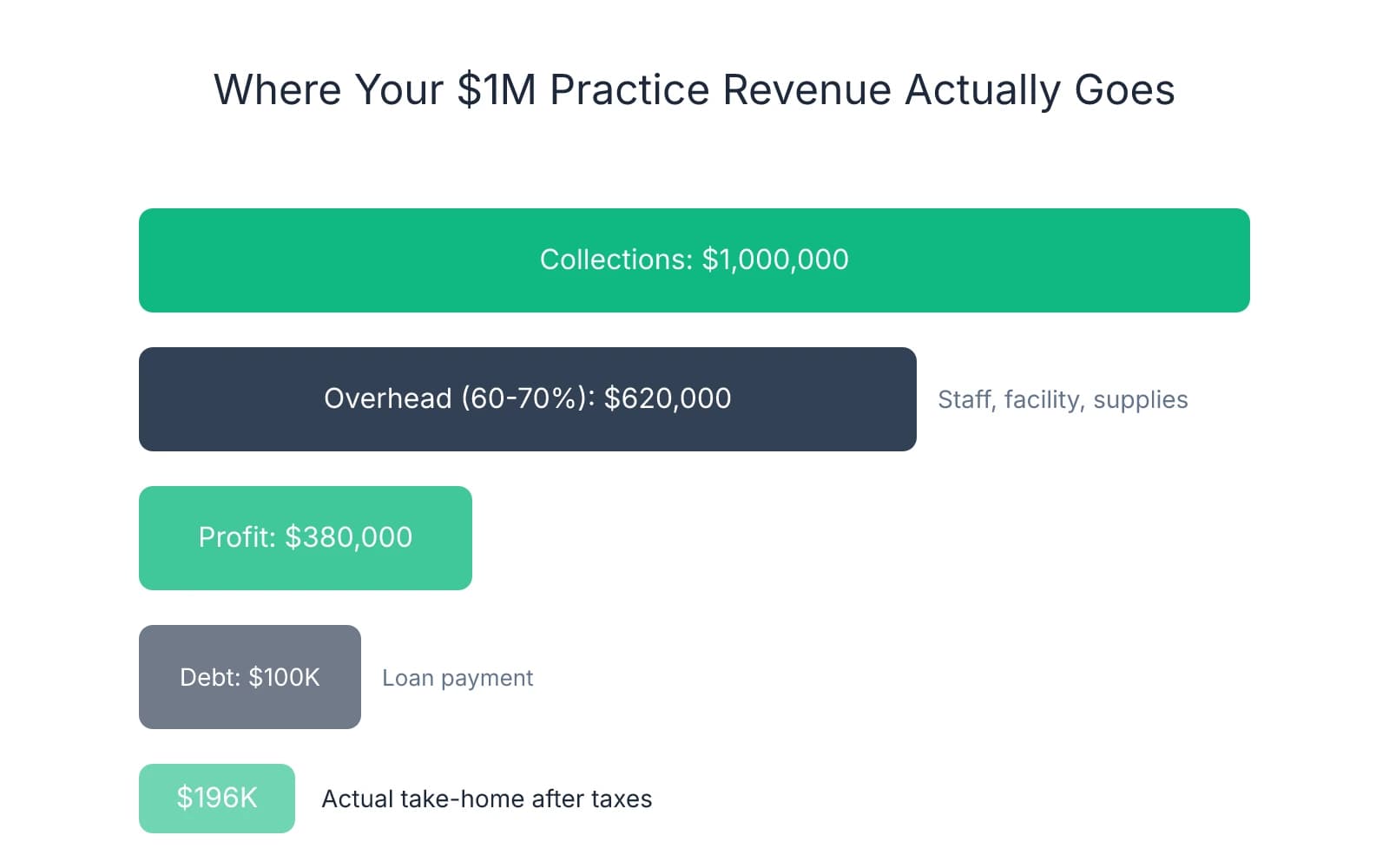
Start by mapping where the money goes. Staff salaries typically consume 20-25% of collections. Facility costs take another 5-8%. Lab fees and supplies add 5-8%. Then come utilities, insurance, marketing, equipment maintenance, software subscriptions, and the dozens of smaller expenses that compound quickly. In a well-managed practice, total overhead sits around 60-65%. In practices with bloated costs or excessive PPO participation, overhead climbs to 70-75%, leaving far less margin for error.
Now subtract debt service. A typical acquisition loan on a $750K purchase — financed at 80% with a 7% interest rate over 10 years — costs roughly $100K annually in the first few years. That $380K profit margin just became $280K. Then subtract taxes, which vary by entity structure but often take another 25-30%. You're now looking at $196K-$210K in actual take-home income — before accounting for reinvestment needs, equipment repairs, or the inevitable surprises that surface in year one.
This gap between "what the practice makes" and "what you take home" is where most buyer anxiety lives. It's also where spouse concerns become most acute. When your partner hears "$1M practice," they're imagining a lifestyle that number doesn't support. When they see the loan payment, the tax bill, and the reality that you'll be working more hours for potentially less take-home than you earned as an associate — at least initially — their hesitation isn't irrational. It's pattern recognition.
One factor many buyers underestimate is first-year income volatility. Patient attrition during ownership transitions typically runs 10-20%, even in smooth handoffs. You'll face a learning curve with systems, staff dynamics, and clinical workflows that differ from your associate experience. Transition costs — whether it's updating technology, refreshing the patient experience, or covering unexpected repairs — add up quickly. A realistic planning assumption is that you'll capture 70-80% of the seller's historical profit in year one, not 100%.
Lower overhead practices offer financial cushion that high-overhead practices don't. A practice operating at 60% overhead can absorb a slow month, an unexpected equipment failure, or a key staff departure without threatening your ability to cover the loan payment. A practice running at 72% overhead requires near-perfect execution from day one — no patient attrition, no revenue dips, no surprises. That's not a business model. It's a tightrope.
Understanding these numbers isn't just about lifestyle planning. It's about knowing whether the deal leaves enough margin for family security, for the mistakes you'll inevitably make as a first-time owner, and for the reality that ownership is harder than it looks from the associate chair.
When Your Spouse's Concerns Are Worth Examining
Your spouse isn't asking difficult questions to sabotage your dream of ownership. They're surfacing risks you've been absorbing alone — and in many cases, risks you've been minimizing because you're emotionally committed to the deal. When your partner expresses anxiety about debt load, income volatility, or work-life balance during transition, that's not an obstacle to overcome. It's a second set of eyes on a decision that will affect your entire household.
The most common concerns tend to cluster around three areas: financial exposure, lifestyle disruption, and loss of stability. A typical acquisition means taking on $500K-$800K in debt — often more than your mortgage — with a repayment timeline that spans a decade. For a spouse who isn't immersed in dental practice economics, that number feels enormous. And it is. If your partner asks, "What happens if collections drop 20% in the first year?" and you don't have a clear answer, that's signal worth examining. The practices worth buying can withstand that level of scrutiny.
One framework that helps: share the actual numbers, not the optimistic projections. Walk through monthly debt service, realistic take-home pay after overhead and taxes, and what your household budget looks like if revenue underperforms in year one. If you're projecting $250K in owner compensation but the practice has only generated $280K in profit historically, your spouse will immediately see the gap. When you can't make the deal make sense in plain language — without relying on "trust me, it'll work out" — you may not fully understand the risks yourself.
Discussing worst-case scenarios feels uncomfortable, but it's where productive conversations happen. What if patient attrition hits 25% instead of 10%? What if a key associate leaves three months after you close? What if the HVAC system fails and costs $30K to replace? Buyers who successfully transition from associate to owner typically build contingency plans for these scenarios before signing — not after. Establishing walk-away criteria together gives both of you clarity: "If overhead is above 70% and the seller won't adjust the price, we pass." "If we can't maintain six months of expenses in savings after the down payment, we wait."
Work-life balance concerns are legitimate. Ownership often means longer hours in year one as you learn systems, build patient relationships, and stabilize operations. It means bringing work stress home when a key employee quits or a patient leaves a negative review. It means less predictable schedules during the transition, which affects childcare, family plans, and your ability to be present at home. If your spouse is already anxious about how ownership will change your availability, and you're dismissing that as "part of the process," you're setting up your relationship to absorb stress it may not be equipped to handle.
Family concerns should directly influence your decision when your spouse identifies financial red flags you've overlooked, when the stress of evaluating the deal is already affecting your relationship before you've even closed, or when moving forward requires your household to operate without adequate financial cushion. A partner who says, "I don't feel comfortable with only $15K in savings after the down payment" isn't being overly cautious. They're recognizing that ownership comes with unpredictable expenses, and a thin margin leaves no room for error.
The deals that close successfully are the ones where both partners feel equipped to handle the downside, not just excited about the upside. If you're asking your spouse to "just trust you" without showing them the numbers, the contingency plans, or the realistic path to stability, the risk profile may be too high — not because the practice is bad, but because you haven't done the work to make the decision together. Walking away because your family isn't aligned isn't failure. It's protecting what matters most while you find a deal that works for everyone.
Sources & References
The data and claims in this article are drawn from the following sources. We prioritize government data, peer-reviewed research, and established industry publications to ensure accuracy.
- 10 Red Flags That Scare Off Dental Practice Buyers (And How to Fix ...— www.ddspracticebroker.com
- How Much Does a Dental Practice Owner Make?— www.dentalbuyeradvocates.comIndustry
- Four Surprising Reasons Why a Dental Practice's ...— www.pkfod.com
Frequently Asked Questions
Find Your Next Practice With Confidence
Whether you're reconsidering a specific opportunity or ready to explore practices that align with your financial goals and family priorities, Minty can help you navigate the decision with real data and expert guidance.