Buying a Dental Practice with Bad Online Reviews

Co-Founder, Minty Dental

In Summary
- 86% of patients check online reviews before choosing a dentist, and 42% avoid practices rated below 3 stars—making reputation a direct driver of revenue and new patient flow
- Most negative reviews stem from seller burnout, front desk dysfunction, billing confusion, or outdated systems—issues that transfer out at closing and don't follow you into ownership
- The diagnostic question is whether problems are tied to the seller's management style or embedded in clinical outcomes—only the latter persist after transition
- A practice with bad reviews and strong financials often represents a discounted acquisition opportunity if the reputation damage is reversible under new leadership
Bad Reviews Often Signal Fixable Problems, Not Fatal Flaws
When you pull up a practice listing and see a 2.8-star Google rating, the instinct is to move on. But where many buyers see a red flag, experienced acquirers see a pricing opportunity—if they can diagnose what's actually broken.
86% of patients check online reviews before choosing a dentist, and 42% avoid practices rated below 3 stars. That makes reputation a direct driver of new patient acquisition. A practice with damaged online presence is leaving revenue on the table every month—which is exactly why sellers with review problems often price below market.
The question worth asking: is the reputation damage tied to the seller, or is it structural?
Negative reviews typically trace back to seller burnout, front desk mismanagement, billing confusion, or outdated technology. One pattern that shows up repeatedly is the solo practitioner who stopped investing in patient communication systems years ago—no appointment reminders, no follow-up, no response to online feedback. Patients leave reviews about long wait times, unanswered calls, and surprise bills. None of those problems are clinical. They're operational, and they transfer out with the seller.
What doesn't transfer: the seller's communication style, their tolerance for patient complaints, their willingness to address negative feedback. When a new owner steps in with updated systems and a responsive front desk, patient perception resets faster than most buyers expect.
Pull the last 50 reviews and categorize them:
- Operational complaints (wait times, scheduling, billing, staff responsiveness) — fixable, often disappear within 90 days of new ownership
- Clinical complaints (treatment outcomes, pain management, diagnosis accuracy) — require deeper investigation and may signal skill gaps that persist
- Interpersonal complaints (bedside manner, pressure tactics, dismissiveness) — seller-specific and vanish at closing
- Structural complaints (parking, accessibility, outdated facility) — follow you and require capital investment to resolve
If 70% of negative feedback falls into the first three categories, you're looking at a practice where reputation damage is reversible. The financials tell you what the practice is worth today under poor management. The review breakdown tells you what it could be worth in 12 months under competent ownership.
A practice with bad reviews and strong financials—consistent collections, high hygiene recare, solid case acceptance—signals that the clinical foundation is intact. The seller just stopped managing the patient experience. That's a negotiable gap, not a fatal flaw. Many buyers who understand why the seller is really exiting can use reputation damage as leverage in price discussions while planning a post-closing recovery strategy.
The risk sits in misdiagnosing the source. If reviews consistently mention failed crowns, botched extractions, or diagnostic errors, that's not a management problem—that's a clinical competency issue that won't improve because the nameplate changes. Similarly, if the practice sits in a location with poor visibility, limited parking, or demographic decline, those structural constraints don't reset with new ownership.
Where buyers get burned is treating all bad reviews as equivalent. A practice with 30 complaints about rude front desk staff and 2 complaints about clinical outcomes is a different acquisition than one with the inverse. The former is a turnaround play. The latter is a liability transfer.
How to Diagnose What's Driving the Negative Feedback
With the review landscape mapped, the next step is understanding what's actually broken. Start by reading every review posted in the last 12–24 months. Not skimming—reading. Pull them from Google, Yelp, Healthgrades, and any platform where the practice has a presence. Copy them into a spreadsheet and assign each one a primary category: front desk behavior, billing disputes, wait times, clinical outcomes, insurance handling, or facility condition.
The pattern that emerges tells you whether you're buying a management problem or inheriting a structural liability.
Front desk and scheduling complaints show up as missed calls, rude receptionists, appointment confusion, or long hold times. These are almost always tied to the seller's hiring decisions or tolerance for dysfunction. One buyer found 18 reviews mentioning "impossible to reach by phone" at a practice where the seller had kept the same front desk employee for 11 years despite chronic absenteeism. New owner, new hire, problem solved within 60 days.
Billing and insurance complaints typically reflect poor communication about treatment costs, surprise balance bills, or aggressive collections tactics. If reviews mention "hidden fees" or "charged more than quoted," that's a process breakdown—not a clinical issue. Cross-reference these complaints with the accounts receivable aging report during due diligence. If AR over 90 days sits above 15% of total receivables, the billing chaos is real, not just perception. That's fixable with better software and staff training, but it confirms the operational neglect.
Wait time and scheduling complaints often point to overbooking, poor time management, or a seller who routinely runs 45 minutes behind. If multiple reviews mention "waited an hour past my appointment time," check the schedule density in the practice management system. Some sellers pack 10-minute hygiene appointments into 8-minute slots to inflate production numbers. That's a seller habit, not a practice constraint—you can reset the schedule on day one.
Clinical complaints require a different lens. If reviews mention failed restorations, recurring pain after treatment, or diagnostic errors, that's not something new ownership fixes automatically. One red flag worth isolating: the same clinical issue appearing across multiple reviews. Three patients mentioning botched root canals in six months suggests a skill gap or case selection problem. That pattern doesn't disappear when the seller leaves—it means the practice has been accepting cases beyond its clinical capability or referring out too late.
Facility and location complaints—outdated equipment, poor parking, accessibility issues—are structural. These follow you. If five reviews mention "feels like a 1980s office" or "impossible to find parking," budget for capital improvements or accept that patient perception won't shift without investment.
The diagnostic step most buyers skip: cross-referencing review themes with patient retention data. Pull the active patient count for the last three years and calculate annual attrition. If the practice is losing 20% of its patient base annually while reviews complain about billing confusion, the two are connected. If retention sits at 85% despite bad reviews, the complaints may reflect a vocal minority rather than systemic failure.
Staff turnover tells a similar story. If the practice has cycled through four front desk employees in two years and reviews mention rude staff, the problem is likely hiring and management—not the individuals. Ask for a staff tenure report during due diligence. High turnover in non-clinical roles usually signals a seller who's checked out or created a toxic work environment. That resets with new leadership.
One step that separates thorough buyers from reactive ones: ask the seller directly about specific negative reviews during your due diligence meeting. Frame it as understanding patient perception: "I noticed several reviews mentioning long wait times in 2023. What changed in the schedule that year?" Their response reveals how they've managed patient relationships. Defensive sellers who blame patients or dismiss complaints as outliers often created the reputation damage through neglect. Transparent sellers who acknowledge operational breakdowns and explain what they tried give you confidence the issues are fixable.
The goal isn't to explain away every bad review. It's to separate complaints that reflect the seller's operational style from problems embedded in the practice's clinical capability or physical constraints. The former disappear at closing. The latter require a plan—and a price adjustment.
Negotiating Price and Protections When Reviews Are Poor
Once you've confirmed the reputation damage is fixable, the conversation shifts to deal structure. A practice with a 3.2-star Google rating and strong financials isn't necessarily overpriced—but it is if the seller hasn't accounted for the cost and time required to rebuild reputation. The sharper approach is calculating the financial impact and structuring the deal around measurable recovery milestones.
Start with patient acquisition cost. The national average sits between $150 and $300 per new patient, depending on market and marketing mix. If bad reviews suppress new patient flow by 20–30%—a conservative estimate given that 42% of patients avoid practices rated below 3 stars—that's quantifiable lost revenue. A practice that should be adding 15 new patients monthly but only brings in 10 is leaving $750–$1,500 on the table every month. Over a year, that's $9,000–$18,000. Use that number in your price negotiation—not as a precise deduction, but as evidence that the asking price doesn't reflect current market position.
One structure that aligns risk between buyer and seller is an earnout tied to reputation recovery. Instead of a flat price reduction, propose that 10–15% of the purchase price gets held back and released only when the practice achieves a minimum star rating (e.g., 4.0+ on Google) or review volume (e.g., 50+ reviews at 4.0+ average) within 12 months post-closing. This shifts some execution risk to the seller while giving you breathing room to invest in patient communication systems and staff training without carrying the full acquisition cost upfront. If you're unfamiliar with how earnouts function in dental acquisitions, the mechanics and risk allocation are worth understanding before proposing one.
Seller transition support becomes more valuable when reputation is damaged. The standard 30-day transition period may not be enough if patient trust is low. One protection many buyers overlook is requiring the seller to send a formal transition letter to all active patients—not a generic announcement, but a personalized message introducing you by name, emphasizing continuity of care, and explicitly stating that the seller supports the transition. This resets patient perception under new ownership and reduces the risk that negative sentiment toward the seller transfers to you.
Build contingencies that allow renegotiation if due diligence uncovers undisclosed issues that align with review complaints. If multiple reviews mention billing errors and your AR analysis reveals $40,000 in disputed balances the seller didn't disclose, that's a material gap. Standard contingency language should cover this, but if the LOI was signed before you saw the reviews, make sure your purchase agreement explicitly allows price adjustment or deal termination if operational problems exceed a defined threshold—e.g., AR over 90 days exceeding 20% of total receivables.
If reviews mention specific staff members negatively, address retention and transition plans before closing. You're not obligated to keep every employee, but if you plan to replace someone who appears in multiple negative reviews, structure the transition so it happens within 30 days of closing. Keeping a staff member who's been publicly criticized while trying to rebuild reputation creates friction with patients who expect change.
The goal isn't to punish the seller for reputation damage. It's to ensure the deal structure reflects the actual work required to restore patient trust and new patient flow. A practice with bad reviews and strong financials can still be a sound acquisition—but only if the price accounts for the recovery timeline and the deal terms protect you from inheriting undisclosed operational liabilities that reviews hinted at but the seller minimized.
Your 90-Day Plan to Reverse Reputation Damage
With the deal closed and keys in hand, new ownership becomes your single best opportunity to reset patient perception—but only if you act immediately. The first 90 days post-closing determine whether reputation damage becomes a lingering liability or a resolved chapter. Patients who left negative reviews under the previous owner are watching to see if anything actually changes. Prospective patients checking your listing want evidence that the problems they're reading about are behind you.
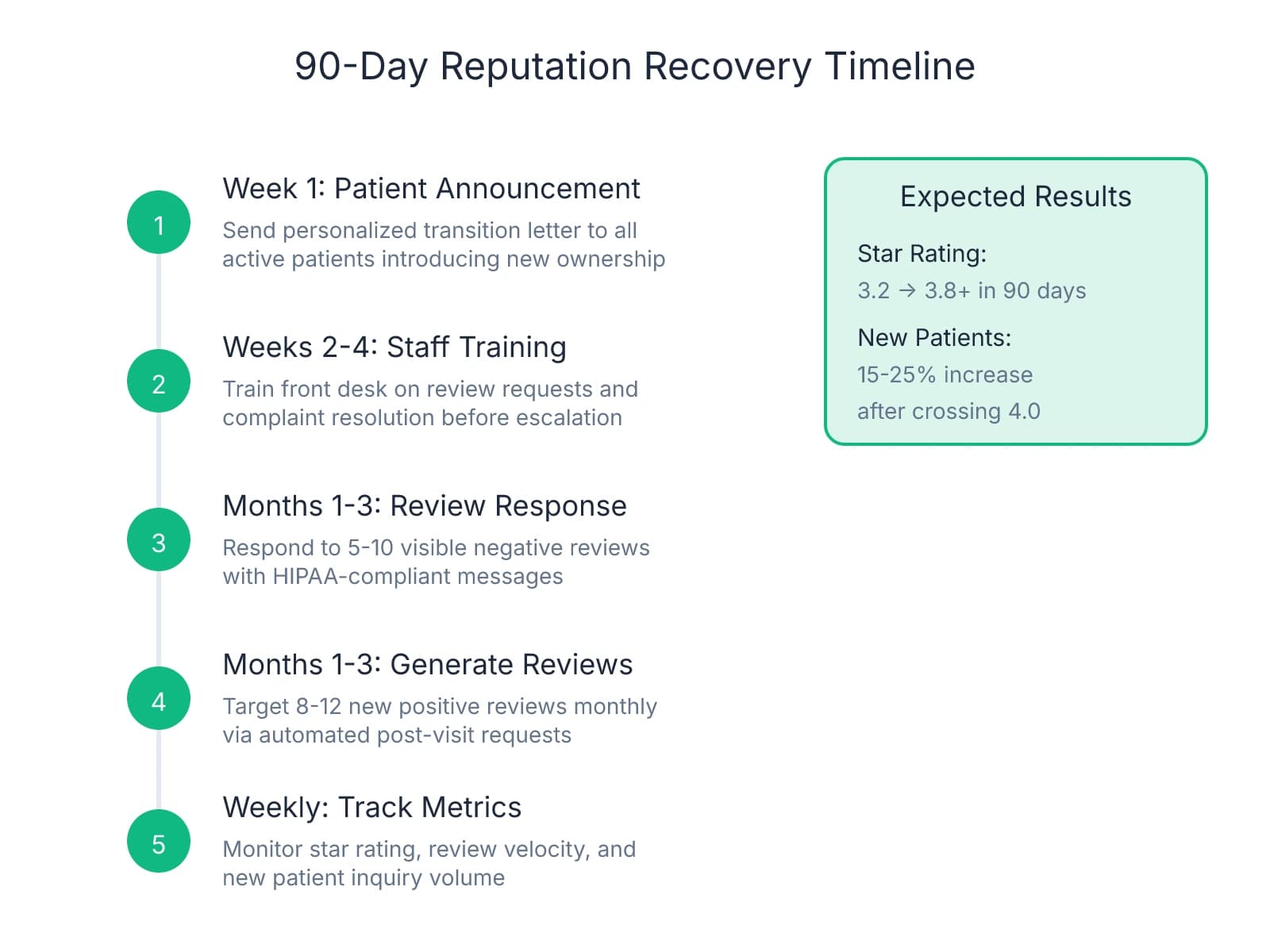
Week 1: Send a transition announcement to every active patient. This isn't a generic "under new ownership" postcard. It's a personalized letter (or email, depending on your patient communication preferences) that introduces you by name, acknowledges the transition, emphasizes continuity of care, and invites feedback. Include a direct phone number or email where patients can reach you with questions or concerns. This single action resets the narrative—patients who had negative experiences under the previous owner now see that leadership has changed, which creates psychological permission to give the practice another chance.
Weeks 2-4: Train your front desk staff on review solicitation and complaint resolution. Most negative reviews are preventable—they happen when a patient has a bad experience, voices frustration to the front desk, and gets a dismissive or defensive response. Your front desk needs two skills: how to ask satisfied patients for reviews, and how to de-escalate complaints before they migrate online. For review requests, the ask should happen immediately after a positive interaction—not days later via email. A simple script works: "I'm glad today's appointment went well. If you have a moment, a Google review really helps other patients find us." For complaints, train staff to acknowledge the issue, apologize without defensiveness, and offer a resolution path before the patient leaves.
Months 1-3: Respond to old negative reviews with a professional, HIPAA-compliant message. You can't delete reviews, but you can show prospective patients that you're engaged and responsive. 39% of dentists report being unable to respond to reviews due to HIPAA concerns, but response is possible if you avoid confirming the patient's identity or discussing treatment details. A template that works: "Thank you for sharing your feedback. We're under new ownership as of [date], and we've made changes to address the concerns you raised. If you'd like to discuss this further, please contact us directly at [phone/email]." Respond to 5-10 of the most visible negative reviews in your first 60 days—prioritize reviews that mention operational issues (wait times, billing, scheduling) rather than clinical complaints.
Months 1-3: Implement a systematic review generation process targeting satisfied patients. Volume of recent positive reviews dilutes old negative ones—both in star rating math and in how prospective patients perceive the practice. 84% of patients trust online reviews when evaluating providers, and recency matters. The process should be automated but feel personal: send a post-appointment text or email within 24 hours thanking the patient for their visit and including a direct link to your Google review page. Target patients who had routine hygiene visits, completed treatment plans without complications, or gave verbal positive feedback during checkout. Aim for 8-12 new reviews per month in your first 90 days.
Track review velocity, star rating, and new patient inquiries weekly. Reputation recovery isn't abstract—it translates directly to patient acquisition. Most practices see measurable improvement within 90 days if they execute consistently: star ratings typically climb from 3.2 to 3.8+ as new positive reviews accumulate, and new patient call volume increases by 15-25% as the practice crosses the 4.0 threshold. Monitor these metrics in your practice management system and correlate them with marketing spend and referral sources. If review velocity stalls or new patient flow doesn't improve, revisit your front desk training and review request process. The first 90 days after closing set the operational tone for the next year, and reputation recovery is one of the few areas where early action compounds quickly.
The practices that move from 3.2 stars to 4.2+ within six months share one trait: they treated reputation recovery as a system, not a campaign. They didn't wait for reviews to improve organically—they built review generation into the patient experience, trained staff to prevent complaints from escalating, and responded to old feedback to signal change. Google rewards review recency and response rate in local search rankings, which means a practice that actively manages its reputation gets more visibility than one that passively hopes for improvement. That visibility translates to new patient flow, which is the entire point of buying a practice with damaged reviews in the first place.
Sources & References
The data and claims in this article are drawn from the following sources. We prioritize government data, peer-reviewed research, and established industry publications to ensure accuracy.
- The Power of Online Reviews & How Curve Dental® Helps You ...— curvedental.comIndustry
- How Online Reviews Impact Dental Practices: The Statistics— connectthedoc.comIndustry
- the billing chaos is real— mgma.com
- What's The Average Cost Per Acquisition (CPA) For New Dental ...— incept-health.comIndustry
- the mechanics and risk allocation— dentaleconomics.com
- Protect your practice's reputation | American Dental Association— ada.orgIndustry
- Protect your practice's reputation | American Dental Association— ada.orgIndustry
Frequently Asked Questions
Ready to acquire and transform a practice?
Buying a dental practice with negative reviews requires strategic planning and post-acquisition expertise. Minty Plus provides hands-on guidance through the entire acquisition process and helps you implement reputation recovery strategies after closing.