How to Quit Your Associate Job After Buying a Dental Practice

Co-Founder, Minty Dental

In Summary
- Most associate contracts require 30-90 days written notice — review your termination clause before signing any purchase agreement to avoid timeline conflicts
- Insurance credentialing takes 60-90 days after closing, creating a revenue gap where you treat patients out-of-network while waiting for approval
- Calculate backward from your target closing date: if your contract requires 60 days notice and you want to close March 1, submit resignation by January 1
- Financing contingencies in your LOI provide 30-60 days of flexibility if closing shifts due to bank delays or lease negotiations
- Non-compete clauses may restrict same-market purchases — have an attorney review your contract before making an offer within the restricted radius
Your Contract Notice Period Determines When You Can Close
The timeline for leaving your associate position starts with your employment contract. Most associate agreements require 30 to 90 days written notice, and this window dictates when you can realistically close. Where buyers stumble is signing a purchase agreement with a fixed closing date, then discovering their contract requires notice they haven't given yet.
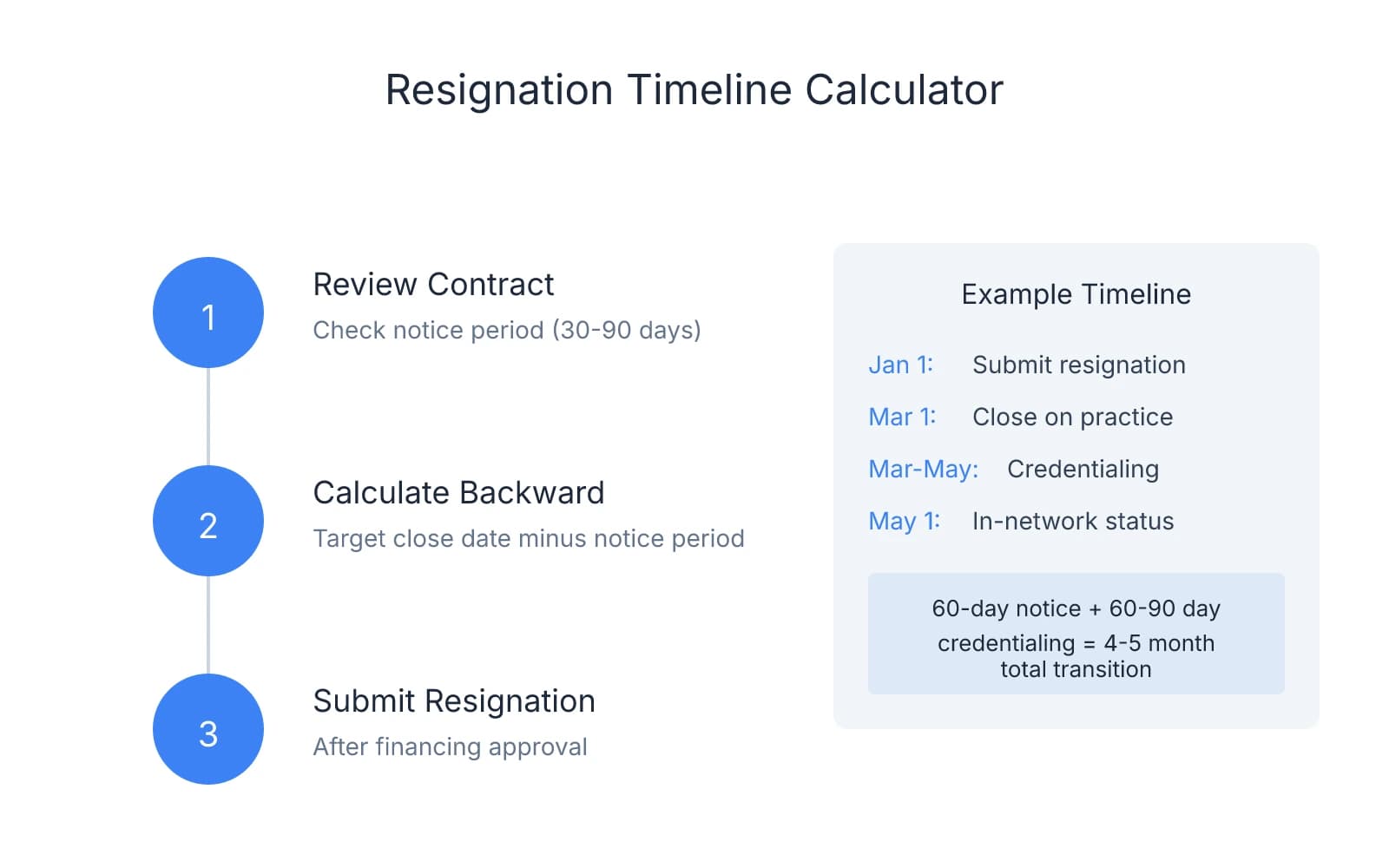
Pull your employment contract and locate the termination clause. The language typically specifies how many days notice you must provide in writing, whether notice must be delivered to a specific person, and whether the employer can waive the period. Some contracts include carve-outs for practice acquisition, but these are rare.
Calculate backward from your target closing date. If you need 60 days notice and want to close March 1, your resignation letter must be submitted by January 1. This math matters because closing timing affects everything from tax planning to seasonal patient volume, and your employment contract is the constraint that locks the timeline in place.
The complication most buyers underestimate is insurance credentialing. According to industry transition specialists, credentialing with insurance carriers takes 60 to 90 days after closing — meaning you may spend two to three months treating patients out-of-network while waiting for approval. This creates a revenue gap where you're paying overhead but collecting reduced reimbursements. Coordinating your last associate paycheck with this credentialing window protects income continuity.
One protection many buyers overlook is financing contingencies in the letter of intent. Banks occasionally delay funding due to appraisal disputes or lease negotiations. A 30- to 60-day financing contingency in your LOI gives you flexibility if the closing date shifts — without forcing you to resign prematurely. The contingency doesn't extend indefinitely, but it prevents the scenario where you've resigned, your closing falls through, and you're left without income.
The pattern that creates friction is signing a purchase agreement with a seller-driven closing date, then realizing your contract notice period doesn't align. Sellers often push for fast closings, but if your employment agreement requires 90 days notice and the seller wants to close in 60, you're either breaching your contract or renegotiating the purchase timeline. Start the resignation calculation before the LOI is signed.
How to Write Your Resignation Letter Without Burning Bridges
The resignation letter should be brief, professional, and devoid of explanation. Many associates feel compelled to justify their departure, but this opens conversations you don't need. A resignation letter is formal notification, not negotiation. State your resignation, provide your last working day, and express gratitude.
A functional template: "I am writing to formally resign from my position as Associate Dentist, effective [date]. My last working day will be [date], which provides the [X] days notice required under my employment agreement. I appreciate the opportunity to work with you and the experience I've gained." Three sentences. No mention of where you're going or why you're leaving.
Deliver the letter in person during a private meeting with the practice owner, not via email. Schedule a time when the office is quiet and frame the conversation as professional courtesy. Hand over the printed letter, state your resignation verbally, and allow space for response. According to guidance from the Michigan Dental Association, how you leave impacts your career, reputation, and future relationships — and that impact starts with how the resignation is delivered.
Timing the resignation correctly protects both income and professional relationships. Submit your letter after financing approval but early enough to meet your contract's notice requirement. Many buyers wait until the week before closing, then discover the bank needs additional documentation or the lease negotiation stalls. By that point, you've already resigned and your employer has hired a replacement. The safer sequence: financing approved → resignation submitted → credentialing initiated → closing finalized.
Frame your departure as career progression, not critique. Even if you're leaving due to scheduling conflicts or compensation disputes, the resignation conversation is not the venue for airing grievances. Thank the owner for mentorship, acknowledge the clinical experience, and position the move as the next step in your development. The dental community is small, and maintaining goodwill protects future referrals and your reputation.
If you're buying the practice where you currently work, the resignation dynamic shifts entirely — you're transitioning from employee to owner. That scenario requires a different communication strategy, as covered in guidance on buying your current practice. But if you're moving to a different location, keep the resignation letter clean, brief, and relationship-preserving.
When to Tell Staff, Patients, and Colleagues You're Leaving
The practice owner should always hear about your resignation first — not from you mentioning it to the office manager or a hygienist who overheard a phone call. Once you've delivered your resignation letter in that private meeting, the owner needs time to process the news, plan their hiring strategy, and decide how to communicate the change to the team. Jumping ahead by telling staff before the owner knows creates friction and signals disrespect for the chain of command.
After the owner has had 24 to 48 hours, they may ask you to inform key staff members directly, or they may prefer to handle those conversations themselves. In most practices, the office manager and lead hygienist hear about associate departures before the rest of the team. If the owner asks you to tell these individuals, keep the conversation factual: you're leaving on [date], you've enjoyed working with them, and you're confident the practice will continue running smoothly.
Patient communication is almost always handled by the practice, not the departing associate. The owner decides when patients are notified, what the messaging says, and whether your name appears in the announcement. What you should not do is proactively tell patients you're leaving before the owner has approved the timing and messaging. Patients who hear conflicting information may cancel appointments or request records transfers, disrupting the transition.
One risk many buyers underestimate is premature disclosure on social media or among colleagues. If you post about your practice acquisition before your closing date is final, word spreads, your current employer hears about it secondhand, and your financing hasn't even cleared. If the deal falls through, you've damaged your relationship with your current employer and potentially lost your job without securing the new practice. Wait until after closing to announce your acquisition publicly.
During the notice period, staff and patients will ask about your plans. The safest response is professionally vague: "I'm exploring a new opportunity, but I'll make sure you're taken care of before I leave." This acknowledges the question without providing details that could spread prematurely. If pressed, add: "I'll have more to share soon, but for now I'm focused on making sure the transition goes smoothly."
The sequence that protects both relationships and deal security: owner first, key staff second (with owner approval), patients only through practice-approved channels, and public announcements after closing. Anything earlier introduces risk without benefit.
If you're inheriting staff from the practice you're buying, the communication strategy shifts — you'll need to evaluate and build relationships with the team before taking over, as discussed in guidance on evaluating staff before closing. Most buyers retain existing staff because they're familiar with patients and procedures, and because changing both the dentist and the team simultaneously creates unnecessary disruption.
Managing Non-Compete Clauses and Same-Market Purchases
The concern that stops many buyers from pursuing a practice in their current market is the non-compete clause in their associate contract. These restrictions typically prohibit working at or opening a competing practice within a defined radius — often 5 to 15 miles — for one to two years after employment ends. What creates confusion is whether purchasing an existing practice falls under that restriction, and whether the clause is enforceable.
Non-compete enforceability varies significantly by state. California, for example, prohibits most employment non-competes entirely, while states like Texas and Florida routinely enforce them if the geographic scope and duration are reasonable. Before signing a purchase agreement for any practice within your current employer's restricted radius, have a dental contract attorney review your specific non-compete language. Some clauses explicitly exempt practice acquisitions. Others are written broadly enough to cover any clinical work within the radius.
One pattern worth noting is how non-competes define "competing practice." Many clauses restrict working at a practice that provides "substantially similar services" or "competes for the same patient population." If you're buying a pediatric practice and your current employer is a general practice with minimal pediatric volume, the overlap may be limited. Similarly, if the practice you're acquiring serves a different demographic, the competitive threat is less direct. These distinctions don't guarantee the non-compete won't be enforced, but they provide negotiating leverage.
Where buyers often find flexibility is negotiating a non-compete waiver or modification as part of their resignation. Some employers will release you from the restriction if you're purchasing a practice rather than joining a competitor as an associate. This negotiation works best when framed as mutual benefit — you're leaving on good terms, providing full notice, and ensuring smooth patient transition. In exchange, the employer agrees to waive or narrow the non-compete.
That negotiation only happens after you've consulted legal counsel about whether and when to disclose your acquisition plans. Telling your employer you're buying a practice within their restricted radius before reviewing your contract language can backfire. The safer sequence: attorney reviews contract → attorney advises on disclosure strategy → you approach employer with a specific request.
If your employer refuses to waive the non-compete and your attorney believes enforcement is likely, you have three options. First, walk away from the purchase and look outside the restricted radius. Second, proceed with the purchase and risk litigation. Third, delay your start date at the new practice until the non-compete period expires — purchasing the practice but hiring a temporary associate to cover clinical work until you're legally clear.
One protection many buyers overlook is indemnification language in the purchase agreement. If the seller knows you're subject to a non-compete and the deal proceeds anyway, the purchase agreement should specify who bears the legal risk if your former employer sues. In most cases, the buyer assumes that risk. This is another area where forming an LLC before making an offer can provide some legal separation, though it won't shield you from a valid non-compete claim.
The risk that creates the most long-term damage is assuming your employer won't enforce the non-compete because the relationship ended amicably. Employers enforce non-competes to protect their patient base and market position. If you're buying a practice two miles away and half your current patients live closer to your new location, your former employer has a financial incentive to enforce. The decision to enforce is usually made by the practice's attorney, not the dentist you worked alongside.
If you're weighing whether to pursue a practice within your non-compete radius, the calculation comes down to enforceability, competitive overlap, and your willingness to negotiate or litigate. An attorney can assess the first factor, market analysis can clarify the second, and your risk tolerance determines the third. What you shouldn't do is sign a purchase agreement, resign, and hope the non-compete issue resolves itself.
Sources & References
The data and claims in this article are drawn from the following sources. We prioritize government data, peer-reviewed research, and established industry publications to ensure accuracy.
- The Hidden Challenge in Dental Practice Transitions — Insurance ...— ameriprac.comIndustry
- [PDF] Best Practices for Leaving a Job: A Guide to a Smooth Transition— commons.ada.orgIndustry
- What Happens to the Staff When a Dental Practice is Sold?— roicorp.com
- prohibits most employment non-competes entirely— dir.ca.gov
Frequently Asked Questions
Ready to transition from associate to owner?
Buying your first dental practice is a major career move. Minty Plus provides hands-on guidance through the entire acquisition process and beyond, helping you navigate the transition smoothly.