Buying a Dental Practice with Mostly Medicaid Patients

Co-Founder, Minty Dental

In Summary
- Medicaid practices typically sell for 40-60% of annual collections compared to 70-85% for private-pay practices, reflecting compressed profit margins rather than seller generosity
- Reimbursement rates in most states fall below 50% of what dentists charge and 60% of private insurance rates, with dramatic state-level variation from Delaware's 78% to New Jersey's 12%
- Profitability depends on high patient volume (often 25-40 patients per day) combined with tight overhead control, not just headline collections numbers
- The lower purchase price prices in reimbursement risk, state policy volatility, and operational constraints that limit future exit options
A Medicaid-Heavy Practice Trades Lower Acquisition Cost for Tighter Margins and Higher Volume Requirements
The first pattern many buyers notice when evaluating Medicaid-heavy practices is the valuation gap. Where a private-pay practice might list at 75-80% of annual collections, a Medicaid-dominant practice typically sits at 40-60%. That spread isn't a discount — it's the market pricing in the structural economics of government reimbursement.
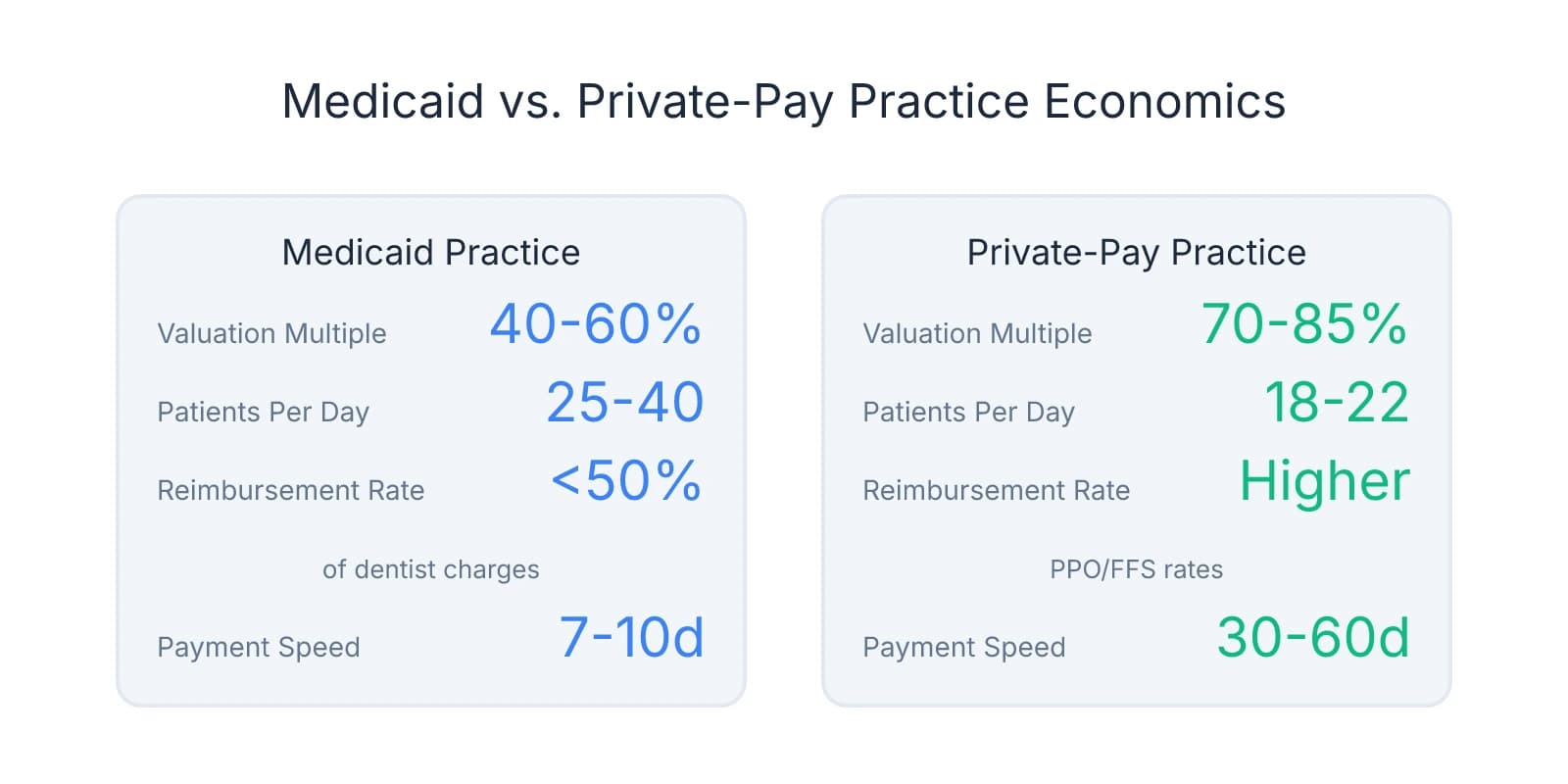
Reimbursement rates in most states fall below 50% of dentist charges and 60% of private insurance rates, per 2025 ADA data. A crown that generates $1,200 from a PPO patient might reimburse $480 from Medicaid in one state and $720 in another. Delaware reimburses at 78% of dentist charges while New Jersey sits at 12%. The same practice model that works in one state can be financially unviable 50 miles away.
The lower per-patient revenue creates a volume dependency that shapes everything about the practice. Where a private-pay practice might see 18-22 patients per day and maintain healthy margins, a Medicaid practice often needs 25-40 patients to generate comparable cash flow. That volume requirement drives staffing decisions, scheduling protocols, equipment utilization, and clinical efficiency in ways that aren't immediately visible in the P&L.
One calculation worth running early: take the practice's trailing twelve-month EBITDA, subtract your projected debt service (assume 10-year SBA terms at current rates), and see what's left for owner compensation. If the number sits below what you'd earn as an associate, the lower purchase price hasn't created value — it's just shifted where the constraint appears.
The operational model that makes a Medicaid practice profitable — high volume, low overhead, efficient systems — also makes it difficult to convert over time. Patients who selected the practice because it accepts Medicaid aren't typically candidates for fee-for-service dentistry, and the neighborhood demographics that support a Medicaid practice often don't support a private-pay model. When you eventually sell, you're likely selling to another buyer willing to operate the same model, at a similar valuation multiple.
What to Evaluate During Due Diligence: Reimbursement Mix, State Policy Risk, and Patient Conversion Potential
The first number to verify is the exact payer mix — not the seller's estimate, but the actual breakdown from the practice management system. A practice with 60% Medicaid and 40% private insurance operates under fundamentally different economics than one with 90% Medicaid.
Pull three years of production reports segmented by payer type. Look for trends: is the Medicaid percentage increasing because private patients are leaving, or stable because the practice serves a consistent demographic? Practices don't accidentally drift from 50% Medicaid to 75% — something changed in the neighborhood, the insurance landscape, or how the practice operates.
Next, verify state reimbursement rates by procedure code. Request the actual fee schedule from the state Medicaid program and compare it against the practice's most common procedures. Medicaid typically reimburses within 7-10 days, which improves cash flow predictability compared to private insurance, but only if the rates support profitability at the practice's current volume.
State policy stability matters more in Medicaid practices than almost any other variable. Review the last five years of rate changes, benefit expansions or contractions, and managed care transitions. Some states have increased reimbursement 15-20% in recent years; others have cut rates or shifted to managed care models that add administrative layers without improving payment. If your state recently transitioned from fee-for-service to managed care Medicaid, ask the seller how that affected collections timing, denial rates, and administrative workload.
Patient demographics and location determine whether you can diversify the payer mix over time. Walk the neighborhood during business hours. Check local income data and insurance coverage rates. If 15-20% of the patient base is privately insured today, you might grow that to 30-35% by targeting families whose income has increased or who've gained employer-sponsored coverage. If the entire ZIP code sits below 150% of the federal poverty line, conversion potential is limited regardless of your marketing efforts.
Review accounts receivable aging with attention to payer-specific patterns. Medicaid's faster payment cycle should show up as lower AR days — if it doesn't, that suggests claim submission issues, high denial rates, or administrative inefficiency. Compare the practice's no-show rate against the 20-30% baseline common in Medicaid populations.
Evaluate scheduling density and staff efficiency. A profitable Medicaid practice typically operates with tighter staffing ratios and higher patient throughput than private-pay practices. The volume requirement isn't optional — it's built into the economics. Before you commit, spend a full day shadowing the practice to see whether the operational model fits how you want to practice.
Can You Shift the Payer Mix After Closing, and What Does That Transition Actually Cost?
The most common assumption first-time buyers make is that they'll gradually convert a Medicaid practice to private-pay once they take ownership. What that plan underestimates is the patient attrition that comes with dropping Medicaid networks, the cash flow gap during insurance credentialing, and the capital required to reposition the practice.
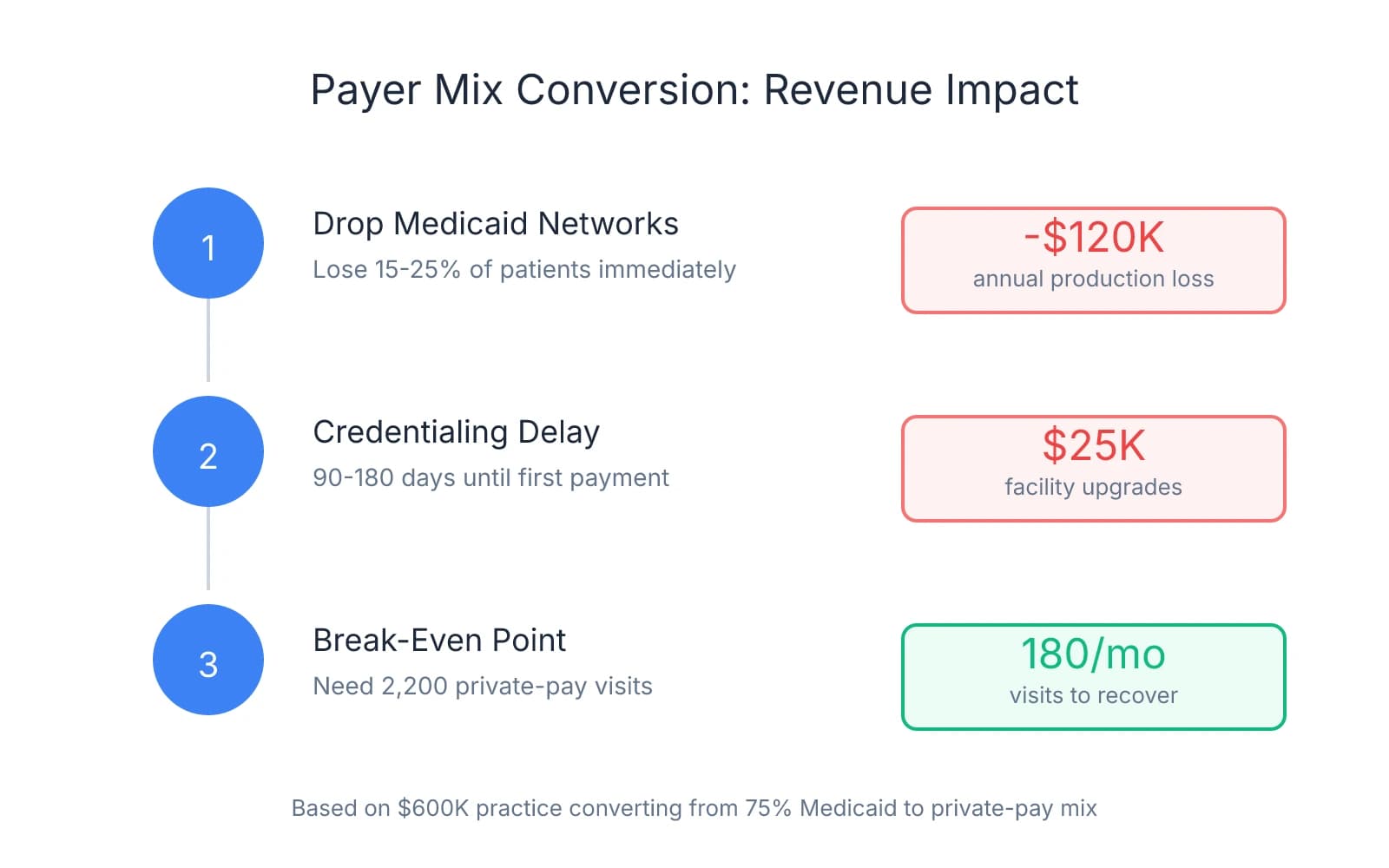
When practices leave PPO networks, they typically lose 15-25% of patients. Medicaid attrition often runs higher because patients have fewer alternative providers. If you drop Medicaid participation in an underserved area, you're eliminating access for patients who may have no other in-network dentist within 20 miles. That creates an immediate revenue drop that many buyers don't model into their first-year projections.
The timeline for credentialing with private insurance networks runs 90-180 days from application to first claim payment. During that window, you're operating with reduced patient volume from Medicaid attrition but not yet receiving private insurance reimbursements. One approach that mitigates this gap: begin credentialing applications 60-90 days before closing so you're in-network when you take ownership.
Shifting payer mix also requires marketing investment that goes beyond new signage and a website refresh. Some buyers invest $15,000-$30,000 in facility upgrades (new flooring, updated reception area, modern operatory finishes) to reposition the practice visually. That's not vanity spending; it's addressing the perception gap between a Medicaid clinic and a practice that attracts privately insured families.
The more viable path for many buyers is a hybrid model: maintain Medicaid participation while gradually growing the private-pay base. This works when the practice has capacity to add patients without extending hours, and when the location can attract both demographics. Over 18-24 months, you might shift from 75% Medicaid to 55% Medicaid without the revenue disruption of a hard network exit.
Before committing to any conversion strategy, evaluate local demographics with specificity. Pull census data for the practice's ZIP code and surrounding areas: what percentage of households have employer-sponsored insurance? What's the median household income? If private insurance penetration sits below 40% in the area, conversion isn't a matter of effort — it's a matter of market reality.
One calculation that clarifies the decision: estimate the revenue loss from Medicaid attrition, add the cost of credentialing delays and facility upgrades, and compare that total against the incremental profit from a higher private-pay mix. If you lose 20% of your patient base (roughly $120,000 in annual production in a $600,000 practice) and spend $25,000 on upgrades, you need to replace $145,000 in production before the conversion generates positive return. At an average private insurance reimbursement of $150 per visit versus $85 for Medicaid, you need approximately 2,200 additional private-pay visits to break even — or about 180 per month.
Who Should Buy a Medicaid Practice—and What Your Exit Strategy Needs to Account For
The buyers who succeed with Medicaid practices share a few common traits: they're comfortable with high patient volume, they can execute efficient systems without cutting clinical corners, and they either plan to operate long-term in an underserved market or have a realistic timeline for shifting payer mix.
Where this opportunity fits best is with buyers who want to serve communities with limited access to care. If you're drawn to public health dentistry, value the mission of treating underserved populations, and can build a sustainable practice around government reimbursement rates, a Medicaid practice aligns with both your clinical goals and your financial model.
State policy stability determines whether this is a long-term investment or a short-term gamble. In states with strong Medicaid reimbursement and a track record of rate increases, these practices can generate consistent cash flow for years. Before you commit, review the last five years of state Medicaid dental policy: rate adjustments, benefit expansions, managed care transitions. If the trend is positive, you're buying into improving fundamentals.
Exit strategy matters more in Medicaid practices than buyers typically anticipate. Individual buyers remain scarce for practices with 70%+ Medicaid — the operational model and margin structure don't appeal to most dentists who can afford to buy. What's changed in the last decade is DSO interest. Private equity-affiliated dental practices are more likely to participate in Medicaid than independent practices, and some groups specifically target access-to-care platforms in underserved markets. That creates exit liquidity that didn't exist before, but it's concentrated in specific geographies and practice sizes.
The calculation that determines whether this works is straightforward: model your debt service coverage ratio at current reimbursement rates. Take trailing twelve-month EBITDA, subtract your projected loan payment (assume 10-year SBA terms at today's rates), and see what remains for owner compensation. If that number sits below what you'd earn as an associate, the practice doesn't generate sufficient cash flow to justify the acquisition — regardless of how low the purchase price appears.
The opportunity is real, but only if you understand the constraints and can execute the operational model required. High volume, tight overhead, efficient systems, and clinical speed aren't optional — they're the foundation of profitability. If you can deliver quality care at scale, operate in a state with viable reimbursement, and either commit to long-term Medicaid participation or have a realistic conversion timeline, a Medicaid practice can be a worthwhile acquisition.
Sources & References
The data and claims in this article are drawn from the following sources. We prioritize government data, peer-reviewed research, and established industry publications to ensure accuracy.
- Average Medicaid reimbursement rate for adult dental services by ...— www.beckersdental.com
- [PDF] Tips for successfully incorporating Medicaid patients into a dental ...— mchoralhealth.orgIndustry
- Percentage Of Dentists And Dental Practices Affiliated With Private ...— www.healthaffairs.orgIndustry
Frequently Asked Questions
Ready to acquire your ideal dental practice?
Whether you're targeting Medicaid-heavy practices or seeking diverse patient demographics, finding the right practice match is crucial. Explore available dental practices nationwide or get expert guidance on acquisition strategy and post-purchase success.