Dental Practice Deal Cancelled After Letter of Intent: Your Options

Co-Founder, Minty Dental

In Summary
- Most LOI provisions—purchase price, asset lists, transition terms—are non-binding and unenforceable, but confidentiality, exclusivity (no-shop), and earnest money terms typically remain binding even after a deal collapses
- Your earnest money deposit is usually refundable if your LOI included contingencies for financing approval, due diligence findings, or lease assignment—check your document for these escape clauses
- If the seller violated exclusivity by negotiating with other buyers during your no-shop period, you may have grounds to recover due diligence costs and legal fees
- Renegotiation makes sense when problems are quantifiable (equipment needs, A/R discrepancies, minor valuation gaps), but walk away if financials were misrepresented, the lease can't transfer, or the patient base differs fundamentally from what was advertised
Most LOI Provisions Are Non-Binding, But Your Deposit and Exclusivity Terms Aren't
When a dental practice deal collapses after you've signed a letter of intent, the first question is: Am I still on the hook? The answer depends on which provisions were marked as binding—and most buyers don't realize their LOI contains both types.
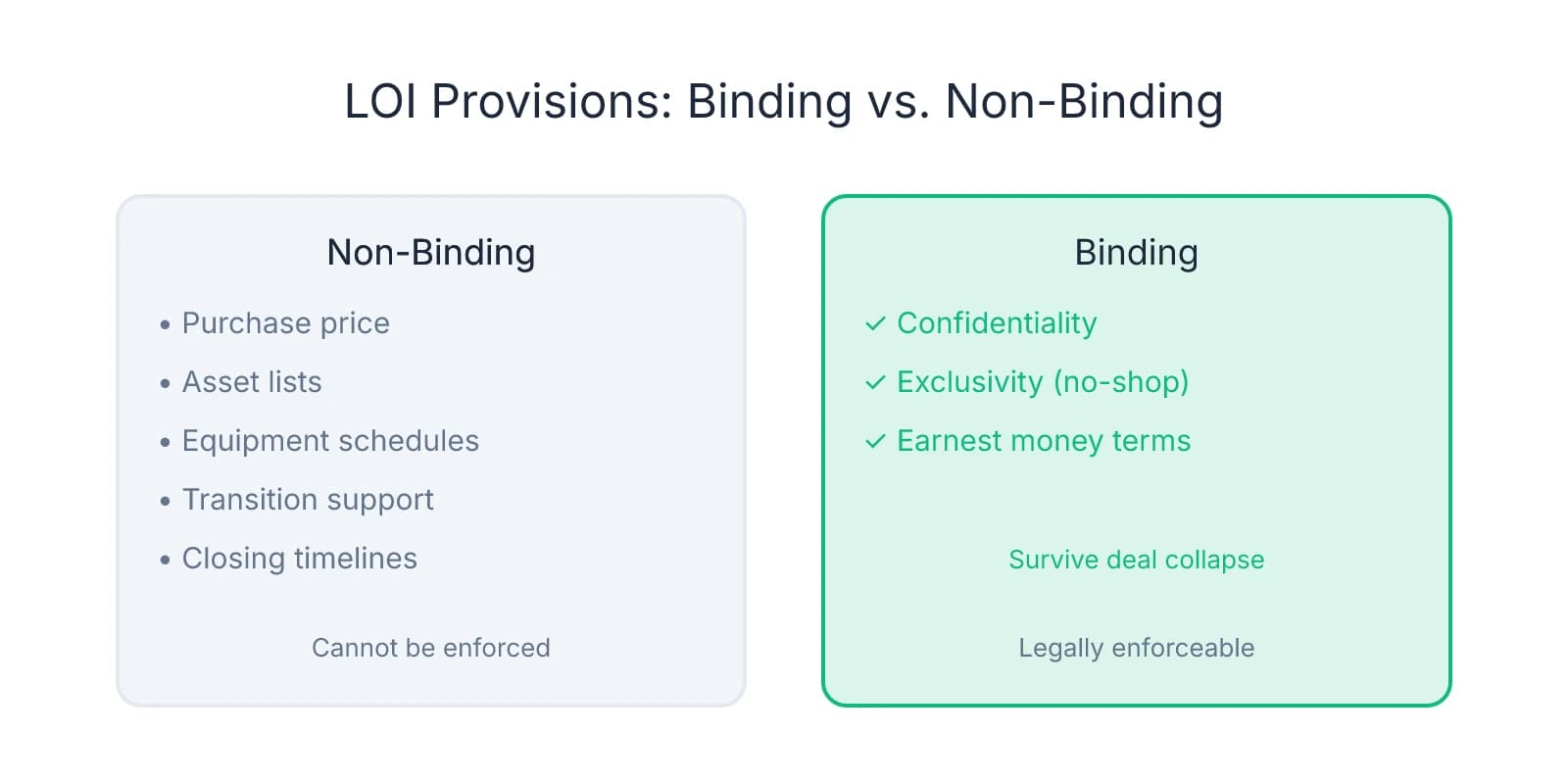
The majority of an LOI is deliberately non-binding. Purchase price, asset lists, equipment schedules, transition support, closing timelines—none create enforceable obligations. Courts treat LOIs as preliminary agreements unless parties explicitly intended to be bound by specific terms. If the seller walks away, you can't force them to sell at the agreed price. If you walk away, they can't sue you for backing out—assuming your LOI was structured correctly.
Three provisions typically are binding: confidentiality, exclusivity, and earnest money terms. These survive the deal's collapse because they protect both parties during negotiation, not just at closing.
Confidentiality binds you to keep the seller's financial records, patient data, and operational details private—even after the deal dies. Violating this can expose you to legal claims, especially if you're pursuing other practices in the same market and the seller believes you're using their information to negotiate elsewhere.
Exclusivity—the no-shop clause—prevents the seller from marketing the practice or negotiating with other buyers during the LOI period, typically 60–90 days. This provision is binding if explicitly marked as such. If the seller violated exclusivity by entertaining other offers during your window, you may have grounds to recover due diligence costs, legal fees, or other expenses. But enforcement depends on how the clause was written—vague language like "seller agrees to negotiate in good faith" won't hold up.
Earnest money deposits sit in a gray area. Whether your deposit is refundable depends on the contingencies written into the LOI. Most buyer-friendly LOIs include escape clauses tied to financing approval, due diligence findings, lease assignment, or third-party consents. If your deal fell apart because the bank denied your loan or you discovered undisclosed liabilities during due diligence, and your LOI included a financing or diligence contingency, your deposit should be refundable. If the LOI was silent on contingencies—or if you walked away for reasons outside the listed conditions—the seller may have a claim to keep it.
One pattern worth noting: sellers who pressure buyers to submit "clean" LOIs with minimal contingencies and non-refundable deposits. This shifts risk entirely onto the buyer and makes it nearly impossible to recover funds if the deal craters for legitimate reasons.
Understanding where you stand legally determines your next move. If the seller violated exclusivity, consult an attorney before walking away—you may have a claim. If your deposit is at risk, review your contingencies and document why the deal failed within the scope of those protections. If you're still bound by confidentiality, be careful about what information you reference when approaching other sellers.
Decide Whether to Salvage the Deal or Walk Away Cleanly
Not every collapsed deal is dead—some can be renegotiated into better transactions than originally signed. The question is whether issues uncovered during due diligence represent fixable problems or fundamental deal-breakers.
When renegotiation makes sense
If due diligence revealed problems that can be quantified and adjusted for, the deal may still be viable:
- Equipment needs replacement: The seller represented the practice as turnkey, but inspection revealed aging compressors, outdated sterilization equipment, or operatory chairs nearing end-of-life. Estimate replacement costs and propose a price reduction or request the seller handle repairs before closing.
- Accounts receivable lower than represented: The seller claimed $120K in collectible A/R, but aging reports show 40% of balances are over 90 days. Rather than walking away, negotiate a holdback—where a portion of the purchase price is held in escrow until the seller collects disputed receivables or writes them off.
- Minor valuation adjustments: Production was slightly lower than advertised, or tax returns revealed personal expenses that inflated reported profitability. If the core practice is viable and the gap is 10–15%, a price adjustment often closes the deal.
The key is whether the seller will engage. If they respond defensively, refuse to provide documentation, or insist the original terms stand despite clear evidence to the contrary, that's a signal the relationship won't survive ownership transition.
When to walk away
Some issues can't be fixed with a price cut or escrow structure:
- The seller misrepresented financials: If tax returns don't match P&L statements, deposits don't align with reported collections, or the seller can't explain discrepancies, you're dealing with a trust problem. Inconsistent financials are one of the fastest ways to kill buyer confidence, and once that confidence is gone, no amount of renegotiation will restore it.
- The lease can't be assigned: If the landlord refuses to transfer the lease or demands terms you can't meet, the practice has no physical location. This isn't negotiable with the seller—it's a structural problem that ends the deal.
- Staff turnover higher than disclosed: The seller claimed a stable team, but exit interviews reveal three hygienists quit in the past year and the office manager is planning to leave. High turnover signals deeper operational or cultural issues that won't disappear after you take over.
- The patient base is fundamentally different than advertised: The seller marketed the practice as family-oriented with strong hygiene recall, but due diligence shows 60% of revenue comes from one-time emergency patients with low recare rates. You're not buying the practice you thought you were.
Where buyers get burned is confusing discomfort with deal-breakers. Cold feet—"Am I ready for this?"—feels similar to legitimate red flags, but the distinction matters. Cold feet pass. Structural problems don't.
How to approach renegotiation
If the practice is still worth pursuing, frame your renegotiation around objective findings, not emotions. Present due diligence results in writing, with supporting documentation—aging A/R reports, equipment inspection summaries, lease correspondence. Then propose specific adjustments:
- Price reduction: "Based on the equipment replacement costs outlined in the attached inspection report, we're proposing a $40K reduction to the purchase price."
- Escrow holdback: "We'd like to proceed with $30K held in escrow for 90 days while you collect the receivables flagged in the aging report. Any uncollected balances will be deducted from the holdback."
- Seller-financed portion: "Given the financing gap created by the lower appraised value, we're proposing the seller carry $50K at 6% over five years to bridge the difference."
Set a deadline for the seller's response—typically 7–10 days. If they don't engage within that window, you have your answer. Renegotiation only works when both parties want the deal to close.
Avoiding sunk cost fallacy
One of the hardest decisions is whether to walk away after investing thousands in legal fees, appraisals, and due diligence. The instinct is to push forward because you've already spent the money. But sunk costs are gone regardless of what you do next—closing a bad deal doesn't recover them, it just adds more risk.
If due diligence revealed problems that fundamentally change the practice's value or your ability to operate it successfully, the money you spent was the cost of avoiding a worse outcome. Many buyers who force a deal to closing despite red flags face those same issues six months later—except now they own the problem. The question isn't whether you've already invested time and money. The question is whether the practice you're actually buying is worth the price you're paying.
Extract Lessons That Strengthen Your Next Offer
A collapsed deal isn't failure—it's diagnostic feedback. Every acquisition that falls apart reveals something about your offer structure, financing readiness, due diligence process, or search criteria that you can fix before the next opportunity.
Conduct a post-mortem on what caused the collapse
Before you submit another offer, identify the specific failure point:
- Financing fell through: Your pre-approval looked solid, but when the bank reviewed actual financials, they reduced the loan amount or added conditions you couldn't meet. This signals you need a different lender, more liquidity, or a lower price tier. Many buyers overestimate how much debt they can carry based on optimistic projections rather than conservative underwriting standards.
- Due diligence uncovered deal-breakers: You didn't request enough documentation upfront, so problems surfaced late. The fix is front-loading more verification into the pre-LOI phase—pulling three years of tax returns, aging A/R reports, and lease terms before you commit to exclusivity.
- The seller backed out: They weren't truly committed, or your offer created too much uncertainty. If this happens repeatedly, your contingency structure may be scaring off sellers who have cleaner offers to choose from.
- Lease or third-party consents failed: The landlord refused assignment, or a key referral source wouldn't commit to continuing the relationship. These are structural risks you should verify before signing an LOI, not during due diligence.
One question worth asking: if you had 30 days to redo this process, what would you do differently? That answer is your action plan.
What to strengthen before your next offer
The most common weaknesses across failed deals are financing gaps, aggressive contingencies, and shallow pre-LOI diligence:
- Upgrade to a firm financing commitment: Pre-approval letters are helpful, but they're not binding. If your lender pulled back during underwriting, consider working with a dental-specific lender who understands practice cash flow, or increase your down payment to reduce loan-to-value risk. Some buyers find that securing a portion of the down payment from family or retirement accounts removes financing uncertainty entirely.
- Reduce contingency timelines while keeping substantive protections: A 90-day due diligence period with vague exit clauses signals indecision. Tighten it to 45–60 days with specific conditions—financing approval, lease assignment, and verification of stated financials.
- Front-load more verification into the pre-LOI phase: Request key documents before you submit an offer—tax returns, P&L statements, aging A/R reports, and lease terms. This reduces surprises during due diligence and shows the seller you're serious. Many buyers who lose deals to higher offers later discover the winning buyer simply moved faster because they verified more upfront.
- Adjust your search criteria if you're losing deals for the same reason: If you've lost multiple deals to higher offers, you may be searching above your price tier. If sellers keep backing out, your offer structure may be creating too much uncertainty. If financing keeps falling through, you need more liquidity or a different lending partner.
The pattern matters more than the individual deal. One failed acquisition is normal. Three failed acquisitions for the same reason is a structural problem.
Common patterns that signal deeper problems
Where buyers often miss the lesson is treating each failed deal as isolated bad luck rather than recognizing recurring issues:
- Consistently losing to higher offers: You're either searching in a price range where you can't compete, or your offer structure is weaker than you realize.
- Sellers backing out repeatedly: If multiple sellers have walked away after signing an LOI, your contingencies may be too aggressive, your timeline too slow, or your communication too uncertain.
- Financing falling through more than once: This isn't a lender problem—it's a readiness problem. Either your debt-to-income ratio is too high, your down payment is too thin, or you're targeting practices that don't meet conservative underwriting standards.
One protection many buyers overlook is treating the first failed deal as a trial run. If you're a first-time buyer and your first LOI collapses, that's often the market telling you what needs to be tighter before you try again.
How to use this experience to build credibility
Sellers talk to brokers, and brokers track which buyers close deals versus which ones waste time. Demonstrating that you've learned from a previous failed deal—tighter financing, cleaner offer structure, faster due diligence—signals that you're a serious buyer. When you submit your next LOI, consider mentioning (briefly) that you've been through the process before and know what documentation you need upfront. That's not a liability—it's proof you understand how transactions work.
The buyers who recover fastest from a collapsed deal treat it as a systems upgrade rather than a personal failure. You're not starting over—you're starting with more information than 90% of first-time buyers ever get.
How Long It Actually Takes to Find and Close Your Next Deal
The timeline anxiety after a failed deal is real—you've just spent 60–90 days on a transaction that went nowhere. But the timeline for getting back into the market and closing your next deal is often shorter than buyers expect, especially if you stay active.
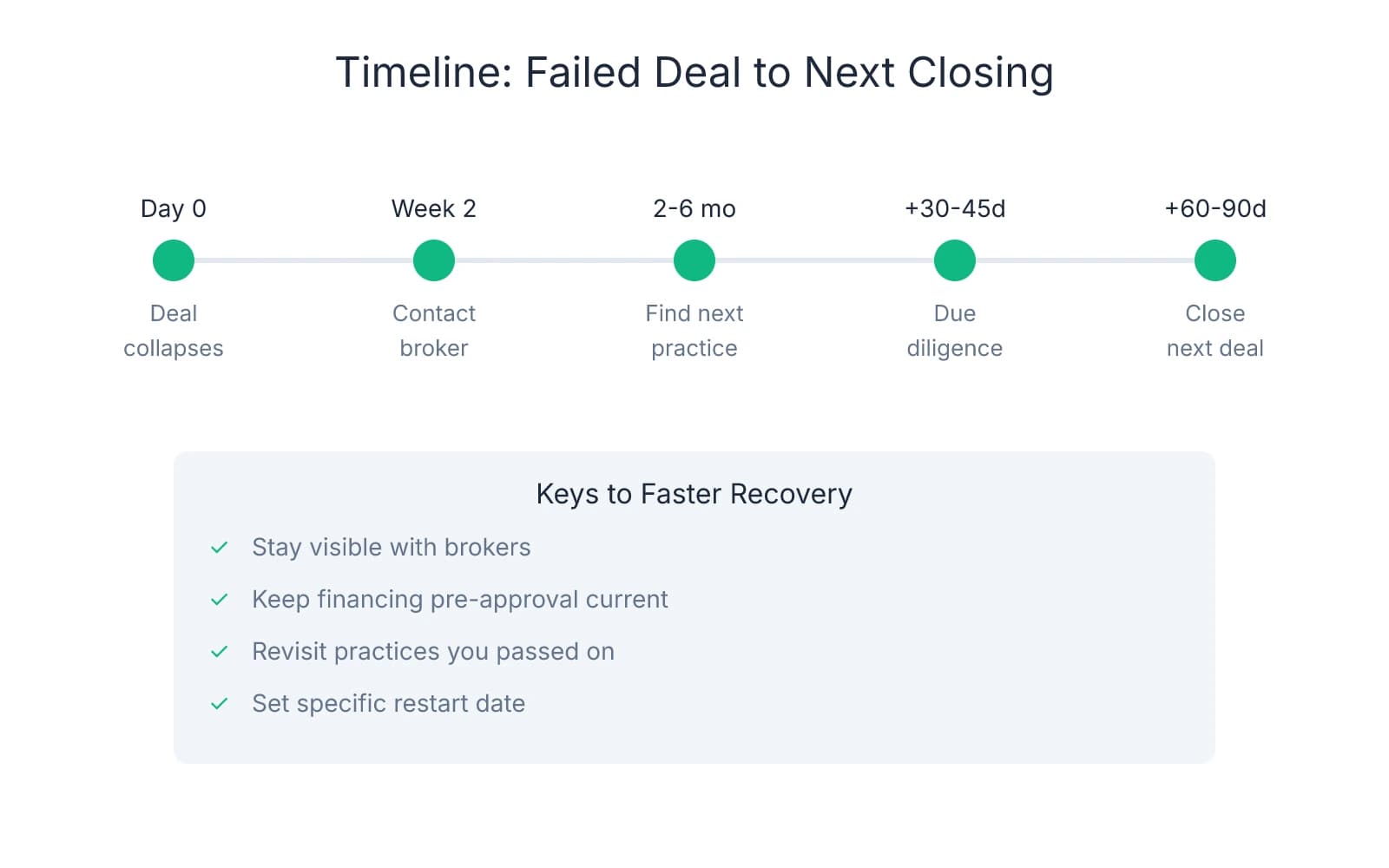
Finding another suitable practice: 2–6 months for active searchers
How long it takes to identify your next opportunity depends on your market and how visible you are to the people who control deal flow. In metro areas with active brokerage networks, buyers who stay engaged typically see 1–3 viable opportunities per quarter. In smaller markets or rural areas, that window stretches—sometimes to 6–9 months.
What accelerates the timeline is staying visible even when you're not actively touring practices. Brokers prioritize buyers they know can close. One step many buyers find valuable is reconnecting with your broker or advisor within two weeks of a failed deal to let them know you're still searching. That keeps you on the active list when new listings hit the market.
Direct outreach to sellers—especially in markets where buying without a broker is common—can cut months off the search timeline. Many practices never hit the open market because the owner finds a buyer through professional networks, study clubs, or direct inquiry.
The acquisition process when it doesn't fall apart: 60–90 days from LOI to closing
Once you've signed an LOI on a deal that's structured correctly, the path to closing typically takes 60–90 days if financing, due diligence, and lease assignment proceed without major surprises. That timeline breaks down roughly as:
- Due diligence: 30–45 days to review financials, inspect equipment, verify lease terms, and confirm third-party consents
- Financing approval: 2–4 weeks for final underwriting, appraisal, and loan commitment
- Contract negotiation and closing prep: 2–3 weeks to finalize the purchase agreement, draft transition documents, and coordinate with escrow
Deals that close faster than 60 days are rare unless the buyer is paying cash or the seller is highly motivated. Deals that stretch beyond 90 days usually signal either incomplete due diligence, financing complications, or a seller who's reconsidering.
Why momentum matters more than perfection
One pattern worth noting: many buyers who lost a deal ended up with a better fit on their second attempt. The first practice felt urgent because it was the first viable opportunity. The second practice felt strategic because the buyer knew what to look for and what to avoid. But that only happens if you stay active in the market.
Where buyers lose momentum is treating the failed deal as a reason to pause and "figure things out." If you step away for three months to recover emotionally or rebuild savings, you're not just delaying your timeline—you're losing visibility with brokers and missing opportunities that won't reappear.
Immediate next steps to take
If your deal just fell apart, these actions keep you positioned for the next opportunity:
- Contact your broker or advisor within two weeks: Let them know you're back in the market and ready to tour practices.
- Revisit practices you passed on earlier: The practice you toured three months ago and decided wasn't quite right may look different now that you've been through due diligence on another deal.
- Update your financing pre-approval if it's expiring: Most pre-approvals are valid for 60–90 days. If yours is about to lapse, request a renewal so you're ready to move when the next opportunity appears.
- Set a timeline for resuming tours and offers: Emotional recovery is real—it's normal to feel burned out after a deal collapses. But setting a specific date to restart your search prevents indefinite delay.
The timeline from failed deal to closed acquisition varies, but the pattern is consistent: buyers who stay visible, maintain their financing readiness, and treat the collapse as diagnostic feedback close their next deal faster than those who disappear and restart from scratch. You're not starting over—you're starting with more information, tighter criteria, and a clearer sense of what a viable deal looks like.
Sources & References
The data and claims in this article are drawn from the following sources. We prioritize government data, peer-reviewed research, and established industry publications to ensure accuracy.
- Letters of intent: Binding or non-binding - McDonald Hopkins— mcdonaldhopkins.comIndustry
- Negotiating the Sale of a Dental Practice - DDS Lawyers— ddslawyers.comIndustry
- The Most Common Due Diligence Surprises That Kill ...— usdentaltransitions.comIndustry
- FAIL: Top 3 Reasons Why Business Sale Deals Fall Through— pinewoodadvisors.comIndustry
- Strategies for an Unwanted Contract in Your Dental Practice— ada.orgIndustry
- How Long Does It Take to Buy a Dental Practice? - Polished Legal— polishedlegal.comIndustry
Frequently Asked Questions
Ready to explore better practice opportunities?
A cancelled deal doesn't mean your acquisition dreams are over. Minty Plus provides expert guidance to help you navigate failed transactions and find the right practice match with ongoing support.