Best Month to Close on a Dental Practice Purchase

Co-Founder, Minty Dental

In Summary
- Insurance credentialing takes 90-180 days on average—closing in Q1 gets you in-network before fall's patient surge, while closing in Q3 means operating at reduced rates during your busiest season
- First-year tax deductions (Section 179, loan interest, startup costs) are most valuable with a full year of income to offset—closing in Q1 can save $40,000-$80,000 versus Q4
- Dental revenue drops 10-15% in summer and spikes in fall when patients use year-end benefits—closing during low-volume months gives you breathing room to learn operations
- Seller transitions run 60-90 days, and timing determines whether you have support during your learning curve or face peak volume alone
Closing Timing Shapes Your First Six Months More Than Most Buyers Realize
You've found the right practice, negotiated the price, and secured financing. The closing date feels like a scheduling detail. But the month you close creates cascading effects that shape your first six months as an owner.
Close in January, and you have most of the year to complete insurance credentialing before fall's patient surge. Close in September, and you're learning the practice during its busiest season while still operating at out-of-network rates.
Four variables determine whether a closing month works in your favor. Credentialing lag: Insurance credentialing takes 90 to 180 days on average, and some carriers stretch past six months. Until you're credentialed, you see insured patients at out-of-network rates—lower reimbursements or patients who reschedule. Closing earlier in the year gives you more time to complete this before patient volume peaks in fall.
Tax planning: First-year deductions—Section 179 equipment expensing, loan interest, startup costs—are most valuable when you have a full year of practice income to offset. Close in Q1, and you capture 12 months of deductions. Close in Q4, and you're left with a narrow window to generate enough income to make those deductions meaningful.
Seasonal revenue patterns: Dental practices experience predictable fluctuations, with production typically dipping 10-15% in summer and spiking in fall when patients rush to use year-end insurance benefits. Closing during a low-volume month gives you breathing room to learn operations.
Seller transition length: Most transition periods run 60-90 days, and the timing determines whether the seller is present during your steepest learning curve or gone before you've built confidence. Close in May with a July exit, and you face the fall rush alone. Close in February with an April exit, and you have support through spring before volume climbs.
None of these variables alone dictates the "best" closing month—your situation determines that. But understanding how they interact gives you a framework to choose strategically rather than defaulting to whatever date the seller prefers.
How Insurance Credentialing Timelines Favor Early-Year Closings
The median credentialing timeline across major dental payers is 117 days, with Delta Dental and Medicaid often stretching to 150-180 days. Every day you operate without in-network status, you're either collecting at reduced rates or watching patients defer treatment.
During the credentialing gap, you can see patients immediately after closing, but you'll bill as an out-of-network provider until each payer approves your application. Out-of-network reimbursement rates typically run 20-40% below contracted rates, and patients face higher out-of-pocket costs—which often means they postpone elective procedures or switch to an in-network provider. For a practice collecting $60,000 per month, operating out-of-network for four months can mean $48,000-$96,000 in lost or reduced revenue.
The credentialing clock starts the day you submit your application, and most of that time sits outside your control. Primary source verification takes 38 days on average, and committee review adds another 56 days. You can't expedite committee meetings or speed up third-party verification. What you can control is when you start the clock relative to your practice's seasonal revenue patterns.
Close in January, and a 120-day credentialing timeline puts you in-network by May—well before fall, when patient volume and insurance utilization both spike. Close in September, and that same timeline means you're still out-of-network in January, right when patients are scheduling treatment to use new calendar-year benefits. Practices that enter fall out-of-network often lose $15,000-$25,000 per month during the year's highest-volume quarter.
If you close in Q1 or early Q2, you have six to nine months before the fall patient surge. That buffer absorbs credentialing delays without cutting into your highest-revenue season. Even if one payer takes 150 days instead of 117, you're still credentialed before September. Close in Q3 or Q4, and any delay pushes you out-of-network during the months when patients are most motivated to schedule—and when your cash flow needs to be strongest.
Some buyers assume they can fast-track credentialing by working directly with payer reps or paying for expedited processing. In practice, committee review cycles and verification timelines are fixed. The only real lever is submission timing—and that means aligning your closing date with the credentialing calendar. Plan for the median timeline, not the best-case scenario, and structure your closing so you're credentialed before your practice enters its busiest season.
Tax Benefits and Calendar-Year Closing Strategy
The month you close determines how much of your first-year tax deductions you can actually use. Section 179 equipment expensing lets you deduct up to $2.5 million in equipment purchases placed in service during the tax year—but that deduction only works if you have taxable income to offset. Close in February, and you have 11 months of practice revenue to absorb those deductions. Close in November, and you have two months.
Beyond Section 179, you're carrying loan interest, startup costs, and depreciation—all deductible in the year incurred. For a buyer financing $800,000 at 7.5%, first-year interest alone runs around $55,000-$60,000. Add startup expenses like legal fees, accounting setup, and licensing, and you're looking at another $15,000-$25,000. Bonus depreciation, now restored to 100% for property placed in service after January 19, 2025, applies to leasehold improvements and certain equipment purchases. Total first-year deductions for many buyers land between $150,000 and $250,000.
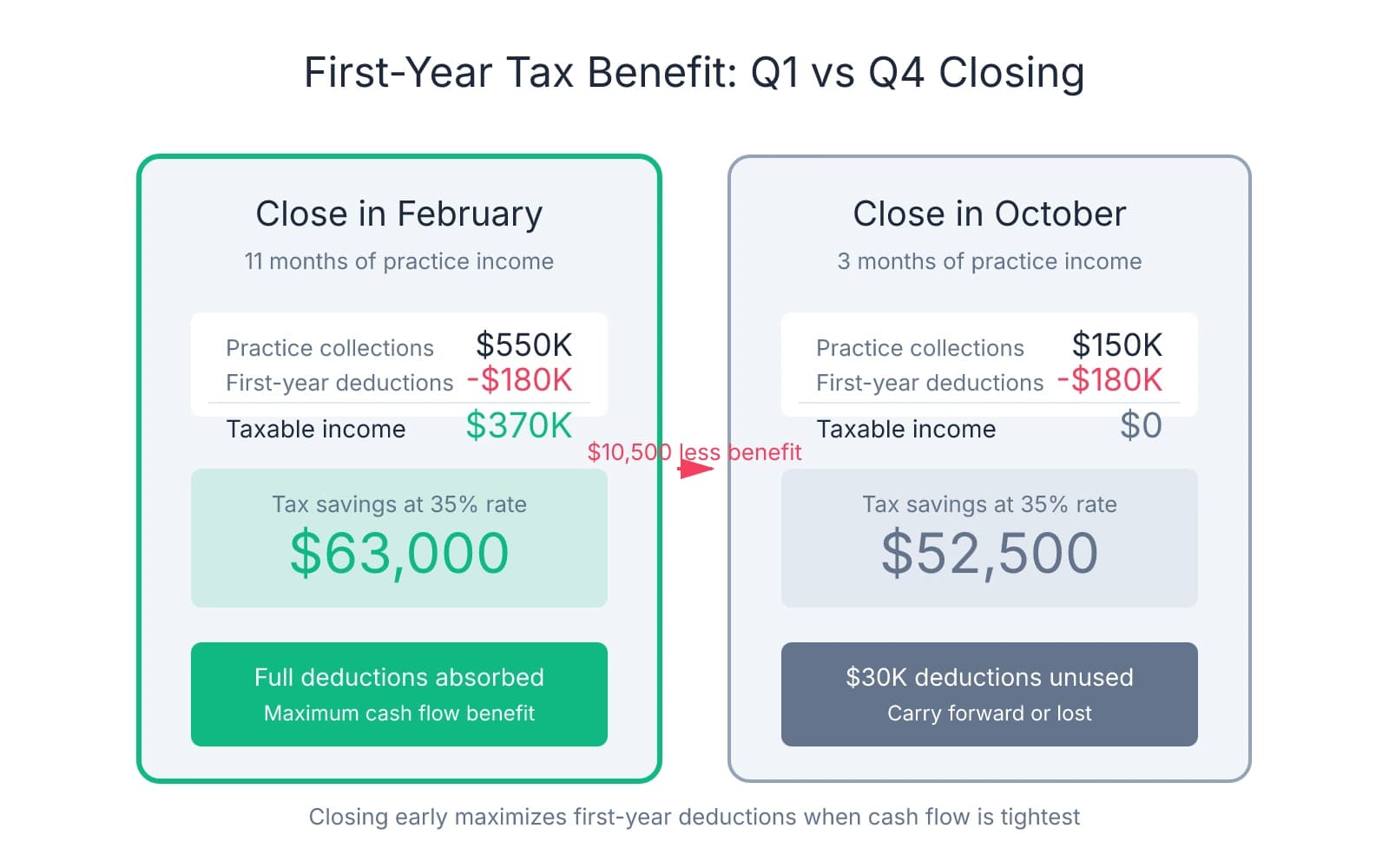
Those deductions reduce your taxable income—but only if you have income to reduce. A practice collecting $50,000 per month generates $550,000 in annual collections if you close in February. That's enough taxable income to absorb most first-year deductions and see meaningful tax savings. Close in October, and you're working with three months of collections—$150,000—which means a large portion of your deductions either carry forward or provide minimal benefit when you need the cash flow relief most.
Buyers who close in January through March capture nearly a full year of practice income while their deduction load is highest. This is when loan interest is steepest, when startup costs hit, and when you're most likely to make equipment purchases to modernize the practice. The tax benefit compounds: lower taxable income in year one means lower estimated tax payments, which frees up cash for working capital or building reserves.
Compare two buyers purchasing the same $800,000 practice. Buyer A closes in February and generates $550,000 in taxable income after expenses. With $180,000 in first-year deductions, their taxable income drops to $370,000—saving roughly $63,000 in federal taxes at a 35% effective rate. Buyer B closes in October and generates $150,000 in taxable income. The same $180,000 in deductions wipes out their income entirely, but $30,000 in unused deductions either carry forward or go unused. The tax benefit in year one? Around $52,500—$10,500 less than Buyer A.
Some buyers benefit from deferring practice income to the following year—particularly if they've already earned significant income as an associate and want to avoid pushing into a higher tax bracket. If you've made $200,000 as an associate through October and then close on a practice generating $30,000 per month, adding $60,000-$90,000 in practice income could bump you into the next bracket. In that case, closing in December or January shifts practice income to the next calendar year.
This scenario is less common, but it's worth modeling with your CPA if you're closing mid-career. For most first-time buyers, the math favors closing early and maximizing first-year deductions when cash flow is tightest.
Questions to ask your CPA before setting a closing date: How much taxable income will the practice generate in the months I'll own it? What first-year deductions am I carrying, and how much income do I need to absorb them? If I close in Q4, do my deductions carry forward or expire?
Tax planning works best when it drives the closing date, not the other way around. If the seller prefers a November closing but your CPA shows you'll leave $50,000 in deductions on the table, that's a negotiation point. Structure the closing around your financial position, and treat the tax benefit as part of the deal's total value.
For a detailed breakdown of which expenses qualify and how to structure purchases for maximum benefit, see tax deductions in your first year owning a dental practice.
Aligning Seller Transition Support with Your Learning Curve
Most transition agreements run 60-90 days, during which the seller introduces you to patients, trains you on systems, and provides clinical overlap. The value of that period depends entirely on when it falls. Close in January with a 90-day transition, and the seller is present through March—giving you support during slower winter months when you can learn workflows without peak patient volume pressure. Close in September, and the seller is gone by December, right when year-end benefit utilization spikes.
The seller's presence serves three functions: they introduce you to long-term patients and signal continuity, walk you through operational systems (supply ordering, scheduling structure, lab relationships, hygiene recall), and provide clinical overlap so you can observe their treatment philosophy before patients become solely your responsibility.
Staff and patient retention are highest when transitions feel gradual and well-supported. If you close in February and the seller stays through April, you've worked together through winter's slower pace and into spring—enough time to establish routines before summer's dip and fall's surge. If you close in August and the seller exits in October, you're learning during a high-volume period and then facing November and December—the year's busiest months—without any safety net.
Buyers who close in Q1 with a 90-day transition get the seller's support through spring, when patient volume is moderate. By the time fall hits and insurance benefit utilization drives patient volume up 15-20%, you've been operating independently for several months. You've built confidence with the team, established your clinical rhythm, and handled enough cases to know when you need to refer or consult.
Compare that to closing in September with a 90-day transition. The seller leaves in December, right when patients are rushing to use remaining benefits. You're managing the year's highest patient volume while still learning which staff members handle what, which patients have complex medical histories, and which referring specialists the practice relies on.
Some buyers prefer the seller to leave quickly. If you've practiced for several years and are confident in your clinical and operational skills, a 30-day transition may be enough. Extended overlap can create confusion about authority—staff may default to the seller's preferences, and you may struggle to establish your own systems while the previous owner is still present. Buyers who want to implement immediate changes often find that a shorter transition gives them clearer authority to lead.
The decision depends on your experience level and how much you value continuity versus autonomy. First-time buyers typically benefit from longer transitions, especially if the practice has complex systems or a large patient base with long-standing relationships.
Closing in Q4 means the seller's exit often coincides with the holidays, when staff and patients are most sensitive to disruption. If the seller leaves in December and you're immediately managing year-end schedules, insurance billing, and holiday coverage, the team has less time to adjust to your leadership style. Patients who've deferred treatment until their benefits reset in January will be scheduling with you—someone they've met only briefly.
Transition length is negotiated in the purchase agreement, and once that period ends, the seller has no obligation to remain—even if you're still learning or patient volume is higher than expected. If you're concerned about managing alone too quickly, negotiate a longer transition upfront. The time to address this is during the LOI stage, not after closing.
For guidance on what happens when the seller's involvement becomes interference, see when the seller won't leave: managing interference after closing. And for strategies to retain the team during this period, see how to keep staff after buying a dental practice.
The month you close determines whether the seller is present during your steepest learning curve or gone before you've built confidence. Choose timing that aligns the seller's support with the period when you'll need it most, and structure the transition length to match your experience level and the practice's complexity.
Sources & References
The data and claims in this article are drawn from the following sources. We prioritize government data, peer-reviewed research, and established industry publications to ensure accuracy.
- Dental Insurance Credentialing: Why It Takes So Long and How to ...— thedentalsignal.comIndustry
- How seasonality affects revenue in the dental practice— dentalproductsreport.comIndustry
- Dental Credentialing Timeline 2026: How Long Does It Really Take?— oneexpert.ai
- Advanced Year-End Tax Planning for Dental Practices: 2025 ...— dentalcpaca.comIndustry
- Tips for Dentists to Have a Smooth Tax Season - Adams Brown— adamsbrowncpa.comIndustry
- Retain Staff and Patients in a Dental Practice Transition— mydentalbroker.comIndustry
Frequently Asked Questions
Ready to close your dental practice acquisition?
Timing your practice purchase strategically can maximize your success. Whether you're targeting a specific closing month or need guidance navigating the acquisition process, Minty Plus provides expert support to help you close with confidence.