Buying a Dental Practice Near a Dental School: Pros and Cons

Co-Founder, Minty Dental

In Summary
- Dental school clinics serve a structurally different patient than private practices — they require screening, accept 3–4 hour appointments, and work around limited scheduling windows, making them a poor substitute for most private practice patients.
- The competitive overlap between dental school clinics and well-run private practices is narrower than most buyers assume, and a practice that has operated profitably alongside a dental school is already evidence of that.
- Urban areas — where dental schools are concentrated — already average 65 dentists per 100,000 residents, meaning the school is rarely the marginal competitive threat in those markets.
- Proximity to a dental school can work in a buyer's favor: lower asking prices, underserved surrounding neighborhoods, and potential referral relationships are all worth evaluating.
- The right due diligence question isn't whether a dental school is nearby — it's what percentage of the existing patient base is price-sensitive enough to switch, and why they haven't already.
Proximity to a Dental School Changes the Math — But Not Always the Way You'd Expect
When a listing shows up within a mile or two of a dental school, many buyers instinctively move on. The assumption is straightforward: dental school clinic nearby equals price competition, patient poaching, and a harder road to profitability. It's a reasonable instinct — but in most cases, it overstates the actual risk.
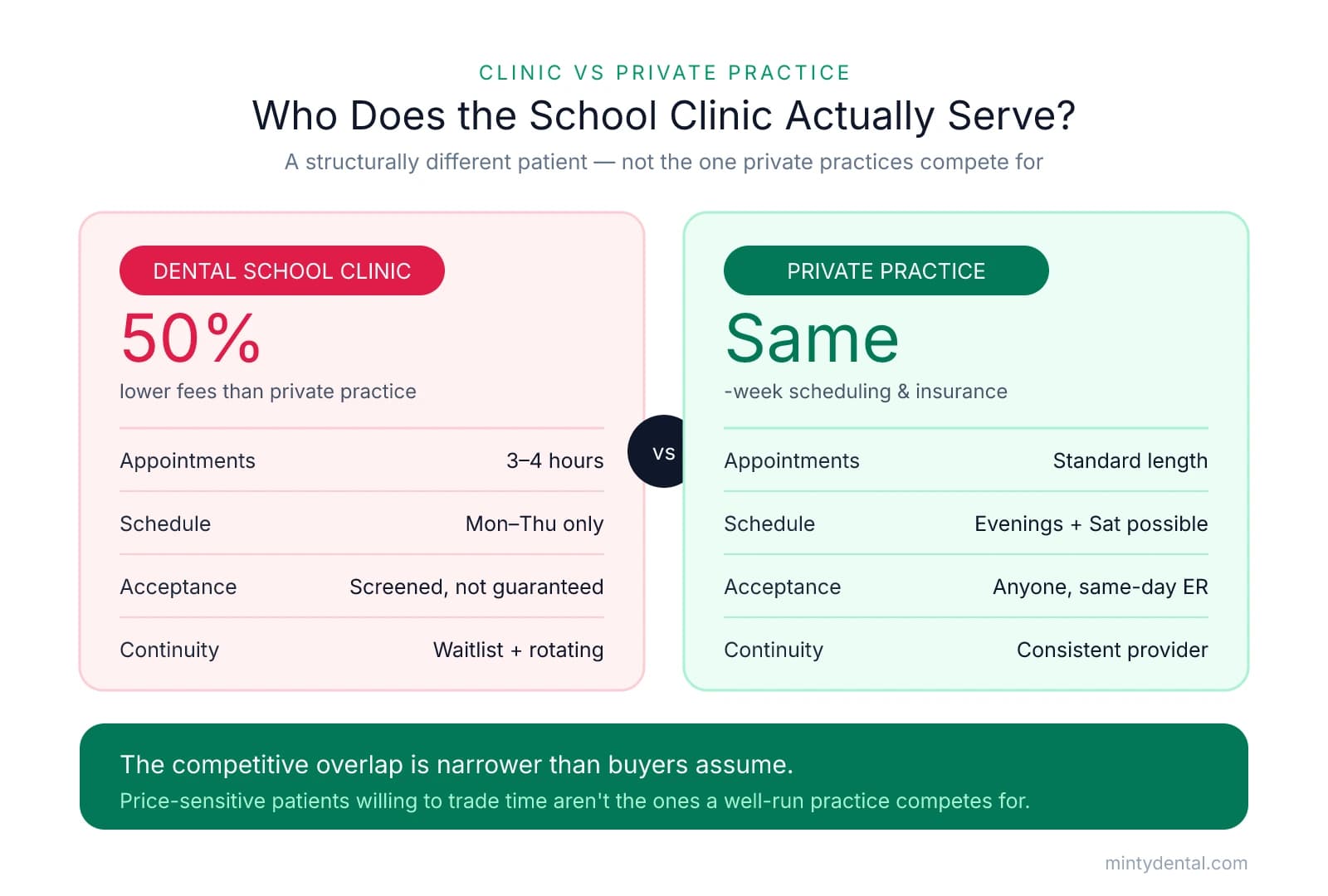
The more useful question isn't is there a dental school nearby? It's who does that dental school clinic actually serve, and how much does that population overlap with this practice's existing patients?
The structural difference between dental school clinic patients and private practice patients: Dental school clinics are not designed to compete with private practices on convenience, speed, or continuity of care. They're teaching environments — and that shapes everything about the patient experience. At institutions like UT Health Science Center, prospective patients must complete a screening appointment before being accepted, and acceptance isn't guaranteed — patients are selected based on whether their case meets student learning needs. Penn Dental Medicine similarly advises prospective patients that reduced fees come with the expectation of longer appointments and a more flexible schedule. The cost savings can reach 50% below private practice rates — but the trade-off in time and predictability is significant.
That trade-off is the key distinction. Patients willing to make it — those price-sensitive enough to sit through 3–4 hour appointments on a Monday-through-Thursday schedule, navigate a waitlist, and accept that their case may not be accepted at all — are not the same patients a well-run private practice is competing for. Private practices win on insurance acceptance, same-week scheduling, and a consistent provider relationship. Dental school clinics don't offer any of those at scale.
There's also a market density point worth sitting with. According to the ADA Health Policy Institute, urban counties — where dental schools are almost exclusively located — average 65 dentists per 100,000 residents, compared to 33 in rural counties. In a market that already has that many providers, the dental school clinic is rarely the marginal competitor a buyer needs to worry about.
Perhaps the most practical signal available during due diligence is the practice's own track record. If it has maintained stable collections and patient retention while operating alongside a dental school for several years, that history is telling you something. Understanding how to evaluate the demographics around a practice location can help you read that signal more precisely — but the baseline question is simple: the overlap was manageable before you arrived, so what would actually change it?
The Real Risks Worth Pricing Into Your Offer
That said, "overstated" doesn't mean "nonexistent." There are three risk categories that deserve real scrutiny during due diligence — not as reasons to walk away, but as inputs that should shape your offer price and underwriting assumptions.
1. Neighborhood Demographics and Payer Mix
Dental schools tend to anchor in urban neighborhoods that skew toward lower-income residents and student populations. That demographic reality doesn't disappear just because the practice has survived nearby — it may already be suppressing the practice's revenue ceiling.
Pull the practice's payer mix and compare it against census income data for the surrounding zip codes. A Medicaid-heavy or deeply PPO-dependent book of business in a dental school neighborhood often signals that price sensitivity is already a structural feature of the patient base, not a temporary condition. That's not automatically disqualifying — but it does affect how you model fee-for-service growth potential. Buyers considering a Medicaid-heavy practice in this context should think carefully about whether the neighborhood demographics support a payer mix shift, or whether that ceiling is fixed.
2. New Graduate Saturation
The competitive pressure from a dental school isn't just the clinic itself — it's the graduates it produces. Urban counties already average 65 dentists per 100,000 residents, and that gap is widening as younger dentists disproportionately settle in urban areas after graduation. Cities with dental schools tend to attract more new entrants over time, compressing the market gradually rather than all at once.
This is a longer-term pressure worth modeling. Review 3–5 years of new patient acquisition trends in the practice's data. Flat or declining new patient flow in a growing neighborhood may reflect competitive density that's already doing quiet damage to growth potential.
3. Price Anchoring in the Surrounding Patient Base
Penn Dental Medicine explicitly markets cost savings of up to 50% compared to private practice rates. When that message has been in the market for years, some portion of the surrounding population may have calibrated their price expectations accordingly — making it harder to move patients toward higher-fee services or reduce insurance dependence.
The most direct way to assess this is a conversation with the seller: Have you lost patients to the dental school clinic? What types of patients? Sellers who've been in the market for a decade often have a clearer read on this than any financial statement will show.
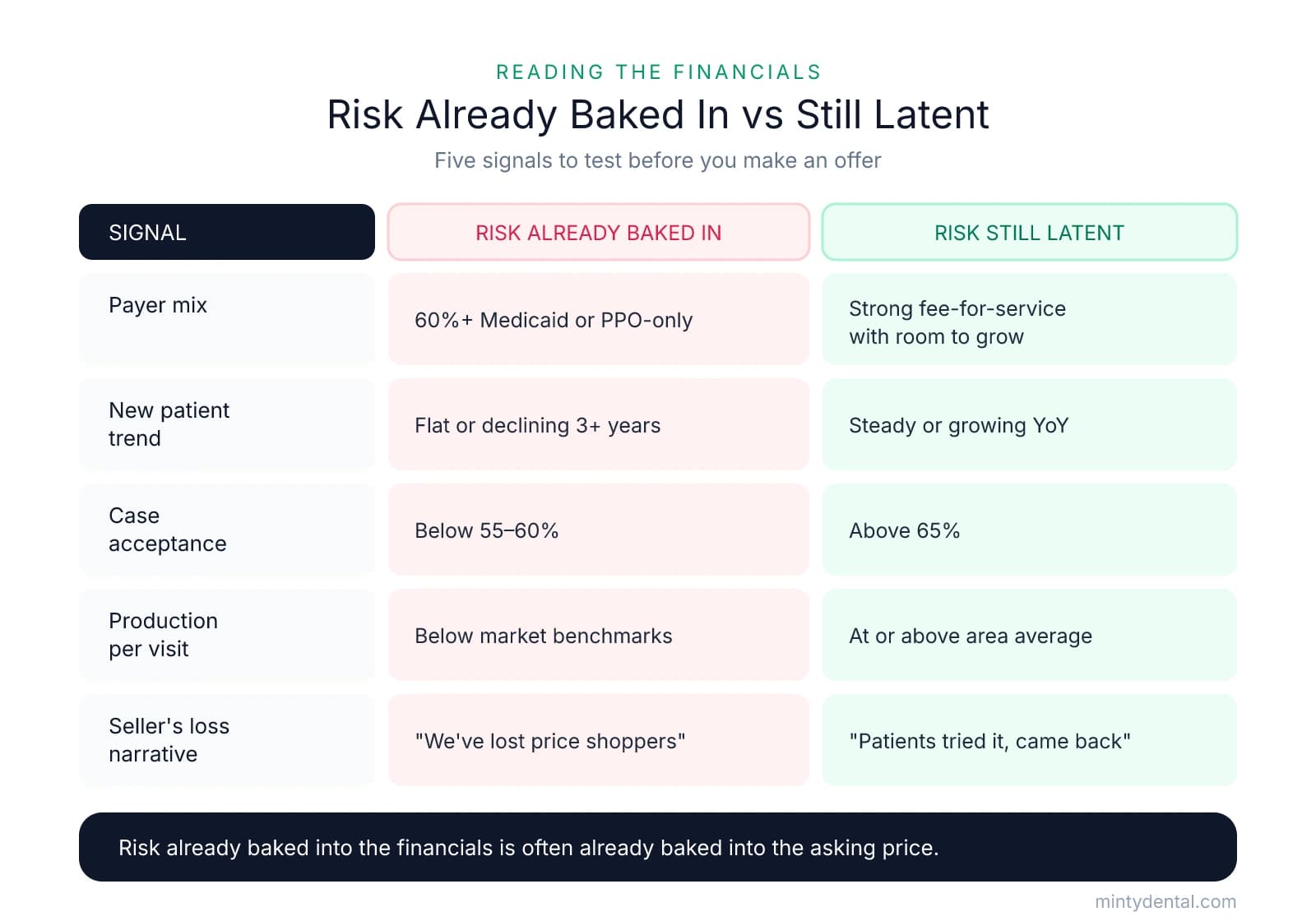
Here's a quick framework for reading the signals in the financials:
| Signal | Risk Already Baked In | Risk Still Latent |
|---|---|---|
| Payer mix | 60%+ Medicaid or PPO-only | Strong fee-for-service with room to grow |
| New patient trend | Flat or declining 3+ years | Steady or growing year-over-year |
| Case acceptance rate | Below 55–60% | Above 65% |
| Average production per visit | Below market benchmarks | At or above area averages |
| Seller's patient loss narrative | "Yes, we've lost price shoppers" | "Patients who tried the school came back" |
Risks already baked into the financials are often already baked into the asking price — which is actually where proximity to a dental school can work in your favor as a negotiating lever.
Where Dental School Proximity Actually Works in a Buyer's Favor
When those risks are already reflected in the financials, they're often already reflected in the asking price. That's where the opportunity lives.
The Market Discount Is Real — and Often Mispriced
Sellers and brokers in dental school markets frequently price practices lower because buyer demand thins out. Most buyers do exactly what this article opened with — they see the dental school on the map and move on. That reflexive avoidance creates a pricing inefficiency that a prepared buyer can exploit.
A buyer who confirms limited patient overlap, reviews payer mix trends, and checks new patient flow may find they're acquiring a fundamentally sound practice at a meaningful discount to comparable practices in similar markets. The competitive concern that scared off other buyers was already priced in. The practice's actual performance tells a different story.
When evaluating whether the discount is real or deserved, comparing the practice's production-per-visit and collections against what a patient base is actually worth in similar markets gives you a useful anchor for the negotiation.
Underserved Demand in the Surrounding Neighborhood
Dental school neighborhoods frequently include working-class and mixed-income communities with genuine unmet dental demand. The school clinic can't fully absorb it — limited hours, selective case acceptance, and long wait times leave a meaningful gap. Dental school cities often have shortage pockets immediately adjacent to the campus that private practices are well-positioned to serve.
A buyer with PPO or Medicaid credentialing, extended evening or Saturday hours, or same-day emergency capacity has a genuine structural advantage over the school clinic in that surrounding population. The school can't offer any of those consistently. If you're considering whether NHSC loan repayment could make serving that population more financially viable, it's worth knowing that practice ownership doesn't automatically disqualify you from those programs.
Referral Relationships Most Buyers Never Pursue
Dental school clinics regularly refer cases out — emergencies that can't wait, complex restorations beyond student scope, patients who need faster turnaround than the clinic can provide. A private practice nearby that builds a working relationship with faculty or clinic coordinators can become the default referral destination for those cases.
This is one of the most underutilized advantages of dental school proximity. Before closing, an introductory conversation with the school's clinic administration — not a formal pitch, but a relationship-building touchpoint — can open a referral pipeline that never appeared in the seller's financials. Most buyers never make that call.
The pattern worth recognizing: the same proximity that makes other buyers hesitate is what creates the discount, the underserved demand, and the referral opportunity. None of those advantages require the dental school to disappear — they require a buyer willing to look past the reflexive concern and do the work.
A Due Diligence Checklist for Evaluating Dental School Proximity
Dental school proximity isn't a reason to pass on a practice — it's a variable that requires structured investigation. The checklist below gives you a working framework to apply before making an offer.
Category 1: Competition Assessment
1. Map the school clinic's actual operating profile. Research the clinic's hours, scheduling model, procedures offered, and patient screening requirements. A clinic that operates Monday through Thursday, requires a screening appointment, and limits case acceptance to student-appropriate complexity has a much narrower competitive footprint than most buyers assume.
2. Pull three years of new patient data. Flat or declining new patient flow in a neighborhood that's otherwise growing may reflect competitive density already quietly suppressing growth. Ask the seller or broker to break this down by referral source.
3. Ask directly about patient attrition to the school clinic. Sellers who've operated nearby for a decade often have a clearer read on this than any financial statement. Have you lost patients to the clinic? What types? The answer tells you whether price sensitivity is a structural feature of the patient base or a marginal concern.
Category 2: Demographic Fit
4. Run the surrounding zip codes through census data and County Health Rankings. Look at median household income, insurance coverage rates, and the dentist-to-population ratio. This tells you whether the neighborhood's demographics are already reflected in the practice's payer mix — or whether there's a gap worth exploring.
5. Compare the payer mix against the demographic profile. A Medicaid-heavy or deeply PPO-dependent book of business in a dental school neighborhood often signals that price sensitivity is already a structural ceiling on revenue. That's not disqualifying, but it should shape how you model fee-for-service growth potential.
Category 3: Opportunity Mapping
6. Ask whether the school clinic refers cases out — and whether this practice has received any. This single question reveals both the opportunity and whether the current owner pursued it. If the answer is no on both counts, that's not a red flag — it's an opening.
7. Assess your clinical scope and scheduling model against the clinic's gaps. Same-day emergency care, evening and weekend hours, and PPO or Medicaid credentialing are the clearest differentiators. If you can offer what the school clinic structurally cannot, the proximity becomes an advantage rather than a liability.
The dental school proximity question is ultimately a due diligence question — not a yes/no filter. The buyers who treat it as the latter leave money on the table. The buyers who work through a framework like this one often find that the concern other buyers ran from is exactly what created the opportunity they were looking for.
Sources & References
The data and claims in this article are drawn from the following sources. We prioritize government data, peer-reviewed research, and established industry publications to ensure accuracy.
- Dental Student Clinics | Patient Services | College of Dentistry— www.uthsc.eduAcademic
- Questions to Ask When Considering Dental School Clinics— penndentalmedicine.orgIndustry
- Private Practice Results - American Dental Association— ada.orgIndustry
- Low-Cost Dental Clinic Philadelphia— penndentalmedicine.orgIndustry
- Dentists | County Health Rankings & Roadmaps— www.countyhealthrankings.orgIndustry
Frequently Asked Questions
Ready to acquire your ideal practice location?
Whether you're targeting a high-competition area near a dental school or seeking a practice in a less saturated market, Minty's acquisition experts guide you through every step of the buying process—from initial search to closing—with no upfront fees.