NHSC Loan Repayment While Owning a Dental Practice

Co-Founder, Minty Dental

In Summary
- Dental practice owners — including solo and group private practice owners — are explicitly eligible for the NHSC Loan Repayment Program; ownership alone does not disqualify you
- Two separate approvals are required: the practice site must be NHSC-approved, and the clinician-owner must independently meet eligibility requirements — both must be in place before repayment begins
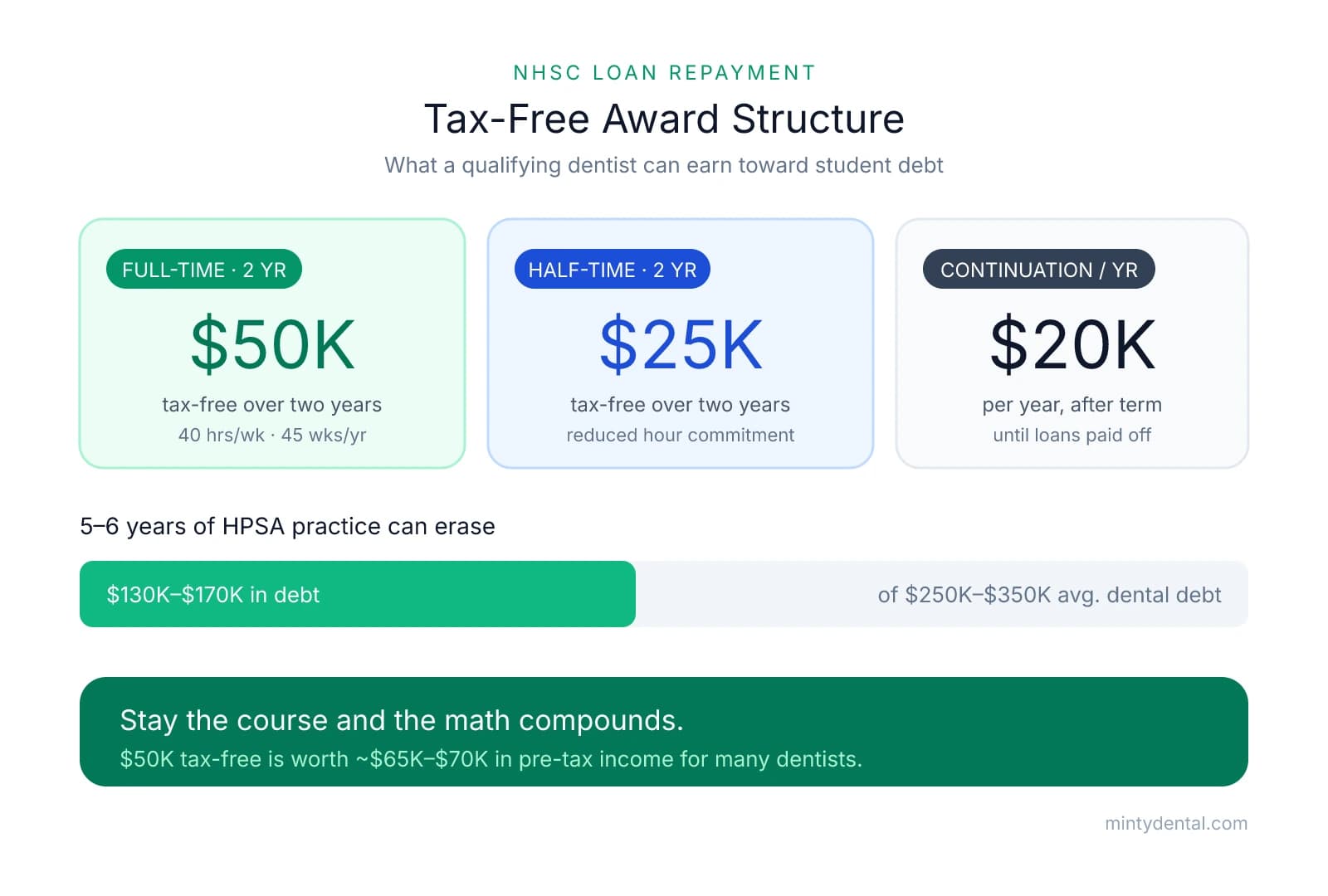
- The program awards up to $50,000 tax-free over two years (full-time) or $25,000 (half-time), with continuation contracts of up to $20,000 per year after that
- The practice must be located in a designated dental Health Professional Shortage Area (HPSA) — this is the non-negotiable threshold that shapes every other decision
- With average dental school debt sitting between $250,000 and $350,000, NHSC LRP can meaningfully accelerate loan payoff — but only if the practice is structured and located to qualify
Practice Owners Can Use NHSC Loan Repayment — With the Right Setup
The NHSC Loan Repayment Program (LRP) is a federal program administered by HRSA that awards tax-free funds to qualifying clinicians who commit to practicing in designated Health Professional Shortage Areas — with the explicit goal of expanding access to care in underserved communities. For dentists carrying significant student debt, it's one of the few repayment tools that doesn't require giving up ownership or joining a large health system.
The short answer to whether practice owners can participate: yes. HRSA explicitly lists private practices — both solo and group — as eligible site types for NHSC approval. Ownership doesn't disqualify you. What matters is whether your practice site meets the program's requirements, and whether you, as the clinician-owner, meet the eligibility criteria separately.
That distinction — site approval and clinician approval as two independent tracks — is where many buyers get tripped up. Both must be in place before any repayment begins. Securing your own eligibility doesn't automatically extend to your practice, and getting the site approved doesn't guarantee your clinician application will follow smoothly. The two processes run in parallel, and both require deliberate preparation.
The award structure makes the effort worth understanding carefully. A full-time, two-year commitment at a qualifying dental HPSA site can yield up to $50,000 in tax-free loan repayment, or $25,000 for half-time participants. After completing the initial term, continuation contracts can add up to $20,000 per year until the loans are paid off. For a buyer carrying the average dental school debt of $250,000–$350,000, that's a meaningful dent — particularly in the early years of ownership when cash flow is tight and every dollar of debt service matters. Buyers already navigating the financial stretch of acquisition may find it worth reading alongside strategies for buying a practice with limited savings to see how the pieces can fit together.
The threshold requirement that shapes everything else is location: the practice must sit within a designated dental HPSA. That single criterion determines whether the site can be approved, which in turn determines whether the clinician-owner can access the program at all. The rest of this article works through what that means in practice — how the two approval tracks function, what operational commitments come with site approval, and how to evaluate whether targeting an HPSA-designated practice makes sense as part of your acquisition strategy.
What Your Practice Has to Become to Qualify as an NHSC Site
Getting your practice approved as an NHSC site isn't a one-time checkbox — it's a structural commitment that changes how your practice operates. Before walking through the steps, it's worth being clear about what you're signing the practice up for, not just yourself.
The Four Core Compliance Obligations
1. Sliding Fee Discount Program (SFDP)
This is the most significant operational trade-off for a private practice owner, and the one that deserves the most scrutiny before you commit.
Per the NHSC Sliding Fee Discount Program guidance, NHSC-approved sites are statutorily prohibited from denying care based on inability to pay. Your practice must implement a documented fee schedule that offers discounted — and in some cases free — care to patients at or below 200% of the Federal Poverty Guidelines, a threshold that covers a meaningful portion of the population in most HPSA-designated areas.
In practice, this means adjusting your patient intake process, training front desk staff on eligibility screening, and accepting that a portion of your collections will come in below your standard fee schedule. For a practice with a predominantly private-pay or PPO patient mix, this is a real revenue consideration — not a paperwork formality. Buyers already evaluating practices with a significant Medicaid or low-income patient base may find the operational dynamics familiar, but for others, it represents a genuine shift in practice model.
2. Annual Data Reporting to HRSA
Approved sites must submit patient data annually — including patient volume, payer mix, and service utilization. This isn't burdensome for practices with solid practice management systems, but it does require consistent data hygiene and someone accountable for the submission.
3. Clinician Recruitment and Retention Plan
The site application requires a documented plan describing how the practice will attract and retain qualified providers. For a solo owner, this may feel abstract — but HRSA is looking for evidence that the site has a sustainable staffing strategy, not just a single clinician holding everything together.
4. HPSA Location and Outpatient Oral Health Services
The practice must be located in a designated dental HPSA — geographic, population-based, or facility-based — and must provide outpatient oral health services. This is the baseline eligibility filter; without it, the rest of the application doesn't proceed.
The Site Approval Process, in Sequence
- Confirm your practice address falls within a designated dental HPSA using the HRSA shortage area locator
- Review the NHSC Site Reference Guide and Site Agreement in full
- Develop your Sliding Fee Discount Program policy and schedule
- Draft your Clinician Recruitment and Retention Plan
- Submit your site application during the annual spring cycle — HRSA typically opens this window once per year
- Await site approval before submitting your individual LRP clinician application
Site approval lasts four years, after which recertification is required. HRSA conducts site visits and can revoke approval for non-compliance at any point — which would put your active LRP contract at risk. Maintaining compliance is an ongoing operational responsibility that follows the practice, not just the owner.
The Clinician Side: What You Must Meet as the Owner-Provider
Site approval gets your practice into the program. But you — as the clinician-owner — have to qualify independently, and the individual eligibility criteria carry their own operational weight that's easy to underestimate until you're already in the contract.
The Baseline Eligibility Checklist
Per the HRSA FY 2026 NHSC LRP Application and Program Guidance, qualifying as an individual clinician requires:
- U.S. citizenship or national status — permanent residency alone does not qualify
- An active dental license in the state where you'll be providing service — not just a license in good standing somewhere, but specifically in your practice state
- Eligibility to participate in Medicare, Medicaid, and CHIP — if you've had any prior exclusion or sanction, it needs to be resolved before you apply
- No existing conflicting service obligation — military commitments, other federal service contracts, or state loan repayment programs with active service terms can disqualify you
Most dentists clear these without issue. The Medicare/Medicaid/CHIP eligibility requirement is worth flagging specifically for buyers structuring a new practice entity — your enrollment status under the new practice's NPI and tax ID needs to be in order before the LRP application goes in. The credentialing gap that often follows a practice acquisition can create timing problems here if not planned for early.
The Service Hour Commitment — and Where Owners Get Caught
Full-time NHSC LRP participation means 40 hours per week for at least 45 weeks per year. Of those 40 hours, at least 32 must be direct patient care. The remaining 8 hours per week can go toward practice management and administrative duties — and that cap is where practice owners consistently run into friction.
The 8-hour administrative ceiling: For a solo owner in the first one to two years of ownership, administrative time routinely exceeds 8 hours per week. Payroll, vendor contracts, insurance credentialing, staff management, equipment decisions — these don't disappear because you're in an LRP contract. Many owners find themselves in technical non-compliance not because they stopped seeing patients, but because the business demands of ownership pushed them past the limit HRSA allows.
This isn't a reason to avoid the program — it's a reason to plan around it deliberately. Owners who hire an office manager early, outsource billing, or bring on an associate to share administrative load tend to navigate the hour requirements more cleanly. The unexpected operational costs of early ownership are real, and building administrative support into your budget from the start serves both your LRP compliance and your broader stability.
The Breach Risk Is Not Theoretical
Penalty exposure: According to Student Defense's reporting, HRSA has imposed penalties exceeding $270,000 on participants who received less than $10,000 in loan relief — in cases involving facility closures, pandemic-related disruptions, and even bad advice from the agency itself.
The LRP contract is legally binding. Life events that feel like obvious exceptions — your practice sells, you relocate, your site loses its HPSA designation — do not automatically release you from the service obligation. HRSA has discretion, but it has exercised that discretion harshly in documented cases. This isn't a program to enter as a fallback or a hedge; it rewards owners who plan deliberately and penalizes those who treat it as flexible.
The Upside of Long-Term Commitment
For owners who stay the course, the math compounds favorably. After the initial two-year term, continuation contracts offer up to $20,000 per year in additional tax-free repayment. An owner who practices in a qualifying HPSA for five or six years can realistically eliminate $130,000–$170,000 in debt through the program alone — making long-term HPSA practice ownership one of the more powerful debt reduction strategies available to dentists willing to build around it.
How to Evaluate Whether Targeting a HPSA Practice Is Worth It
Everything above points toward one practical question: should HPSA status be part of your practice search criteria from the start?
For buyers already planning to pursue NHSC LRP, the answer is almost always yes. Trying to retrofit an existing practice into NHSC compliance — relocating, restructuring the patient mix, implementing a sliding fee program retroactively — is far harder than identifying a qualifying practice during the acquisition search itself. Buyers who build HPSA status into their criteria early are working with the program's structure rather than against it.
The Financial Case, Modeled Honestly
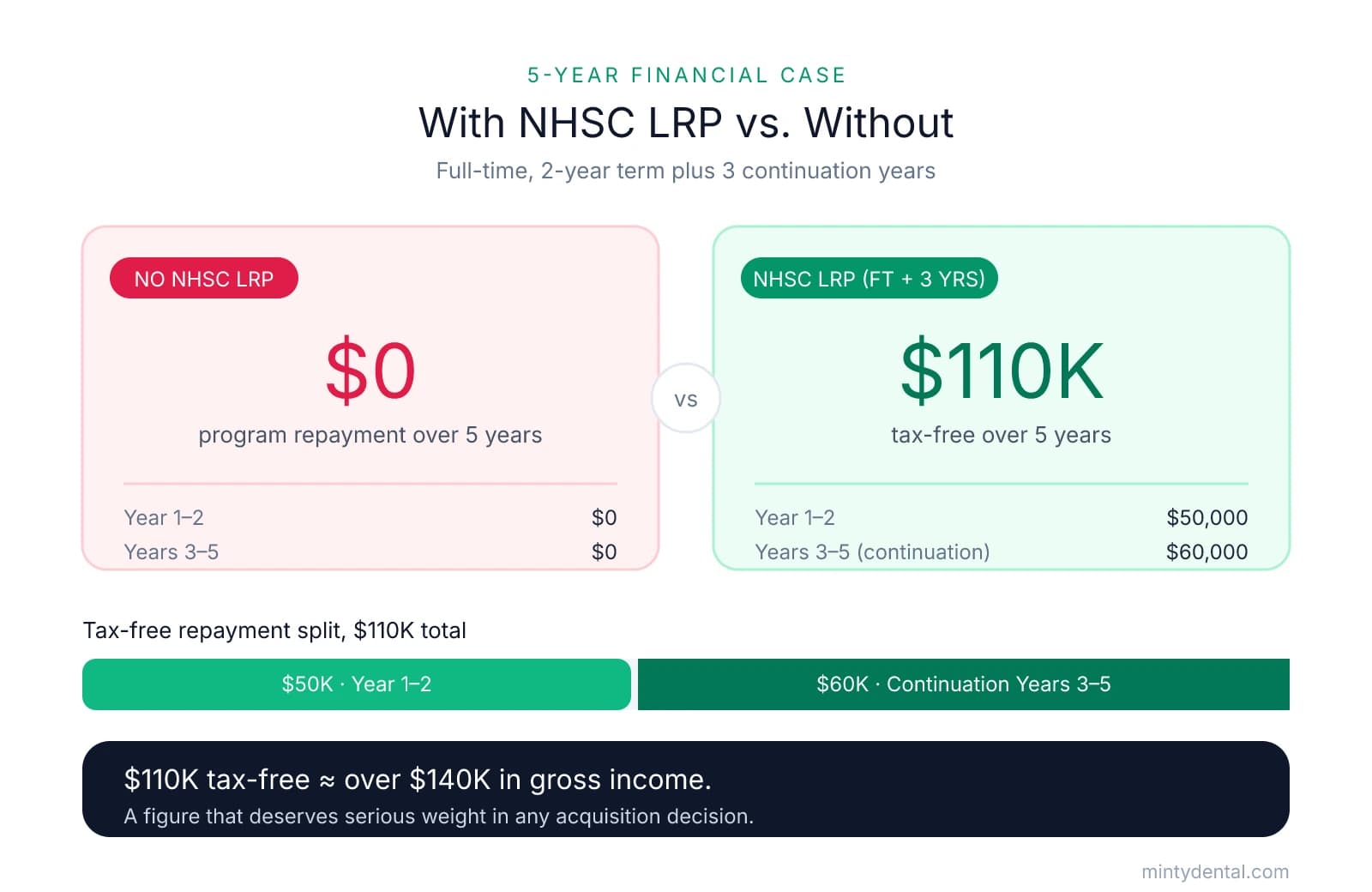
The $50,000 tax-free award over two years isn't just a headline number — it's the equivalent of roughly $65,000–$70,000 in pre-tax income for many dentists, depending on their effective tax rate. Stacked on top of owner-level earnings that ADA News notes often more than double what dentists earn as associates, the combined effect can meaningfully compress the timeline to financial stability.
| Scenario | Year 1–2 Loan Repayment | Years 3–5 (Continuation) | 5-Year Total (Program Only) |
|---|---|---|---|
| No NHSC LRP | $0 | $0 | $0 |
| NHSC LRP (FT, 2-yr + 3 continuation years) | $50,000 tax-free | $60,000 tax-free | $110,000 tax-free |
That $110,000 in tax-free repayment is the equivalent of well over $140,000 in gross income for most practice owners — a figure that deserves serious weight in any acquisition decision.
The Trade-Offs That Must Be Modeled, Not Assumed
HPSA-designated practices often carry lower purchase prices due to reduced buyer competition — the same market dynamics that create the shortage can create acquisition opportunity. But lower entry cost doesn't automatically offset the revenue trade-offs. Before making an offer, verify the practice's payer mix carefully and model what sliding fee compliance will cost in actual collections. A practice with a high Medicaid concentration may already be operating close to NHSC compliance — or it may be running on thinner margins than the headline revenue suggests. Evaluating location and demographic data for any HPSA-designated practice is worth doing rigorously, not as a formality.
One step that should happen before any offer: verify the practice's HPSA designation through the HRSA Health Workforce Connector. Designations can and do change. A practice that qualifies today may not qualify at your two-year renewal — and a lapsed designation mid-contract creates real breach exposure.
Who This Strategy Is Actually For
NHSC LRP works best for buyers who are genuinely mission-aligned with serving underserved communities and financially motivated to accelerate loan payoff — not buyers looking to check a compliance box with a practice that doesn't authentically serve a shortage area. The program is designed to be verified and enforced, and HRSA has shown it will pursue breach penalties even in sympathetic circumstances.
For buyers that description fits, the combination of lower acquisition cost, owner-level income, and compounding tax-free repayment makes HPSA practice ownership one of the more powerful financial structures available to early-career dentists — and one worth building your search around from day one.
Sources & References
The data and claims in this article are drawn from the following sources. We prioritize government data, peer-reviewed research, and established industry publications to ensure accuracy.
- How to Meet NHSC Site Eligibility Requirements— nhsc.hrsa.govGovernment
- NHSC & Other Student Loan Repayment Benefits at MCDC— mydental.orgIndustry
- [PDF] Dental Student Loan Repayment Programs & Resources— ada.orgIndustry
- [PDF] NHSC Sliding Fee Discount Program Information Package— chcams.orgIndustry
- Health Workforce Shortage Areas - HRSA Data Warehouse— data.hrsa.govGovernment
- [PDF] NHSC Site Reference Guide - National Health Service Corps - HRSA— nhsc.hrsa.govGovernment
- NHSC Loan Repayment Program— nhsc.hrsa.govGovernment
- Stopping Crippling Financial Penalties on Medical Professionals— defendstudents.orgIndustry
- How to avoid common practice ownership conundrum - ADA News— adanews.ada.orgIndustry
- Health Workforce Shortage Areas - HRSA Data Warehouse— data.hrsa.govGovernment
Frequently Asked Questions
Ready to own a dental practice in an HPSA?
If you're interested in acquiring a dental practice in a Health Professional Shortage Area while leveraging NHSC loan repayment benefits, Minty can guide you through the entire acquisition process—from finding the right practice to closing the deal.