Buying Your First Dental Practice at 40 or 45

Co-Founder, Minty Dental

In Summary
- Practice ownership among U.S. dentists dropped from 85% in 2005 to 73% in 2023, but ownership remains the career endpoint for most dentists—it's just happening later
- Dentists who graduated in the 1990s-2000s owned practices at 63-70% rates within 5-9 years; recent graduates (2016-2020) show only 21% ownership at the same stage
- Late-career ownership rates converge across generations, meaning delayed ownership is a structural shift in career paths, not a sign you've missed your window
- The timeline shift reflects DSO experience, associate roles, and debt management strategies—not a fundamental change in who should own practices
The Ownership Timeline Has Shifted for Everyone—Not Just You
If you're 40 or 45 and wondering whether you've waited too long, the data says otherwise. Practice ownership rates among U.S. dentists have dropped from 85% in 2005 to 73% in 2023, but that decline isn't about abandonment—it's about delay. The ownership timeline has stretched across the entire profession, and buying now puts you squarely in the majority of your generation.
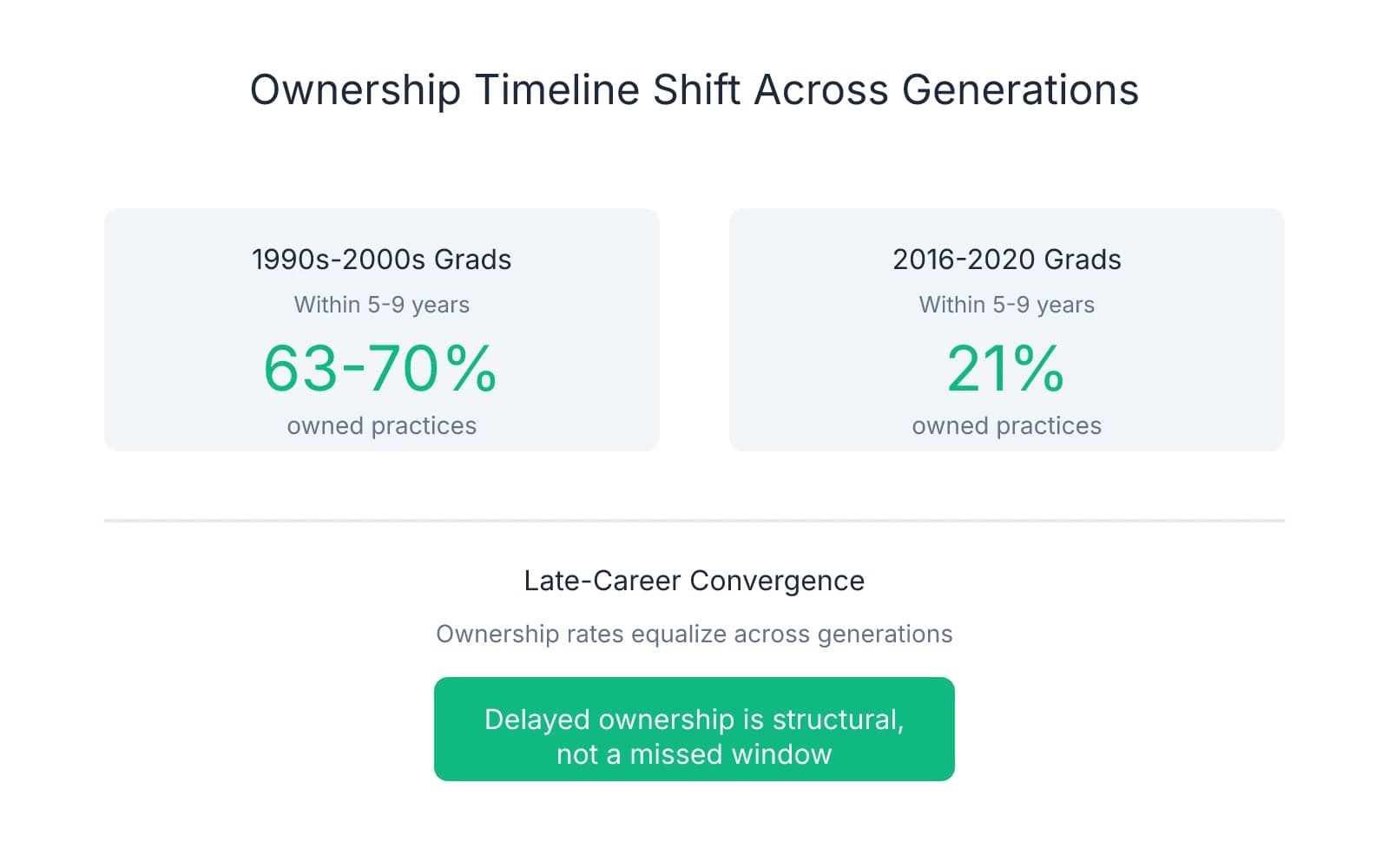
The gap shows up starkest in early-career numbers. Dentists who graduated in the 1990s and 2000s owned practices at rates between 63% and 70% within 5-9 years of finishing school. Among dentists who graduated between 2016 and 2020, only 21% owned practices at the same career stage. That's not a rejection of ownership—it's a different path to the same destination.
What matters more than the early-career gap is what happens later. Late-career ownership rates converge across generations. The dentists who started as associates in DSOs, spent years managing debt, or waited until their mid-40s to buy eventually reach ownership at rates comparable to earlier cohorts. The endpoint hasn't changed—just the route.
The timeline shift reflects structural changes in how dentists build careers. More graduates start in DSO roles to gain clinical speed and systems experience. Others stay as associates longer to pay down six-figure debt loads before taking on practice financing. Some wait until they've built a referral base or identified a geographic market where they want to settle long-term. None of these paths suggest you're behind—they're the new normal.
Where many mid-career buyers get stuck is comparing themselves to an outdated benchmark. The dentist who bought a practice at 28 in 1998 faced a different financial and professional landscape—lower debt, simpler practice models, less competition from corporate groups. That timeline doesn't apply anymore, and trying to match it creates unnecessary pressure.
The question isn't whether you're too old. It's whether the conditions that delayed your ownership decision—debt payoff, clinical confidence, market knowledge, financial stability—have now positioned you better than you would have been at 30. For most dentists in their 40s, the answer is yes.
Mid-Career Buyers Bring Advantages Younger Dentists Can't Match
The concern about age flips when you look at what lenders and sellers value. A 40-year-old buyer with 15 years of production history represents lower risk than a recent graduate with minimal debt but no track record. The clinical competence, patient trust, and business judgment you've built over two decades aren't just nice-to-haves—they're the foundation of a faster, more stable transition.
Clinical speed at this stage translates directly to revenue. You're not learning complex endo cases or full-mouth reconstructions while trying to manage payroll and staff conflicts. Most mid-career dentists can walk into an established practice and maintain or exceed the seller's production from month one. That matters when your break-even timeline depends on hitting revenue targets within the first 90 days. Younger buyers often need 12-18 months to reach the same clinical efficiency, which stretches cash flow and increases financial stress during the transition.
Patient trust follows a similar pattern. Treatment acceptance rates improve with visible experience. A 45-year-old dentist presenting a $4,000 crown-and-buildup case carries credibility that a 28-year-old associate hasn't yet earned. Patients read confidence in how you discuss options, handle objections, and explain why a procedure matters. That confidence comes from having done the case 200 times, not from reviewing it in a textbook. Where younger buyers might convert 60-70% of treatment plans, experienced dentists routinely hit 75-85%—a gap that compounds across hundreds of patient interactions each month.
Lenders notice the same pattern. Student loan debt doesn't disqualify you from practice financing—banks evaluate total debt-to-income ratios and production capacity, not just the balance sheet. A dentist with $150,000 in remaining student debt but a documented history of $600,000 in annual production presents lower risk than a recent graduate with $80,000 in debt and two years of associate work. The production history proves you can generate the revenue needed to service both loans simultaneously.
Beyond the clinical and financial metrics, mid-career buyers typically bring stronger personal foundations. You've likely established credit, built modest savings, and developed realistic expectations about cash flow variability. Most 40-year-old buyers understand that the first six months will be tight, that staff turnover happens, and that patient attrition is normal during ownership transitions. Younger buyers often underestimate these realities, which creates stress when the practice doesn't perform exactly as projected. The emotional maturity to handle uncertainty without panic is worth more than an extra $50,000 in savings.
What many mid-career buyers miss is that age isn't the liability—it's the proof you're ready. The question isn't whether you're too old to buy. It's whether you've finally accumulated the clinical skill, financial stability, and business judgment that make ownership less risky than it would have been a decade ago.
The Loan Repayment Math Works Better Than You Think
The retirement timeline concern assumes you need 30 years to pay off a practice and build wealth. That's not how dental practice loans work. Standard financing runs 10-15 years, meaning a buyer at 40 owns the practice outright by 50-55—with a decade or more of debt-free income before typical retirement age. The math isn't just workable—it's often better than staying an associate for the same period.
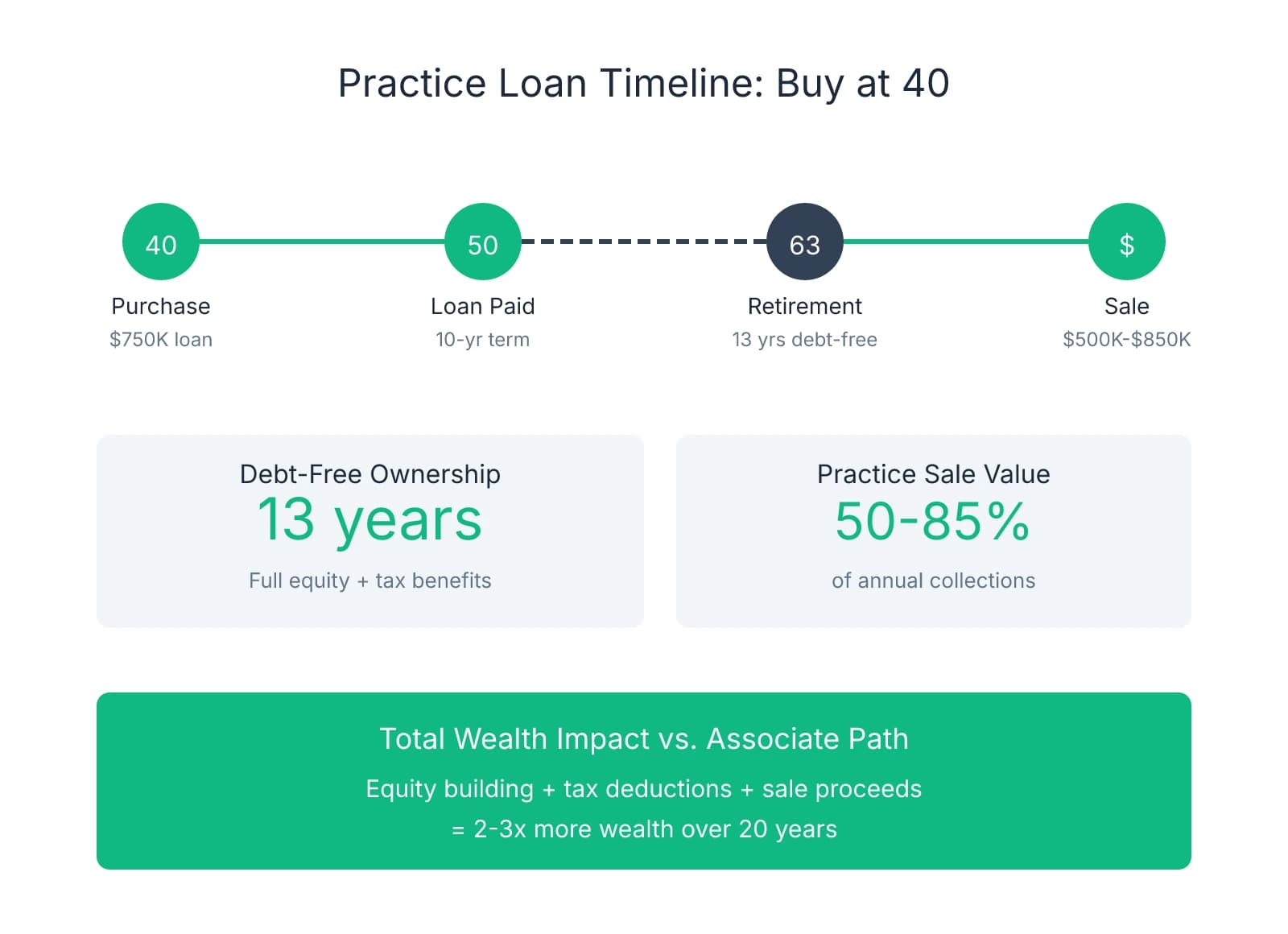
Most dental practice loans carry 10-year terms with fixed rates, though some lenders extend to 15 years for larger acquisitions. A $750,000 practice loan at 7% over 10 years runs roughly $8,700 per month. That's a significant expense, but it's structured against a revenue-generating asset—not a depreciating purchase. Every payment builds equity in something you'll eventually sell, unlike associate income that stops the day you stop working.
The equity accumulation starts immediately. Similar to a mortgage, each loan payment splits between interest and principal. In year one, you might pay $50,000 in interest and $55,000 toward principal. By year five, the ratio shifts—more of each payment reduces the loan balance and increases your ownership stake. If the practice maintains stable collections during that period, you're building equity in an asset worth 50-85% of annual revenue while simultaneously paying down debt.
That sale value matters more than most mid-career buyers realize. Practices typically sell for 50-85% of collections, depending on location, payer mix, and equipment condition. A practice collecting $1 million annually could net $500,000-$850,000 at sale. If you buy at 42, pay off the loan by 52, and sell at 65, you've owned a debt-free asset for 13 years while building equity worth half a million or more. An associate working the same timeline walks away with saved income—no equity, no sale proceeds, no transferable asset.
The tax structure accelerates the wealth-building gap. Practice owners deduct equipment depreciation, retirement plan contributions, continuing education, travel, and business expenses that associates pay with after-tax dollars. A $200,000 equipment purchase depreciates over seven years, reducing taxable income by roughly $28,000 annually. Retirement contributions through a defined benefit plan can shelter $100,000-$200,000 per year for high earners—far beyond the $22,500 limit most associates face with a 401(k). These deductions compound across a 10-15 year ownership period, often reducing effective tax rates by 10-15 percentage points compared to W-2 income.
One scenario worth calculating: a dentist who buys at 43, pays off the loan by 53, and continues ownership until 63. That's 10 years of debt-free income with no loan payment, full equity accumulation, and maximum tax efficiency. Even if collections stay flat at $800,000 annually, the practice likely sells for $400,000-$680,000. Add the tax savings, retirement contributions, and equity growth, and the total wealth built over 20 years exceeds what most associates accumulate by a factor of two or three.
The timeline concern assumes you're racing against retirement. The reality is you're building an asset that pays you twice—once through income while you own it, and again when you sell. Understanding how long it takes to break even on the initial investment helps clarify why buying at 40-45 still leaves enough runway to capture both payoffs.
What to Prioritize When You're Buying Mid-Career
The due diligence process looks different when you're buying at 40-45 than it does for a 30-year-old with unlimited runway. You're not buying potential—you're buying operational efficiency and a stable platform that lets you apply your clinical skills without rebuilding infrastructure.
Start with staff stability and retention patterns. A practice with three hygienists who've each been there 8-12 years signals systems that work and a culture that retains talent. You don't have 15 years to rebuild a team from scratch or fix broken HR processes. Where younger buyers might accept high turnover as something they'll eventually solve, mid-career buyers should treat it as a structural red flag. Pull at least three years of payroll records and note any patterns—frequent hygienist changes, front desk turnover every 18 months, or assistant churn all suggest deeper problems with compensation, management, or workplace culture that won't fix themselves after the sale.
Patient demographics matter more at this stage than raw production numbers. A practice collecting $900,000 annually looks strong until you realize 60% of active patients are over 65 with minimal restorative needs remaining. You need a patient base that supports 15-20 years of growth—balanced age distribution, family practices with children entering their peak cavity years, and community stability that suggests patients will stay local. One pattern worth examining: practices in areas with strong school systems and low residential turnover tend to retain multi-generational families, which creates natural patient flow as kids age into adulthood and start their own families. Buyers and financiers focus on recent performance, not historical potential, which makes current patient demographics more predictive than past production peaks.
Seller transition support becomes critical when you're optimizing for speed. You already have the clinical skills—what you need is accelerated relationship transfer and operational handoff. Negotiate 60-90 days of structured seller presence with defined responsibilities: patient introductions, staff meetings, insurance credentialing guidance, and referral relationship transfers. The goal isn't to shadow the seller for three months—it's to compress what would normally take 12-18 months of relationship-building into a focused transition period. The questions you ask during this process should focus less on clinical protocols and more on patient expectations, staff dynamics, and community relationships the seller has built over decades.
Systems and infrastructure should already be in place. At 40-45, you're not buying a turnaround project or a practice that needs a complete technology overhaul. Look for established recall systems with 80%+ reactivation rates, digital radiography and practice management software that's been updated within the past five years, and documented protocols for treatment planning, insurance verification, and collections. When old equipment becomes a red flag depends on whether it's functional legacy infrastructure or deferred maintenance that signals deeper operational neglect. A 12-year-old panorex that's been serviced regularly is fine. A 12-year-old autoclave with no maintenance records is a problem.
Calculate the opportunity cost of waiting another 3-5 years. Every year as an associate is a year of lost equity building, lost tax advantages, and a shorter ownership timeline before retirement. If you're earning $200,000 as an associate and could own a practice generating $250,000 in owner compensation, the gap isn't just $50,000—it's $50,000 plus the equity you're not building, the retirement contributions you're not maximizing, and the sale proceeds you're not accumulating. Compound that across five years and the cost of waiting exceeds $500,000 in total wealth impact.
The decision framework comes down to this: if you're clinically confident, financially stable, and clear on where you want to practice long-term, the cost of waiting outweighs the risk of buying. The practices that fit mid-career buyers aren't the cheapest listings or the highest-revenue opportunities—they're the ones with stable infrastructure, balanced patient demographics, and operational systems that let you focus on what you already do well. You're not too old. You're finally ready.
Sources & References
The data and claims in this article are drawn from the following sources. We prioritize government data, peer-reviewed research, and established industry publications to ensure accuracy.
- [PDF] Practice Ownership Trends in Dentistry A New Look at Old Data— ada.orgIndustry
- [PDF] Practice Ownership Trends in Dentistry A New Look at Old Data— ada.orgIndustry
- 10 Must Dos to Prepare Your Practice for Sale - ADA.org— www.ada.orgIndustry
Frequently Asked Questions
Your 40s Are Your Perfect Practice Ownership Window
Mid-career dentists bring experience, financial stability, and clinical expertise that younger buyers often lack. Minty Plus connects established dentists like you with acquisition opportunities and provides hands-on guidance through every step of ownership.