How Long Until Your Dental Practice Purchase Breaks Even?

Co-Founder, Minty Dental

In Summary
- Break-even for a dental practice acquisition is when your cumulative owner benefit (compensation + equity buildup + tax advantages) exceeds your total invested capital and opportunity cost—not when the practice becomes profitable
- Most acquisitions hit true break-even between 3-7 years, determined by debt service coverage ratio, overhead percentage, and owner compensation strategy in the first 24 months
- A $1M collection practice with 60% overhead and $7,000/month loan payment typically needs 5-6 years to recover a $100K down payment plus forgone associate income
- First-year reality: most buyers take home less than they did as associates while the practice remains profitable—that gap is the temporary cost of building equity
- The timeline compresses with strong cash flow (DSCR above 1.5x) or extends if overhead creeps above 65%, making your first 12-24 months critical
Break-Even Isn't About Profitability—It's About When the Investment Starts Paying You Back
When buyers ask "how long until this practice breaks even," they're usually asking the wrong question. The practice you're buying is likely already profitable—it covers expenses, pays the seller, and generates positive cash flow. What you're really asking is: when does this investment start building wealth for me?
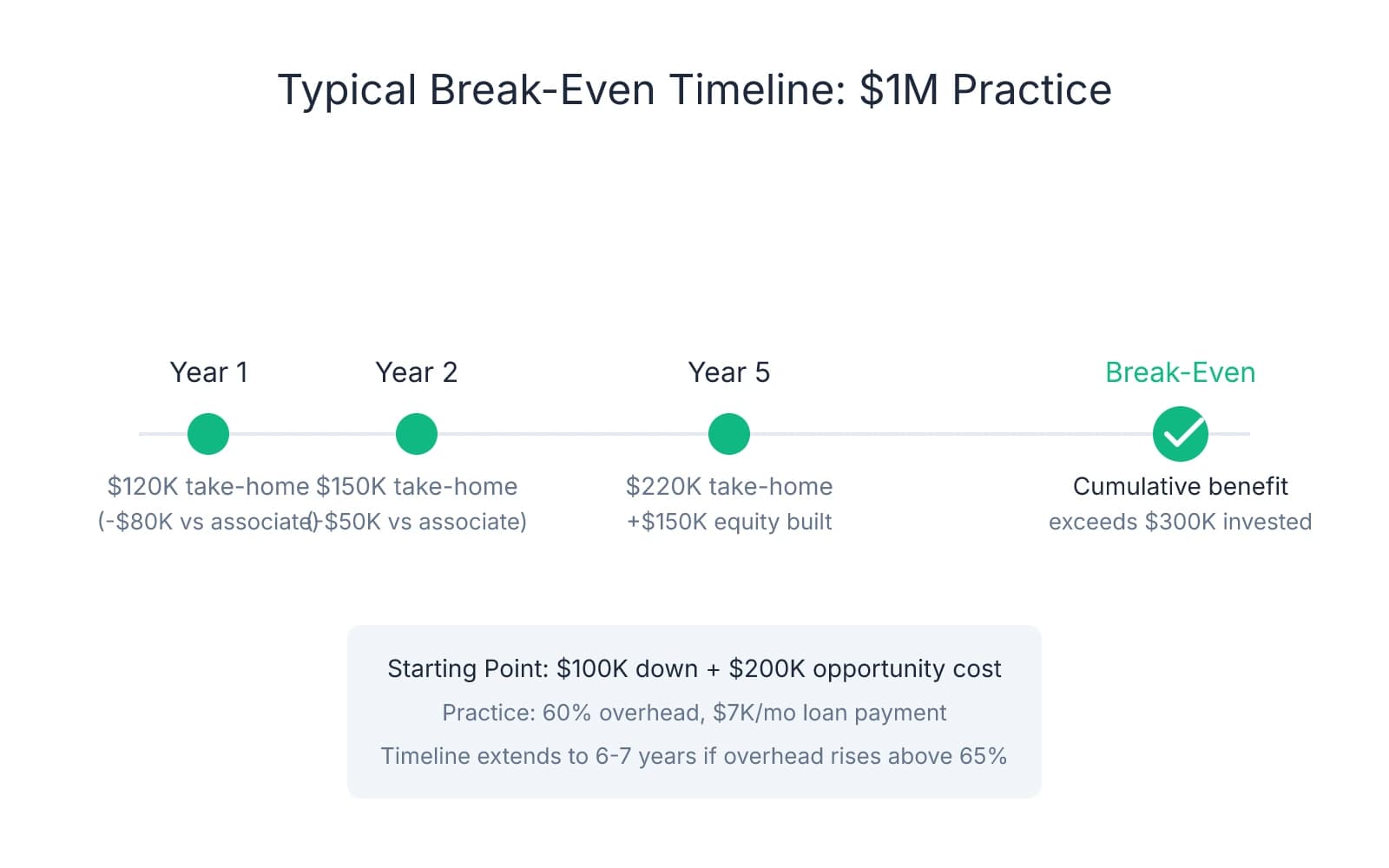
Break-even in an acquisition context means the point where your cumulative owner benefit—compensation, equity buildup, and tax advantages—exceeds your total invested capital and opportunity cost. For most practice acquisitions, that timeline runs 3-7 years, driven by three primary factors: your debt service coverage ratio, your overhead percentage, and how you structure owner compensation in the first 24 months.
Here's what that looks like in practice. Take a $1M collection practice with 60% overhead and a $7,000 monthly loan payment. If you put $100K down and left a $200K associate position to buy it, you're starting with $300K in opportunity cost. In year one, after debt service and operating expenses, you might take home $120K—$80K less than you made as an associate. Year two, assuming stable collections and controlled overhead, you might reach $150K. By year five, if you've managed overhead well and collections have grown modestly, you're taking home $220K and you've built $150K in equity through loan paydown. At that point, your cumulative benefit crosses $300K and you've hit true break-even.
The timeline compresses significantly if you buy a practice with strong cash flow. A debt service coverage ratio above 1.5x—meaning the practice generates $1.50 in net income for every $1.00 in loan payments—gives you room to take higher distributions early without starving the business. Many buyers overlook cash flow strength during due diligence, focusing instead on headline collections or seller personality, but DSCR is often the single best predictor of how quickly you'll recover your investment.
The timeline extends if overhead creeps above 65%. A practice running at 68% overhead with the same loan payment might leave you taking home $90K in year one—$110K less than your associate income. That gap takes longer to close, and the compounding effect of high overhead pushes break-even out to year six or seven.
One pattern worth noting: most first-time buyers take home less in year one than they did as associates. That's not failure—it's the cost of building equity. The transition from associate to owner involves trading short-term income for long-term wealth accumulation. The question isn't whether you'll take a pay cut in year one—it's whether the practice has the fundamentals to make that trade worthwhile by year five.
What Actually Determines Your Break-Even Timeline
Three variables control how quickly a practice acquisition pays for itself: debt service coverage, overhead percentage, and owner compensation strategy. Each one is a lever you can adjust to compress or extend your break-even timeline by years.
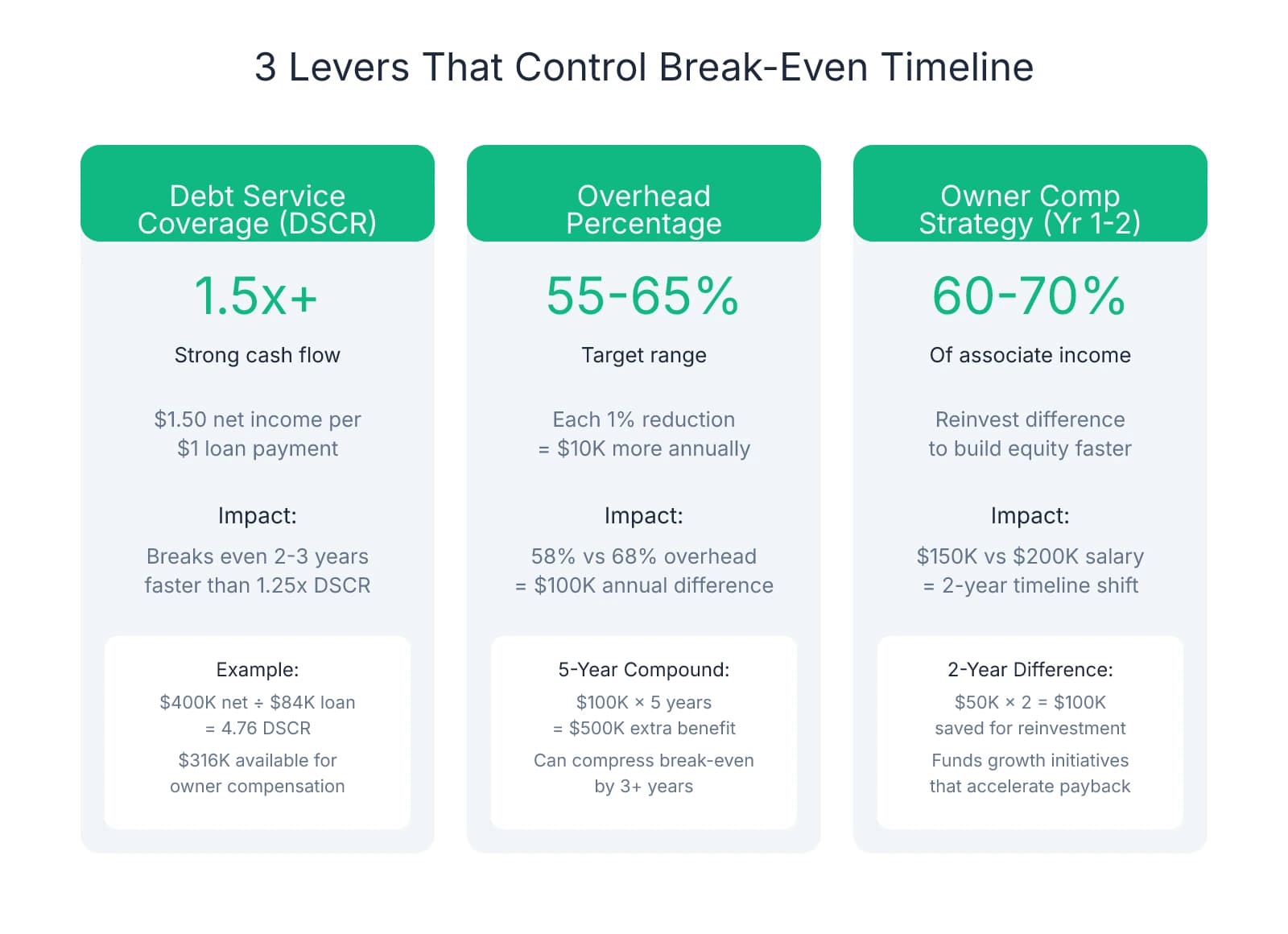
Debt service coverage ratio measures how much net income the practice generates for every dollar of loan payment. A practice with 1.5x DSCR produces $1.50 in net income for every $1.00 in debt service—that extra $0.50 per dollar is your margin for taking distributions, reinvesting in equipment, or weathering unexpected costs. Practices with DSCR above 1.5x typically break even 2-3 years faster than those running at 1.25x.
Here's what that looks like in real numbers. A $1M collection practice with 60% overhead generates $400K in net income before debt service. If your loan payment is $7,000/month ($84K annually), your DSCR is 4.76—exceptionally strong. You have $316K available for owner compensation and reinvestment. Compare that to a practice with 68% overhead generating $320K in net income. Same loan payment gives you a DSCR of 3.81, with $236K available. That $80K annual difference compounds over five years into $400K in cumulative owner benefit—often the difference between breaking even in year four versus year seven.
Overhead percentage matters more than most buyers realize. According to industry benchmarks, well-run practices target 55-65% total overhead, but many acquisitions drift higher in the first year as new owners inherit inefficient systems or fail to renegotiate vendor contracts. A practice at 58% overhead versus 68% overhead generates an extra $100K annually on $1M collections. Over five years, that's $500K in additional owner benefit—enough to compress break-even by 3+ years.
The gap widens when you account for compounding. Lower overhead in year one gives you more cash to invest in marketing, technology, or team development, which drives collection growth in years two and three. Higher overhead forces you to defer those investments, which keeps collections flat and extends the timeline. Verifying that reported overhead is accurate during due diligence is critical—sellers often understate supply costs or omit deferred maintenance expenses that surface in your first six months.
Loan structure determines monthly cash flow more than total purchase price. A 10-year term at 7.5% on $600K costs $7,122/month. A 7-year term at the same rate costs $8,500/month. That $1,400/month difference—$16,800 annually—is the margin between comfortable cash flow and financial strain. According to SBA loan data, extending the term by three years typically adds 8-12% to total interest cost but reduces monthly payment by 15-20%, which matters far more when you're managing first-year cash flow volatility.
Owner compensation strategy in years 1-3 determines timeline more than any other factor. Taking $150K salary while building equity accelerates break-even versus trying to match your $200K associate income immediately. The difference isn't just $50K in year one—it's the compounding effect of reinvesting that $50K into the practice. Many buyers underestimate how much cash the practice needs in the first 18 months to absorb hidden costs: insurance credentialing delays that push revenue out 60-90 days, patient attrition during transition (typically 8-12% in the first year), and deferred equipment maintenance that surfaces once you own the practice.
One pattern that consistently extends break-even: buyers who discover during month three that the hygiene schedule was artificially packed to inflate pre-sale revenue, or that the seller deferred $40K in equipment repairs. These issues often surface only after closing, adding 6-12 months to break-even if you didn't budget for them during due diligence.
The First-Year Cash Flow Reality Most Buyers Don't Expect
The psychological shock of year-one ownership isn't that the practice loses money—it's that despite owning a profitable business, you're often taking home less than you earned as an associate. A practice collecting $900K annually with $600K in acquisition debt typically generates $50K-80K in owner take-home during year one after debt service and overhead. For buyers leaving $180K-200K associate positions, that gap feels like failure. It's not—it's the temporary cost of building equity.
Here's where the money actually goes in a typical first year. Start with a $900K collection practice at 62% overhead, generating $342K in net income before debt service. Your loan payment on $600K at 7.5% over 10 years runs $7,122 monthly, or $85,464 annually. That leaves $256K. From there, subtract working capital reserves ($30K-40K for the first 90 days), equipment repairs that surface post-closing ($15K-25K on average), and insurance credentialing delays that push 60-90 days of production into accounts receivable limbo. What remains for owner compensation in year one often lands between $150K-180K.
Patient attrition during ownership transition typically runs 5-15%, meaning a practice collecting $900K may drop to $800K-850K in the first 6-9 months before stabilizing. According to industry transition data, the drop is steepest when the seller exits abruptly or when the buyer changes clinical protocols too quickly. That revenue dip compounds the cash flow squeeze because your loan payment stays fixed while collections fall.
Working capital needs in the first 90 days are consistently underestimated. Plan for $30K-50K in reserves beyond your down payment to cover payroll gaps, insurance credentialing delays, and unexpected repairs. The gap between when you perform procedures and when insurance pays can stretch 45-60 days, and if you're waiting on credentialing with major PPOs, that timeline extends to 90+ days. Buyers who don't budget for this gap often find themselves tapping personal savings or credit lines by month three.
The cash flow squeeze is temporary. As you pay down principal and optimize overhead, years 2-3 see significant improvement even without revenue growth. A practice that generated $75K owner take-home in year one often reaches $140K-160K by year three simply through loan amortization and overhead refinement. The principal portion of your loan payment builds equity—by year three, you've typically accumulated $60K-80K in equity through paydown alone. According to dental practice profitability benchmarks, practices that maintain overhead below 65% during the transition period see 10-15% collection growth in years 2-3 as new ownership stabilizes.
Common cash flow mistakes in year one: undercapitalizing working capital, overestimating immediate collections, and underestimating personal living expenses. Buyers who structure year-one compensation at 60-70% of their associate income and plan to scale up in year two consistently report less financial stress than those who try to match associate income immediately.
Structuring Your First Two Years to Accelerate Payback
The fastest path to break-even isn't maximizing revenue in year one—it's stabilizing cash flow, controlling overhead, and making strategic decisions about compensation and reinvestment.
Start with overhead control. Reducing overhead from 65% to 60% on $1M collections adds $50K annually to owner benefit without seeing a single additional patient. According to dental practice overhead benchmarks, the fastest gains come from three categories: supplies (where vendor pricing varies 20-30% and waste is common), lab fees (where case selection and lab relationships drive significant cost differences), and facility expenses (where lease renegotiation or utility audits often yield 10-15% savings). Renegotiating supply contracts in months 1-3 typically saves $8K-12K annually, and switching to a supply management system that tracks usage and compares pricing across vendors can add another $5K-8K in year-one savings.
Focus first-year efforts on patient retention and hygiene reactivation rather than new patient acquisition. A 10% improvement in recall compliance generates more predictable cash flow than chasing new patients, and it costs significantly less. Most practices have 200-400 patients overdue for hygiene visits—reactivating 30-40% of that list through systematic outreach adds $30K-50K in annual production with minimal marketing spend. Compare that to new patient acquisition, which costs $200-300 per patient and takes 6-9 months to convert into predictable revenue. The practices that compress break-even timelines fastest stabilize existing patient flow before investing in growth.
Debt refinancing opportunities typically emerge 18-24 months post-acquisition once you've established payment history. Dropping interest rate from 7.5% to 6.5% on $500K remaining balance saves $5K+ annually and reduces total interest paid by $25K-30K over the remaining term. If cash flow is tight in year two, extending the term and reducing monthly obligation by $800-1,200 gives you breathing room to reinvest in the practice. If cash flow is strong, keeping the term and capturing interest savings accelerates equity buildup.
The compensation decision in years 1-2 is critical. Paying yourself $150K while building equity versus taking $200K to match associate income creates a 2-year difference in break-even timeline. That $50K annual difference—$100K over two years—compounds when reinvested in the practice. It funds the hygiene reactivation campaign that adds $40K in year-two production, or the equipment upgrade that improves case acceptance by 15%, or the working capital buffer that lets you weather a slow quarter without stress.
Strategic reinvestment in technology or facility improvements should wait until year 2-3 unless directly tied to revenue retention. A $40K CBCT purchase in month six feels like a growth investment, but if case acceptance and patient flow are still stabilizing, that $40K would generate better returns sitting in working capital or paying down high-interest debt. The decision framework: if the investment directly prevents patient attrition or generates immediate revenue, make it in year one. If it's a "nice to have" that might improve efficiency over time, defer it to year two when cash flow is more predictable.
Here's the decision framework for months 1-6 versus months 7-24. In the first six months, prioritize cash flow stability: renegotiate vendor contracts, reactivate hygiene recalls, establish working capital reserves, and keep compensation conservative. In months 7-24, shift to strategic growth: invest in marketing if patient flow has stabilized, refinance debt if rates have improved, scale up compensation as cash flow allows, and make facility or technology investments that have clear ROI. The questions you asked during due diligence should inform your priorities.
The practices that hit break-even in 3-4 years share a pattern: they control overhead aggressively in year one, stabilize patient flow before chasing growth, defer personal compensation in favor of equity buildup, and make strategic reinvestment decisions based on cash flow reality rather than aspirational goals.
Sources & References
The data and claims in this article are drawn from the following sources. We prioritize government data, peer-reviewed research, and established industry publications to ensure accuracy.
- Dental Practice Profitability: 8 Powerful Income Insights Every Owner ...— kmfbusinessadvisors.com
Frequently Asked Questions
Find Your Path to Dental Practice Profitability
Purchasing a dental practice requires strategic planning to navigate the financial realities of year one. Minty Plus provides hands-on guidance through acquisition and post-close management to help you optimize profitability from day one.