Questions to Ask Before Buying a Dental Practice

Co-Founder, Minty Dental

In Summary
- Most red flags in dental practice acquisitions emerge when you ask questions that force specificity—like "Can you show me a patient aging report by last visit date?" or "What percentage of production comes from procedures you personally perform?"
- Dodgy answers or resistance to running reports altogether—indicate that the numbers might not hold up under scrutiny
- Questions about hygiene recall rates, patient tenure, and no-show patterns reveal whether patients are loyal to the practice or just showing up sporadically—the biggest predictor of post-sale retention
- Operational questions expose deferred maintenance, turnover patterns, and lease issues that can kill deals at closing or drain cash in your first year
- The goal isn't to catch sellers lying—it's to separate optimistic projections from operational reality before you commit
The Questions That Separate Real Numbers from Seller Optimism
Sellers present the best version of their numbers. The documents they provide—P&Ls, tax returns, patient summaries—rarely reveal problems. Those emerge when you ask questions that force specificity.
When a seller claims 2,000 active patients, that number means nothing until you define "active" and verify it against actual visit data. When collections look strong, you need to know whether that strength depends on procedures only the seller performs.
Can you show me a patient aging report by last visit date for the past 18 months?
This separates real active patients from inflated counts. Many practices define "active" as anyone who visited in the last 18-24 months, but a practice claiming 2,400 active patients might only have 1,200 who visit regularly.
Ask to see the report pulled directly from the practice management software while you're there. A healthy practice shows most patients concentrated in the recent 6-month window. If the distribution is flat or weighted toward older visits, the "active" patient base is smaller than advertised.
Modern practice management systems generates this report in under two minutes.
What percentage of total production comes from procedures you personally perform?
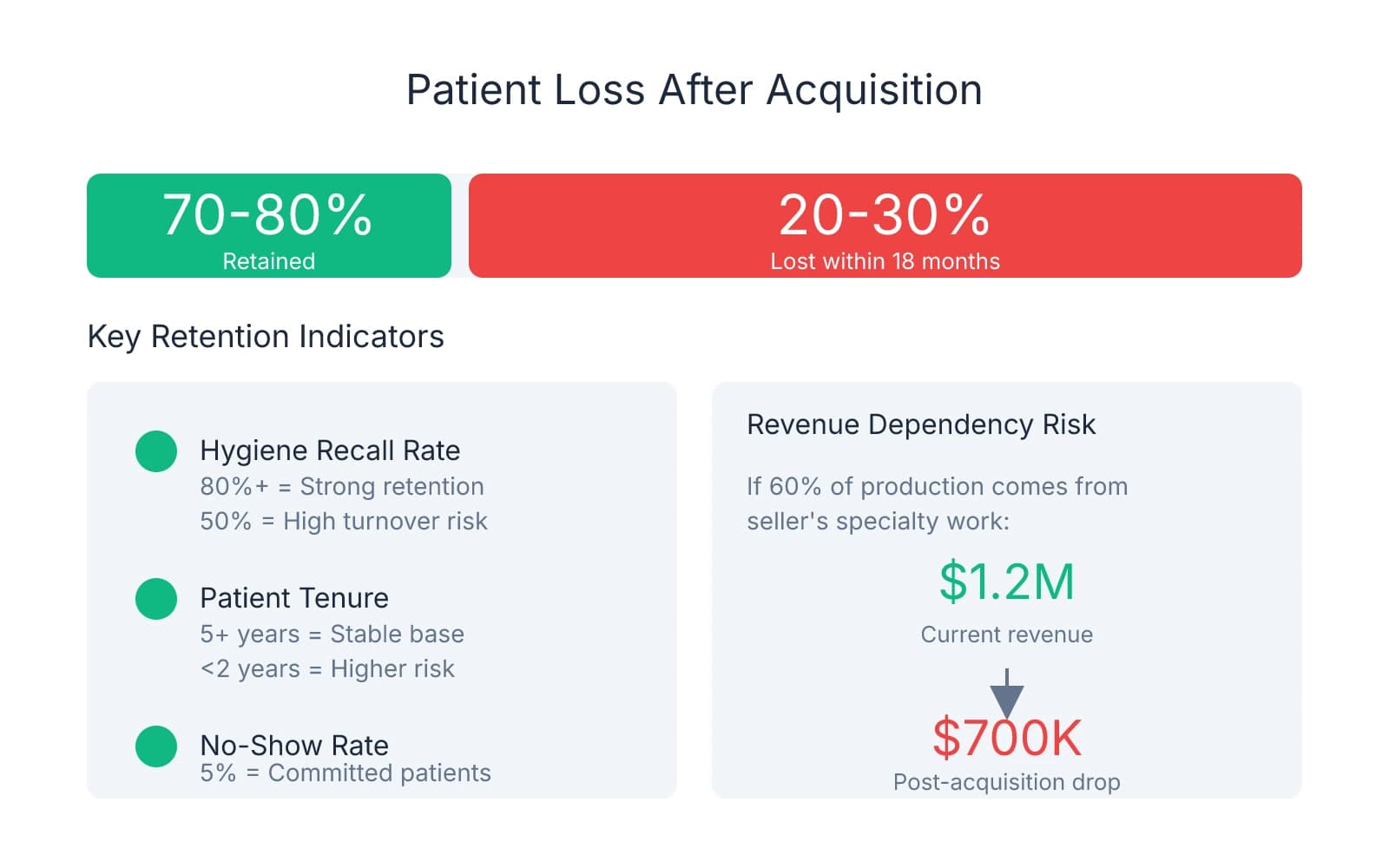
This reveals whether the practice's revenue depends on the seller's clinical skills. If 60% of production comes from implants, endo, or cosmetic cases the seller handles personally, a practice generating $1.2 million annually might drop to $700,000 if the seller's specialty work disappears.
It's important to understand how to audit a practice and understand whether seller production is propping up the financials.
How do you define an active patient, and can we run that report together from your practice management software?
This forces the seller to commit to a specific definition and prove it with real data. Running the report together eliminates manipulation. If the seller hesitates or suggests running it later, the number won't match what's in the marketing materials.
Can you walk me through your three highest-revenue months and three lowest-revenue months over the past two years?
This exposes volatility and one-time events that inflate annual collections. A practice that does $120,000 in January and $60,000 in July has a different risk profile than one that consistently produces $90,000 per month—even if the annual total is the same.
Listen for explanations that reveal structural problems: "We had a big insurance payout in March" or "The associate left in August." These tell you the baseline revenue is lower than the annual number suggests.
Before you place a bid, make sure you understand if the collections number hold up.
What answers like "I'd have to check with my accountant" actually mean
When a seller defers to their accountant or "the person who handles that," they're signaling they either don't know their numbers or the answer might not support their story.
A seller actively involved in their practice can answer questions about patient counts, production sources, and revenue trends without consulting anyone. If they can't, you're dealing with someone who hasn't been engaged—or someone avoiding specificity because the real numbers don't match the pitch.
Questions That Reveal What Patients Will Actually Do After You Take Over
Patient retention is the largest financial risk in most acquisitions. Practices often lose 20-30% of patients within 18 months of a sale, and that loss compounds quickly: lost patients don't refer new ones, yet your fixed costs remain.
What's your hygiene recall compliance rate, and how do you track it?
Hygiene recall compliance—the percentage of patients who return for scheduled cleanings—is one of the most reliable indicators of patient engagement. A practice with 80%+ recall compliance has committed patients. A practice with 50% compliance has patients who come when something hurts and disappear for years.
If the answer is "We don't really track that," the practice doesn't have systems to retain patients—and you'll start from scratch post-acquisition. Where recall sits below 70%, expect higher turnover after the sale.
How many patients have been with the practice for less than two years versus more than five years?
This reveals patient tenure and loyalty patterns. A practice with most patients in the 5+ year category has a stable base less likely to leave. A practice where most patients are newer carries higher retention risk—new patients haven't built relationships that survive transitions.
Ask for a patient tenure report from the practice management software. A healthy distribution shows a core of long-term patients with steady new patient acquisition. A distribution weighted toward recent patients suggests either rapid growth (verify it's sustainable) or high churn masked by aggressive marketing.
What procedures do you refer out, and have you tracked how many patients don't return after those referrals?
When a patient gets referred to an endodontist or oral surgeon and never comes back, that's not just lost revenue—it's a sign they found a new dental home. Practices that refer out high volumes often lose 15-20% of those patients permanently.
A seller who says "Patients always come back" without data is either unaware or unwilling to acknowledge the problem. Ask to see referral logs cross-referenced against patient visit history.
Can you show me your no-show and cancellation rates over the past year?
A practice with a 5% no-show rate has patients who value their appointments. A practice with 20% has patients who aren't committed—and systems that aren't working.
High no-show rates signal deeper problems: patients who don't value the relationship, scheduling systems that don't work, or a team that's stopped enforcing policies. These problems often worsen post-transition.
What do you think patients value most about this practice—and how much of that is tied to you personally?
This forces the seller to acknowledge relationship dependency. Listen for answers that reveal transferable value versus personal loyalty. "Patients love that we're always on time" transfers. "Patients trust me" doesn't.
A seller who can't articulate why patients would stay after they leave is telling you the practice's value is tied to their personal brand—not the systems, location, or team. Asking the right questions will ensure that you cover all your bases on due diligence.
Questions About Staff, Operations, and the Things That Break After Closing
Financial and patient questions reveal whether the numbers are real. Operational questions reveal whether the practice will still function after the seller leaves. Many buyers discover too late that the practice ran entirely on the seller's personal involvement—no documented systems, no stable team, no maintenance records.
How long has each team member been here, and have you had any positions you've struggled to keep filled?
This exposes turnover patterns and management problems. High turnover in clinical roles signals deeper issues that often accelerate post-transition. Replacing a hygienist costs $15,000-$25,000 in lost production and recruiting expenses.
Ask for a list of all employees with hire dates and any positions vacant or refilled in the past 24 months. A seller who can't provide this is hiding instability you'll inherit.
If you were gone for two weeks, what would break first?
This tests whether the practice runs on systems or the seller's personal involvement. A healthy answer identifies specific gaps: "We'd need someone to handle insurance appeals." A problematic answer reveals total dependency: "Everything would fall apart."
Practices that depend entirely on the seller don't have documented protocols, cross-trained staff, or operational redundancy. You're not buying a business—you're buying a job where you recreate every system from scratch.
When was the last time major equipment was serviced, and can I see maintenance records?
This reveals deferred maintenance and upcoming capital expenses. A practice where the compressor, autoclave, and X-ray units haven't been serviced in three years means you'll write $30,000-$50,000 in repair checks within six months.
A seller who has maintained equipment will have invoices and service logs readily available. A seller who deflects or claims records were lost has neglected equipment—budget for replacements immediately.
Does your lease allow assignment to a new owner, and what does your landlord require for approval?
This kills more deals than any other operational issue. If the lease doesn't allow assignment or requires landlord consent the landlord refuses, your lender won't fund the deal.
Ask to see the lease and identify the assignment clause. Look for "Landlord may withhold consent at its sole discretion"—that gives the landlord full control to block the sale. Better language includes "consent not to be unreasonably withheld."
A seller who says "The landlord is great, it won't be a problem" without showing you the lease is setting you up for a deal that collapses at closing. For more on post-close problems, see 5 Problems Every Practice Buyer Faces (And How to Handle Each One).
What's your current staff compensation structure, and are there any informal arrangements or promises I should know about?
This reveals hidden obligations you'll inherit. Many sellers make informal promises—bonus structures, PTO accruals, verbal commitments about raises—that aren't documented but become your problem when employees expect you to honor them.
Ask for written compensation details for every employee, then ask directly: "Are there any informal arrangements I should know about?" A seller who hesitates is avoiding specificity because those arrangements exist and will surface after closing.
How to Ask These Questions Without Killing the Deal
These questions work—but only if you can ask them without making the seller defensive. Frame a question as an accusation and you'll get evasive answers. Frame it as collaborative due diligence and you'll get the information you need.
Lead with "Help me understand" instead of "Prove this to me"
Instead of "Can you prove you have 2,000 active patients?" try "Can you help me understand how you define active patients and show me how that breaks down in the system?" The first sounds like you're calling them a liar. The second sounds like you're learning their methodology.
Use phrases like:
- "Walk me through how you track..."
- "Help me understand what drives..."
- "Show me how you define..."
These signal collaboration, not confrontation.
Ask broad questions first, then follow up with specific data requests
Start with open-ended questions: "What do you think drives patient retention here?" Listen, then follow up: "That makes sense—can we pull a recall compliance report so I can see how that's tracked?"
This sequencing gives sellers a chance to volunteer information before you ask for proof. Your follow-up request feels like a natural next step rather than a challenge.
What to do when a seller says "I don't have that information"
Offer to help generate it: "No problem—can we pull it together from your practice management software while I'm here?" This removes the excuse. If the data exists, you'll get it. If it doesn't, you've confirmed the seller genuinely doesn't track what they claimed—which is itself valuable information.
Where a seller says "I'd have to check with my accountant," set a specific deadline: "That works—can you send that over by Friday?" If Friday comes without the information, that delay is your signal. Sometimes, the right move is to walk away.
When evasive answers should change your deal structure
Evasive answers don't always mean you walk away—but they should change how you structure protection. If a seller can't verify patient retention or revenue stability, those unknowns become risks you offset with earnouts, extended transition periods, or seller financing with clawback provisions.
An earnout ties purchase price to post-close performance. Extended transition periods give you time to verify claims and address problems. Holdbacks let you withhold a portion of the purchase price for 6-12 months, releasing it only if the practice performs as represented.
Where a seller resists these structures after providing evasive answers, that resistance tells you they know the numbers won't hold up.
When the pattern of non-answers means it's time to walk
A single evasive answer isn't a dealbreaker—but a pattern of deflection, delays, and missing documentation is. Walk away when:
- Multiple documentation requests go unfulfilled despite follow-ups
- The seller becomes defensive when you ask for verification
- Key claims can't be supported with data
- The seller pressures you to "just trust me" without answering questions
The time to walk is before you've spent $15,000 on legal fees and committed to a closing date.
Sources & References
The data and claims in this article are drawn from the following sources. We prioritize government data, peer-reviewed research, and established industry publications to ensure accuracy.
- Dental Acquisition Due Diligence: Patient Retention Red Flags— mybcat.com
- Red Flags to Watch for When Buying a Dental Practice— engageadvisors.com
Frequently Asked Questions
Find Your Next Practice With Confidence
Armed with the right questions, you're ready to evaluate dental practices thoroughly. Minty Plus connects you with experienced advisors who guide you through due diligence and help you avoid costly mistakes when acquiring your next practice.