What to Negotiate in Your Dental Practice Letter of Intent

Co-Founder, Minty Dental

In Summary
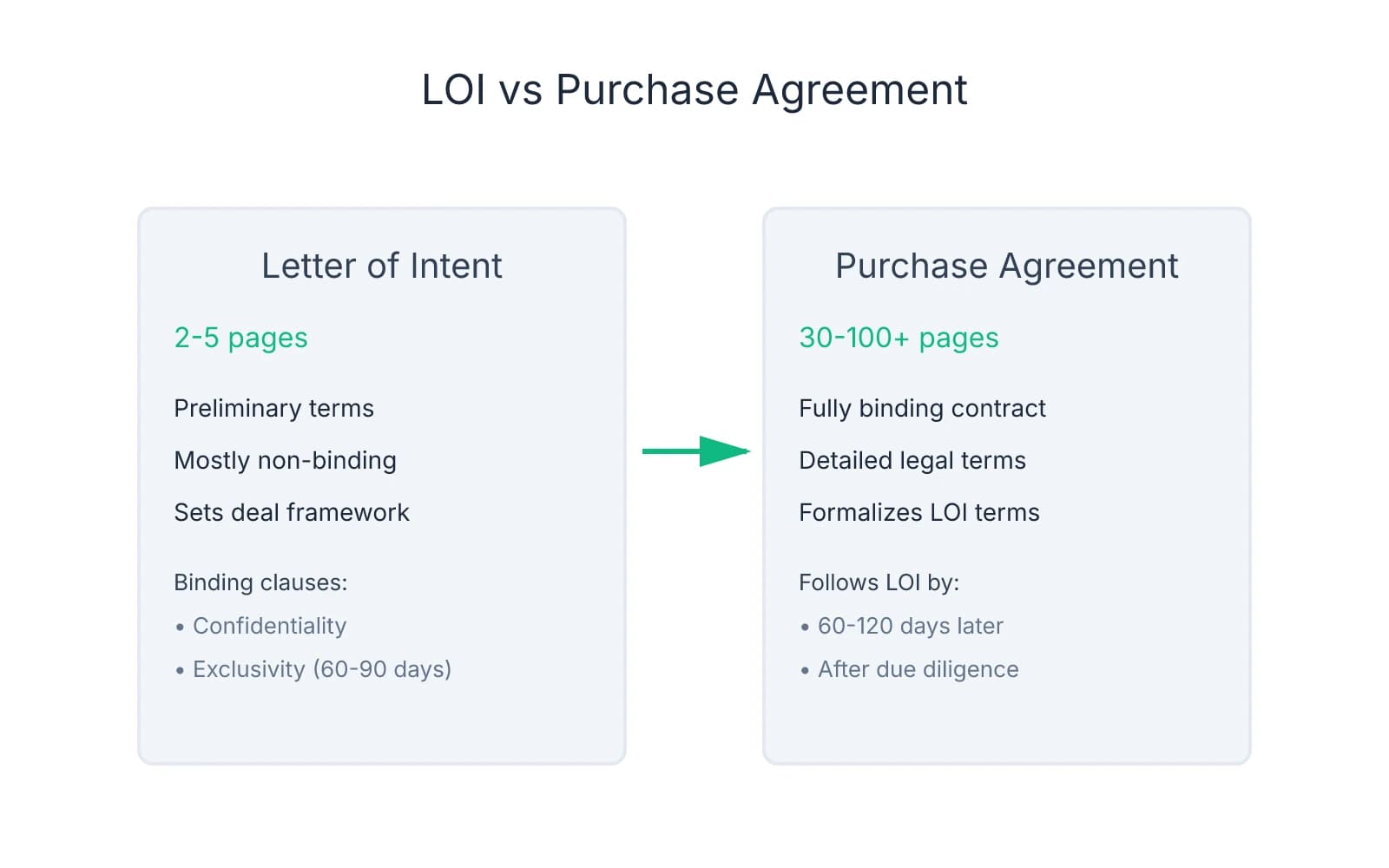
- The LOI is a 2-5 page preliminary agreement outlining major deal terms, while the purchase agreement that follows 60-120 days later is a 30-100+ page binding contract
- Most LOI provisions are non-binding, but confidentiality and exclusivity clauses typically become binding the moment you sign
- Terms you agree to in the LOI create the negotiating baseline—changing them later during the purchase agreement phase requires reopening discussions when you have less leverage
- Buyers who treat the LOI as paperwork often discover they've locked themselves into unfavorable deal structures by the time due diligence reveals the real risks
The LOI Sets the Deal Framework—Not Just the Price
The letter of intent sits in an unusual position: it feels preliminary, but it shapes everything that follows. Most buyers focus on the headline purchase price and assume the real negotiating happens later. What they miss is that the LOI establishes the deal's architecture—the allocation of risk, the transition structure, the contingencies that protect you if something goes wrong.
By the time you're negotiating the purchase agreement 60-120 days later, the LOI has already set expectations. The seller sees those terms as the baseline. If you want to change something material—say, extending the seller's transition period from 30 days to 90, or adding a clawback provision tied to patient retention—you're not just negotiating, you're renegotiating. That's a harder conversation when you're deep into due diligence and emotionally committed.
The LOI itself is typically 2-5 pages of preliminary terms, covering purchase price, payment structure, transition support, and key contingencies. The purchase agreement that follows is a 30-100+ page binding contract that formalizes every detail. Most LOI provisions are non-binding—they're statements of intent, not legal obligations. But two sections almost always carry binding weight the moment you sign: confidentiality and exclusivity. The confidentiality clause protects the seller's patient data, financials, and proprietary information. The exclusivity clause prevents the seller from entertaining other offers for a defined period, usually 60-90 days. If you breach either, you've created legal exposure before the deal even closes.
Where buyers get caught is assuming they can revisit unfavorable terms once they see the full financial picture. In practice, that rarely works. The seller has already moved forward based on the LOI's structure. Your lender has underwritten the deal using those terms. If you try to renegotiate after due diligence uncovers issues—say, the seller's production is propping up collections, or patient retention is weaker than represented—you're asking the seller to absorb risk they thought was settled. Many sellers walk at that point, or they hold firm and force you to decide whether to proceed anyway.
One pattern worth paying attention to: buyers who negotiate the LOI carefully tend to have smoother purchase agreement phases. They've already addressed the structural risks—transition support, earnout triggers, working capital adjustments—so the purchase agreement becomes a matter of formalizing what both sides already agreed to. Buyers who rush through the LOI often find themselves fighting uphill battles during due diligence, when they have the least leverage and the most to lose if the deal falls apart.
The LOI isn't just a formality. It's the foundation. What you negotiate here determines how much risk you carry, how much flexibility you retain, and whether the deal structure protects you if the practice underperforms in the first year.
Price Structure and Payment Terms Worth Negotiating Now
A $1 million all-cash deal and a $700,000 cash plus $300,000 earnout structure are fundamentally different transactions, even if the headline number looks similar. The first gives you immediate ownership with no performance contingencies. The second ties a substantial portion of your purchase price to hitting targets you'll need to achieve while managing a practice you're still learning to run.
The LOI is where you define how and when you'll actually pay for the practice. If the deal includes seller financing, specify the interest rate, repayment term, and whether payments are subordinated to your bank loan. If it includes an earnout, define the measurement period (typically 12-24 months), the performance metrics (usually collections or EBITDA), and the exact calculation method. Vague language like "earnout based on practice performance" creates room for disputes later. You want formulas, thresholds, and timing spelled out now—not negotiated during the purchase agreement phase when you've already committed.
Earnout structures are common when sellers want to capture future growth they believe the practice will achieve under new ownership. The challenge is you're betting on your ability to maintain or grow production in a practice you don't yet understand, with patients who haven't decided whether they'll stay, using systems you haven't mastered. If the earnout is tied to collections, clarify whether it's measured on cash collected or services rendered. If it's tied to patient retention, define how retention is calculated and what happens if the seller's hygienist leaves three months after closing.
Accounts receivable represent another structural decision that affects both price and cash flow. In some deals, the purchase price includes AR and you collect it post-closing. In others, the seller retains AR and you start with a clean slate. If AR is included, you're paying for revenue the practice already earned but hasn't collected yet—which means you're fronting cash for work you didn't do, with no guarantee patients will actually pay. If AR is excluded, your post-closing cash flow starts slower because you're waiting 30-60 days for your own production to convert to collections. Neither approach is inherently better, but the structure needs to match your financing and working capital plan.
Working capital adjustments can shift tens of thousands of dollars after closing, and most buyers don't see them coming. Working capital is the practice's current assets (cash, AR, inventory) minus current liabilities (payables, accrued expenses). If the practice's working capital at closing is lower than the target level specified in the LOI, you get a credit. If it's higher, you owe the seller more. The challenge is that "target working capital" is often defined vaguely in the LOI, or not defined at all, which creates room for disagreement when the final numbers come in 90 days post-closing.
One protection many buyers overlook is establishing the target working capital level and adjustment mechanism directly in the LOI. This means calculating an average working capital balance based on the trailing 12 months of financials, then specifying that the purchase price will be adjusted dollar-for-dollar if the closing balance deviates from that target. Without this language, you're negotiating the adjustment formula during due diligence, when the seller has less incentive to agree to buyer-friendly terms. The working capital true-up happens months after you've taken ownership, and by then you've already committed to the deal.
Payment structure also determines your financing options. Lenders treat all-cash deals, seller-financed deals, and earnout structures differently. If 20-30% of the purchase price is deferred through seller financing, that reduces the amount you need to borrow and can improve your debt service coverage ratio. If a large portion is tied to an earnout, your lender may not count that toward the purchase price for underwriting purposes, which means you'll need more cash or a larger loan to cover the guaranteed portion.
The key is making the payment structure explicit in the LOI—not as a general concept, but as a specific set of terms with defined calculations, timelines, and contingencies. When the structure is clear upfront, the purchase agreement becomes a matter of formalizing what both sides already agreed to. When it's vague, you're renegotiating deal terms during due diligence, which is exactly when you have the least leverage to push back.
Exclusivity, Due Diligence, and Contingencies That Protect Your Position
Three provisions in the LOI control how much time you have to evaluate the practice, whether the seller can walk away to pursue other offers, and what happens if the deal falls apart. These determine whether you can conduct real due diligence or whether you're forced to make a binding decision based on incomplete information.
Exclusivity periods typically run 60-120 days, giving you a protected window to complete due diligence, secure financing, and finalize the purchase agreement without competing against other buyers. The seller agrees not to solicit or entertain offers from anyone else during this period. In exchange, you're expected to move forward in good faith—meaning you're actively working toward closing, not using the exclusivity period to shop for better deals elsewhere. Sellers resist anything longer than 90-120 days because it takes their practice off the market during peak selling season. Buyers need enough time to verify collections, review patient records, assess staff dynamics, and close financing without rushing. Most lenders need 60-90 days to underwrite and fund a practice acquisition loan, which means your exclusivity period needs to accommodate that timeline or you'll be negotiating the purchase agreement before you know whether you can actually finance the deal.
Where buyers often get burned is accepting a 10-14 day due diligence window because it feels reasonable in the moment. Ten days isn't enough to pull three years of P&L statements, compare reported collections against deposit records, interview the office manager about billing practices, and assess whether the seller's production is masking underlying patient retention issues. A realistic due diligence period runs 30-45 days minimum—long enough to verify the financial representations in the LOI and uncover any structural problems before you're contractually committed.
The due diligence period also defines what you're allowed to inspect. Some LOIs grant broad access to financials, patient records, staff files, and lease terms. Others limit you to summary-level information until the purchase agreement is signed. The difference matters because you're trying to answer specific questions: Are collections consistent across the trailing 24 months, or did they spike recently? Is the seller's hygienist planning to stay, or are they leaving with the seller? Does the lease allow assignment to a new owner, or does the landlord have approval rights that could kill the deal? You need access to the underlying records, and the LOI is where you secure that access.
Contingencies are your exit ramps—the conditions that must be satisfied before you're obligated to close. Standard contingencies include financing approval, lease assignment, and license transfer. These protect you if your lender declines the loan, the landlord refuses to assign the lease, or the state dental board delays your license application. Most sellers accept these as reasonable because they're outside your control. Where sellers get nervous is when buyers add excessive contingencies—partner approval, board approval, "satisfactory due diligence"—that feel like ways to back out for any reason.
One structural decision that affects both parties is whether your deposit is refundable if a contingency isn't met. In most deals, you'll put down 5-10% of the purchase price as an earnest money deposit when the LOI is signed. If financing falls through or the lease can't be assigned, you want that deposit back. If you simply change your mind or fail to pursue financing in good faith, the seller expects to keep it as compensation for taking the practice off the market. The LOI should specify exactly which contingencies trigger a refund and which don't.
What tends to work across deals is that buyers who negotiate a realistic due diligence period and limit contingencies to the truly essential ones maintain seller trust throughout the process. They've built in enough time to verify the practice's condition without creating the impression that they're looking for reasons to walk away. Buyers who ask for 120-day exclusivity, 60-day due diligence, and five contingencies often find that sellers question their seriousness—and in competitive markets, that's enough to lose the deal to another buyer who's willing to move faster with fewer protections.
The goal isn't to eliminate all risk. It's to negotiate enough time and flexibility to make an informed decision, while demonstrating to the seller that you're a committed buyer who's prepared to close if the practice matches what was represented.
Transition Support and Non-Compete Terms That Preserve Practice Value
Two provisions in the LOI directly determine whether patients stay with the practice after you take ownership: the seller's transition period and the non-compete agreement. These are structural protections that preserve the goodwill you're paying for.
A structured transition period typically runs 60-90 days, during which the seller remains involved in the practice with defined responsibilities. This isn't about keeping the seller on payroll indefinitely. It's about creating a handoff process that maintains patient confidence during the ownership change. Patients are more likely to return when they receive a personal introduction to the new dentist from someone they trust—their former provider. Without that bridge, many patients simply stop scheduling appointments, and your revenue drops before you've had a chance to establish your own relationships.
The transition period should specify what the seller will actually do. Patient introductions—both in-person during appointments and through written communication—give you credibility with patients who've never met you. Staff training ensures you understand the practice's clinical workflows, billing systems, and patient management protocols before the seller leaves. Clinical handoffs for complex cases—ongoing ortho, implant planning, perio maintenance—prevent treatment gaps that erode patient trust. Where deals go sideways is when the transition period is defined vaguely in the LOI as "seller will assist with transition as needed," which creates room for the seller to show up twice and disappear, or for you to expect full-time involvement when the seller planned to be minimally present.
Negotiate the seller's compensation during the transition period directly in the LOI—typically structured as a daily rate or percentage of collections—to avoid disputes later. Some buyers assume the seller will participate in the transition as part of the sale. Some sellers assume they'll be paid at their full associate rate for every day they're present. If you don't define this in the LOI, you're renegotiating compensation during the purchase agreement phase when both sides have already committed. A common structure is paying the seller a per diem rate for scheduled transition days, or a percentage of collections they personally generate during the transition period, with a defined cap on total transition compensation.
The non-compete agreement protects the goodwill you're purchasing by preventing the seller from opening a competing practice nearby or taking patients to another location. Non-compete terms typically include a 3-5 year duration and a 5-10 mile radius, though urban practices may use a smaller radius (3-5 miles) while rural practices need a larger one (10-15 miles) to reflect realistic patient draw patterns. The radius should match where patients actually live—if 80% of your patients drive from within 7 miles, a 5-mile non-compete leaves a gap where the seller could open a new practice and recapture a significant portion of the patient base.
Clarify what the non-compete actually restricts. Does it prevent the seller from opening a new practice, working as an associate at another office within the radius, or both? Does it restrict the seller from soliciting patients and staff, or just from treating patients who seek them out independently? A non-compete that prohibits "practicing dentistry within 10 miles" but allows the seller to work as an associate three miles away doesn't protect you. Define the restricted activities explicitly: no ownership interest in a competing practice, no employment as a dentist within the radius, no solicitation of patients or staff for a defined period.
Sellers sometimes negotiate carve-outs that allow them to teach at a local dental school, cover emergencies for another dentist, or provide limited consulting services. These carve-outs are reasonable if they're narrow and don't undermine the non-compete's purpose. What you're protecting against is the seller opening a new practice, joining a nearby group, or systematically contacting patients to move their care elsewhere—not preventing them from teaching students or covering a colleague's vacation for a few days per year.
The non-compete and transition period work together. A fair transition period—where the seller is compensated appropriately and has clear responsibilities—makes the seller more willing to honor the non-compete because they feel the deal treated them fairly. A reasonable non-compete—one that restricts competitive activity without preventing the seller from working entirely—makes you more confident that the goodwill you're paying for will actually transfer. When both provisions are structured well in the LOI, they create mutual protection: the seller knows they'll be compensated for their transition support, and you know the seller won't undermine your investment by competing against you the day after closing.
If the seller resists a transition period or pushes back on a standard non-compete radius, that's worth examining. It may signal they're planning to return to practice sooner than they've indicated, or that they're not fully committed to ensuring the practice succeeds under new ownership. Either way, these terms belong in the LOI—not deferred to the purchase agreement—because they directly affect the practice's value and your willingness to proceed with the deal.
Sources & References
The data and claims in this article are drawn from the following sources. We prioritize government data, peer-reviewed research, and established industry publications to ensure accuracy.
- Dental Practice Letter Of Intent (LOI)- 12 Essential Terms For A ...— odgerslawgroup.comIndustry
- Earnout Agreements and Structures: A Business Owner's Guide with ...— www.axial.netIndustry
- Transition Period in Dental Acquisitions - Kamkari Law— www.dentalmedicalattorney.comIndustry
- Understanding Restrictive Covenants When Selling Your Dental ...— ameriprac.comIndustry
Frequently Asked Questions
Ready to negotiate your practice acquisition?
Understanding LOI terms is crucial, but having expert guidance through the entire acquisition process makes all the difference. Minty Plus provides hands-on support to help you navigate negotiations and close your practice purchase with confidence.