Working Capital Adjustments at Dental Practice Closing

Co-Founder, Minty Dental

In Summary
- Working capital is the amount of short-term assets a practice has available to cover its short-term obligations and keep daily operations running smoothly.
- Working capital adjustments reconcile the difference between a negotiated target and actual working capital at closing, resulting in dollar-for-dollar price changes—often discovered 60-90 days after you've already taken ownership
- If actual working capital falls $50,000 below the peg, you receive a refund; if it's $50,000 above, you owe the seller more—making the adjustment a direct modifier to what you actually pay
- The peg calculation method matters as much as the number itself—a target set using a seasonal peak rather than a trailing 12-month average can leave you writing an unexpected check months after closing
- Most disputes center on accounts receivable collectibility, inventory obsolescence, and understated liabilities—all preventable through detailed due diligence and clear purchase agreement language
What is Working Capital, and why is it important?
In the transition period of a dental practice acquisition, working capital is the pool of money and short-term assets that allows the practice to continue operating normally while cash flow is temporarily misaligned due to the ownership change.
The key issue is timing: on the day you close, you take over the obligation to pay expenses immediately—but much of the cash associated with recent production hasn’t been received yet.
This typically includes:
Assets (things that will turn into cash):
- Cash and bank balances – operating accounts, petty cash
- Accounts receivable (AR) – insurance claims owed but not yet paid, patient balances
- Supplies inventory – gloves, composites, impression material, disposables
- Prepaid expenses – prepaid lab fees, insurance premiums, software subscriptions
Liabilities (things that will cost you cash):
- Accounts payable (AP) – unpaid lab bills, supplier invoices
- Accrued payroll and payroll taxes – wages owed but not yet paid
- Credit card balances – practice credit cards used for supplies or expenses
- Short-term debt – equipment loans or lines of credit due within a year
- Accrued expenses – utilities, rent owed but not yet paid
Working Capital Adjustments Change the Price You Actually Pay—Usually After Closing
The purchase price you negotiate during the letter of intent phase isn't necessarily the price you'll pay. In most dental practice acquisitions, the final number gets adjusted after closing through a mechanism called the working capital true-up—a reconciliation process that compares the practice's actual working capital at closing to a negotiated target level.
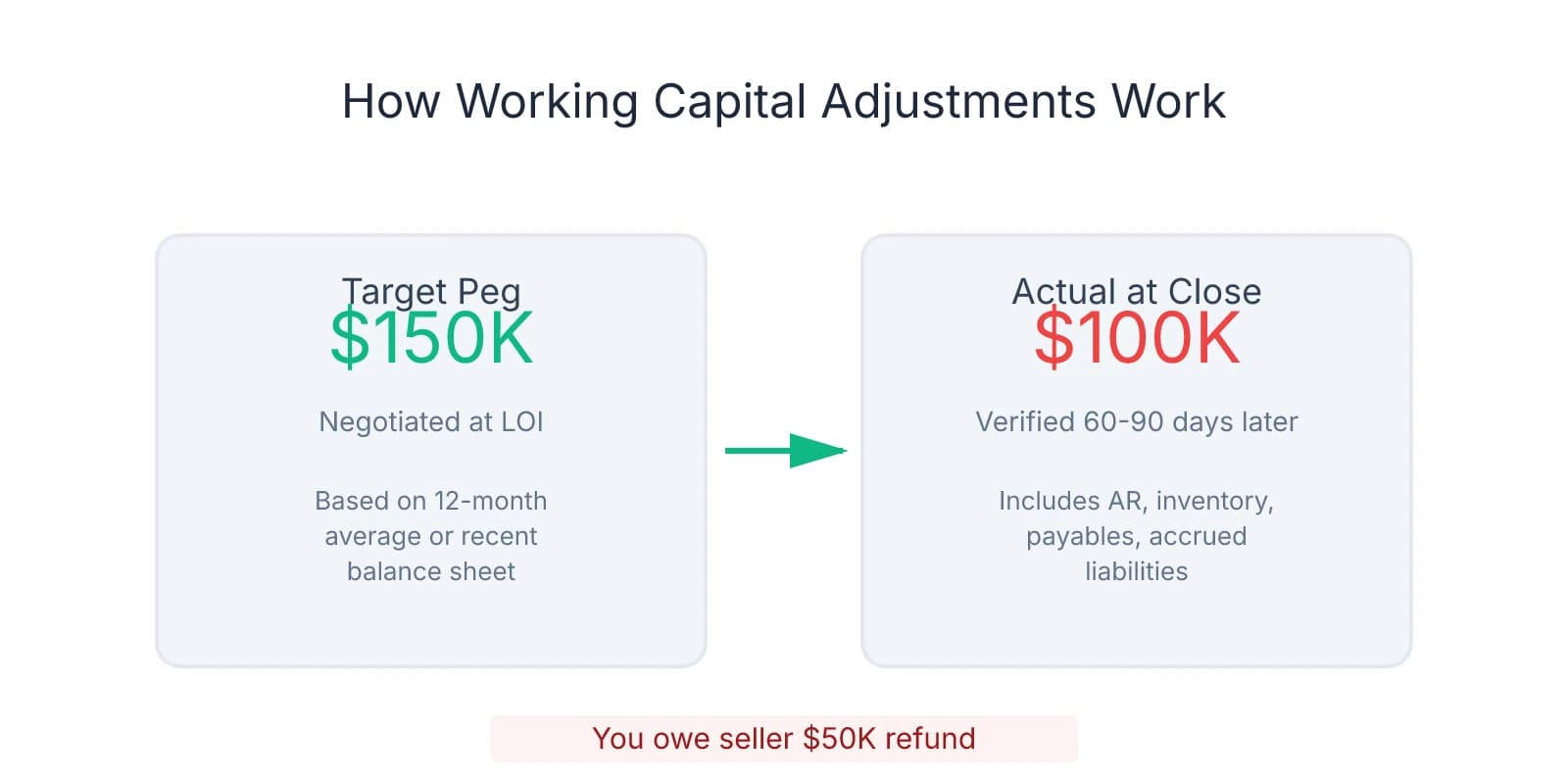
During the LOI or purchase agreement stage, you and the seller agree on a "target" or "peg" working capital amount—typically based on historical averages or the practice's recent balance sheet. This peg represents the level of short-term liquidity the seller is expected to deliver at closing. According to Baker Tilly, the target working capital is essential because it works in tandem with the valuation—any shortfall reduces the value of the company, and vice versa.
After closing, usually within 60 to 90 days, you or a third-party accountant reviews the actual balance sheet accounts to calculate the delivered working capital. The difference between the peg and the actual amount results in a dollar-for-dollar adjustment to the purchase price. If actual working capital is $50,000 below the peg, you receive $50,000 back. If it's $50,000 above, you owe the seller $50,000 more.
In dental practice acquisitions, working capital typically includes accounts receivable, inventory (supplies, lab materials), prepaid expenses (insurance, rent deposits), accounts payable, and accrued liabilities. Cash and debt are usually excluded—those are handled separately in the purchase agreement.
The tension most buyers face is that the working capital peg gets set during negotiation, often without a detailed review of the balance sheet. Many buyers treat it as a formality, assuming the seller's accountant provided accurate numbers. But what buyers miss when evaluating a dental practice often includes the composition of those working capital accounts—aged receivables that won't collect, overstated inventory, or liabilities that weren't disclosed.
By the time the true-up happens, you've already closed. You've already taken on the practice's operations, staff, and patient base. The adjustment becomes a financial surprise at a moment when you're least equipped to absorb it. Buyers who negotiate the peg carefully during the LOI phase tend to avoid post-closing disputes. Those who treat it as boilerplate often find themselves writing an unexpected check 90 days after closing.
The Peg Calculation Determines Whether You Win or Lose on the Adjustment
The working capital peg isn't just a number—it's the baseline that determines whether you walk away from closing with a refund or an unexpected bill. In most dental practice transactions, the peg is calculated using a trailing 12-month average of working capital. But sellers often push for methods that result in a higher target, which increases the likelihood you'll owe money at the true-up.
The calculation method matters as much as the number itself. If the peg is set using the most recent month-end balance, and that month happened to be December—when many practices carry elevated inventory and higher payables due to year-end supply orders—you're locked into a target that doesn't reflect normal operating levels. When actual working capital at closing reverts to the mean, you'll owe the difference.
According to Prairie Capital Advisors, the net working capital adjustment ensures the buyer receives sufficient working capital to operate without requiring an immediate capital injection. That protection only works if the peg reflects the actual liquidity needed to run the practice—not an artificially inflated snapshot.
Accounts Receivable Changes the Entire Calculation
In dental practice acquisitions, whether accounts receivable is included in the sale dramatically changes the working capital calculation. Many deals exclude AR entirely—the seller retains the right to collect outstanding patient and insurance balances, and the buyer starts fresh with zero receivables. But even when AR is legally excluded, AR-related liabilities often transfer operationally.
Unapplied credits, insurance overpayments, and patient refund obligations don't disappear just because AR was excluded from the purchase agreement. These balances sit in the practice management system, and patients and insurers expect resolution. After closing, buyers frequently discover they're responsible for refunding overpayments or writing off credits that should have been reconciled before the transaction.
Where this gets expensive: if the peg was calculated including AR but the sale excluded it, you're delivering less working capital than the target assumes—and you'll owe the seller the difference. Conversely, if the peg excluded AR but included AR-related liabilities, you're inheriting obligations without the corresponding asset to offset them. How to know if dental collections are real before you buy becomes critical here—because unapplied credits and overpayments are often symptoms of weak AR management.
Inventory Valuation Rarely Reflects What You'll Actually Use
Inventory is another line item where the peg calculation often diverges from operational reality. The seller's accountant typically values inventory at cost, but that doesn't account for expired supplies, slow-moving stock, or items specific to the seller's clinical preferences that you won't use.
One protection many buyers overlook is requiring a physical inventory count at closing, with adjustments for expired or obsolete items. If the peg assumes $40,000 in inventory but $10,000 of that is expired composite or outdated lab materials, you're delivering $30,000 in usable working capital—not $40,000. The $10,000 difference comes out of your pocket at the true-up.
During due diligence, review the inventory list and flag any items that don't align with your clinical approach. If the seller uses a specific implant system you don't, or carries six months of supply for a procedure you rarely perform, those items have limited value to you. Negotiate either a lower peg or an exclusion for non-transferable inventory.
Seasonality Distorts the Peg If You're Not Careful
Seasonality matters more in dental practices than most buyers realize. A practice with heavy summer production may show artificially high working capital in July—elevated AR from busy months, higher inventory to support volume, and lower payables because the seller paid down balances before vacation season. That same practice in December may show low working capital due to holiday slowdowns and deferred supply orders.
If the peg is set using a single month-end balance rather than a normalized average, you're either benefiting from or penalized by timing. The right questions to ask when looking to acquire a dental practice include how the seller's accountant calculated the peg and whether it accounts for seasonal variation.
Sellers prefer methods that result in a higher peg, because it increases the likelihood of a post-closing payment from the buyer. Buyers who accept the seller's proposed calculation without scrutiny often find themselves writing a check 90 days after closing—not because working capital declined, but because the peg was set at a seasonal peak that was never sustainable.
What Gets Disputed in the True-Up Process (and How to Avoid It)
The true-up process follows a predictable timeline, but the disputes that arise during it are rarely predictable. In most dental practice transactions, the buyer has 30 to 60 days after closing to prepare a closing balance sheet that calculates actual working capital. The seller then has 15 to 30 days to review and dispute the calculation. If the parties can't agree, an independent accountant—often specified in the purchase agreement—arbitrates the disagreement.
According to Alvarez & Marsal, parties frequently underappreciate the importance of the working capital adjustment until after closing when disputes arise. By that point, you've already taken ownership, and the financial outcome depends on how well you documented the balance sheet during due diligence.
Accounts Receivable Collectibility Drives Most Disputes
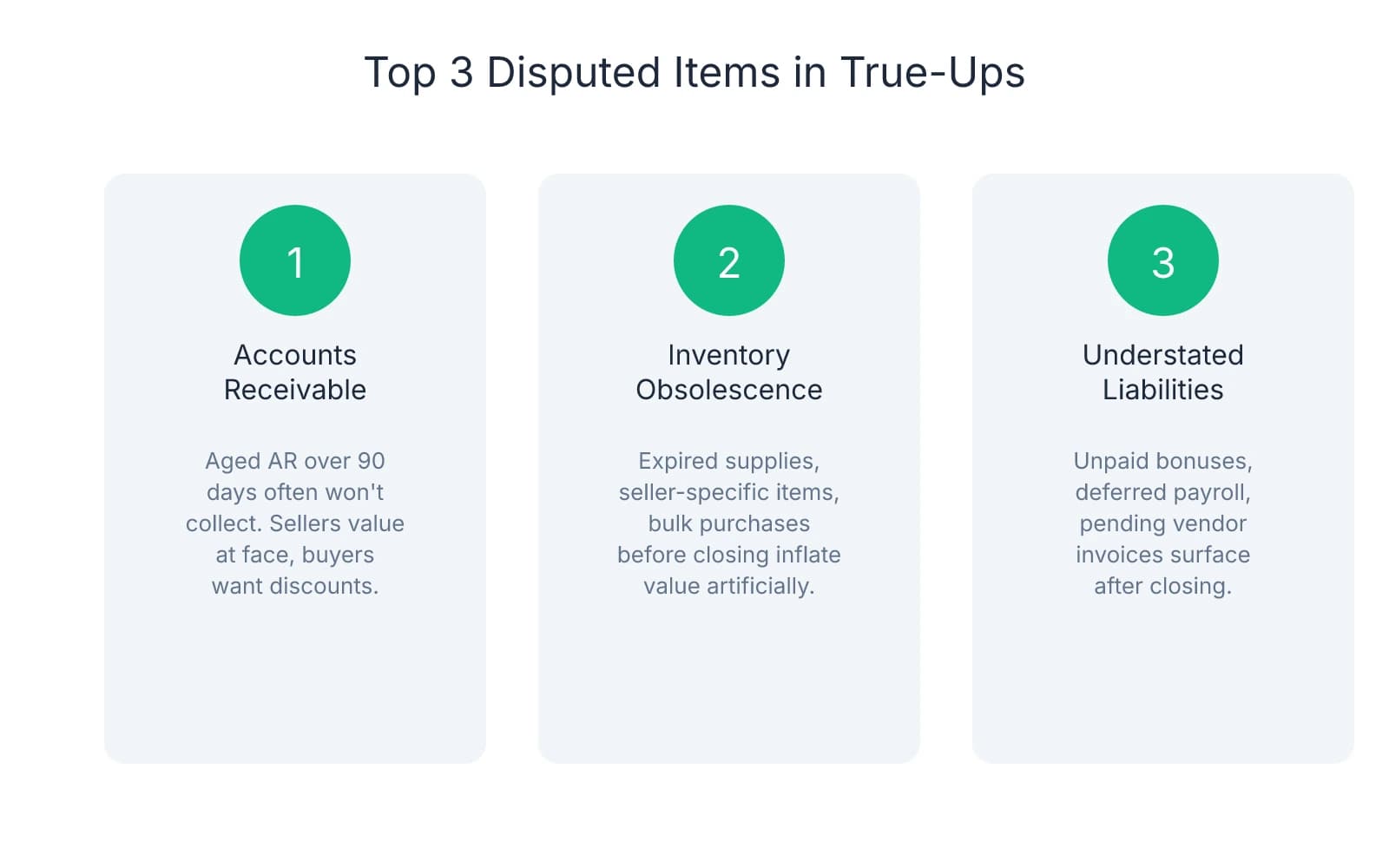
The most common source of disagreement in dental practice true-ups is accounts receivable collectibility. Buyers argue that aging AR over 90 days should be written down because historical collection rates for aged balances are low. Sellers counter that their practice has always collected well, and that the AR should be valued at face value based on past performance.
Where this gets contentious: the purchase agreement may specify that AR should be valued using "historical collection rates," but if the seller's accounting records don't break out collection rates by aging bucket, there's no objective way to apply that standard. The buyer's accountant uses industry benchmarks—often showing that AR over 120 days collects at 20% or less—while the seller's accountant points to overall collection percentages that don't account for write-offs.
One protection many buyers overlook is requiring an aging report at closing and specifying in the purchase agreement that AR over a certain threshold (e.g., 90 or 120 days) will be valued at a discounted rate or excluded entirely. Without that language, you're left arguing about collectibility after the fact, when the seller has already received the purchase price and has little incentive to concede.
Inventory Disputes Center on Obsolescence and Timing
Inventory is the second most disputed line item in dental practice true-ups. The disagreements typically fall into three categories: expired supplies, items specific to the seller's clinical approach, and bulk purchases made just before closing.
Expired supplies are straightforward—if the inventory count includes composite that expired six months ago, it has no value. But sellers often argue that expired materials were still usable or that the buyer should have identified them during due diligence. The solution is a physical inventory count at closing with both parties present, and clear language in the purchase agreement that expired items are excluded from the working capital calculation.
Items specific to the seller's clinical approach are harder to dispute. If the seller used a particular implant system and left $15,000 in inventory for that system, but you use a different manufacturer, those items have limited value to you. The outcome depends on how the purchase agreement defines "usable inventory" and whether it requires alignment with the buyer's clinical preferences.
Bulk purchases made just before closing are where disputes get expensive. A seller who orders six months of supplies two weeks before closing inflates the inventory balance—and if the peg was set using historical averages, the actual working capital at closing will exceed the target, requiring the buyer to pay more. The defense is a purchase agreement clause that limits inventory purchases in the 60 days before closing to normal operating levels.
Accrued Liabilities Surface After Closing
Accrued liabilities are often understated at closing, which reduces actual working capital and triggers a payment from the buyer to the seller. The most common culprits are unpaid bonuses, deferred payroll, and pending vendor invoices that weren't recorded on the seller's books.
Unpaid bonuses are particularly problematic in dental practices where staff compensation includes year-end or production-based bonuses. If the seller accrued $20,000 in bonus liability but didn't record it on the balance sheet, the actual working capital at closing is $20,000 lower than the peg—and you owe the seller the difference. Worse, you're also responsible for paying the bonuses to staff, so the liability hits you twice.
Pending vendor invoices are the hardest to catch. A seller who delays paying suppliers in the weeks before closing reduces accounts payable, which inflates working capital. After closing, those invoices arrive, and you're responsible for payment—but the working capital adjustment already happened, and the seller received credit for a liability that didn't exist on paper.
The defense is a detailed review of accrued liabilities during due diligence, with specific attention to payroll, bonuses, and vendor payment patterns. If accounts payable is unusually low compared to historical averages, that's a signal that liabilities may be understated. Requiring the seller to provide a schedule of all known but unpaid obligations at closing gives you documentation to support adjustments during the true-up process.
Protecting Yourself Before the LOI: Questions to Ask and Terms to Negotiate
The working capital adjustment becomes nearly impossible to change once the purchase agreement is signed. By that point, you've committed to the deal structure, the peg calculation method, and the accounts included in the true-up. The time to protect yourself is during the LOI and purchase agreement negotiation phases—before you're locked in.
Request Historical Balance Sheet Data to Verify the Peg
One step many buyers find valuable is requesting 12 to 24 months of month-end balance sheets from the seller. This data shows whether the proposed peg reflects normal operating levels or a temporary spike. If the seller proposes a $150,000 peg based on the most recent month-end, but the trailing 12-month average is $110,000, you're negotiating against an inflated baseline.
According to Hinckley Allen, using a 12-month lookback period is a common approach in determining target working capital, though the appropriate mechanism should account for facts specific to the business at hand. In dental practices, that means adjusting for seasonality and excluding non-recurring items like one-time equipment purchases or insurance refunds.
Accepting the seller's proposed peg without verifying the underlying data is where buyers often get burned. If the seller's accountant calculated the target using a single month that doesn't represent normal operations, you'll either owe money at the true-up or spend 90 days disputing the calculation.
Attach a Sample Working Capital Calculation to the Purchase Agreement
Deals that include a detailed sample working capital calculation in the purchase agreement rarely result in post-closing disputes. The sample shows exactly which balance sheet accounts are included, how they're valued, and what adjustments apply for aged receivables, expired inventory, or non-transferable prepaid expenses.
Without that sample, you're left interpreting vague language like "working capital will be calculated using generally accepted accounting principles" or "accounts receivable will be valued at historical collection rates." Those phrases sound precise, but they leave room for disagreement when the seller's accountant and your accountant apply different methodologies.
During purchase agreement negotiation, request that the seller's accountant prepare a sample calculation using the most recent month-end balance sheet. Review the calculation line by line with your accountant or advisor, and attach it as an exhibit to the purchase agreement. That sample becomes the template for the post-closing true-up, eliminating ambiguity about which accounts are included and how they're valued.
Negotiate a Collar or Threshold to Limit the Adjustment
Many buyers overlook the option to negotiate a collar—a threshold that limits the working capital adjustment to a certain dollar amount or percentage. For example, the purchase agreement might specify that no adjustment occurs unless the difference between the peg and actual working capital exceeds $25,000. Or it might cap the maximum adjustment at $50,000, regardless of the actual shortfall or excess.
Collars protect both parties from minor fluctuations that don't materially impact the practice's operations. If actual working capital is $5,000 below the peg, that's likely within normal variation and doesn't justify a post-closing payment. But without a collar, that $5,000 becomes a dollar-for-dollar adjustment—and you'll spend time and accounting fees reconciling a difference that's operationally insignificant.
Sellers resist collars because they reduce the likelihood of a favorable adjustment. But in deals where the peg is based on historical averages and both parties have confidence in the calculation, a collar signals good faith and reduces the risk of post-closing disputes.
Require an Escrow to Cover Potential Adjustments
In most dental practice acquisitions, 10 to 15% of the purchase price is held in escrow for 90 to 120 days to cover working capital adjustments and other post-closing claims. The escrow ensures that if actual working capital falls below the peg, you have a mechanism to recover the shortfall without chasing the seller for payment.
Without an escrow, you're relying on the seller's willingness to write a check after closing—which becomes contentious if the seller disputes the calculation. The escrow removes that friction by holding funds in a neutral account until the true-up is complete. Once the adjustment is finalized, the remaining escrow balance is released to the seller.
This matters most in deals where the seller is retiring or relocating after closing. If the seller moves out of state and disputes the working capital calculation, collecting a post-closing payment becomes a legal process rather than a financial one. The escrow protects you from that scenario by ensuring funds are available to cover adjustments before the seller leaves.
Clarify How Accounts Receivable and Related Liabilities Are Handled
If accounts receivable is excluded from the sale—meaning the seller retains the right to collect outstanding balances—the purchase agreement should specify how AR-related liabilities will be handled. Unapplied credits, insurance overpayments, and patient refund obligations don't disappear just because AR was excluded. Those balances transfer operationally, and patients and insurers expect resolution.
One protection many buyers overlook is requiring the seller to reconcile all unapplied credits and overpayments before closing, with any remaining balances deducted from the working capital peg. That adjustment ensures you're not inheriting liabilities without the corresponding asset to offset them.
If AR is included in the sale, the purchase agreement should specify how aged receivables will be valued. A common approach is to discount AR over 90 days to reflect lower collection rates, or to exclude AR over 120 days entirely. Without that language, you'll pay full value for receivables that may never collect—and the shortfall will hit your cash flow in the months after closing.
The working capital adjustment is negotiable during the LOI and purchase agreement phases, but it becomes fixed once you sign. Buyers who treat the peg as a formality often discover 90 days after closing that they owe the seller money—or worse, that they're entitled to a refund but lack the documentation to support it. The questions you ask and the terms you negotiate before the LOI determine whether the adjustment protects you or costs you.
Sources & References
The data and claims in this article are drawn from the following sources. We prioritize government data, peer-reviewed research, and established industry publications to ensure accuracy.
- Net Working Capital Adjustments in M&A Deals— www.prairiecap.com
- Critical Considerations for Drafting and Negotiating Working Capital ...— www.hinckleyallen.com
- Avoiding Working Capital Dispute Pitfalls | Alvarez & Marsal— www.alvarezandmarsal.com
Frequently Asked Questions
Avoid Surprise Adjustments in Your Practice Sale
Working capital adjustments can significantly impact your final payout after closing. Minty Plus provides expert guidance through every stage of your dental practice acquisition, ensuring you understand all financial terms before signing.