Dental Practice Loan Denied by Multiple Banks: What to Do Next

Co-Founder, Minty Dental

In Summary
- Multiple rejections typically stem from one specific, measurable issue—credit scores below 680, debt-to-income ratios above 40-45%, insufficient liquidity (less than 10% of loan amount), or practice-specific red flags like declining collections
- Personal financial barriers are fixable but require time: credit improvements need 3-6 months, DTI corrections 6-12 months, and liquidity building often 8-12 months of focused saving
- When the practice itself triggers rejections—declining revenue, A/R ratios above 1.5, valuation disputes—alternative financing (seller notes, credit unions, partnerships) may work, but finding a stronger practice is often faster and less risky
- Reapply to different lenders after fixing issues; banks remember previous denials, and fresh eyes evaluate your improved profile without that bias
Multiple Rejections Usually Point to One of Four Problems
When three banks turn down your dental practice loan, it's rarely about your qualifications as a dentist. Lenders evaluate the same core criteria—credit history, debt load, liquidity, and practice fundamentals—so repeated rejections typically signal one specific threshold you're crossing on every application.
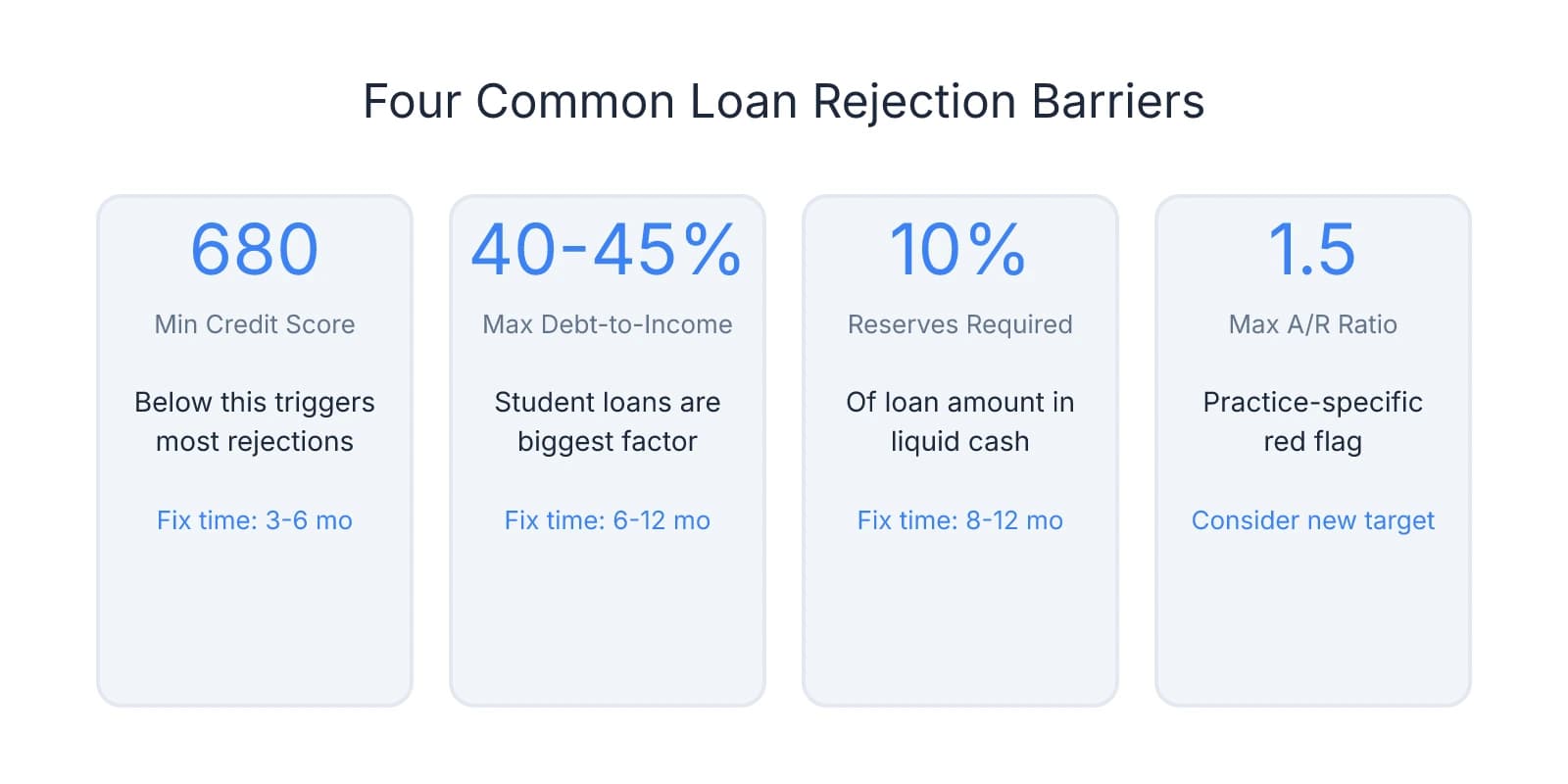
Credit score barriers sit below 680 for most dental lenders. The minimum requirement typically falls between 680 and 700, with some lenders accepting high 600s if other factors compensate. Recent delinquencies—even one 30-day late payment in the past year—can disqualify an otherwise solid application. High credit utilization matters too: carrying balances above 30% of available credit signals risk, even when you're making payments on time.
Debt-to-income ratio concerns emerge above 40-45%. Lenders calculate total monthly debt obligations—student loans, car payments, credit cards, mortgage—as a percentage of gross monthly income. Above 40-45%, most dental lenders hesitate. Student loans create the biggest pressure here. Carrying $400K in student debt alongside other obligations can push you past acceptable thresholds before the practice loan enters the equation.
Liquidity requirements demand roughly 10% of the loan amount in accessible cash reserves, separate from your down payment. A $500K practice loan typically requires $50K in liquid reserves—money accessible within 30 days—plus your down payment. Many first-time buyers focus entirely on scraping together the down payment and miss the reserve requirement.
Practice-specific red flags block approval even when personal finances look strong. Declining collections over 12-24 months raise concerns about sustainability. Accounts receivable ratios above 1.5 months suggest collection problems. Valuation disputes—asking prices 20-30% above comparables—make lenders nervous about collateral value. Lease transfer issues can kill deals regardless of practice performance.
One pattern worth noting: vague rejection letters usually point to credit or DTI problems. Lenders tend to be explicit about practice concerns—they'll cite specific A/R ratios or collection trends. When explanations stay vague, the barrier typically lives in your personal financial profile.
How to Fix Personal Financial Issues Before Reapplying
Most personal financial barriers are fixable, but they require time. Credit score problems typically need 3-6 months. Debt-to-income issues vary by debt structure. Liquidity concerns often demand 6-12 months of focused saving.
Credit score improvements follow a predictable 3-6 month arc. Pull your credit reports from all three bureaus through AnnualCreditReport.com. Look for errors first: incorrect late payments, accounts that aren't yours, outdated delinquencies. Dispute these immediately—corrections can appear within 30-45 days.
Next, address credit utilization. Paying balances below 30% of available limits can improve your score within one to two billing cycles. Focus on highest-utilization cards first—a card at 80% utilization hurts more than one at 40%.
Avoid new credit inquiries during this period. Each hard inquiry can drop your score 5-10 points temporarily. More importantly, opening new accounts lowers your average account age. Set up automatic payments on all existing accounts—a single recent late payment can drop your score 50-100 points and disqualify you for 12 months.
Debt-to-income fixes require either lowering monthly obligations or increasing income. Refinancing student loans to extend repayment terms reduces monthly payments. If your current payment is $3,200/month on a 10-year term, refinancing to 20 years might drop that to $2,000/month. That $1,200 monthly reduction can move your DTI from 48% to 38%.
Paying off smaller debts eliminates monthly obligations faster than chipping away at large balances. If you have an $8,000 car loan with $280/month payments and a $4,000 credit card with $120/month minimums, paying off the card removes $120 from your DTI immediately.
Increasing associate production boosts the income side. If you're producing $35,000/month and can push to $42,000 through additional clinical days or improved case acceptance, your DTI drops even if debt stays constant. Many lenders calculate income based on your most recent 12-24 months, so sustained increases matter more than one strong month.
Liquidity building takes longer but follows a straightforward path. If you need $50K in reserves and have $15K saved, you're looking at 6-12 months of aggressive saving. Set a monthly target—$3,000/month gets you there in 12 months, $5,000/month in 7—and automate transfers to a separate high-yield savings account.
Family loans can accelerate this timeline if structured properly. A $20K gift or loan from parents bridges the gap faster than saving alone. If it's a loan, document it formally—lenders want to see whether this creates a new monthly obligation affecting your DTI. Gifts work better from an underwriting perspective but require a gift letter confirming no repayment is expected.
Track progress monthly to stay accountable. Pull your credit score every 30 days to confirm utilization changes are registering. Recalculate your DTI after each debt payment. Monitor savings growth weekly—if you're falling short of your monthly target, you'll know early enough to adjust.
Consider working with a dental-specific CPA who understands lender requirements. They can model different scenarios—refinancing vs. debt payoff, income increases vs. liquidity building—and show you which path gets you to approval fastest. Many dental CPAs can preview your updated financials before you formally reapply, saving you from another rejection if you're not quite ready.
Most buyers who address personal financial barriers successfully need 6-12 months before reapplying. That timeline feels long when you're eager to own, but it's far shorter than continuing to apply and get rejected. Each rejection creates a hard inquiry and potentially signals to future lenders that other institutions saw problems.
When the Practice Is the Problem: Alternative Financing and Different Targets
When your credit score sits above 700, your DTI clears 40%, and you have adequate reserves, but banks still won't finance the deal—the practice itself is the barrier. At this point, you're choosing between alternative financing for this specific practice or finding a different practice that meets conventional lending standards.
Seller financing typically covers 20-40% of the purchase price at 6-9% interest over 3-7 years. The seller becomes a lender for part of the deal, allowing you to secure a smaller bank loan for the remaining amount. A $500K practice might break down as $300K from a bank, $200K from the seller. The seller note usually carries higher interest than bank financing and runs for 3-7 years with monthly payments.
But seller financing often signals underlying practice weakness—if the practice were strong, banks would compete to finance it. Sellers offer notes when they need to make a difficult practice marketable or when their CPA recommends it for tax reasons. The former is far more common.
One protection worth considering: subordination language. If the bank finances $300K and the seller finances $200K, clarify which lender gets paid first if the practice fails. Banks typically demand first position, meaning the seller's note becomes riskier.
Credit unions and regional banks may finance practices that national dental lenders reject. National lenders apply standardized underwriting criteria across all markets. Regional banks and credit unions often take a more flexible approach, especially for practices in their geographic footprint where they understand local market dynamics.
Credit unions serving healthcare professionals sometimes approve deals with slightly higher debt-to-income ratios or lower practice valuations than national lenders accept. Interest rates may run 0.5-1.0% higher, but approval odds improve when the practice has characteristics that spook larger institutions—rural location, heavy Medicaid payer mix, or revenue concentration in a few procedures.
Partnership arrangements split both the purchase price and ownership. Another dentist or investor co-finances the acquisition, reducing your individual debt load but diluting your ownership stake. A $500K practice might become a 60/40 partnership where you finance $300K and a partner finances $200K. Your monthly debt service drops, your DTI improves, and you share operational risk.
The structure works best when the partner brings either capital or clinical capacity you lack. An established dentist with strong cash flow might finance part of the deal in exchange for equity and profit distributions. Another associate unable to carry a full loan individually might co-invest and share clinical duties.
Document everything upfront. Who makes clinical decisions? How are profits distributed? What happens if one partner wants to exit in three years? Operating agreements should address buy-sell provisions, deadlock resolution, and valuation methods for future buyouts.
When multiple lenders cite identical practice concerns, those are structural problems you'll inherit. If three banks independently flag declining revenue, an A/R ratio above 1.5, or lease transfer issues, they're identifying real operational risks. Declining collections over 18-24 months suggest patient attrition, payer mix deterioration, or production problems that won't reverse simply because ownership changes.
Valuation disputes appear when the asking price sits 20-30% above what comparable practices sold for recently. A seller asking $600K for a practice generating $500K in collections when similar practices sold at 0.8-0.9x collections creates a math problem no amount of seller financing solves.
Finding a different practice that meets lender standards may be faster and less risky than forcing a problematic deal. Alternative financing takes longer to structure, carries higher costs, and often masks underlying practice problems rather than solving them. If you're six months into trying to finance a practice with declining revenue and poor A/R, walking away and finding a practice with clean financials can get you to ownership faster.
Practices that meet conventional lending standards share common traits: stable or growing collections over 24 months, A/R ratios below 1.3, transferable leases with 5+ years remaining, and asking prices within 10-15% of recent comparable sales. These practices attract multiple buyer offers and competitive bank financing.
Red flags that suggest walking away entirely include sellers who won't provide transition support, financials that don't reconcile, and lease transfer barriers. A seller unwilling to commit to 60-90 days of structured transition support signals either personal issues or awareness that the practice will struggle under new ownership. Financials showing discrepancies between tax returns, P&L statements, and deposit records suggest either poor bookkeeping or intentional misrepresentation.
Lease issues kill deals even when financing is available. If the landlord won't transfer the lease, demands a personal guarantee you can't provide, or insists on rent increases that make the economics unworkable, the deal can't close regardless of how you structure financing.
When practice problems block conventional financing, the decision isn't just about finding alternative money—it's about whether this specific practice is worth the additional cost, complexity, and risk.
Building Your Reapplication Strategy: Timeline and Next Steps
Multiple loan rejections aren't failure—they're diagnostic feedback telling you exactly what needs to change. The buyers who reach ownership after initial rejections treat denial as information, address the specific barrier lenders identified, and approach the next opportunity with measurably stronger financials or a better target practice.
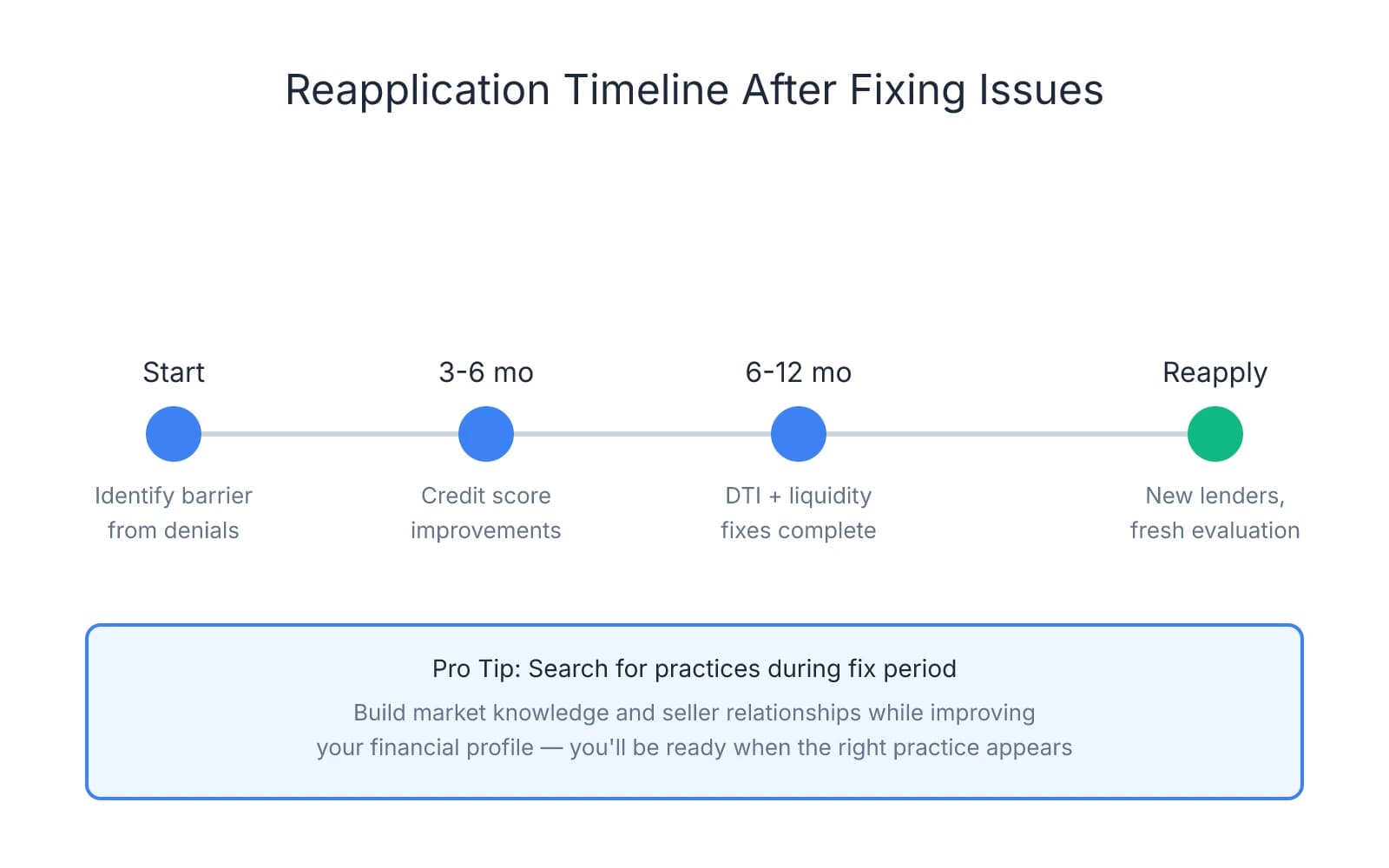
Start by categorizing which problem caused your rejections. Pull the denial letters from each lender and look for patterns. If all three cite credit score or DTI, your barrier is personal financial. If they flag practice revenue trends, A/R ratios, or valuation concerns, the practice itself is the problem.
Personal financial fixes typically require 6-12 months before reapplying. Credit score improvements need 3-6 months. DTI corrections take longer if you're refinancing student loans or paying off debts. Liquidity building depends on your savings rate, but most buyers need 8-12 months to accumulate required reserves if starting from a low base.
When you reapply after fixing personal financial issues, approach different lenders than those who initially rejected you. Banks keep records of previous applications. Even if your credit score jumped 40 points and your DTI dropped from 47% to 39%, the same loan officer who rejected you six months ago may anchor to that initial assessment. Talking to at least three different banks gives you multiple approval paths and competitive rate options.
Target credit unions and regional banks if national dental lenders rejected you initially. These institutions often apply more flexible underwriting criteria—especially if the practice sits in their geographic market. The rate might run 0.5-1.0% higher, but approval matters more than rate optimization when you're rebuilding from rejection.
If the practice was the barrier, decide whether to pursue alternative financing for this deal or find a different practice entirely. Seller financing, credit union loans, or partnership structures can sometimes salvage a deal that conventional lenders won't touch—but they also add cost, complexity, and risk. A practice with declining revenue and high A/R doesn't become a better investment just because the seller agrees to finance part of it.
Finding a practice that meets conventional lending standards—stable collections, clean A/R, transferable lease, reasonable valuation—often gets you to ownership faster than forcing a problematic deal through alternative financing.
Keep searching for practices even while fixing financial issues. Market knowledge and seller relationships take time to build. If you're spending six months improving your credit and DTI, use that time to understand what practices in your target market actually sell for, which neighborhoods have strong demographics, and which sellers are beginning to think about transition timelines.
Work with a dental-specific CPA, attorney, or buyer's broker who understands lender requirements and can preview your updated financial profile before you formally reapply. Many dental advisors have relationships with multiple lenders and can tell you whether you're ready to reapply or need another 2-3 months of improvement.
Many successful practice owners faced initial loan rejections. The difference between those who eventually bought and those who gave up isn't talent or luck—it's treating rejection as diagnostic information rather than personal failure. Lenders told you what needs to change. The timeline to fix it is measurable. Ownership remains achievable, but it may require patience, strategic adjustments, and the discipline to address root causes rather than searching for shortcuts that don't exist.
Sources & References
The data and claims in this article are drawn from the following sources. We prioritize government data, peer-reviewed research, and established industry publications to ensure accuracy.
- Talk to 3 Banks: The First Step in Buying a Dental Practice— www.ada.orgIndustry
- How to Lower Your Debt-to-Income Ratio Before Applying for a Loan— www.experian.comIndustry
- Seller Financing in Dental Transitions: What It Means and When to ...— ameriprac.comIndustry
- What Dentists Need to Know About Seller Financing— www.dentalbuyeradvocates.comIndustry
Frequently Asked Questions
Find Your Next Dental Practice Today
When traditional financing falls through, exploring available dental practices on the market opens new possibilities. Minty's marketplace connects you with practices nationwide, including seller-financed opportunities and alternative acquisition paths.